Your itinerary

Day 1
Adventure starts in Beijing; free afternoon and Beijing duck dinner
Our adventure begins in Beijing, the capital of China and home to world-renowned landmarks such as the Forbidden City. Free arrival transfers are available for everyone arriving into either Beijing Capital Airport (PEK) or Daxing Airport (PKX).Around 6pm, say ni hao to your tour leader and fellow travellers, when we gather as a group for the first time to get to know each other and learn more about the adventures ahead. Your tour leader then ensures a big welcome by arranging dinner at a local restaurant, allowing us to sample one of the city’s most famous dishes: Beijing duck. Vegetarians, do not fear – there will be an array of different dishes on a lazy Susan to choose from.Want more time in Beijing? Secure pre-tour hotel nights through your sales representative.
Meals: Dinner
Day 2
Drive to Huanghuacheng Great Wall section; afternoon begin trekking.
This morning we leave the capital and head into the countryside to the Great Wall, a 2-2.5 hour journey to the north west of the city. We reach the lesser-visited section at Huanghuacheng, which has an incredibly picturesque location by a lake. The name Huanhuacheng translates as ‘Yellow Flower City’, as during the summer the surrounding mountains are swathed in yellow as the local wild flowers come into bloom. The walk today is relatively challenging and with uneven topography, but the views are worth every effort! We will spend the night in a guesthouse close to this section of the wall.
Meals: Breakfast,Lunch,Dinner
Day 3
Morning trek at Mutianyu, passing many watchtowers.
Today we take a short drive (1-1.5 hours) to Mutianyu. At this lesser-visited section, the Wall is an impressive sight indeed, snaking off across mountains and valleys into the distance. As one of the best-preserved parts of the Great Wall, the Mutianyu section used to serve as the northern barrier defending the capital and the imperial tombs. There are 22 watchtowers (20 of which are open to the public) on this 2,250-metre-long section. After Mutianyu section, we transfer to Jiankou village to enjoy the hospitality of a local guesthouse.
Meals: Breakfast,Lunch,Dinner
Day 4
Trek at Jiankou's "Wild Wall"
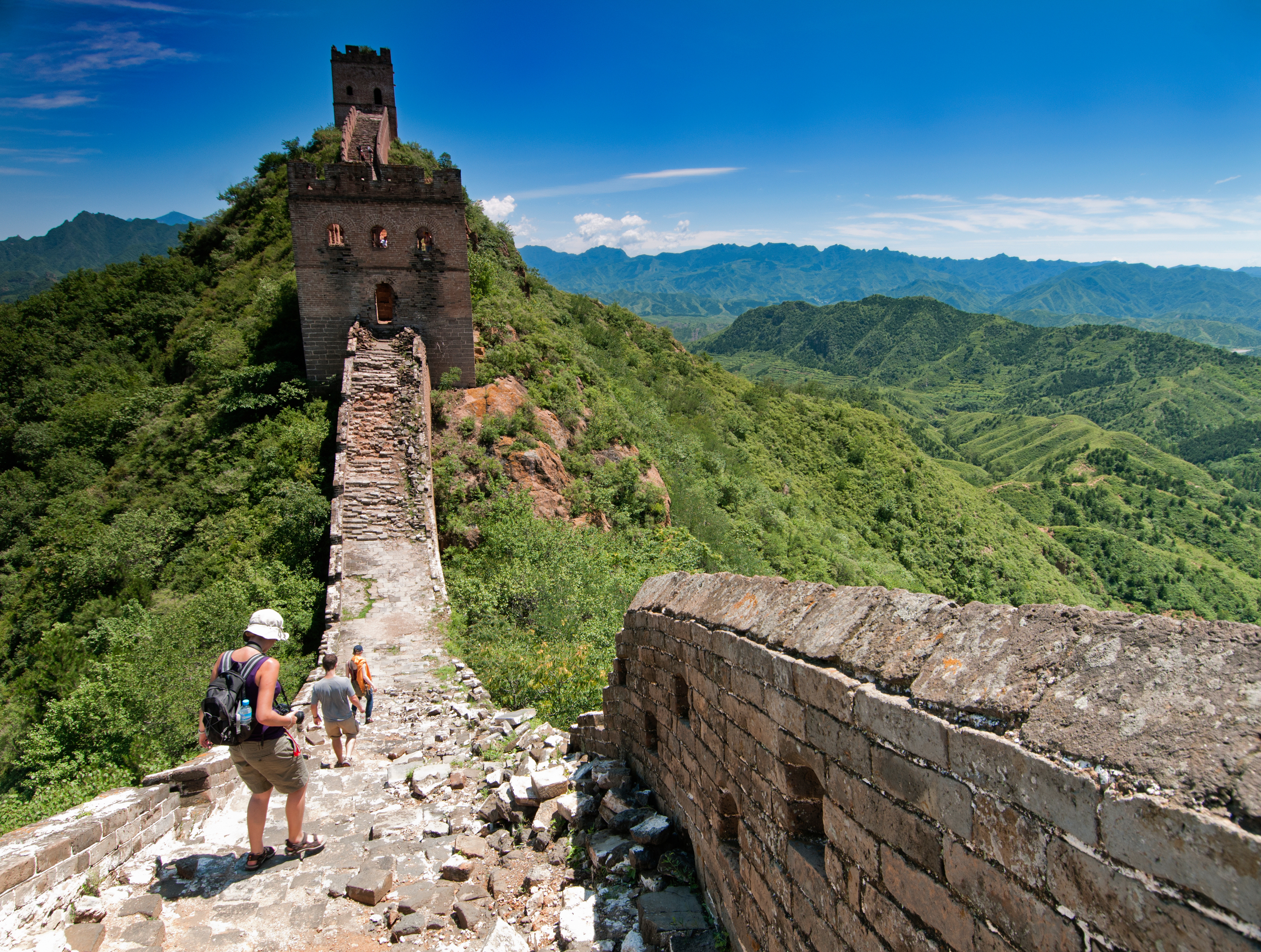
The Jiankou wild wall section was built along a mountain edge and remains completely wild, with towers clinging impossibly to the steepest of ridges. Highlights of the day include “Spiderman Wall”, or “Sanshibadeng” in Chinese; an optional short vertical climb to the top of the wall for a panoramic view (those who are not a fan of climbing/heights can walk around and regroup at the viewpoint). This area is the most photographed section of the Great Wall due to the unique construction style combined with stunning scenery. We walk along this portion for approx. 4 km in the morning, returning to the guesthouse for lunch, then walking about another 4.5 km in the afternoon. We have the option of seeing sunset from the wall.
Meals: Breakfast,Lunch,Dinner
Day 5
Transfer to Jinshanling; Hike the Great Wall Jinshanling section.
Today we walk the length of the Jinshanling Great Wall section (from Erchi Tower to Zhuandoukou Tower), which is renowned for being one of the best-preserved parts of the Great Wall and dates from the Ming Dysnasty (1368-1644). This section reaches seven metres high and six metres wide and incorporates five main passes, sixty-seven watchtowers and two beacon towers as it zig-zags its way through the Big and Small Jinshan Mountains (the Big and Small Jinshan Watchtowers are the highlight). The construction is of huge bricks, each weighing around 12 kilograms (26 pounds) and this section features various structures which were used for an array of functions ranging from weapon stores to soldiers’ bedrooms.
Meals: Breakfast,Lunch,Dinner
Day 6
The most challenging walk today along the Gubeikou section
Today we hike from Zhuanduokou Tower along the Gubeikou section of the wall to Panlongshan. This portion keeps the original essence of the wall and will transport us back to the time of the Han Dynasty. We will pass many watchtowers until we reach the unique 24 Window Tower (three level tower).
Meals: Breakfast,Lunch,Dinner
Day 7
Panlongshan section of the Great Wall
We will walk from Panlongshan north gate to the main entrance.Following our walk along this part of the wall we’ll drive for about three hours back to Beijing.
Meals: Breakfast,Lunch
Day 8
Beijing city tour visiting hutongs, Tiananmen Square and the Forbidden City.
We take a morning walking tour of the city’s hutongs (narrow alleys) to see what is left of old Beijing and its traditions. We also visit Tian’anmen Square; the largest in the world and able to hold over a million people. Later in the day, we visit the Forbidden City with its innumerable courtyards and temples.This evening, recommended optional activities include the amazing Beijing opera or a Kung Fu show, or you may prefer to opt for a foot reflexology treatment to sooth your weary feet! The leader will also arrange a farewell dinner (optional).Beijing is a fantastic place to explore at your own pace; if you wish to add on any additional time please speak to your sales consultant at the time of booking.NoteFollowing the Covid-19 pandemic, maximum numbers of daily visitors to the Forbidden City have been significantly reduced, impacting availability of tickets. Our local team aim to secure tickets for the Forbidden City, but if unable to do so, we’ll visit the Ancestral Temple (used during the Ming and Qing Dynasties to offer sacrifices to ancestors, and architecturally quite similar to the Forbidden City) and the Temple of Heaven. You will be advised at the start of the trip if this change needs to be made.
Meals: Breakfast
Day 9
Adventure ends in Beijing
The trip ends in Beijing after breakfast, and we begin our return journeys. Free departure transfers are available for all customers departing from either Beijing’s Capital airport (PEK) or Daxing airport (PKX).If you’d like more time in Beijing, please speak to your sales representative about extending your stay.
Meals: Breakfast
What’s included
What’s not included
Additional information
Food
All breakfasts, 6 lunches and 6 dinners are included. Food is cheap in China and you can avoid the spicier regional food if you wish. The cuisine on this trip is fantastically varied with lots of new flavours and ‘things’ to try.
Gastronomically the trip can be divided into two parts: ‘tourist hotels’ and ‘local hotels’. In tourist hotels the breakfast is normally a buffet, with a huge spread of Chinese and western food, including coffee, juice, breads, cakes, fruit, eggs, bacon and a wide variety of noodle and stir fried dishes. Dinners are normally taken in the hotel or local restaurants, serving rice with assorted vegetables, pork, fish, chicken and duck dishes with flavours roughly approximating those you would find in a Chinese restaurant in the UK. In the local hotels, breakfast includes rice porridge, dumplings, eggs, noodles, etc, however, we tend to augment this with fruit and cakes where available. Dinners are taken in local restaurants where the food is heavily flavoured with ginger, garlic bamboo shoots and chilli. Lunches are taken in local village restaurants and will normally consist of noodle soup or stir fried vegetable noodles. Expect an audience most lunches as the locals crowd around to watch the ‘big noses’ trying to master the use of chopsticks!
Vegetarians can be accommodated, though options are often quite limited. Vegans will find options are very limited. Not all food allergies and intolerances are well understood in China. Options that contain no gluten at all are very limited (soy sauce contains gluten and is very widely used). Peanut oil is also used widely.
Jinshanling Great Wall Traverse
Cross a masterwork of Ming fortification as you cross the Jinshanling Great Wall between Erchi Tower and Zhuandoukou. Walk broad ramparts, climb arrow towers, and admire the line of 60+ watchtowers, including the celebrated Big and Small Jinshan Watchtowers, set against sweeping mountain backdrops.
Here, Ming dynasty engineering is on full display: thick bricks, crenellations, and beacon towers once coordinating signals across the frontier. Peer into alcoves that served as weapon stores and soldiers’ quarters, tracing the wall’s strategic logic along high, wind-brushed ridges.
Xi’an Terracotta Army Extension
Add time in the former Silk Road capital Xi’an to visit the Terracotta Army of Qin Shi Huang, an archaeological wonder revealing vaults of life-size warriors and horses guarding the first emperor’s mausoleum.
Museum galleries, excavation pits, and interpretive exhibits illuminate 3rd-century BCE craftsmanship and imperial ambition. This extension is at additional cost and can be arranged in advance or on tour, with travel and guiding coordinated for a seamless add-on before or after your Beijing stay.
Mutianyu Great Wall Watchtowers Walk
Explore a beautifully rebuilt rampart as you step onto the Mutianyu Great Wall and trace its path between pine-clad ridgelines. Climb battlements and duck into towers on a guided panoramic walk, taking in far-reaching views and the rhythm of 22 watchtowers linked by stone stairs.
Once a key shield for the capital and imperial tombs, these Ming dynasty defenses showcase sturdy brickwork, arrow slits, and beacon points. The forest-covered ridgelines and lighter crowds make Mutianyu an atmospheric window into China’s monumental frontier.
Jiankou “Wild Wall” Trek & Sunset Vantage
Trek the untamed spine of the mountains as you trek the Jiankou ‘Wild Wall’, an unrestored, rugged stretch where masonry clings to knife-edge ridges. Navigate broken steps and wind-scoured parapets, with an optional short scramble up the Spiderman Wall (Sanshibadeng) for a thrilling panorama.
Unreconstructed towers, lichen-darkened bricks, and precipitous drops give Jiankou its legendary character. If conditions align, linger to watch sunset over the mountains, when ridgelines glow and ruined watchtowers silhouette against the deepening sky.
Gubeikou to Panlongshan Heritage Hike
Follow a storied frontier as you hike the Gubeikou section toward Panlongshan, where the wall remains largely unrestored. Tread original brick and tamped-earth battlements to the distinctive 24 Window Tower, with long views across folded hills and misty mountain passes.
Gubeikou guarded a vital approach to the capital and witnessed clashes across dynasties. The original brick and earth ramparts, weathered battlements, and time-softened towers lend a palpable sense of antiquity and strategic purpose to every step.
Panlongshan Ridge Walk
Walk the final stretch of the Panlongshan Great Wall, tracing a scenic ridge from the north gate to the main entrance. The ramparts undulate across a coiled-dragon ridgeline, offering high lookouts for mountain vistas and close study of crenellations and surviving towers.
Named for its serpent-like course, Panlongshan showcases layered defenses and line-of-sight communication posts. This contemplative end to the hiking sequence invites you to pause for photos and reflection amid wind-bent grasses and far-ranging horizons.
Beijing Hutongs, Tiananmen Square & Forbidden City
Walk the hutongs—narrow lanes lined with traditional siheyuan courtyards—to glimpse daily life in old Beijing. Continue to Tiananmen Square, one of the world’s largest public squares, before entering the Forbidden City (Palace Museum) with its throne halls, ceremonial courtyards, and vermilion gates.
Hear how imperial power shaped the city’s grid from the Ming and Qing eras. If Forbidden City tickets are limited, your guided visit features the Temple of Heaven and the Imperial Ancestral Temple, preserving the day’s rich architectural and cultural arc.
Beijing Welcome Dinner: Peking Duck Experience
Gather with your group to meet your Tour Director and sample Beijing (Peking) duck, lacquered and carved tableside. Wrap crisp skin and tender slices in warm pancakes with scallion, cucumber, and sweet bean sauce, sharing favorites from a lazy Susan of regional dishes.
Linked to imperial banquets since the Ming era, roast duck remains Beijing’s signature flavor. Expect convivial toasts—toasting the journey ahead—and a delicious introduction to the city’s culinary heritage, typically early in the tour.
Evening Performance: Peking Opera or Kung Fu Show
Choose your night out: experience a Peking Opera performance of stylized movement, acrobatics, and falsetto singing in colour-splashed costumes, or opt for a high-energy Kung Fu show blending martial arts, choreography, and theatrical spectacle.
Both performances illuminate Beijing’s stage traditions—from courtly storytelling to modern athletic theatre. This activity is at additional cost, bookable on tour, with convenient theatre options and transfers arranged by your leader. Expect vivid staging and the thunder of drums and gongs.
Foot Reflexology Session in Beijing
Unwind after your wall walks and opt for a foot reflexology treatment guided by traditional Chinese medicine principles. Therapists focus on pressure points to soothe trekking-tired feet and refresh weary calves.
Typical sessions run 45–60 minutes in reputable local clinics near the hotel. This restorative experience is at additional cost and bookable on tour—ideal mid-journey or toward the end for a calming reset.
Farewell Dinner in Beijing
Conclude your adventure with an optional group meal to share a farewell dinner of regional classics—hand-pulled noodles, dumplings, and spice-laced stir-fries—in a convivial neighborhood restaurant.
Reflect on summit views and stone ramparts as you raise a glass to the Wall and new friends. This experience is at additional cost and can be arranged by your Tour Director for a relaxed final evening.
Huanghuacheng Lakeside Great Wall Trek
Hike a quieter stretch of the Huanghuacheng Great Wall, where crenellated stone threads above a reservoir and terraced hills. Follow mountain paths and stair-steps as you join a guided hike along lakeside ramparts, pausing at watchtowers for sweeping views across forested valleys.
Learn how this Ming-era stronghold took its name, “Yellow Flower City,” from summer blooms that color the slopes. A mix of restored wall and weathered masonry reveals centuries of frontier defense—perfect moments to pause for photos and reflection amid rugged scenery.