Your itinerary
Day 1
Day 1: Bangkok
Arrive in Bangkok. If you arrive early, explore the city, get a massage or relax by the pool. Meet the group at the hotel at 6pm, then head out for Pad Thai and a night on Khao San Road.
Day 2
Day 2: Bangkok to Kanchanaburi
Take a Bangkok water taxi to the Royal Palace for a guided visit, then tour the klongs by private boat. After returning to the hotel, find lunch independently before travelling to Kanchanaburi. Visit the famous bridge and WWII Cemetery, then settle into a riverfront room for a dinner of local specialities and sunset views.
Meals: Breakfast,Dinner
Day 3
Day 3: Kanchanaburi to Chiang Mai via Ayutthaya
Visit Erawan Falls, with time to walk the trails or dip your feet in the water. Continue to Ayutthaya and cycle past temples, spires and ancient palaces. Board the overnight train to Chiang Mai.
Meals: Breakfast
Day 4
Day 4: Overnight Train to Chiang Mai via Elephant Nature Park
Arrive in Chiang Mai and visit an elephant nature park to watch elephants in their habitat. Have lunch at the park, then return to Chiang Mai for a free evening, with an optional Vespa outing.
Meals: Lunch
Day 5
Day 5: Chiang Mai
Spend a free day in Chiang Mai. Options include a Muay Thai lesson and an evening cooking class that begins with a chef-guided market tour and continues with preparing a Thai meal in a rice field.
Meals: Breakfast
Day 6
Day 6: Chiang Mai to Chiang Rai
After breakfast, travel to Chiang Rai. Visit Wat Rong Khun (White Temple), Wat Rong Seua Ten (Blue Temple) and the Baan Dam Museum, also known as the Black House Museum.
Meals: Breakfast
Day 7
Day 7: Chiang Rai to Pakbeng
Cross from Thailand into Laos and continue towards Pakbeng, travelling part of the way by river cruise on a local slow boat.
Meals: Breakfast,Lunch,Dinner
Day 8
Day 8: Pak Beng To Luang Prabang
Continue by slow boat along the Mekong River to Luang Prabang. Watch the sunset from a hill-top stupa and shop at the local night markets.
Meals: Breakfast,Lunch
Day 9
Day 9: Luang Prabang
Cycle around Luang Prabang in the morning. Explore independently or make an optional afternoon visit to Kuang Si Falls. In the evening, watch the sunset from a riverside bar.
Meals: Breakfast
Day 10
Day 10: Luang Prabang to Vang Vieng
Early risers can take part in Luang Prabang’s daily ritual of offering alms to monks. Travel by high-speed train to Vang Vieng. This evening, optionally explore its rivers and caves by kayak, or relax and watch the sunset over the mountains.
Meals: Breakfast
Day 11
Day 11: Vang Vieng to Vientiane
Travel to Vientiane. See Pha That Luang stupa and Patuxai, visit the COPE centre to learn about its prosthetics and rehabilitation work, then explore the Buddhist sculptures at Buddha Park.
Meals: Breakfast
Day 12
Day 12: Vientiane to Phnom Penh
Fly from Laos to Phnom Penh, Cambodia. Visit the Royal Palace and Silver Pagoda, then spend the evening exploring independently.
Meals: Breakfast
Day 13
Day 13: Phnom Penh
With a local guide, visit the Killing Fields and Tuol Sleng Genocide Museum to learn about Khmer Rouge rule. Afterwards, optionally take a tuk-tuk tour of the city’s food spots before returning to the hotel near an after-dark dinner hotspot.
Meals: Breakfast
Day 14
Day 14: Phnom Penh to Siem Reap
Travel by coach from Phnom Penh to Siem Reap. Spend the afternoon and evening as you choose, with options to relax by the pool or visit the Phare Circus.
Meals: Breakfast
Day 15
Day 15: Siem Reap
Watch sunrise at Angkor Wat, then explore Angkor Thom and Ta Prohm. An optional quad bike ride by the rice paddies is available around golden hour. Have dinner at a social enterprise that trains disadvantaged people in hospitality, then optionally visit Pub Street and the night markets.
Meals: Breakfast,Dinner
Day 16
Day 16: Siem Reap To Ho Chi Minh City
Say goodbye to some group members at breakfast and travel to Vietnam. Explore the streets of Ho Chi Minh City, with the chance to try bánh mì and Vietnamese coffee. Tonight, you can share a meal with the group and explore the nightlife.
Meals: Breakfast
Day 17
Day 17: Ho Chi Minh City To Mekong Delta
Take a 3.5-hour coach ride from Ho Chi Minh City to the Mekong Delta, then explore the river by traditional boat. Visit a rice paper factory, sample rice whisky, and enjoy a home-cooked meal and live local music. Stay overnight at a local homestay.
Meals: Breakfast,Lunch,Dinner
Day 18
Day 18: Mekong Delta To Ho Chi Minh City
After an early breakfast, return towards Ho Chi Minh City via the Cu Chi Tunnels. See traps, hidden doors and sections of the tunnel network, with a chance to enter the tunnels. Back in the city, enjoy free time; more travellers join the group this evening.
Meals: Breakfast
Day 19
Day 19: Ho Chi Minh City To Nha Trang
Take a walking tour of Ho Chi Minh City and visit the War Remnants Museum. Fly to Nha Trang and arrive at the hotel in the evening. The night is free for dinner by the beach or independent exploration.
Meals: Breakfast
Day 20
Day 20: Overnight Train to Hoi An
Spend the day in Nha Trang: relax on the beach, get a massage or join an optional cruise. Return to the hotel to freshen up before taking the overnight train north towards Hoi An.
Meals: Breakfast
Day 21
Day 21: Hoi An
Wake in Da Nang and drive to Hoi An. Join a guided bike tour through town, visiting the Japanese Bridge, a traditional ancient house and the central market. An optional Vietnamese cooking class tonight covers up to four traditional dishes.
Meals: Breakfast
Day 22
Day 22: Hoi An
Enjoy a free day to browse Hoi An’s galleries and market stalls and try local food. You could ride a bamboo basket boat, and the group will have fresh coconut water.
Meals: Breakfast
Day 23
Day 23: Hoi An to Hanoi via Da Nang
After breakfast, travel to Da Nang airport and fly to Hanoi. Eat at KOTO, a restaurant supporting disadvantaged youth, then visit the Temple of Literature and Ho Chi Minh Mausoleum. Spend the evening independently or take an optional Hanoi After Dark Vespa ride with street-food stops.
Meals: Breakfast,Lunch
Day 24
Day 24: Hanoi to Ninh Binh
Travel from Hanoi to Ninh Binh. This afternoon, optionally join a Bike & Boat excursion in Van Long, cycling through villages and cruising the rivers by sampan. Alternatively, enjoy free time among the greenery and look for birds.
Meals: Breakfast
Day 25
Day 25: Ninh Binh to Halong Bay
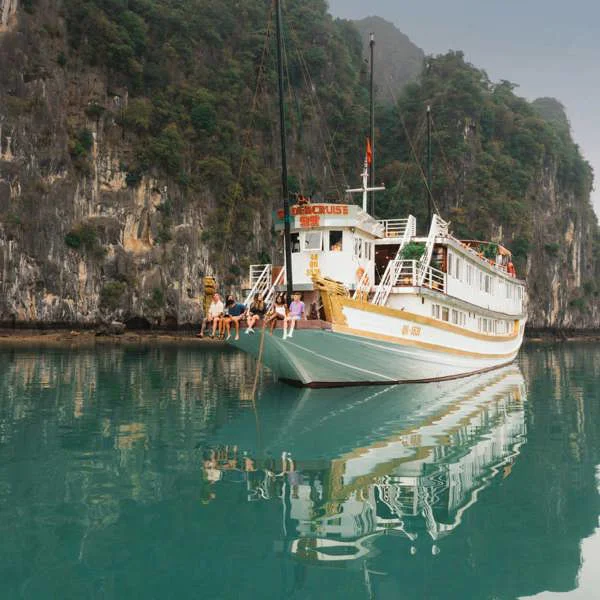
Start early and climb 500 steps to the top of Mua Cave. Drive to Halong Bay and board a Chinese-style junk boat for the night. Cruise past limestone islands, hidden lagoons, forests and grottos, and spend time on Ti Top Island. Finish with a fresh seafood dinner and sunset at the docking spot.
Meals: Breakfast,Lunch,Dinner
Day 26
Day 26: Halong Bay To Hanoi
Have breakfast aboard the junk boat and stop to explore Sung Sot Caves. Return to Hanoi for a free final evening, with the option of a group dinner followed by dancing on Ta Hien.
Meals: Breakfast,Lunch
Day 27
Day 27: Hanoi
Have a final breakfast with the group before the tour ends in Hanoi.
Meals: Breakfast
What’s included
What’s not included
Additional information
Dining Summary
- 25 Breakfast (B)
- 5 Dinner (D)
- 7 Lunch (L)
Included Experience
- Bangkok: Nose around the gilded Royal Palace, then travel like a local: floating down the Rivers.
- Kanchanaburi: A sombre slice of history. See the Death Railway Museum, WWII Cemetery and the famous Bridge itself.
- Kanchanaburi: Cool off in emerald pools, shower under a waterfall and get your step count up. All in a day’s work.
- Phra Nakhon Si Ayutthaya: Golden temples, a giant reclining Buddha and so many incredible sights to see. Try not to fall off your bike in shock!
- Elephant Nature Park: Help to protect to these majestic giants by learning about their struggle while watching them roam free – the way they were meant to live. ?
- Chiang Rai: Tour one of Thailand’s most-recognisable temples – the White Temple. You’ll find plenty of Buddhist symbolism hinted throughout its beautiful architecture (you know, to satisfy your artistic soul).
- Chiang Rai: Blazing blue deities will welcome you at the gates of this mesmerising temple. Don’t forget your camera for a spectacular view of this unconventional style of Buddhist art.
- Chiang Rai: Visit the place that has hosted art scholars and researchers for over 50 years. This museum is all about mixing traditional and modern Thai architectural styles, and it’s pretty spellbinding too.
- Pak Beng: Float down the Mekong from Pak Beng, past craggy caves and sleepy hillside villages. A proper taste of Laos life.
- Luang Prabang: Definitely the most surreal caves we’ve ever seen. Rock caverns packed with thousands of mini-Buddha statues. Pics or it didn’t happen.
- Luang Prabang: Cycle around the former capital of Laos, visiting Ock Pop Tock, Wat Xieng Thong, and Big Brother Mouse.
- Luang Prabang: Meditate at this ornate temple, or just marvel at its gilded beauty and take lots of pics.
- Luang Prabang: Step inside the Living Crafts Centre in Luang Prabang and watch over 50 Lao artisans at work, creating beautiful clothes and homeware using traditional weaving techniques. Learn how Ock Pop Tok, founded by Joanna Smith and Veomanee Douangdala in 2000, empowers women by turning their skills into a viable career, while promoting Laotian textiles and crafts across the globe.
- Luang Prabang: Always wanted to live like a Buddhist? Here is your chance to offer an ‘Alms’ to monks, in the spirit of karmic giving.
- Luang Prabang: Hop onto the train from Luang Prabang, travelling at a dashing 160 km/h. You’ll catch some breathtaking views on the way.
- Vientiane: See the incredible work of COPE, a non-profit helping locals with mobility-related disabilities, including victims of unexploded bombs. Witness how they provide prosthetic and orthotic devices, surgery, physiotherapy, and rehabilitation – giving people back mobility, dignity, and independence.
- Vientiane: This isn’t your typical hectic capital city. Today, you’ll walk around the peacefully lovely city of Vientiane and admire Laos’ version of the Arc de Triomphe – the Patuxai.
- Vientiane: It’s bizarre. It’s beautiful. And it has a lot of Buddha statues. This fanciful sculpture garden will leave you with wonder (and a little bit of confusion) in your eyes.
- Vientiane: Fasten your seatbelts folks, we’re off to Phnom Penh
- Phnom Penh: Admire the architectural wonder of some of the best buildings from the Khmer Empire of Vietnam – built back in the 1800s!
- Phnom Penh: A sombre but important remembrance for the victims of the Khmer Rouge. Visit the fields and Genocide Museum.
- Phnom Penh: Spend the evening at one of Phnom Penh’s best-loved after-dark hotspots for refreshing beverages and tantalising food.
- Siem Reap: Visit Angkor Wat, Ta Prohm and Bayon – where Tomb Raider was filmed. But dress appropriately (no hotpants, soz).
- Siem Reap: Not only is the food top-notch, this social enterprise trains and employs street youth (and also gives opportunities to other marginalized or at-risk groups!). Every bite supports these young locals to build skills, confidence and a brighter future. Respect.
- Siem Reap: Back on the plane. (Didn’t get a window seat last time? Now’s your chance…)
- Mekong River Delta: Grab your buddies and take a shot at catching an elephant ear fish for dinner. FYI: it tastes better than it looks.
- Mekong River Delta: Watch and learn as local craftspeople make rice wine, tea, sweets and more local delicacies.
- Ho Chi Minh City: Brave this subterranean world. The hand-dug tunnels were built by the Viet Cong to hide out during the war.
- Ho Chi Minh City: Tick off all of the landmarks on your bucket list – Notre Dame Cathedral, General Post Office and the Presidential Palace.
- Ho Chi Minh City: A meaningful reminder of the atrocities of the Vietnam War and its impact on local people and wildlife.
- Ho Chi Minh City: Passports at the ready folks.
- Hoi An: This 15th century port and UNESCO site is best explored on two wheels with a local expert. Don’t forget your Go-Pro!
- Da Nang: Next stop, Hanoi. But before we hit the streets, it’s time to hit the sky one more time.
- Hanoi:
Step inside KOTO Restaurant and enjoy a high-quality meal with a twist where you’re helping young, at-risk Vietnamese trainees sharpen their hospitality skills. KOTO (AKA Know One, Teach One) is Vietnam’s first social enterprise, offering a 24-month free training program for disadvantaged youth, with a special focus on empowering women.By eating here, you’re supporting more than just a meal. KOTO equips trainees with hospitality, entrepreneurship, and leadership skills, opening doors to long-term careers and breaking cycles of poverty. Each year, over 100 young people get a shot at realising their dreams—all while serving up delicious, expertly crafted dishes.
- Hanoi: Listen up culture-lovers. This shrine – dedicated to ancient philosopher Confucius – is known as ‘Vietnam’s first university’.
- Hanoi: Take a look at the resting place of Vietnamese revolutionary leader and President Ho Chi Minh. This is where he, along with his party, declared the independence of Vietnam.
- Ninh Binh: Cool tropical breeze. Lush-green landscapes. And an unforgettable view of the sunrise over the shimmery silhouette.
- Halong Bay: Grab your new BFFs and hang out in this mini paradise. The powdery sand and turquoise waters will bless you with #islandvibes
- Halong Bay: The best way to drift off into dreamy sleep? Drifting along the Gulf of Tonkin in a traditional Chinese-style Junk Boat, of course!
- Halong Bay: Yet another work of art from Mother Nature. These huge underground caves are made for exploring. But can you spot the ‘mammoth’?
FAQs
- Bangkok: A modular trip means fellow travellers will join and leave at various locations. There’ll be some goodbyes, sure, but there’ll also be plenty of hellos with new like-minded travellers.
Phnom Penh Royal Palace & Silver Pagoda
Visit Phnom Penh’s Royal Palace and Silver Pagoda to see the ceremonial architecture associated with Cambodia’s monarchy. Explore the palace grounds and admire the pagoda’s richly decorated religious setting.
The palace was established in the nineteenth century and remains an important royal site. Its tiered Khmer-style roofs and formal courtyards offer a vivid contrast to the streets beyond, while the Silver Pagoda adds a closer look at Cambodia’s Buddhist artistic heritage.
Siem Reap Social-Enterprise Dinner
Dine at a Siem Reap social enterprise that trains and employs young people facing disadvantage. Enjoy a hosted meal while learning how hospitality work can provide practical skills and opportunities for its trainees.
This is more than a restaurant stop: the organisation connects food service with training, confidence and future employment. Sharing dinner here gives the group a chance to experience Cambodian hospitality while supporting a locally focused purpose.
Hoi An Vietnamese Cooking Class
Prepare up to four traditional Vietnamese dishes in a Hoi An cooking class. Work with familiar local ingredients and practise the preparation behind a meal you can enjoy yourself.
Hoi An’s food culture reflects its coastal location and long history as a trading port. A hands-on class offers a closer appreciation of the flavours encountered in its markets and kitchens. It is optional, at additional cost and bookable on tour.
Vang Vieng Kayaking & Cave Exploration
Kayak Vang Vieng’s waterways and explore local caves against a backdrop of steep limestone karsts. This active option brings you closer to the rivers and rock formations that define the area’s scenery.
From the water, the surrounding cliffs and greenery take on a different scale; the caves add an underground dimension to the landscape. The adventure is optional, at additional cost and bookable on tour.
Operated By
Contiki
Bangkok Welcome Evening on Khao San Road
Meet your Trip Manager and fellow travellers in Bangkok before heading out for Pad Thai and an introduction to Khao San Road, a lively street known for food stalls, music and late-night crowds.
This hosted evening offers a sociable first taste of the capital. Watch vendors work their woks, find a table with the group and experience the bustle that has made the neighbourhood a long-standing gathering place for travellers.
Bangkok Royal Palace Guided Visit
Explore Bangkok’s Royal Palace complex with a local guide and discover the gilded roofs, ornate courtyards and ceremonial spaces associated with Thailand’s monarchy. Your guide explains the traditions behind this landmark rather than leaving its elaborate details to speak for themselves.
Established in 1782 as the royal residence, the complex reflects generations of Thai craftsmanship. Its layered rooflines, mirrored decoration and formal grounds provide a vivid introduction to the country’s artistic and royal heritage.
Bangkok Canal Cruise
Travel by local water taxi and cruise Bangkok’s klongs on a private boat. From the water, see a different side of the capital: canalside homes, passing boats and everyday activity along the banks.
Bangkok’s waterways once formed an essential transport network, giving the city its enduring association with canals. This experience pairs the practical rhythm of a local water taxi with a closer look at neighbourhoods away from the busiest streets.
Kanchanaburi Bridge, War Cemetery & Death Railway Museum
Visit the Bridge over the River Kwai, a Second World War cemetery and the Death Railway Museum in Kanchanaburi. Together, these sites tell the story of the railway built under Japanese occupation by prisoners of war and Asian labourers.
Exhibits provide historical context, while the cemetery offers a quiet place to acknowledge those who died. At the bridge, the familiar river setting takes on deeper meaning through the accounts of the people who built the railway.
Erawan Falls Nature Walk
Walk the forest trails of Erawan National Park to see its tiered waterfalls and clear, emerald-toned pools. There is time to enjoy the setting up close, whether that means following the paths or cooling your feet in the water.
The falls descend through limestone woodland west of Kanchanaburi, creating a succession of cascades rather than a single viewpoint. The sound of running water and shaded trails make this a distinctive change from Thailand’s cities and temple sites.
Ayutthaya Historical Park by Bicycle
Cycle among Ayutthaya’s temple ruins, passing ancient palaces, tall spires and Buddhist monuments in the former capital of Siam. Exploring by bike lets you take in the scale of the historic city and its remarkable concentration of sacred sites.
Ayutthaya flourished as a major trading centre before its destruction in 1767; its surviving remains are now UNESCO-listed. Weathered brickwork and temple silhouettes reveal both the grandeur of the old kingdom and the passage of time.
Elephant Nature Park Visit
Observe elephants at Elephant Nature Park near Chiang Mai and learn about the challenges facing these animals. Watch them move through the park while gaining insight into the care and protection work carried out there.
This MAKE TRAVEL MATTER® experience centres on observation and education, not elephant riding. Seeing the animals’ individual behaviour at an unhurried pace gives the visit its meaning, alongside a wholesome lunch served at the park.
Chiang Rai’s White Temple, Blue Temple & Baan Dam Museum
Discover three striking expressions of Thai art in Chiang Rai: the white, mirrored surfaces of Wat Rong Khun, the saturated blue interiors of Wat Rong Seua Ten and the dark-toned buildings of Baan Dam Museum.
These are distinctive modern creations, each drawing differently on Thai visual traditions. Look for Buddhist symbolism at the White Temple, richly coloured deities at the Blue Temple and a blend of traditional forms and contemporary art at Baan Dam.
Mekong Slow-Boat Cruise through Laos
Cruise the Mekong River by local slow boat, travelling through the landscapes around Pakbeng and towards Luang Prabang. Watch wooded hills, riverside villages and other boats come into view from the water.
The Mekong has long connected communities across Laos. Its slower pace makes the journey an experience in its own right: time to notice daily life on the banks and the changing shapes of the hills rather than simply crossing the distance between towns.
Pak Ou Caves Buddha Visit
Explore the Pak Ou Caves near Luang Prabang, where thousands of Buddha figures fill rocky chambers overlooking the Mekong. Look closely at the statues’ varied sizes and poses as you move through this unusual riverside shrine.
Local worshippers have placed images here over generations, giving the caves a significance beyond their dramatic setting. The contrast between shadowed stone, devotional objects and river views makes this a memorable encounter with Lao Buddhist tradition.
Luang Prabang Hilltop Sunset & Night Market
Watch sunset from a hilltop stupa above Luang Prabang, taking in the town’s temple roofs and surrounding river landscape. Browse the night market for a closer look at the textiles, crafts and food stalls that fill its evening streets.
Luang Prabang’s historic centre brings Buddhist architecture and French-era buildings into a compact riverside setting. The viewpoint reveals that broader landscape, while the market offers a more intimate sense of the town after dark.
Luang Prabang Cycling Tour & Wat Xieng Thong
Cycle through Luang Prabang to explore its historic streets and community landmarks, including Wat Xieng Thong and the Big Brother Mouse literacy project. A bicycle offers a close-up view of the town’s temples and everyday street life.
Wat Xieng Thong is among Luang Prabang’s most celebrated Buddhist temples, known for its elegant, low-sweeping rooflines and decoration. The community visit adds a contemporary perspective to a town often admired chiefly for its architecture.
Ock Pop Tok Living Crafts Centre
Meet Lao textile traditions at Ock Pop Tok’s Living Crafts Centre in Luang Prabang. Watch artisans use established weaving techniques to create clothing and homewares, and learn how pattern, colour and handwork shape the finished pieces.
Founded in 2000, Ock Pop Tok works to sustain Lao crafts while helping artisans turn their skills into livelihoods. This visit gives the town’s textile heritage a human face through the people practising it today.
Luang Prabang Morning Alms Giving
Take part in Luang Prabang’s morning alms-giving ritual as Buddhist monks make their daily procession through the town. Experience the quiet atmosphere of the early streets and learn about the practice of offering food in support of the monastic community.
Known locally as tak bat, the ritual is a living expression of Buddhist generosity rather than a performance. Respectful participation and observation are central to appreciating its place in Luang Prabang’s daily life.
Vientiane Landmarks: Pha That Luang & Patuxai
See Pha That Luang and Patuxai while exploring Vientiane’s relaxed streets. The golden stupa is a national symbol of Laos; Patuxai, the city’s monumental arch, provides a contrasting expression of modern national identity.
Together, these landmarks show different sides of the capital’s story, from Buddhist devotion to twentieth-century commemoration. Vientiane’s unhurried atmosphere makes space to appreciate their details without the pace of a larger, busier capital.
COPE Visitor Centre
Visit the COPE Visitor Centre in Vientiane to learn how the organisation supports people with mobility-related disabilities. Exhibits explain the continuing impact of unexploded ordnance in Laos and the role of prosthetics, rehabilitation and other services.
This is a thoughtful encounter with a difficult part of the country’s recent history. COPE’s work also focuses attention on practical recovery, showing how specialist care helps people regain mobility and independence.
Vientiane Buddha Park
Wander among the sculptures of Buddha Park outside Vientiane, pausing to examine its imaginative collection of Buddhist and Hindu figures. The garden’s oversized and sometimes surreal forms make it unlike a conventional temple visit.
Created in the twentieth century, the park brings spiritual imagery into an open-air setting where visitors can move between individual sculptures. Its mixture of familiar symbols and unexpected shapes invites a slower, curious look at each work.
Killing Fields & Tuol Sleng Genocide Museum
Visit the Killing Fields and Tuol Sleng Genocide Museum with a local guide to learn about the Khmer Rouge period. These sites preserve evidence of the violence inflicted on Cambodians and honour those who suffered and died.
The former detention centre and memorial grounds make for a difficult but essential visit. Your guide’s historical context helps connect the places to the lives affected, encouraging reflection rather than treating them as ordinary sightseeing stops.
Angkor Wat Sunrise, Angkor Thom & Ta Prohm
Watch sunrise at Angkor Wat before exploring Angkor Thom and Ta Prohm. See the great temple’s silhouette in the first light, encounter the carved faces of the Bayon within Angkor Thom and walk among Ta Prohm’s tree-root-wrapped ruins.
These sites reveal different expressions of the Khmer Empire, from monumental religious architecture to a former royal city. At Ta Prohm, the meeting of stone and jungle is particularly striking; its setting also made it a filming location for Tomb Raider.
Mekong Delta Traditional-Boat Exploration
Explore the Mekong Delta by traditional boat, travelling past lush riverbanks and communities shaped by life on the water. Watch the activity along the river as channels and shores reveal a quieter side of southern Vietnam.
The delta’s waterways are working routes as well as scenic ones, connecting homes, farms and local trade. Seeing them from a small boat brings that everyday relationship with the river into focus at a pace suited to the landscape.
Mekong Delta Food Crafts & Local Homestay
Watch local food-making demonstrations in the Mekong Delta, including rice paper production, and sample regional rice whisky. The experience also introduces other locally made delicacies and the people whose skills keep these food traditions alive.
Stay in a local homestay and share a home-cooked meal accompanied by live music. The overnight setting makes this a closer encounter with delta hospitality than a brief sightseeing stop, with food and conversation at its centre.
Cu Chi Tunnels Visit
Explore the Cu Chi Tunnels near Ho Chi Minh City and see concealed entrances, traps and sections of the underground network used by Viet Cong fighters. There is an opportunity to enter a narrow tunnel section and experience its confined dimensions firsthand.
Hand-dug during years of conflict, the tunnels formed part of a much larger system for movement and shelter. Seeing their construction up close adds a physical perspective to accounts of the Vietnam War.
Ho Chi Minh City Walking Tour
Walk among Ho Chi Minh City’s central landmarks, taking in the Notre-Dame Cathedral, Central Post Office and former Presidential Palace. The guided route introduces the city’s busy streets alongside buildings associated with different chapters of its history.
The cathedral and post office reflect the French colonial period, while the palace is closely tied to the end of the Vietnam War. Seeing their exteriors within the surrounding city helps place those stories in today’s energetic urban setting.
War Remnants Museum
Visit the War Remnants Museum in Ho Chi Minh City for an account of the Vietnam War and its consequences. Exhibits bring attention to the experiences of civilians as well as the lasting effects of the conflict.
Photographs, objects and testimony make this an emotionally demanding visit. It offers important context for understanding the country’s recent history and the human stories behind events encountered elsewhere on the tour.
Hoi An Guided Bicycle Tour
Ride through Hoi An with a local expert, visiting the Japanese Covered Bridge, a traditional ancient house and the central market. Cycling brings you close to the town’s lanes, shopfronts and everyday sounds.
This UNESCO-listed former trading port preserves architecture shaped by centuries of commercial exchange. The bridge and old house reveal details of that layered heritage, while the market shows the historic town as a place people still use and enjoy.
KOTO Restaurant Social-Enterprise Meal
Eat at KOTO Restaurant in Hanoi, where young Vietnamese trainees develop hospitality skills while serving guests. The included meal offers a direct way to support the organisation’s work as you experience contemporary Vietnamese dining.
KOTO stands for Know One, Teach One. Founded as a social enterprise, it provides training and pathways into employment for young people facing disadvantage. The restaurant connects that mission to a tangible, welcoming dining experience.
Hanoi Temple of Literature & Ho Chi Minh Mausoleum
Visit the Temple of Literature and see the Ho Chi Minh Mausoleum, two Hanoi landmarks reflecting very different periods of Vietnamese history. Explore the temple’s courtyards and learn about the significance of the mausoleum site.
Founded in the eleventh century, the Temple of Literature is associated with Vietnam’s earliest national university and honours Confucius. The mausoleum commemorates the revolutionary leader whose declaration of independence reshaped the country’s modern history.
Mua Cave Viewpoint Climb
Climb roughly 500 steps to the Mua Cave viewpoint in Ninh Binh for sweeping views over limestone hills and green lowlands. Bring your camera for the elevated perspective across this distinctive landscape.
The climb is the heart of the experience: stone steps rise above the surrounding fields to reveal why the region is often celebrated for its karst scenery. Early light can add soft colour to the ridgelines and waterways below.
Halong Bay Overnight Junk-Boat Cruise
Cruise Halong Bay aboard a Chinese-style junk boat and spend the night on the water. Drift among limestone islands, forested slopes and sheltered stretches of the Gulf of Tonkin, with changing views from the deck.
The overnight stay gives you more time to absorb the bay’s scenery than a passing boat trip. Enjoy the atmosphere as daylight fades and share a fresh seafood dinner while the vessel rests amid the islands.
Ti Top Island Visit
Spend time on Ti Top Island during the Halong Bay cruise, stepping ashore to enjoy its beach setting and views of the surrounding limestone islands. It is a chance to appreciate the bay from land as well as from the boat.
With boats on the water and karst formations rising beyond them, the island offers a memorable perspective on this seascape. Pause by the shore and take in the contrast between pale sand, water and steep green slopes.
Sung Sot Cave Exploration
Explore Sung Sot Cave in Halong Bay, walking through spacious limestone chambers filled with sculptural rock formations. Look out for the shapes visitors have long picked out in the stone, including the formation likened to a mammoth.
The cave reveals another side of the bay’s geology: an interior landscape hidden within its islands. Moving from the open water into these high-ceilinged chambers makes their scale and intricate surfaces especially striking.
Chiang Mai Evening Vespa Ride
Explore Chiang Mai by Vespa on an evening ride offered as an alternative way to experience the city. Moving through its streets at night gives you a closer sense of local neighbourhoods and the city’s after-dark atmosphere.
Chiang Mai blends old-city heritage with a lively contemporary scene, making a street-level ride a distinctive way to take it in. This experience is optional, at additional cost and bookable on tour.
Chiang Mai Muay Thai Lesson
Try a Muay Thai lesson in Chiang Mai and learn the basics of Thailand’s well-known martial art. This hands-on option puts you in the practice space rather than leaving you to watch from the sidelines.
Often called the art of eight limbs, Muay Thai uses punches, kicks, elbows and knees. A lesson offers an active introduction to its techniques and discipline. It is optional, at additional cost and bookable on tour.
Chiang Mai Market Visit & Thai Cooking Class
Tour a local market with a head chef in Chiang Mai before learning to prepare an authentic Thai meal. The cooking session takes place in a rice-field setting, connecting the ingredients in the market to the dishes on your plate.
See how fresh herbs, aromatics and other staples contribute to northern Thailand’s food culture, and practise techniques you can take home. This class is optional, at additional cost and bookable on tour.
Kuang Si Falls Visit
Visit Kuang Si Falls near Luang Prabang to see a broad cascade descending through forest into pale blue pools. Paths around the falls offer different perspectives on the water and its limestone setting.
At around 60 metres high, the main waterfall is a striking natural contrast to Luang Prabang’s temples and streets. This nature excursion is optional, at additional cost and bookable on tour.
Phnom Penh Tuk-Tuk Food Tour
Ride through Phnom Penh by tuk-tuk and sample local food at selected stops around the city. This option combines the energy of its streets with a chance to taste dishes beyond a single restaurant meal.
Food is a direct route into the capital’s everyday life, from the movement of neighbourhood kitchens to the flavours served after dark. The tour is optional, at additional cost and bookable on tour.
Phare Circus Performance
Watch a Phare Circus performance in Siem Reap for an evening of Cambodian contemporary performance. The show brings together physical theatre and circus skills in a live setting.
Phare is known for using performance to tell stories grounded in Cambodian experiences and imagination. It offers a cultural counterpoint to the region’s ancient temple sites. Attendance is optional, at additional cost and bookable on tour.
Siem Reap Rice-Paddy Quad-Bike Ride
Ride a quad bike near Siem Reap’s rice paddies as the light softens towards evening. This active excursion trades the city’s streets for open rural scenery and a different perspective on the surrounding countryside.
Golden-hour light brings out the patterns of fields and tracks, making the ride as much about the landscape as the vehicle. It is optional, at additional cost and bookable on tour.
Nha Trang Coastal Cruise
Take a cruise from Nha Trang for time on the water along Vietnam’s south-central coast. The outing offers an alternative to spending the day on the city’s beach, with a view back towards the shoreline.
Nha Trang’s coastal setting is central to its character, from its broad sandy waterfront to the sea beyond. Specific cruise stops are not detailed in the tour itinerary. This experience is optional, at additional cost and bookable on tour.
Hoi An Bamboo Basket-Boat Ride
Ride in a Vietnamese bamboo basket boat during your time in Hoi An. The small, round craft offers a playful way to experience a form of boat traditionally associated with the region’s fishing communities.
Its woven shape is unlike a conventional riverboat, making the movement on the water part of the experience. The itinerary suggests this ride as a choice rather than a guaranteed activity; it is optional, at additional cost and bookable on tour.
Hanoi After Dark Vespa & Street Food Ride
Experience Hanoi after dark by Vespa, with street-food stops amid the city’s illuminated streets. This evening option pairs the movement of the capital with opportunities to taste food in its lively neighbourhoods.
Hanoi’s street-food culture comes into its own at night, when small kitchens and diners spill into the streets. Exploring by Vespa adds a distinct perspective on that atmosphere. The ride is optional, at additional cost and bookable on tour.
Van Long Cycling & Sampan Adventure
Cycle through villages near Van Long before taking a sampan boat ride among Ninh Binh’s limestone scenery. The combination of quiet roads and waterways reveals why the region is often called Ha Long Bay on land.
From the boat, look for the shapes of karst hills reflected in the water and the birdlife that inhabits the wetlands. This bike-and-boat adventure is optional, at additional cost and bookable on tour.