Your itinerary
Day 1
Day 1: Welcome to Istanbul
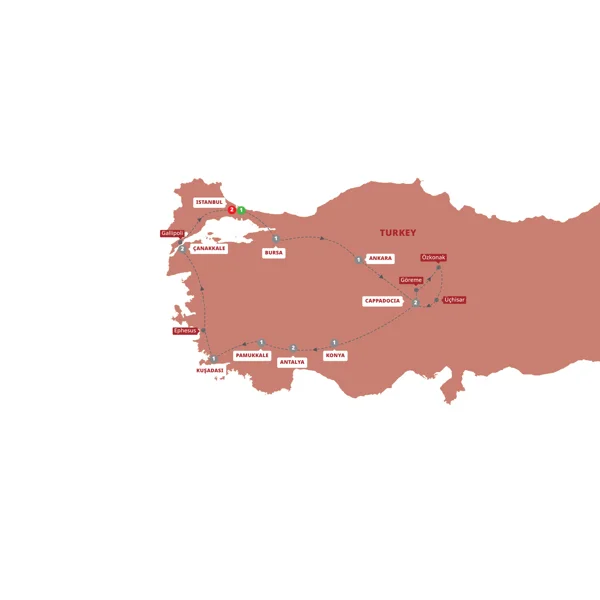
Arrive in Istanbul and transfer from the airport to the hotel. Relax and settle in before dinner with your Travel Director and fellow travelers.
Meals: Dinner
Day 2
Day 2: Bosphorus Cruise and Bursa
Cruise along the Bosphorus Strait past fishing villages, Ottoman palaces and fortresses. Travel to Bursa, the first major capital of the Ottoman Empire, and visit the Green Mosque, Grand Mosque and Mausoleum Complex. Spend the afternoon exploring the bazaars, silk markets and historic monuments. Dinner at a local restaurant.
Meals: Breakfast,Dinner
Day 3
Day 3: Cumalikizik and Gordion
Visit Cumalıkızık, with its traditional wooden houses and narrow cobblestone streets. Continue to Gordion, once the capital of ancient Phrygia, on the way to Ankara. Spend the evening at leisure; the hotel has an indoor pool, jacuzzi and hammam.
Meals: Breakfast
Day 4
Day 4: Sophisticated Ankara
Explore Ankara, visiting the Hittite Museum and the Mausoleum of Atatürk. Continue to Avanos in Cappadocia and visit the underground city of Özkonak, carved into soft volcanic rock.
Meals: Breakfast,Dinner
Day 5
Day 5: Cappadocia
Rise early to watch hot air balloons at sunrise. Visit Göreme’s rock-hewn churches and ancient wall paintings, then enjoy a MAKE TRAVEL MATTER® experience and lunch at Uçhisar Kadineli Restaurant. Continue to Paşabağ Valley and tour a local Cappadocian’s cave house. In the evening, watch the Whirling Dervishes before dinner at a local restaurant.
Meals: Breakfast,Lunch,Dinner
Day 6
Day 6: Konya
Learn about traditional pottery-making in Avanos. Travel along the Silk Road to visit a 13th-century caravanserai, then continue to Konya, the former capital of the Anatolian Seljuk Empire.
Meals: Breakfast,Dinner
Day 7
Day 7: Through the Taurus Mountains
See the Karatay Medrese and Ince Minaret Medrese, and visit the Mevlana Museum. Drive through the Taurus Mountains to Aspendos and explore its well-preserved Roman theater.
Meals: Breakfast,Dinner
Day 8
Day 8: Antalya's Old Town
Visit Antalya’s Old Town, including its souvenir markets and sea views. The rest of the day is free to relax at the hotel or explore at your own pace; suggested options include a walk around the harbor or a boat trip off the coast.
Meals: Breakfast
Day 9
Day 9: The Pools of Pamukkale
Cross the Taurus Mountains to visit the remains of Hierapolis, then explore Pamukkale’s white travertine terraces with your Travel Director. Return to the hotel, where facilities include indoor and outdoor thermal pools, a steam room and a Turkish bath complex.
Meals: Breakfast,Dinner
Day 10
Day 10: Ancient Ephesus
Explore Ephesus, walking the Arcadian Way and seeing the Library of Celsus and Great Theater. Visit the House of the Virgin Mary, then learn about Anatolia’s leather-making heritage. In nearby Selçuk, visit the Archaeological Museum and see artifacts from the Ephesus excavations.
Meals: Breakfast,Dinner
Day 11
Day 11: Troy and Çanakkale
Explore Troy and see the replica Trojan Horse beside the city walls. Continue to Çanakkale, gateway to the Gallipoli WWI battlefields. An optional evening city-center walk, The Flavors of Canakkale, offers local bites including a Biga-style Turkish meatball sandwich and a traditional cheese dessert.
Meals: Breakfast,Dinner
Day 12
Day 12: Çanakkale
Attend the annual Dawn Service to honor the fallen soldiers. Visit Lone Pine and Chunuk Bair Cemeteries and learn about the events leading to the Anzac troops’ campaign to gain control of the Dardanelles Strait. Return to the hotel for an afternoon at leisure, with the option to relax by the pool or book a spa treatment.
Meals: Breakfast
Day 13
Day 13: Gallipoli and ANZAC Cove
Cross the Dardanelles Strait by ferry to the Gallipoli Peninsula. Visit Anzac Cove and pay your respects at Lone Pine Cemetery, then return to Istanbul, where you will spend the next two nights.
Meals: Breakfast
Day 14
Day 14: Istanbul and the Ottoman Empire
Visit the Blue Mosque and Hippodrome, then choose between the Hagia Sophia Digital Experience and a visit to Hagia Sophia. Visit Topkapi Palace and explore the Grand Bazaar. In the evening, have dinner with fellow travelers at a local restaurant.
Meals: Breakfast,Dinner
Day 15
Day 15: Farewell Istanbul
Transfer to the airport for onward flights. Travelers extending their stay can ask the Travel Director for recommendations.
Meals: Breakfast
What’s included
What’s not included
Additional information
Operated By
Insight Vacations
Dining Summary
- 10 Dinner (D)
- 14 Breakfast (B)
- 1 Lunch (L)
How You'll Travel
- Business class coach with extended leg room
- Top-rated dining, from farm-to-table to local restaurants
- 4 & 5-star stays
Authentic Dining
- Istanbul: Begin your travels savoring traditional flavors over dinner at a local restaurant.
- Cappadocia: Experience a Sema ceremony performed by the whirling dervishes, part of the Mevlevi Sufi tradition. You’ll watch the ritual unfold through music, movement and costume, in a form of worship still practised across Turkey today.
- Istanbul: Toast the culmination of your travels during dinner at a local restaurant.
Premium Experience
- Cappadocia: Step inside a traditional cave house and meet a local Cappadocian who has lived there for decades. Hear how the home was shaped, how it has changed over time and what it means to remain rooted in this landscape.
Trafalgar Choice
- Istanbul: An immersive digital experience through the iconic structure’s rich past, showcasing its transformation from a Byzantine cathedral to an Ottoman mosque and now a museum, with captivating exhibits and architectural wonders.
- Istanbul: Visit Hagia Sophia with your Local Specialist. You’ll step beneath the central dome and see how elements from its time as a Byzantine basilica and as an Ottoman mosque share the same interior, reflecting the building’s long and layered history.
Bosphorus Strait Cruise
Cruise the Bosphorus Strait between Istanbul’s European and Asian shores, sharing the water with ferries, fishing boats and cargo ships. Watch waterfront neighborhoods give way to Ottoman palaces, fortresses and former fishing villages.
This busy passage links the Black Sea with the Sea of Marmara. From the water, Istanbul’s position between continents feels tangible: its buildings and working waterfront unfold along a route that has shaped trade and daily life for centuries.
Bursa’s Mosques and Silk Market
Explore Bursa with your Travel Director, visiting the Green Mosque, the Grand Mosque and a mausoleum complex. Discover the city’s bazaars and historic Silk Market, where covered trading spaces recall its long association with silk.
Bursa was the Ottoman Empire’s first major capital. Its early monuments reveal the architecture and patronage of a rising dynasty, while its market streets retain the bustle of a city built around craft and commerce.
Ancient Gordion
Visit Gordion, the former capital of ancient Phrygia on the Anatolian plateau. Encounter a place associated with King Midas and the legend of the Gordian Knot, where the landscape holds traces of a powerful Iron Age kingdom.
Gordion’s archaeological setting offers a different perspective on Turkey’s layered past, reaching well beyond its Roman, Byzantine and Ottoman monuments. Its remains speak to the communities and rulers who crossed and settled central Anatolia.
Özkonak Underground City
Descend into Ozkonak Underground City in Cappadocia, moving through passages and interconnected rooms cut into the region’s soft volcanic rock. The enclosed spaces reveal how people adapted the landscape to create places of refuge.
Notice the defensive features built into this subterranean complex, designed to help its occupants block intruders. It is a striking contrast to Cappadocia’s open valleys and rock formations above ground, showing another way the region’s geology shaped human life.
Cappadocia Sunrise Balloon Viewpoint
Watch sunrise from a Cappadocia viewpoint as hot air balloons drift above valleys, fairy chimneys and sculpted volcanic rock. The changing light brings definition to ridges and formations that can appear almost abstract before dawn.
This is a ground-based viewing experience, with time to take in the panorama and photograph the balloons against the landscape. Cappadocia’s unusual shapes were formed by volcanic deposits and long erosion, giving the morning scene its distinctive contours.
Göreme Rock-Cut Churches
Explore Goreme’s rock-cut churches, carved into Cappadocia’s soft volcanic stone. Step inside to see surviving frescoes and discover how early Christian communities made places of worship within the landscape.
The painted interiors offer a vivid counterpoint to the pale rock outside. They preserve centuries-old religious imagery and give a closer sense of the people who lived, prayed and worked among Cappadocia’s valleys and caves.
Uçhisar Kadineli Restaurant Experience
Taste homemade Anatolian dishes at Uchisar Kadineli Restaurant, a women-owned enterprise in Cappadocia. The meal offers an introduction to local flavors while supporting an organization that provides employment for women from the village.
Kadineli employs more than 65 women in roles spanning cooking, service, teaching and administration. Its work also helps women develop craft and business skills, making this a dining experience with a direct connection to the surrounding community.
Whirling Dervishes Sema Ceremony
Witness a Whirling Dervishes Sema ceremony in Cappadocia. Watch the measured turning, flowing white garments and musical accompaniment that make this ritual immediately recognizable.
The Sema belongs to the Mevlevi Sufi tradition and is a form of worship, not simply a staged dance. Seeing its movements unfold offers insight into a spiritual practice closely associated with the teachings of the poet and mystic Rumi.
Avanos Pottery Studio
Visit a pottery studio in Avanos to watch artisans prepare and shape clay at the wheel. Follow the stages of making a piece, from forming the vessel to drying and decoration.
Avanos stands beside the Kizilirmak River, whose red clay has supported local pottery-making for generations; the area’s ceramic tradition reaches back to Hittite times. Seeing the craft at close range connects a familiar finished object to the materials and practiced hands behind it.
Sultanhani Caravanserai
Step inside Sultanhani Caravanserai, a 13th-century roadside inn built to shelter traders and travelers crossing the Anatolian plain. Explore its courtyard and the spaces arranged for animals, goods and overnight rest.
Built in 1229 along a historic trade route, the caravanserai makes the practical demands of long-distance travel easy to picture. Its substantial stone architecture reflects the importance of protecting people and merchandise moving through Seljuk Anatolia.
Konya’s Mevlana Museum and Seljuk Monuments
Visit Konya’s Mevlana Museum with a Local Specialist for insight into Rumi and the Mevlevi tradition of the Whirling Dervishes. See the Karatay Medrese and Ince Minaret Medrese, two landmarks of the city’s Seljuk heritage.
Konya was a capital of the Anatolian Seljuk Empire and remains an important spiritual center. Its religious and educational monuments reveal a city where scholarship, architecture and Sufi practice have long held a prominent place.
Aspendos Roman Theater
Explore the Roman theater at Aspendos, near Antalya, and take in the sweep of its seating and the imposing stage building. Its remarkable preservation makes the layout and scale of an ancient performance venue unusually clear.
Built during the Roman period, the theater offers a direct sense of how large audiences gathered for public entertainment. Walk through a structure whose surviving stonework still conveys the engineering skill and civic ambitions of its builders.
Antalya Old Town
Walk through Antalya’s Old Town, known as Kaleici, where narrow streets lead past historic buildings and market stalls toward views of the Mediterranean. Take in the contrast between the enclosed lanes and the open sweep of the coast.
Set around the city’s old harbor, Kaleici carries traces of Antalya’s long history as a port. Its streets offer a close-up look at the everyday life and architecture of this southern Turkish city.
Hierapolis and Pamukkale Travertine Terraces
Explore the ruins of Hierapolis and walk alongside Pamukkale’s white travertine terraces with your Travel Director. See where mineral-rich thermal water flows across the hillside, leaving pale calcium deposits in its wake.
Hierapolis developed as an ancient spa city beside these springs. Together, its surviving remains and the terraces show why people have been drawn to this site for centuries: the same waters that shaped the landscape also gave the settlement its purpose.
Ephesus, House of the Virgin Mary and Archaeological Museum
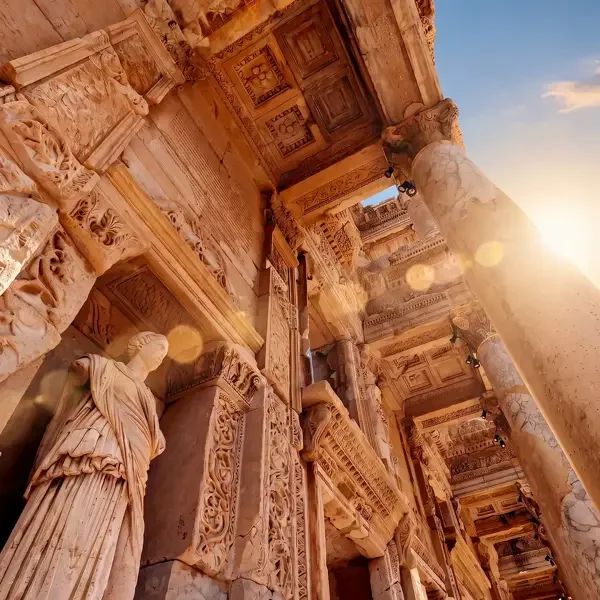
Walk through Ephesus with a Local Specialist, following the Arcadian Way to the Library of Celsus and Great Theater. Visit the House of the Virgin Mary in the hills above the ruins, a place of pilgrimage.
In nearby Selcuk, explore the Ephesus Archaeological Museum, where statues, mosaics and household objects give detail to life in the ancient city. Together, the streets and artifacts reveal the scale and texture of this former Roman capital of Asia Minor.
Ancient Troy and the Trojan Horse
Explore the archaeological site of Troy with an orientation from your Travel Director. See its ancient remains and a reconstructed Trojan Horse while hearing the stories associated with Homer’s account of the Trojan War.
Troy’s history extends far beyond the legend of Paris and Helen: settlement here spans thousands of years. The visit places those celebrated myths beside the physical traces of a city rebuilt and inhabited across many eras.
Gallipoli ANZAC Day Dawn Service and Memorials
Attend the ANZAC Day Dawn Service on the Gallipoli Peninsula, joining others in remembrance of those who died in the First World War. Pay your respects at the Lone Pine and Chunuk Bair cemeteries.
The commemorations recall the 1915 campaign, when Australian and New Zealand forces fought as part of an Allied attempt to secure the Dardanelles. At first light, the ceremony’s quiet formality gives space to reflect on the campaign’s human cost.
ANZAC Cove and Gallipoli Battlefield Visit
Visit ANZAC Cove on the Gallipoli Peninsula, where Australian and New Zealand troops landed on 25 April 1915. Walk through this historically significant coastal setting and pay your respects at Lone Pine Cemetery.
Learning about the nine-month Gallipoli campaign at the places where it unfolded brings the history into focus. The shoreline, steep ground and memorials help convey both the military challenge of the landings and the enduring importance of remembrance here.
Hagia Sophia Visit — Included Choice
Visit Hagia Sophia with a Local Specialist as one of two included choices in Istanbul. Step beneath its vast central dome and observe details that reflect its use as a Byzantine church and an Ottoman mosque.
Completed in AD 537, Hagia Sophia has stood at the heart of the city’s religious and architectural history for nearly 1,500 years. This choice suits travelers who want to encounter the landmark itself and examine its layered interior firsthand.
Hagia Sophia Digital Experience — Included Choice
Choose an immersive Hagia Sophia digital experience as an alternative to the included visit to the landmark. Exhibits use visual storytelling to explore the building’s architecture and changing role across the centuries.
Discover how a sixth-century Byzantine cathedral became an Ottoman mosque and later a museum. This option offers a focused way to understand the ideas, imagery and historical events behind one of Istanbul’s most significant monuments.
The Flavors of Çanakkale
Join a food-focused walk through central Canakkale, sampling local bites as you explore the city on foot. Tastings include a Biga-style Turkish meatball sandwich and a traditional cheese dessert.
Set beside the Dardanelles, Canakkale has a lively local character beyond its role as a gateway to Gallipoli. This gentle walk introduces that everyday side of the city through its streets and flavors. It is an optional experience at additional cost, bookable on tour.
Cumalikizik Ottoman Village
Walk through Cumalikizik, a village more than 700 years old near Bursa. Its narrow cobblestone lanes and traditional timber-framed houses offer a close look at the scale and texture of an Ottoman-era settlement.
Rather than the palaces and monumental mosques of an imperial capital, the village preserves a more intimate side of Ottoman heritage. Notice how the houses cluster along winding streets beneath the slopes of Mount Uludag.
Ankara Orientation, Museum of Anatolian Civilizations and Anitkabir
Explore Turkey’s capital with your Travel Director, discovering its Roman and Byzantine heritage. Visit the Museum of Anatolian Civilizations to encounter objects from the region’s ancient cultures, including its Hittite past.
At Anitkabir, Ataturk’s mausoleum, walk through the ceremonial complex and enter the Hall of Honor. The monument’s scale and formal setting express the importance of Mustafa Kemal Ataturk, the republic’s founder and first president, to modern Turkey.
Pasabag Valley and a Cappadocian Cave Home
Explore Pasabag Valley’s rock formations and step inside a traditional Cappadocian cave home. Meet a local resident who has lived in the home for decades and hear how it was shaped and adapted for family life.
Pasabag’s fairy chimneys show the effects of erosion on layered volcanic rock. The home visit brings a personal dimension to that geology, revealing what it means to live within a landscape often viewed chiefly for its striking scenery.
Istanbul’s Blue Mosque, Hippodrome, Topkapi Palace and Grand Bazaar
Explore Istanbul’s historic peninsula with a Local Specialist. Visit the Blue Mosque and Hippodrome, see Topkapi Palace above the Bosphorus and Golden Horn, and experience the covered lanes of the Grand Bazaar.
These landmarks trace the city’s passage from Byzantine Constantinople to an Ottoman capital. Roman chariot racing, imperial court life, mosque architecture and centuries of trade meet within a compact area whose streets remain full of activity.