Your itinerary
Day 1
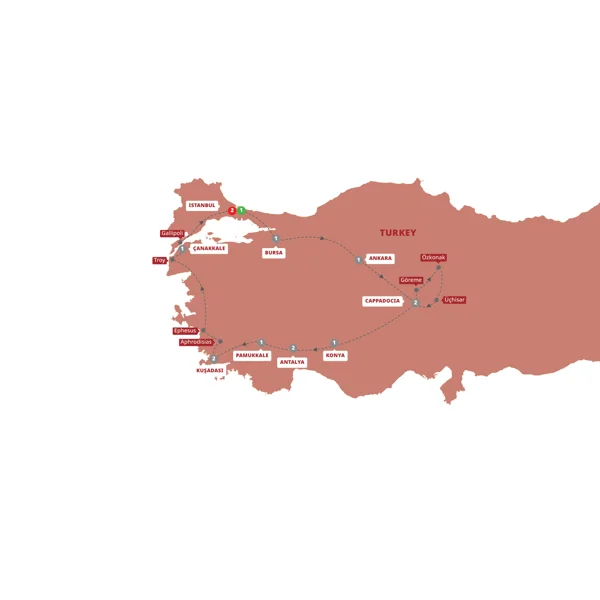
Day 1: Welcome to Istanbul
Arrive in Istanbul, where a representative will pick you up from the airport and transfer you to the hotel. Relax and settle in before dinner with your Travel Director and fellow travelers.
Meals: Dinner
Day 2
Day 2: Bosphorus Cruise and Bursa
Cruise along the Bosphorus Strait past fishing villages, Ottoman palaces and fortresses. Travel to Bursa, the first major capital of the Ottoman Empire, and visit the Green Mosque, Grand Mosque and Mausoleum Complex. Free time to explore the bazaars, silk markets and historic monuments, followed by dinner at a local restaurant.
Meals: Breakfast,Dinner
Day 3
Day 3: Cumalikizik and Gordion
Visit Cumalıkızık, with its traditional wooden houses and narrow cobblestone streets, then travel via ancient Phrygia’s former capital, Gordion, to Ankara. Enjoy a relaxed evening at the hotel, with an indoor pool, jacuzzi and hammam.
Meals: Breakfast
Day 4
Day 4: Sophisticated Ankara
Explore Ankara, including the Hittite Museum and the Mausoleum of Atatürk. Travel to Avanos in Cappadocia and visit the underground city of Özkonak, carved into soft volcanic rock.
Meals: Breakfast,Dinner
Day 5
Day 5: Cappadocia
Rise early to watch hot air balloons drift above Cappadocia’s valleys. Explore the rock-hewn churches of Göreme and their ancient wall paintings. Join a MAKE TRAVEL MATTER® Experience at Uçhisar Kadineli Restaurant, supporting employment for local women, then visit Paşabağ Valley and a local’s cave house. In the evening, watch the Whirling Dervishes before dinner at a local restaurant.
Meals: Breakfast,Lunch,Dinner
Day 6
Day 6: Konya
Learn about traditional pottery-making in Avanos, then travel along the Silk Road to visit a 13th-century caravanserai. Continue to Konya, the former capital of the Anatolian Seljuk Empire.
Meals: Breakfast,Dinner
Day 7
Day 7: Through the Taurus Mountains
See the Karatay Medrese and Ince Minaret Medrese and visit the Mevlana Museum. Drive through the Taurus Mountains to Aspendos and explore its well-preserved Roman theater.
Meals: Breakfast,Dinner
Day 8
Day 8: Antalya's Old Town
Visit Antalya’s Old Town, including its souvenir markets and sea views. The rest of the day is free to relax at the hotel or explore independently; you could stroll around the harbor or take a boat trip off the coast.
Meals: Breakfast
Day 9
Day 9: The Pools of Pamukkale
Cross the Taurus Mountains to visit the remains of Hierapolis, an ancient Roman spa city, and the white travertine terraces of Pamukkale. Explore the area with your Travel Director, then return to the hotel, with indoor and outdoor thermal pools, a steam room and a Turkish bath complex.
Meals: Breakfast,Dinner
Day 10
Day 10: Kuşadası
Visit the Temple of Aphrodite at Geyre, in the ruins of Aphrodisias, and see the re-erected columns. Continue to the coastal resort of Kuşadası for an evening at leisure.
Meals: Breakfast,Dinner
Day 11
Day 11: Ancient Ephesus
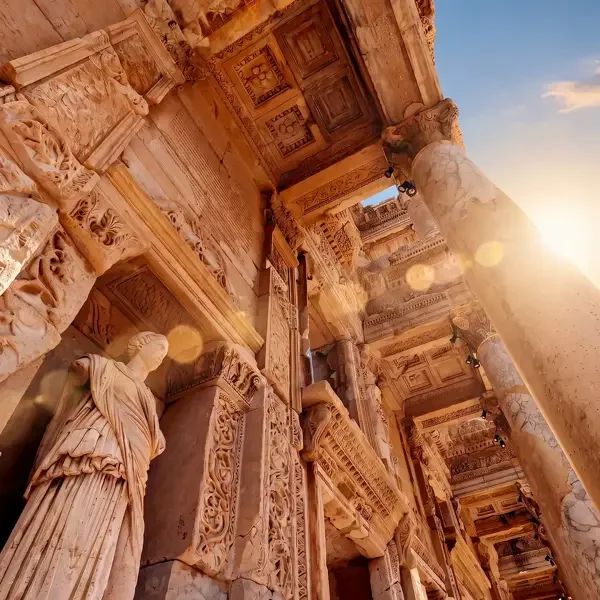
Visit the House of the Virgin Mary on Mount Koressos, then explore Ephesus: walk the Arcadian Way, see the Library of Celsus and enter the Great Theater. Discover Anatolia’s leather-making heritage and visit the Ephesus Archaeological Museum to see statues of Artemis, mosaics and household artifacts. An optional hands-on Turkish cooking class is available.
Meals: Breakfast
Day 12
Day 12: Troy and Çanakkale
Explore Troy and see the replica Trojan Horse beside the city walls. Continue to Çanakkale. An optional city-center walk with local food is available in the evening.
Meals: Breakfast
Day 13
Day 13: Gallipoli and ANZAC Cove
Cross the Dardanelles Strait by ferry to the Gallipoli Peninsula. Visit ANZAC Cove and pay your respects at Lone Pine Cemetery, then return to Istanbul for the next two nights.
Meals: Breakfast
Day 14
Day 14: Istanbul and the Ottoman Empire
Visit the Blue Mosque and Hippodrome, then choose between the Hagia Sophia Digital Experience and a visit to Hagia Sophia. Visit Topkapi Palace and the Grand Bazaar. In the evening, celebrate the trip with dinner at a local restaurant.
Meals: Breakfast,Dinner
Day 15
Day 15: Farewell Istanbul
A transfer takes you to the airport for your onward flight. If extending your stay in Istanbul, ask your Travel Director for recommendations.
Meals: Breakfast
What’s included
What’s not included
Additional information
Operated By
Insight Vacations
Dining Summary
- 9 Dinner (D)
- 14 Breakfast (B)
- 1 Lunch (L)
How You'll Travel
- Business class coach with extended leg room
- Top-rated dining, from farm-to-table to local restaurants
- 4 & 5-star stays
Authentic Dining
- Istanbul: Begin your travels savoring traditional flavors over dinner at a local restaurant.
- Cappadocia: Experience a Sema ceremony performed by the whirling dervishes, part of the Mevlevi Sufi tradition. You’ll watch the ritual unfold through music, movement and costume, in a form of worship still practised across Turkey today.
- Istanbul: Toast the culmination of your travels during dinner at a local restaurant.
Premium Experience
- Cappadocia: Step inside a traditional cave house and meet a local Cappadocian who has lived there for decades. Hear how the home was shaped, how it has changed over time and what it means to remain rooted in this landscape.
Trafalgar Choice
- Istanbul: An immersive digital experience through the iconic structure’s rich past, showcasing its transformation from a Byzantine cathedral to an Ottoman mosque and now a museum, with captivating exhibits and architectural wonders.
- Istanbul: Visit Hagia Sophia with your Local Specialist. You’ll step beneath the central dome and see how elements from its time as a Byzantine basilica and as an Ottoman mosque share the same interior, reflecting the building’s long and layered history.
Istanbul Welcome Dinner
Meet your Travel Director and fellow travellers over a welcome dinner in Istanbul. Share a meal as the group gathers in a city whose neighbourhoods stretch across both Europe and Asia.
It is an opportunity to get to know the people travelling with you and hear an introduction to Turkey’s varied regions, from Anatolia’s inland landscapes to the historic shores of the Aegean.
Bosphorus Strait Cruise
Cruise the Bosphorus Strait between Istanbul’s European and Asian shores, watching ferries, fishing boats and cargo ships navigate the waterway. Ottoman palaces, waterfront neighbourhoods and old fortresses come into view from the boat.
Linking the Black Sea with the Sea of Marmara, the strait has shaped the city’s trade and daily life for centuries. From the water, Istanbul’s two continents form a single, continuously changing skyline.
Bursa’s Ottoman Mosques, Mausoleum and Silk Market
Explore Bursa’s early Ottoman landmarks with your Travel Director, visiting the Green Mosque, the Grand Mosque and a mausoleum complex. Discover the bazaars and Silk Market in a city that served as the Ottoman Empire’s first major capital.
Monumental prayer halls and historic trading spaces reveal different sides of Bursa’s heritage. The market recalls the silk commerce that helped make the city an important centre of production and exchange.
Gordion, Ancient Phrygian Capital
Discover Gordion, once the capital of ancient Phrygia, on a visit to this historic site west of Ankara. Encounter a place associated with King Midas and the enduring legend of the Gordian Knot.
Gordion’s long history reaches well beyond its famous myths: successive communities occupied this strategic Anatolian settlement. Its ancient setting offers a different perspective on Turkey’s past, rooted in the civilisations of the central plateau.
Özkonak Underground City
Descend into Ozkonak Underground City in Cappadocia, exploring rooms and narrow passages carved into the region’s soft volcanic rock. See how an interconnected subterranean settlement could provide shelter when communities faced danger.
The confined spaces and defensive features show how residents adapted the landscape for protection and daily needs. Moving through the rock-cut chambers makes Cappadocia’s history tangible beneath the valleys and stone formations visible above ground.
Cappadocia Sunrise Balloon Viewpoint
Watch hot air balloons rise over Cappadocia from a panoramic viewpoint at sunrise. See their silhouettes drift above valleys, fairy chimneys and sculpted volcanic ridges as the first light brings out the rock’s warm colours.
This is a ground-based viewing and photography experience, not a balloon flight. The changing light and wide view reveal the scale of the landscape while offering a clear perspective on one of Cappadocia’s most recognisable sights.
Göreme Rock-Cut Churches
Explore Goreme’s rock-cut churches, carved into Cappadocia’s volcanic stone and decorated with early Christian wall paintings. Step inside to examine frescoes and the spaces where communities gathered to worship.
The churches belong to a landscape shaped by both geology and faith: workable rock allowed chapels and dwellings to be cut directly into the hills. Their surviving painted interiors offer a close encounter with the region’s Byzantine Christian heritage.
Uçhisar Kadineli Restaurant Experience
Taste homemade Anatolian dishes at Uchisar Kadineli Restaurant in Cappadocia. This MAKE TRAVEL MATTER® experience connects a regional meal with the women who prepare it and run the establishment.
The women-owned restaurant provides employment for more than 65 women from the village, alongside opportunities to develop practical and commercial skills. Your visit supports an initiative focused on women’s economic participation while introducing local flavours through the people who make them.
Visit a Cappadocian Cave Home
Step inside a traditional cave home and meet a Cappadocian resident who has lived there for decades. Hear how the home was shaped from the region’s workable volcanic rock and how it has changed with family life.
Unlike viewing the cave dwellings from outside, this hosted visit offers a personal account of living in them. The resident’s stories connect Cappadocia’s familiar rock-hewn architecture with the routines, memories and traditions of a local household.
Whirling Dervish Sema Ceremony
Witness a Sema ceremony in Cappadocia, watching whirling dervishes turn in flowing white garments to music. Observe the measured movements and ritual form associated with the Mevlevi Sufi tradition.
The ceremony is a spiritual practice rather than simply a dance performance. Its music, costume and repeated turning express a tradition connected to the teachings of Rumi, offering insight into a form of worship that remains part of Turkey’s cultural life.
Avanos Pottery Studio Visit
Watch pottery-making in an Avanos studio beside the Kizilirmak River. See how local red clay is prepared, shaped on the wheel, dried and decorated by craftspeople working with a long-established material.
Avanos’s clay-working tradition reaches back to Hittite times. Seeing the stages of production brings that heritage into the present, showing the skill and control needed to turn river clay into vessels and decorative pieces.
Sultanhani Caravanserai
Visit Sultanhani Caravanserai, a 13th-century roadside inn built to shelter travellers and traders crossing the Anatolian plain. Explore its courtyard and the spaces designed for people, goods and animals.
Built in 1229 during the Seljuk period, the complex reflects the infrastructure that supported commerce across Anatolia. Its sturdy walls, storerooms and stables make the practical demands of a long-distance trading journey easier to picture.
Konya’s Mevlana Museum and Seljuk Landmarks
Visit Konya’s Mevlana Museum with a Local Specialist for insight into Rumi and the Mevlevi tradition associated with the whirling dervishes. See the Karatay Medrese and Ince Minaret Medrese, two landmarks of the city’s Seljuk heritage.
Konya was a capital of the Anatolian Seljuk Empire and remains closely identified with Rumi’s teachings. Its religious and educational buildings reveal the city’s enduring importance as a centre of learning, craftsmanship and spiritual life.
Aspendos Roman Theater
Explore the Roman theater at Aspendos near Antalya, taking in its vast seating tiers and remarkably intact stage building. The scale of the structure gives a vivid sense of public entertainment in an ancient city.
Built in the second century CE, the theater is celebrated as one of the best-preserved examples of its kind. Its surviving architecture makes it possible to appreciate how Roman builders organised sightlines, movement and performance within a single monumental space.
Antalya Old Town Visit
Wander Antalya’s Old Town, known as Kaleici, through narrow streets lined with shops and historic buildings. Enjoy views towards the harbour and Mediterranean coast from this older heart of the city.
Set behind sections of ancient walls, Kaleici reflects layers of Antalya’s past in its street plan and architecture. Its lanes and sea-facing outlook offer a contrast to the wider modern resort city, with opportunities to browse local markets along the way.
Hierapolis and Pamukkale Travertine Terraces
Explore ancient Hierapolis and Pamukkale with your Travel Director. See the remains of a Roman spa city beside white travertine terraces formed by mineral-rich thermal water, and walk along the designated areas of the formations.
Hierapolis grew around the area’s hot springs, while calcium deposits continue to shape Pamukkale’s pale hillside. Together, the ruins and terraces show how the same waters influenced both an ancient settlement and the landscape that draws visitors today.
Aphrodisias and the Temple of Aphrodite
Visit ancient Aphrodisias near Geyre, exploring the archaeological site dedicated to Aphrodite. See the Temple of Aphrodite and its re-erected columns among the remains of the city.
Aphrodisias was renowned in the Roman world for its sculptors, who worked with marble from nearby quarries. Its surviving architecture and statues reveal a place where religious devotion, civic ambition and skilled stonework came together.
House of the Virgin Mary and Ancient Ephesus
Visit the House of the Virgin Mary, a pilgrimage site in the hills above Ephesus, and explore the ancient city with a Local Specialist. Follow the Arcadian Way to the Library of Celsus and step into the vast Great Theater.
Once a major Roman centre in Asia Minor, Ephesus preserves streets and civic monuments that convey its former scale. The hillside shrine adds another dimension, drawing visitors from both Christian and Muslim traditions.
Anatolian Leather-Making Heritage
Discover Anatolia’s leather-making heritage during your visit to the Ephesus region. Learn about a craft historically connected with skilled makers and traders, and the traditions that helped organise their work.
Among those traditions were the medieval Ahi guilds, associated with the 13th-century leatherworker Ahi Evran. This craft-focused experience adds a working perspective to the region’s history, extending the story beyond its better-known archaeological remains.
Ephesus Archaeological Museum
Explore the Ephesus Archaeological Museum to see objects uncovered from the ancient city and its surroundings. Examine statues of Artemis, mosaics and household artefacts that reveal details not always visible among the ruins.
Excavations at Ephesus began in the 19th century, bringing to light evidence of religious practice, artistic skill and everyday domestic life. The museum’s collections provide a closer view of the people who inhabited this major centre of the Roman world.
Ancient Troy and the Trojan Horse
Explore the archaeological site of Troy with your Travel Director and see a reconstructed wooden Trojan Horse. Hear how the ancient settlement became inseparable from Homer’s account of the Trojan War and the legend of Paris and Helen.
The site’s remains represent a long history of occupation, reaching well beyond the events of epic poetry. Standing among the ruins offers a chance to distinguish the enduring myths from the traces left by successive communities.
Gallipoli’s ANZAC Cove and Lone Pine Cemetery
Visit ANZAC Cove and Lone Pine Cemetery on the Gallipoli Peninsula, learning about the 1915 campaign and paying your respects at sites connected with Australian and New Zealand troops.
ANZAC Cove was the landing place for those forces on 25 April 1915 and remains a focus of annual remembrance. The cemetery provides a quiet setting to reflect on the human cost of the fighting for control of the Dardanelles.
Istanbul’s Blue Mosque, Hippodrome, Topkapi Palace and Grand Bazaar
Explore Istanbul’s historic peninsula with a Local Specialist. Visit the Blue Mosque and Hippodrome, see Topkapi Palace above the Bosphorus and Golden Horn, and browse the covered lanes of the Grand Bazaar.
These landmarks trace the city’s life as Byzantine Constantinople and later the Ottoman capital. Roman chariot-racing grounds, imperial palace spaces and a working market sit close together, making centuries of political and commercial history visible within a compact district.
Hagia Sophia Choice Experience
Choose how to explore Hagia Sophia’s history in Istanbul: visit the landmark with a Local Specialist or take an immersive digital journey focused on its architecture and changing roles. These are alternative included experiences; travellers choose one.
Built in 537 CE, Hagia Sophia has served as a Byzantine cathedral and an Ottoman mosque. Both choices illuminate the layered heritage of its monumental dome and the artistic traditions associated with the building.
Turkish Cooking Class
Learn Turkish culinary techniques in a hands-on cooking class offered during your time in the Ephesus region. Take part in preparing food rather than simply tasting it, gaining a practical introduction to local kitchen traditions.
The class offers a different way to connect with Turkey’s food culture through ingredients and methods. This is an Optional Experience at additional cost, bookable on tour; ask your Travel Director for the available menu and arrangements.
The Flavors of Çanakkale Walk
Walk through central Canakkale and taste local bites on an evening food experience. Sample a Biga-style Turkish meatball sandwich and a traditional cheese dessert while exploring the city on foot.
This gentle walk pairs regional flavours with the atmosphere of a town on the Dardanelles, giving you a more personal introduction to its food culture. It is an Optional Experience at additional cost, bookable on tour.
Cumalikizik Ottoman Village Visit
Walk through Cumalikizik, a centuries-old village near Bursa, to see narrow cobblestone lanes and traditional houses with timber-framed upper storeys. Its compact streets offer a close view of village life beyond the former Ottoman capital.
Founded more than 700 years ago, Cumalikizik preserves an early Ottoman settlement pattern at the foot of Mount Uludag. The closely spaced homes and winding lanes give the village its distinctive, lived-in character.
Ankara Orientation, Museum of Anatolian Civilizations and Anitkabir
Explore Ankara with your Travel Director, discovering the capital’s Roman and Byzantine heritage and visiting the Museum of Anatolian Civilizations. At Anitkabir, walk through the ceremonial complex dedicated to Mustafa Kemal Ataturk.
The museum’s collections illuminate the peoples and cultures of ancient Anatolia. Anitkabir’s imposing avenues and Hall of Honor tell a more recent story: Ataturk’s role in founding the Republic of Turkey and shaping the modern nation.
Pasabag Valley Rock Formations
Explore Pasabag Valley in Cappadocia, where tall, capped fairy chimneys rise from the volcanic landscape. Take in the unusual shapes and textures of rock formed by layers of ash, hardened stone and long periods of erosion.
Also known as Monks Valley, Pasabag is a particularly striking place to examine Cappadocia’s geology at close range. Its clustered formations show why the region’s natural contours have inspired distinctive ways of living and building.