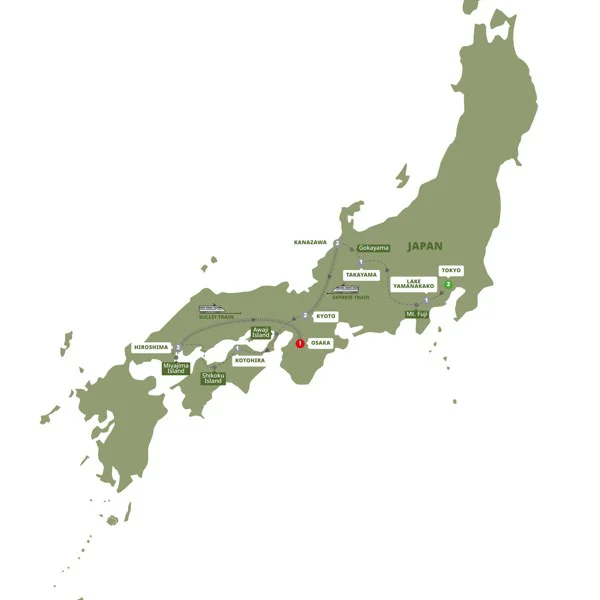
Your itinerary
Day 1
Day 1: Konnichiwa Tokyo
Your in-depth exploration of Japan begins in Tokyo. On arrival at Narita or Haneda Airport, take a shuttle bus transfer to your centrally located hotel, where you’ll join your Travel Director and fellow guests for a drink and local appetisers.
Day 2
Day 2: Explore Vibrant Tokyo
Begin your city tour in Asakusa, Tokyo’s historic entertainment district, where you’ll encounter the Sensoji Buddhist Temple, one of the city’s most colourful and popular temples. Founded in 628 and rebuilt many times over the centuries, Sensoji is Tokyo’s oldest temple site. Next, stroll down Nakamise Street and immerse yourself in the sights and sounds of Shitamachi (downtown Tokyo), admiring the wooden dolls, colourful chiyogami (origami paper) and traditional Japanese sweets. Ascend Tokyo Skytree, the world’s tallest free-standing broadcasting tower, for panoramic views of the city skyline. End the day with a stroll around Ginza, Tokyo’s famous shopping district or join an Optional Experience to explore Shinjuku by night with your Travel Director.
Meals: Breakfast
Day 3
Day 3: Off to the Five Lakes District
Start your day at the Imperial Palace Plaza, where you’ll view the two bridges leading to the palace’s inner grounds. Walk through the East Gardens, a peaceful space once part of the original Edo Castle. At the Tokyo National Museum, take time to browse the country’s oldest collection of Japanese art. Then, join a sushi chef to learn how to prepare this iconic dish. Head into the Fuji Five Lakes District and look out for Mt. Fuji dominating the horizon. In the small village of Oshino Hakkai, discover eight clear spring‑fed ponds—registered as a component of the Mount Fuji UNESCO World Heritage site—and see how snowmelt from Mt. Fuji supports rural life in this scenic part of Japan.
Meals: Breakfast,Lunch,Dinner
Day 4
Day 4: Majestic Mt. Fuji and Timeless Takayama
Journey up Mt. Fuji by road to the 5th Station, sitting 2,300 m (7,546 ft) above sea level. From here, take in sweeping views over Lake Kawaguchiko and the surrounding peaks before travelling through the scenic landscapes of the Japanese Alps to Takayama, a hillside town known for its traditional streets and mountain setting. Tonight, settle into your hotel where you’ll sit down to dinner together.
Meals: Breakfast,Dinner
Day 5
Day 5: Experience Gokayama and on to Kanazawa
Immerse yourself in tradition as you walk through the Edo-style streets of Takayama’s Old Town. Indulge a lunch of Japanese Hida-gyu – beef from a black-haired Japanese cattle breed, renowned as one of the finest quality varieties of beef. Journey back in time this afternoon during a visit to the peaceful UNESCO-listed Gokayama, a mountain village set amidst five valleys. Admire the unique construction of the local Gassho-zukuri wooden houses that have been built without the use of nails with steeply sloped thatched roofs to prevent snow from building up on them. Meet with a local family in one of these houses. Observe local artisans making washi paper and try your hand at making your own. Make a difference to the sustainability of this small business during MAKE TRAVEL MATTER® Experience. Stay overnight in Kanazawa.
Meals: Breakfast,Lunch
Day 6
Day 6: Traditional Kanazawa
Join a Local Specialist this morning to learn about gold leaf painting, a delicate craft practised in Japan since the 16th century. Continue to Kenroku-en, one of Japan’s most celebrated gardens, shaped over more than 100 years with ponds, bridges and planted landscapes. Here, you may choose an Optional Experience to try on a traditional kimono for a photo in the garden. Later, explore Omicho Market, where seafood stalls reflect Kanazawa’s coastal setting, before stepping into the Nagamachi District to see preserved samurai houses and visit Nomura House.
Meals: Breakfast
Day 7
Day 7: Onwards to Kyoto
Board an express train to Kyoto, Japan’s cultural capital. Begin your visit with a walking tour through the Gion district, known for its wooden machiya townhouses and long-standing geisha traditions. Then visit the UNESCO-listed Kinkakuji Temple. Set in peaceful gardens beside a reflective pond, this Zen temple is best known for the Kinkaku, or Golden Pavilion — once a 14th-century villa and now one of Kyoto’s most recognizable landmarks.
Meals: Breakfast
Day 8
Day 8: Discover Enchanting Kyoto
The blazing orange torii gates of Fushimi Inari Shrine guide your path through the forest, up into the mountains and to a sacred site that has heard prayers for prosperity and happiness since the 8th century. Continue to Sanjusangen-do Hall and admire the intricate detail of its 1,001 statues of the “thousand-handed” goddesses of mercy. Later, Connect with Locals at a traditional restaurant on your Be My Guest experience. Learn about local Japanese customs from your hosts over a shared meal. This evening, enjoy dinner with your Travel Director and fellow travellers.
Meals: Breakfast,Lunch,Dinner
Day 9
Day 9: Cross the Seto Inland Sea to Awaji Island
This morning, leave Japan’s main island Honshu behind as you cross the world’s largest suspension bridge over the Seto Inland Sea to Awaji Island. Enjoy free time for lunch, then take a walk around Yumebutai, a complex of buildings built on the side of the mountain. One of the most striking features is the ‘100 Stepped Garden’ — a group of 100 flowerbeds in small square gardens arranged in grids across several levels on an incline. Visit the Water Temple and admire the reflection of the surrounding mountains, rice paddies and bamboo groves as you descend the steps to the Buddhist temple beneath its still waters. Journey to the small mountain hot springs village of Kotohira, where tonight’s accommodation is one of Trafalgar’s Stays With Stories – a traditional Japanese ryokan. You’ll have time this evening to climb the steps adjacent to the hotel to visit Kotohira-gu Shrine and enjoy breathtaking views of the countryside. Later, perhaps unwind with a relaxing soak in the onsen (hot spring) bath at the hotel.
Meals: Breakfast,Dinner
Day 10
Day 10: Spiritual Kotohira and Onwards to Hiroshima
This morning visit the Zentsuji Temple, the birthplace of one of the most revered figures of Japanese Buddhism, the high priest Kobo Daishi. It is the 75th temple on the 88-temple Shikoku Pilgrimage, a spiritual journey covering approximately 1,200 kilometres, traditionally completed on foot over 60 days. Today, many pilgrims undertake the route, though modern methods includes cars, taxis, buses, bicycles and motorcycles. Continue to Ōshima Island and stop at a local restaurant for lunch. Then, drive to Hiroshima via the scenic Setouchi Shimanami Kaido Expressway, a 60-kilometre highway that links the islands of the Seto Inland Sea with nine individual bridges. Check into your hotel for a relaxing evening.
Meals: Breakfast,Lunch
Day 11
Day 11: Set Sail for Miyajima Island
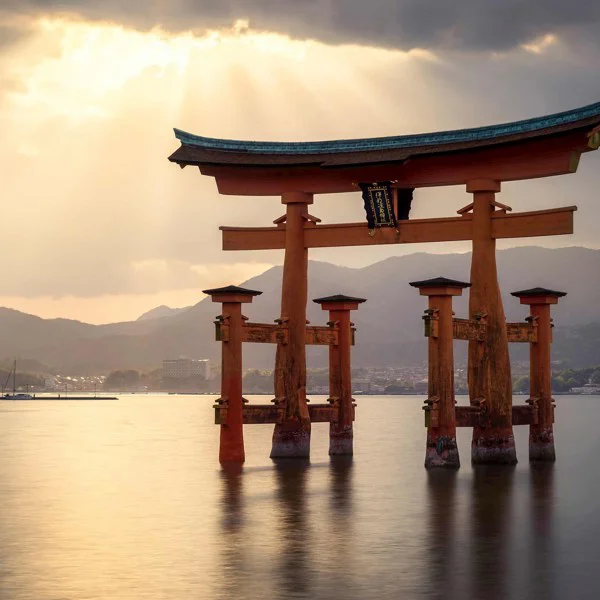
Travel by ferry to the sacred Miyajima Island, where you’ll see the UNESCO-listed Itsukushima Shrine and admire its iconic torii gate, which stands majestically in the sea. After some free time for lunch and to explore the island’s spiritual sanctuaries, return to Hiroshima for a visit to the Peace Memorial Park and Museum. Imagine the devastation and horror that followed the world’s first atomic explosion in 1945 as you see the UNESCO-listed Peace Memorial, the only structure left standing in the area, now a powerful symbol of hope for world peace. This evening, indulge in Hiroshima-style okonomiyaki, a savoury pancake made with egg, cabbage, soba noodles, and meat, seafood or cheese, grilled in layers on a hot plate.
Meals: Breakfast,Dinner
Day 12
Day 12: High Speed Bullet Train to Osaka
Board the high-speed bullet train to Osaka this morning and enjoy some free time for lunch and shopping in the Dotonbori Street area. Visit Osaka Castle, a historic landmark that played a major role in the unification of Japan during the 16th century. This evening, join your Travel Director and fellow guests for dinner at a local restaurant, celebrating the memories made during your journey.
Meals: Breakfast,Dinner
Day 13
Day 13: Departure from Osaka
Your encounter with Japan’s age-old traditions and modern cityscapes comes to an end, take a transfer by airport shuttle service to Kansai International Airport or Osaka Itami Airport for your onward flight.
Meals: Breakfast
What’s included
What’s not included
Additional information
Dining Summary
- 12 Breakfast (B)
- 4 Lunch (L)
- 6 Dinner (D)
Iconic Experience
- Tokyo: Explore Tokyo’s oldest temple, Sensoji, in the historic Asakusa district. Wander through Nakamise Arcade, lined with traditional treats and crafts, before arriving at the main hall, a symbol of faith, resilience and local spirit.
- Tokyo: Rise above the skyline at Tokyo Skytree, the tallest structure in Japan. From its observation deck, you’ll take in panoramic views of the city, from Mount Fuji to Tokyo Bay. It’s a modern marvel and an unforgettable moment that will leave you awestruck.
- Ginza: With the guidance of your professional sushi chef, make your own selection of sushi specialities. Afterwards enjoy the fruits of your labour with a delicious lunch.
- Tokyo: Visit the Tokyo National Museum to browse collections of Japanese art and archaeological objects.
- Mt Fuji: Admire the stunning countryside at Mt. Fuji 5th Station.
- Gokayama: Take some time to admire the peaceful mountain village of Gokayama. Discover their unique homes that have been built without the use of nails and their sloped thatched roofs.
- Kanazawa: Learn about the delicacy of the 16th-century craft gold leaf painting with your Local Specialist.
- Kanazawa: Step back in time at the Nomura Samurai House, once home to a respected warrior family. Explore its gardens, traditional architecture and treasured artefacts. You’ll learn about samurai life and honour in feudal Japan with a rare glimpse into the elegance of Edo-period craftsmanship.
- Kyoto: Admire the beautiful golden pavilion of Kinkakuji Temple.
- Kotohira: Bask in the breath-taking views as we visit Kotohiragu Shrine.
- Hiroshima: Admire the islands of the Seto Inland Sea as you travel across the Shimanami Kaido Expressway.
- Hiroshima: Spend some time admiring the majestic Itsukushima Shrine.
- Hiroshima: Discover the rich history when you visit the Peace Memorial Museum and Park.
- Hiroshima: Sample the famous Hiroshima style okonomiyaki.
- Osaka: Discover another side of Osaka in Dotonbori, a lively entertainment district known for its theatres and street food. You’ll walk the main strip before turning into Hozenji Yokocho, a stone-paved alley lined with traditional eateries leading to a small temple where locals splash water over a moss-covered statue for good luck. You may also wish to pause at one of the nearby street stalls to try takoyaki — Osaka’s famous octopus snack, said to have originated here.
- Osaka Castle: Visit Osaka Castle, built by Toyotomi Hideyoshi, a powerful samurai leader who unified Japan for the first time in 1590.
Miyajima Ferry & Itsukushima Shrine
Cross the Seto Inland Sea by ferry to Miyajima, gliding toward the vermilion silhouette of the floating torii gate. Deer wander the lanes as mountain and sea meet in a scene long celebrated in poetry and print.
Visit Itsukushima Shrine, a UNESCO site whose pier-like halls appear to hover at high tide. Shinto ritual, cypress bark roofs and mirror-calm waters combine in an unforgettable expression of sacred nature.
Hiroshima Peace Memorial Park & Museum
Reflect at the Hiroshima Peace Memorial Museum and walk the surrounding park to the A-Bomb Dome (Genbaku Dome), preserved as a stark witness. Monuments, flame and fountains shape a landscape of remembrance and resolve.
Paper cranes, survivor testimony and everyday artifacts connect global history to human stories. Pause at the Children’s Peace Monument and let the river’s slow current carry your thoughts toward hope.
How You'll Travel
- Selected hotel dinners plus a locally hosted meal
- 4-star stays
- Deluxe coach and train travel
Tokyo Skytree Observation Deck
Ascend the 634-metre tower to ascend Tokyo Skytree and take in panoramic views that sweep from the Sumida River to Tokyo Bay and, on clear days, Mount Fuji. Transparent floor panels and wraparound windows place the world’s largest city at your feet.
Set in the traditional shitamachi east of the city, Skytree fuses engineering prowess with poetic skyline drama. Watch the arterial expressways glow, trace temple roofs below, and feel the quiet hush that only height can bring above the city’s bright hum.
Imperial Palace East Gardens & Tokyo National Museum
Stroll the Imperial Palace East Gardens, where moats, stone ramparts and broad lawns hint at the might of old Edo. Pass remnants of keeps and gates that guarded the Edo Castle ruins, now a tranquil green lung at the city’s heart.
Continue to the Tokyo National Museum in Ueno Park to encounter swords, lacquerware and Buddhist sculpture spanning millennia. Curated galleries reveal Japan’s artistic lineage—from Haniwa clay figures to silk screens—set within a serene, scholarly atmosphere.
Mount Fuji 5th Station & Oshino Hakkai Springs
Travel into the foothills to pause at the Mount Fuji 5th Station (2,300 m), where cool alpine air and sweeping views open over the Five Lakes and Japan’s most revered peak. Trail shrines and souvenir huts underline Fuji’s role as sacred mountain and cultural muse.
Descend to the crystal-clear ponds of Oshino Hakkai, spring-fed from ancient snowmelt and a registered component of Fuji’s UNESCO listing. Timber waterwheels, thatched farmhouses and koi-dappled pools reveal how the volcano’s lifeblood nourishes rural life.
Takayama Old Town Walk & Hida-gyu Tasting Lunch
Walk Takayama’s Old Town along the Sanmachi-suji streets, where dark-latticed merchant houses, sake breweries and hanging sugidama cedar balls preserve Edo-era rhythms. Lanterns, timber beams and mountain air frame a town famed for refined carpentry and seasonal festivals.
Then savour a regional specialty: Hida-gyu beef, prized for its marbling and delicate sweetness. Tasted in simple, precise preparations, it captures the alpine terroir of Gifu and the understated artistry of Japanese cuisine.
Gokayama Heritage Village & Washi Paper Workshop (MAKE TRAVEL MATTER)
Step into the UNESCO-listed Gokayama valleys to see steep thatched gassho-zukuri farmhouses, their hands-pressed roofs engineered to shed heavy snow. Meet a local family and hear how communal traditions have sustained mountain life for centuries.
Try your hand at traditional washi papermaking in a small, family-run workshop. Your visit is a MAKE TRAVEL MATTER experience that helps safeguard artisanal livelihoods and supports UN SDG 11—keeping culture and craftsmanship alive in resilient rural communities.
Kanazawa Gold Leaf Craft Demonstration
Discover the finesse of gold leaf in a city that produces the vast majority of Japan’s supply. Watch artisans beat precious metal into sheets thinner than a breath and learn how the craft flourished in Kanazawa since the 16th-century craft guilds.
From tea ceremony implements to temple ornamentation, gold leaf lends a quiet glow to daily life. Observe burnishing, cutting and application techniques that transform fragile film into durable, luminous artistry.
Kenrokuen Garden Stroll
Wander Kenrokuen Garden, famed for embodying the Six Attributes of a Perfect Garden: spaciousness, seclusion, artifice, antiquity, watercourses and panoramas. Curved bridges, stone lanterns and teahouses frame reflections on Kasumigaike Pond.
Seasonal highlights—plum blossom, irises, fiery maples, snow-laced pines—reveal meticulous design shaped over centuries by the Maeda lords. Each path reveals a new perspective, composed like a scroll painting in living color.
Nagamachi Samurai Quarter & Nomura House
Explore the earthen walls and narrow lanes of the Nagamachi Samurai District, once home to Kaga domain retainers. Step inside the Nomura Samurai House to see heirloom swords, lacquerware and a jewel-box courtyard garden.
Tatami rooms, a tokonoma alcove and shoji screens evoke feudal aesthetics and codes of etiquette. The quiet harmony of stone, water and maple leaves offers a contemplative counterpoint to the samurai’s disciplined life.
Omicho Market Food Walk
Sample Kanazawa’s coastal bounty at Omicho Market, an Edo-era marketplace where stalls brim with snow crab and sashimi, gleaming amberfish and seasonal produce. Vendors call, blades flash, and steam rises from counters serving warm bites.
Learn how the Sea of Japan shapes local cuisine and pick up tips on regional specialties—from marinated nodoguro to sweet gold-leaf–topped treats—before pausing for a quick taste amid the buzz.
Kyoto Gion District Walk & Kinkaku-ji Golden Pavilion
Walk the latticed lanes of the Gion District, where wooden machiya townhouses shelter teahouses tied to geiko and maiko traditions. Lanterns flicker, geta clack on stone, and the fragrance of roasted tea drifts from quiet doorways.
Continue to Kinkaku-ji (Golden Pavilion), its gold leaf shimmering over a mirror-like pond. Once the villa of shogun Ashikaga Yoshimitsu, this Zen temple distills Muromachi aesthetics into elegant, reflective harmony.
Fushimi Inari Torii Trail & Sanjusangen-do Hall
Follow thousands of vermilion gates on the Fushimi Inari Shrine trails, winding through cedar-clad slopes guarded by fox statues, messengers of the rice deity. The rhythmic arc of thousands of vermilion torii creates a meditative path through forest light.
Enter Sanjusangen-do Hall to face a shimmering army of 1,001 gilded Kannon statues. The hall’s long, dim nave and intricate wooden sculpture invite quiet reflection on devotion and craftsmanship.
Be My Guest: Kaiseki Lunch with the Nakamura Family
Connect over a Be My Guest experience in Kyoto, sharing a seasonal kaiseki lunch that balances taste, texture and presentation across artful courses. Dashi broth, mountain vegetables and pristine seafood showcase the subtleties of washoku.
Meet the hosts—meet the Nakamura family—to learn dining customs, from bowing etiquette to the meaning of each courseware piece. Stories of seasonal festivals and hometown flavors turn a meal into cultural exchange.
Awaji Island Architecture: Yumebutai & Water Temple
Walk the terraced Yumebutai complex, where Tadao Ando sculpted a hillside into courtyards and the photogenic 100 Stepped Garden. Squares of seasonal flowers form living pixels that tumble toward the sea.
Descend into Tadao Ando’s Water Temple at Honpukuji, where a serene reflecting pool crowns an underground sanctuary. Concrete, light and lotus leaves orchestrate silence—an elegant dialogue between modern design and Buddhist devotion.
Traditional Ryokan Onsen Stay & Kotohira-gu Shrine
Experience a traditional ryokan stay in Kotohira: slip into a yukata, pad across tatami, and soak in an onsen as mineral-rich waters ease travel-weary muscles. Low tables, seasonal dishes and quiet courtyards complete the ritual.
Climb the stone steps to Kotohira-gu Shrine (Konpira-san), a pilgrimage site with sweeping countryside views. Lanterns, guardian lions and cypress beams underscore centuries of maritime devotion and mountain faith.
Zentsuji Temple Visit & Shimanami Kaido Scenic Drive
Visit Zentsuji Temple, birthplace of Kobo Daishi (Kukai), founder of Shingon Buddhism. Temple halls, pagodas and pilgrim pathways reveal a living chapter of the 88-temple Shikoku route.
Continue across the Setouchi Shimanami Kaido, a chain of bridges linking islands over misty straits. Pause for photos as island-dotted seascapes, fishing boats and citrus groves unfold beneath sweeping steel spans.
Hiroshima-style Okonomiyaki Dinner
Taste Hiroshima-style okonomiyaki, a savory pancake layered with cabbage, yakisoba noodles, egg and your choice of fillings, seared on a sizzling teppan griddle. Watch the rhythmic spatula work as sauces glaze and aromas rise.
This convivial specialty contrasts with Osaka’s mixed batter version, revealing regional character in flavor and technique. Pull up a counter stool, trade smiles with the chef and enjoy a delicious slice of local life.
Osaka Castle Visit
Visit Osaka Castle, rebuilt to its 16th-century grandeur with soaring white keeps and green copper roofs. Exhibits trace the rise of Toyotomi Hideyoshi and the castle’s pivotal role in unifying Japan.
Climb to the observation deck for views over moats, stone ramparts and the surrounding park—particularly striking in cherry blossom and autumn maple seasons.
Sushi-Making with a Professional Chef
Roll, press and season under expert guidance as you learn sushi-making with a professional chef. From vinegared rice to knife work, discover the balance that defines nigiri and maki, then savor the results for lunch.
Along the way, hear how Edo-style techniques evolved with access to Tokyo Bay, and why wasabi, soy and rice temperature matter. It’s a delicious window into culinary precision and pride.
Shinjuku by Night (Optional)
Join your Travel Director to explore Shinjuku by night, where neon canyons and backstreet lanterns reveal Tokyo’s after-dark personality. Thread past the pocket bars of Golden Gai alleyways and the bright marquees of Kabukicho.
Hear local stories, learn izakaya etiquette and soak up the buzz of ramen steam and jazz riffs. This experience is at additional cost and bookable on tour.
Kimono Dress-Up Photo Session in Kenrokuen (Optional)
Embrace elegance with a kimono dress-up experience, as attendants wrap you in silk layers and tie the obi sash just so. Pose for a photo in Kenrokuen, where bridges, lanterns and pines frame timeless portraits.
Learn the symbolism of colors and seasonal motifs and feel how posture changes with traditional attire. This experience is at additional cost and bookable on tour.
Asakusa Senso-ji Temple & Nakamise Street
Explore the temple quarter of Asakusa and step beneath the vermilion lantern of the Kaminarimon Gate to reach Asakusa’s Senso-ji Temple, Tokyo’s oldest Buddhist site. Offer incense at the main hall and absorb the hum of prayers, shopkeepers’ calls, and the gentle clang of bells that animate this storied sanctuary.
Wander the Nakamise Shopping Street, a centuries-old market of artisanal sweets, fans and handcrafts that channels living Shitamachi culture. This is where Tokyo’s past lingers in wood, paper and spice, framed by pagodas and fluttering good-luck charms.
Operated By
Trafalgar
Dotonbori and Hozenji Yokocho Evening Walk
Stroll the neon canal of Dotonbori, where giant signs, theaters and the Glico running man light Osaka’s exuberant heart. Street vendors sizzle takoyaki, lanterns glow, and laughter spills from izakaya doors.
Slip into Hozenji Yokocho, a stone-paved alley of traditional eateries leading to a moss-covered deity bathed in ladles of water. The shift from spectacle to stillness captures the city’s soulful, savory contrasts.