Your itinerary
Day 1
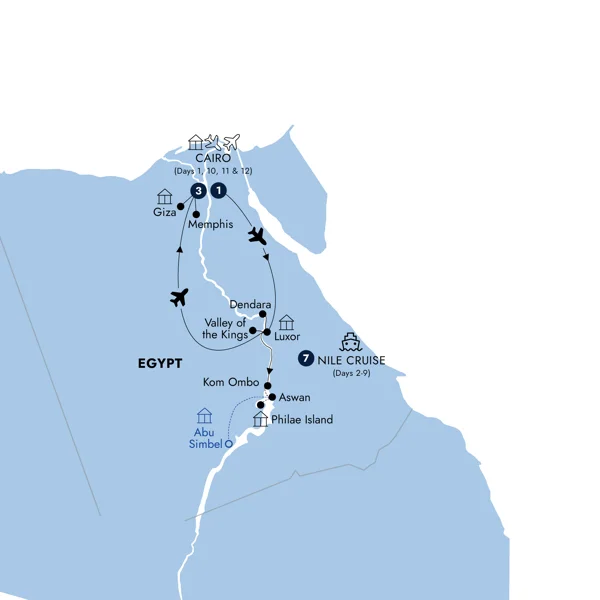
Day 1: Arrive in Cairo
Arrive at Cairo Airport and transfer to your hotel. Time to unwind and explore the hotel, followed by a welcome drink with your Travel Director and fellow travellers.
Day 2
Day 2: Fly to Luxor, Cruise the Nile
Fly to Luxor in the morning and visit the Karnak temple complex, including the avenue of ram-headed sphinxes and the Hypostyle Hall. Transfer to your cruise ship, your home for the next seven nights. After lunch on board, visit the Luxor Museum. Dinner on the ship.
Meals: Breakfast,Lunch,Dinner
Day 3
Day 3: Exploring Dendera and on to Edfu
Visit the Temple of Hathor in Dendera, which features a depiction of Cleopatra and her son Caesarion. At lunchtime, return to the ship and travel through the Esna Lock to Edfu.
Meals: Breakfast,Lunch,Dinner
Day 4
Day 4: Edfu to Aswan
Cruise along the Nile to Kom Ombo, then continue to Aswan. Choose an Egyptian cooking demonstration or tea with the Captain for your Insight Choice experience. In the evening, enjoy an Egyptian dinner and galabeya party.
Meals: Breakfast,Lunch,Dinner
Day 5
Day 5: Aswan’s High Dam and Temple of Isis
Visit Aswan’s High Dam and granite quarries to see the unfinished obelisk. Travel by motorboat to the Temple of Isis on Philae Island and hear stories of the Nile flood and the goddesses Isis and Hathor in a Roman-style theatre. The rest of the day is free to enjoy the cruise ship’s facilities.
Meals: Breakfast,Lunch,Dinner
Day 6
Day 6: Feluccas and High Tea
Explore the Nile aboard a traditional felucca and meet a local sailor who shares the history and techniques of navigating the boat. Visit a local women’s co-op on a MAKE TRAVEL MATTER® Experience and see how scrap materials are turned into handicrafts. At sunset, enjoy high tea at the Old Cataract Hotel. End the day with a Sound and Light Show at Philae Island.
Meals: Breakfast,Lunch,Dinner
Day 7
Day 7: Free Time and on to Kom Ombo
The morning is free, with an optional experience to Abu Simbel. Later, sail to Kom Ombo and visit Egypt’s only double temple, dedicated to Sobek and Horus the Elder.
Meals: Breakfast,Lunch,Dinner
Day 8
Day 8: Cruising the Nile to Luxor
Continue cruising along the Nile to Luxor. Enjoy the facilities on board and the sights along the river. In the evening, visit Luxor Temple; the ship docks there for the night.
Meals: Breakfast,Lunch,Dinner
Day 9
Day 9: Explore Luxor and fly to Cairo
Disembark and travel by coach to the west bank of the Nile. Visit the Temple of Hatshepsut and the Valley of the Kings. In Geziret Bahirat, share bread with a local family and hear stories of daily life. Transfer to the airport for your return flight to Cairo.
Meals: Breakfast
Day 10
Day 10: Cairo Sightseeing
Ascend to the Citadel for views over the city and visit the Alabaster Mosque, also known as the Great Mosque of Muhammad Ali Pasha. Continue to the Grand Egyptian Museum to see its collection of ancient artefacts, including the treasures of Tutankhamun.
Meals: Breakfast
Day 11
Day 11: Cairo and the Pyramids of Giza
Visit Memphis to see the statue of Ramses II and the Great Alabaster Sphinx. Continue to Sakkara to view the Step Pyramid of King Zoser. In the afternoon, travel to Giza to see the Sphinx. At the hotel, share canapés and a drink with your Travel Director and fellow travellers.
Meals: Breakfast
Day 12
Day 12: Depart Cairo
Transfer to Cairo International Airport.
Meals: Breakfast
What’s included
What’s not included
Additional information
Dining Summary
- 11 Breakfast (B)
- 7 Lunch (L)
- 7 Dinner (D)
- 1 Afternoon Tea (AT)
Insight Experiences
- Luxor: Enjoy listening to stories of village life from local residents, when you visit a family home for a tasting of authentic Egyptian sun bread.
Travel Director
- “Koshari is our national dish, and it never disappoints. Believed to have originated in the 19th century, this vegetarian street food staple is made of rice, pasta, lentils, and chickpeas, topped with delicious fried onions and a spicy tomato-based garlic sauce.”
- “I love to share our Ancient Egyptian civilization and history with our guests and to explain all the details and stories related to Egyptian mythology so our guests can enjoy a very special guided vacation.”
- “The Abu Simbel Temples are utterly unique in scale, architecture, art and history. From one of the most prominent eras of Ancient Egyptian history, these magnificent structures emphasise how persistent and clever ancient Egyptian architects were to carve a mountain to make such incredible tributes for Egyptian deities.”
Temple of Hathor at Dendera
Visit the Temple of Hathor at Dendera, one of Egypt’s best-preserved temple buildings. Examine its carved columns and reliefs, including a rare depiction of Cleopatra and her son Caesarion.
Dedicated to Hathor, a goddess associated with music, motherhood and joy, the temple preserves richly detailed decoration from the late Ptolemaic and Roman periods. Its surviving chambers make the symbolism of an ancient sanctuary unusually tangible.
Whats Included NOT IN USE
- Hand sanitizer is freely available on board for you to use throughout the day.
Operated By
Insight Vacations
Cairo Welcome Drink
Meet your Travel Director and fellow travellers over a welcome drink in Cairo. This hosted gathering offers a chance to get acquainted and ask questions about the journey ahead.
As conversation turns to the Nile, ancient temples and the pyramids, share the anticipation of exploring Egypt with a group of like-minded travellers. The relaxed setting makes this a social introduction rather than a formal sightseeing stop.
Karnak Temple Complex
Explore Karnak Temple Complex in Luxor with an Egyptologist. Walk past ram-headed sphinxes and stand among the towering columns of the Great Hypostyle Hall, where carved reliefs record the ambitions of successive pharaohs.
Developed over many centuries, Karnak was a major centre of worship for Amun. Its enormous courts, obelisks and ceremonial spaces reveal the scale of religious life in ancient Thebes.
Luxor Museum
Visit Luxor Museum to examine ancient artefacts in a collection closely connected to the temples and tombs of the surrounding region. Its carefully displayed objects offer a more intimate view of Egyptian craftsmanship.
Set beside the Nile, the museum provides context for the monuments of ancient Thebes. Look beyond their monumental scale to consider the beliefs, artistry and everyday skills of the people who created them.
Nile Cruise
Cruise the Nile aboard a river ship, watching palm-lined banks, riverside settlements and working boats from the deck. The voyage links the temple cities of Luxor and Aswan, including passage through the Esna Lock.
Egypt’s river has sustained farming, trade and travel for millennia. Seeing its changing banks from the water brings that enduring connection into focus, while the slower pace offers a distinctive perspective on life beyond the archaeological sites.
Egyptian Cooking Demonstration — Insight Choice
Join an Egyptian cooking demonstration with the onboard chef during your time in Aswan. Watch local ingredients and techniques come together, and learn about flavours that appear in Egyptian home cooking.
This is one of two Insight Choice activities: select it instead of the Captain’s quarters visit. The close-up demonstration offers a culinary perspective on Egypt alongside the tour’s temples and river scenery.
Captain’s Quarters Visit — Insight Choice
Visit the Captain’s quarters aboard the Nile cruise ship and hear how the vessel is navigated along the river. Learn about the practical knowledge involved in sailing and how experience has been passed between generations.
This is one of two Insight Choice activities: select it instead of the Egyptian cooking demonstration. The visit offers a behind-the-scenes look at the people and skills that make river travel possible.
Egyptian Dinner & Galabeya Party
Experience an Egyptian dinner and galabeya party aboard the Nile cruise ship. Learn about the galabeya, a loose-fitting garment worn in Egypt, while sharing an evening centred on local dress and conviviality.
The gathering adds a social dimension to the voyage: a chance to enjoy Egyptian food and celebrate with fellow travellers. Its focus on clothing and custom makes it more than a standard onboard dinner.
Aswan High Dam & Unfinished Obelisk
Visit Aswan High Dam and the nearby granite quarries to see the enormous Unfinished Obelisk, still attached to the bedrock from which ancient stoneworkers began to carve it.
The two sites reveal different eras of Egyptian engineering. The dam transformed the Nile’s flow in the 20th century; the abandoned obelisk offers a close look at how ancient builders worked the granite used in monumental construction.
Temple of Isis at Philae
Travel by motorboat to visit the Temple of Isis at Philae, an island sanctuary surrounded by Nile waters near Aswan. Explore its courts, columns and reliefs while learning about the goddess Isis and her place in Egyptian belief.
The temple complex was carefully relocated when the construction of the Aswan dams threatened its original island setting. Its preserved stonework and waterside approach make the visit both an encounter with ancient religion and a story of modern conservation.
Traditional Felucca Sailing in Aswan
Sail aboard a traditional felucca on the Nile at Aswan and meet a local sailor. Hear how these boats are navigated and discover the techniques behind a form of river travel long associated with Egypt.
From the water, take in Aswan’s riverbanks and the movement of other vessels. The sailor’s perspective turns a scenic outing into a closer look at a living Nile tradition.
Aswan Women’s Co-operative Visit
Meet the women of a local co-operative in Aswan and see how discarded and natural materials, including palm and bamboo, are transformed into handicrafts. Hear about the skills the members develop and the work they create.
The women-owned organisation supports participants seeking greater financial independence and a sense of community. This MAKE TRAVEL MATTER® visit offers a direct connection with local makers and their efforts to reduce waste.
High Tea at the Old Cataract Hotel
Enjoy high tea at Aswan’s Old Cataract Hotel as the light softens over the Nile. Settle into the historic hotel for an afternoon-tea experience associated with travellers such as Agatha Christie and Sir Winston Churchill.
Overlooking the river, the hotel has long been part of Aswan’s travel history. Its elegant setting and sunset views offer a distinctive pause amid visits to ancient sites and time aboard the cruise ship.
Philae Sound and Light Show
Watch the Sound and Light Show at Philae as illumination brings the temple’s carved facade into focus after dark. The presentation recounts tales of Isis, Hathor and the Nile’s sacred floods against the island sanctuary’s ancient stonework.
Reached by boat, Philae has a different atmosphere at night. Light, narration and the surrounding water create a theatrical interpretation of the myths associated with this temple complex.
Kom Ombo Temple
Explore Kom Ombo Temple beside the Nile, a distinctive double temple with parallel spaces dedicated to Sobek, the crocodile-headed god, and Horus the Elder, represented as a falcon.
Look for the symmetry of its design and the carved reliefs that express each cult’s traditions. The riverside setting reinforces the connection between ancient worship and the Nile landscape on which surrounding communities depended.
Luxor Temple
Visit Luxor Temple on the east bank of the Nile and step through a monumental complex shaped by pharaohs including Amenhotep III and Ramses II. Look up at the surviving pylon and explore its courts and columns.
Unlike many ancient sanctuaries, Luxor Temple sits within the modern city. Its layered history and imposing stonework reveal how ancient Thebes remains woven into the streets and daily life of Luxor.
Valley of the Kings
Explore the Valley of the Kings with an Egyptologist on Luxor’s west bank. Visit this royal burial ground, where pharaohs of the New Kingdom were laid to rest in tombs cut deep into the desert hills.
The valley is closely associated with Tutankhamun, whose tomb was discovered here in 1922. Its painted burial chambers and secluded landscape illuminate ancient Egyptian beliefs about death and the afterlife.
Mortuary Temple of Hatshepsut
Visit the Mortuary Temple of Hatshepsut at Deir el-Bahari with an Egyptologist. See its broad terraces and colonnades set against the steep limestone cliffs of Luxor’s west bank.
Built for one of ancient Egypt’s most prominent female pharaohs, the temple commemorated her reign and served her royal cult. Its architecture uses the dramatic desert setting as part of the monument’s design.
Colossi of Memnon
See the Colossi of Memnon, two immense seated statues standing on Luxor’s west bank. Pause to appreciate their scale and the weathered detail of monuments that have remained in place for thousands of years.
The figures once guarded the entrance to the mortuary temple of Amenhotep III. Although much of that complex has disappeared, the statues still mark the pharaoh’s ambition and the ceremonial landscape of ancient Thebes.
Bread Sharing with a Family in Geziret Bahirat
Visit a family in Geziret Bahirat near Luxor to share Egyptian sun bread and hear stories of village life. The hosted encounter brings conversation and local hospitality into focus.
Listen to residents describe everyday routines and traditions in their own words. Sharing bread in a family setting offers a personal perspective on contemporary Egypt, distinct from the royal histories told at Luxor’s temples and tombs.
Cairo Citadel & Alabaster Mosque
Ascend to Cairo’s Citadel for wide views across the city and visit the Great Mosque of Muhammad Ali Pasha, often called the Alabaster Mosque. Explore its domed interior with your Egyptologist.
The hilltop fortress has shaped Cairo’s history since the medieval period, while the mosque reflects the ambitions of Muhammad Ali, a pivotal figure in modern Egypt. Together, they offer a view of the city’s Islamic heritage.
Grand Egyptian Museum
Explore the Grand Egyptian Museum near Giza with an Egyptologist. Encounter treasures from Tutankhamun’s tomb and stand before a colossal statue of Ramses II among the museum’s extensive ancient Egyptian collections.
Displays spanning thousands of years place celebrated royal objects alongside evidence of art, belief and daily life. The museum’s setting near the pyramids gives its artefacts a powerful geographical connection to the civilisation that made them.
Ancient Memphis
Visit ancient Memphis, once a capital and major religious centre of Egypt. See its colossal statue of Ramses II and the Alabaster Sphinx among the surviving remains.
Memphis was closely tied to the rise of the Old Kingdom and held an important place in Egyptian political and cultural life. Its monuments offer a glimpse of a city whose former influence far exceeds what remains visible today.
Step Pyramid of Djoser at Saqqara
View the Step Pyramid of Djoser at Saqqara, the ancient necropolis associated with Memphis. Examine the tiered form that makes this early pyramid so different from the later monuments at Giza.
Built in the 27th century BC and associated with the architect Imhotep, it represents a landmark in large-scale stone construction. The surrounding funerary complex reveals how royal tomb design developed over time.
Pyramids of Giza & the Great Sphinx
Explore the Pyramids of Giza with an Egyptologist and meet the Great Sphinx on the edge of the desert. See the monumental tombs built for Old Kingdom pharaohs and hear how they formed part of larger funerary complexes.
The Great Pyramid is the only surviving Wonder of the Ancient World. The experience also includes entry into one of the pyramids, offering a close encounter with its interior passages and chambers.
Papyrus-Making Demonstration
Visit a Papyrus Institute to see how papyrus reeds are prepared and pressed into a writing surface. Watch the steps of the craft and learn why the material became so important to ancient Egyptian record-keeping and art.
The demonstration connects the painted and written objects seen throughout Egypt with the plant from which their pages were made. It offers a practical counterpoint to the tour’s temples, tombs and museum collections.
Farewell Canapés & Drink in Cairo
Gather with your Travel Director and fellow travellers in Cairo for canapés and a drink. This hosted farewell offers space to share impressions of Egypt’s archaeological sites, Nile landscapes and local encounters.
Rather than a standard meal, it is a dedicated social occasion marking the group’s shared journey. Compare favourite discoveries and enjoy a final conversation in the company of the people who explored Egypt alongside you.
Abu Simbel Temples
Choose an optional excursion to Abu Simbel to see the Great Temple of Ramses II and the neighbouring Temple of Hathor, built for Queen Nefertari. Their monumental facades stand above Lake Nasser in southern Egypt.
The rock-cut temples were relocated in the 1960s to protect them from the lake’s rising waters, an extraordinary conservation effort. This experience is at additional cost and bookable on tour; transport and other arrangements are confirmed locally.
How You'll Travel
- Top-rated dining, from farm-to-table to local restaurants
- 4 & 5-star hotel and overnight cruise stays
- Business class coach with extended leg room, cruise travel and select flights