Your itinerary
Day 1
Day 1: Arrive in Cairo
Arrive at Cairo Airport and transfer to your hotel. Unwind and enjoy the hotel’s amenities. Later, meet your Travel Director and fellow travelers over a welcome drink.
Day 2
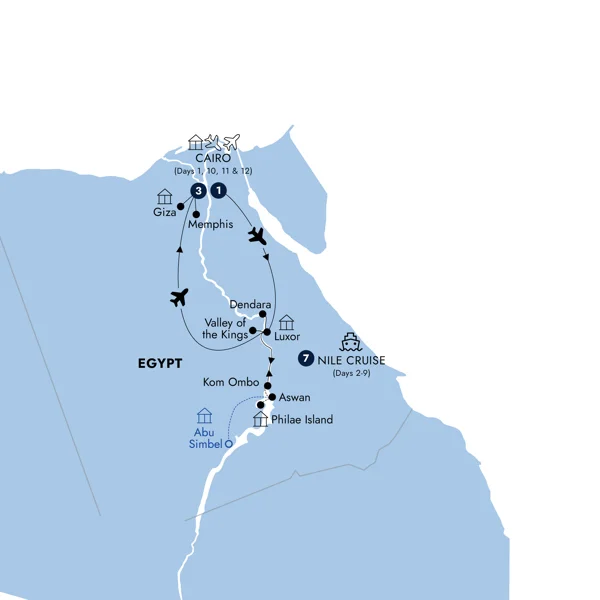
Day 2: Fly to Luxor, Cruise the Nile
Fly to Luxor and visit Karnak, including the avenue of ram-headed sphinxes and the columns of the Hypostyle Hall. Transfer to your cruise ship, your home for the next seven nights. Have lunch on board, then visit the Luxor Museum. Dinner is on the ship.
Meals: Breakfast,Lunch,Dinner
Day 3
Day 3: Exploring Dendera and on to Edfu
Visit the Temple of Hathor in Dendera, which features a depiction of Cleopatra and her son Caesarian. Return to the ship for lunch, then cruise through the Esna Lock en route to Edfu.
Meals: Breakfast,Lunch,Dinner
Day 4
Day 4: Edfu to Aswan
Cruise along the Nile to Kom Ombo, then continue to Aswan. In the evening, enjoy an Egyptian dinner and galabeya party.
Meals: Breakfast,Lunch,Dinner
Day 5
Day 5: Aswan’s High Dam & Temple of Isis
Visit Aswan’s High Dam and granite quarries to see the unfinished obelisk. Travel by motorboat to the Temple of Isis on Philae Island. The rest of the day is free to relax and enjoy the cruise ship’s facilities.
Meals: Breakfast,Lunch,Dinner
Day 6
Day 6: Feluccas and Sundowner
Sail on a traditional felucca and meet a local sailor who explains the boat’s history and sailing techniques. Visit a local women’s co-op, where scrap materials are made into handicrafts. Enjoy high tea at the Old Cataract Hotel, then attend the Sound and Light Show at Philae Island.
Meals: Breakfast,Lunch,Dinner
Day 7
Day 7: Free Time and on to Kom Ombo
The morning is free, with an optional excursion to Abu Simbel. Later, sail to Kom Ombo and visit its double temple, dedicated to Sobek and Horus the Elder.
Meals: Breakfast,Lunch,Dinner
Day 8
Day 8: Cruising the Nile to Luxor
Cruise to Luxor and enjoy the facilities on board. Take part in an Egyptian cooking class and prepare moussaka. In the evening, visit Luxor Temple; the ship docks there overnight.
Meals: Breakfast,Lunch,Dinner
Day 9
Day 9: Explore Luxor and fly to Cairo
Disembark and travel to the west bank of the Nile. Visit the Temple of Hatshepsut, the Valley of the Kings and the Valley of the Queens, including its tombs of royal family members. Transfer to the airport for your return flight to Cairo.
Meals: Breakfast
Day 10
Day 10: Cairo Sightseeing
Visit the Citadel for views over Cairo and see the Alabaster Mosque, also known as the Great Mosque of Muhammad Ali Pasha. Continue to the Grand Egyptian Museum to see its ancient artifacts, including the treasures of Tutankhamun.
Meals: Breakfast
Day 11
Day 11: Cairo and the Pyramids of Giza
Visit Memphis to see the statue of Ramses II and the Great Alabaster Sphinx. Continue to Sakkara to view the Step Pyramid of King Zoser. In the afternoon, travel to Giza to see the Sphinx. Later, meet your Travel Director and fellow travelers at the hotel for canapés and a drink.
Meals: Breakfast
Day 12
Day 12: Depart Cairo
Transfer to Cairo International Airport.
Meals: Breakfast
What’s included
What’s not included
Additional information
Egyptian Dinner & Galabeya Party
Join an Egyptian dinner and galabeya party aboard your Nile cruise ship. Learn about the loose-fitting galabeya, a garment worn in Egypt, while sharing an evening of food and celebration with your fellow travellers.
This hosted event offers a sociable introduction to local dress beyond the monuments and museums. The river setting and festive atmosphere make it a cultural experience in its own right, rather than a routine onboard meal.
Temple of Hathor at Dendera
Discover the Temple of Hathor at Dendera, one of Egypt’s best-preserved temple complexes. Examine its richly decorated columns and look for the rare relief depicting Cleopatra VII with her son Caesarion.
Dedicated to Hathor, a goddess associated with music, joy and motherhood, the temple preserves layers of late ancient Egyptian history. Its detailed ceilings and carved walls offer an unusually vivid sense of the imagery that once filled sacred spaces.
Kom Ombo Double Temple
Visit the Temple of Kom Ombo, an unusual riverside sanctuary laid out for two deities: the crocodile-headed Sobek and the falcon-headed Horus the Elder. Explore its paired spaces and carved reliefs with the Nile close by.
The temple’s mirrored design reflects its dual dedication, setting it apart from other stops on the cruise. Its inscriptions offer a window into religious beliefs and the practical concerns of communities living beside the river.
Aswan High Dam & Unfinished Obelisk
Visit the Aswan High Dam and ancient granite quarries to see two very different feats of Egyptian engineering. At the quarry, examine the enormous Unfinished Obelisk, still attached to the bedrock where its makers abandoned it.
The obelisk offers a rare glimpse of how ancient stoneworkers shaped monuments before transport. The dam, completed in the 20th century, transformed the Nile’s flow and created Lake Nasser, making this visit a striking comparison across eras.
Dining Summary
- 11 Breakfast (B)
- 7 Lunch (L)
- 7 Dinner (D)
- 1 Afternoon Tea (AT)
Whats Included NOT IN USE
- Hand sanitizer is freely available on board for you to use throughout the day.
Travel Director
- “Koshari is our national dish, and it never disappoints. Believed to have originated in the 19th century, this vegetarian street food staple is made of rice, pasta, lentils, and chickpeas, topped with delicious fried onions and a spicy tomato-based garlic sauce.”
- “I love to share our Ancient Egyptian civilization and history with our guests and to explain all the details and stories related to Egyptian mythology so our guests can enjoy a very special guided vacation.”
- “The Abu Simbel Temples are utterly unique in scale, architecture, art and history. From one of the most prominent eras of Ancient Egyptian history, these magnificent structures emphasise how persistent and clever ancient Egyptian architects were to carve a mountain to make such incredible tributes for Egyptian deities.”
Women-Only
- Aswan: Delve into the fascinating history of papyrus. Experience a fascinating demonstration on how the ancient Egyptians used papyrus leaves for writing. Learn how paper was made from the papyrus water-plant which grew abundantly in the marshy delta of the Nile. Be amazed at the history of when excavators of a tomb at Saqqara discovered the earliest known roll of papyrus, dating to around 2900 B.C. You’ll also receive a small gift to commemorate your visit.
- Aswan: Discover the ancient art of belly dancing, reported as far back as the 4th century as an identifying element of Egyptian culture.
- Aswan: On a traditional Nile felucca, meet a sailor and learn the art of sailing this ancient Nile craft. Visit the High Dam and Granite Quarries.
- Aswan: Savor cocktails and canapés at the historic Old Cataract Hotel while watching the sunset over the Nile. Enjoy this blend of natural beauty and timeless elegance for an unforgettable experience.
- Luxor: Satisfy your curiosity and your taste buds over an Egyptian cooking class with your talented onboard chef. Learn the time-honored secrets behind how to make Egyptian vegetable Moussaka, a beloved Egyptian dish made of eggplant, tomatoes and peppers.
- Luxor: Get up close and personal with ancient history at the Valley of the Queens. Located amid the hills along the western bank of the Nile River in Upper Egypt, this site was a burial ground first for officials and later for royal wives, daughters and sons from 1550 to 1080 BC. You can visit from a selection of tombs open to the public.
Operated By
Insight Vacations
How You'll Travel
- Top-rated dining, from farm-to-table to local restaurants
- 4 & 5-star hotel and overnight cruise stays
- Business class coach with extended leg room, cruise travel and select flights
Cairo Welcome Drinks
Meet your Travel Director and fellow travellers over a welcome drink in Cairo. This hosted gathering offers a chance to get acquainted with the women sharing your journey through Egypt.
Settle into the atmosphere of a city shaped by pharaonic, Islamic and modern history. It is an informal introduction to the people who will bring those stories to life throughout the tour.
Karnak Temple Complex
Explore Karnak with an Egyptologist, walking past its avenue of ram-headed sphinxes and into the Great Hypostyle Hall, where monumental columns rise above you like a stone forest.
Built and enlarged by successive pharaohs over many centuries, this vast complex was a principal centre of worship for Amun-Ra. Carved reliefs and the monuments of Ramses II reveal how rulers used architecture to honour the gods and proclaim their power.
Luxor Museum
Visit Luxor Museum to examine ancient artefacts discovered in and around the former city of Thebes. Its carefully presented collection brings you close to sculpture and objects that illuminate daily life, religion and royal rule.
Situated beside the Nile, the museum offers a more intimate perspective on the civilisation represented by Luxor’s immense temples and tombs. An Egyptologist’s insights help connect individual finds with the monuments across the river valley.
Seven-Night Nile Cruise
Cruise the Nile between Luxor and Aswan, with time on deck to watch riverside villages, date palms and cultivated fields pass against the desert beyond. The ship provides a distinctive vantage point on the landscapes linking Egypt’s ancient monuments.
River travel has connected communities along this corridor for millennia. Sailing through the Esna Lock and between temple towns makes the Nile itself part of the experience, rather than simply a route between visits.
Philae Temple of Isis
Travel by motorboat to Philae and explore the Temple of Isis, whose pylons and colonnades rise from an island setting near Aswan. A guided visit introduces the goddess and the rituals associated with her sanctuary.
To protect the monuments from rising water, the temple complex was dismantled and reassembled on Agilkia Island. Its survival is a story of modern conservation as well as ancient devotion, best appreciated from the water and among its carved stones.
Felucca Sailing Experience with a Local Sailor
Sail the Nile aboard a traditional felucca and meet a local sailor who explains the techniques behind handling this distinctive vessel. Observe how its sail catches the breeze as Aswan’s riverbanks and islands come into view.
Feluccas have long been part of life on the Nile. Hearing about the craft directly from someone who navigates it adds a personal perspective to the quiet rhythm of sailing and the river’s continuing importance to local communities.
Aswan Women’s Handicraft Co-operative
Meet women at a locally owned co-operative in Aswan and see how discarded and natural materials, including palm and bamboo, become handmade crafts. Learn how shared skills and a supportive workspace help members build financial independence.
The organisation supports women from surrounding villages, including those facing poverty or isolation. This visit connects the finished objects with the people who make them and directly supports the tour’s stated commitment to gender equality.
Old Cataract Hotel Sundowner
Enjoy refreshments at Aswan’s historic Old Cataract Hotel while taking in sunset over the Nile. The tour describes this occasion as a sundowner, with refreshments presented as high tea or cocktails and canapés.
Perched above the river, the hotel has welcomed notable guests including Agatha Christie and Winston Churchill. Its terraces and long association with Nile travel lend a sense of place to this hosted pause above Aswan’s waterways.
Philae Sound and Light Show
Watch the Philae temple illuminated after dark during a Sound and Light Show on the island near Aswan. Lighting and narration turn the ancient facade into a setting for stories of Isis, Hathor and the Nile.
The performance presents mythology in the very place where worshippers once honoured Isis. Reflections on the surrounding water and the changing light bring a different perspective to the carved architecture seen during a daytime visit.
Papyrus-Making Demonstration
See how papyrus is made during a demonstration in Aswan. Learn how the ancient Egyptians worked the stems of a Nile marsh plant into a writing surface, and receive a small gift to commemorate the visit.
Papyrus helped preserve records, literature and religious texts across thousands of years. Watching the process makes those surviving manuscripts feel less remote, connecting a familiar museum object to the plant and practical craft behind it.
Egyptian Belly Dancing Experience
Explore the art of belly dancing in Aswan as part of the women-only tour’s cultural experiences. Gain insight into the movement and performance traditions associated with this expressive form of dance.
Known in Egypt as raqs sharqi in its staged form, belly dancing has a place in the country’s entertainment culture. This experience offers a different lens on Egyptian heritage, centred on music and movement rather than ancient stonework.
Egyptian Moussaka Cooking Class
Prepare Egyptian vegetable moussaka in a cooking class with the onboard chef. Work with ingredients such as eggplant, tomatoes and peppers while learning how this local version of the dish comes together.
Cooking offers a hands-on encounter with Egypt beyond its archaeological sites. The chef’s guidance turns familiar produce into a regional recipe, giving you techniques and flavours to remember from your time on the Nile.
Luxor Temple
Step inside Luxor Temple and examine the great pylon associated with Ramses II, monumental statues and courts built by successive rulers. An evening visit brings a different atmosphere to this ancient landmark in the heart of modern Luxor.
Founded during the New Kingdom, the temple formed part of Thebes’ sacred landscape and was linked to Karnak by a ceremonial avenue of sphinxes. Its layers of construction reveal how the site remained significant over centuries.
Temple of Hatshepsut
Visit the mortuary temple of Hatshepsut on Luxor’s west bank, where broad terraces rise against the limestone cliffs of Deir el-Bahari. Explore a monument conceived on a grand scale for one of ancient Egypt’s best-known female pharaohs.
Hatshepsut ruled during the New Kingdom and used art and architecture to express her authority. The temple’s striking relationship with the desert escarpment makes its setting as compelling as the history preserved in its reliefs.
Valley of the Kings
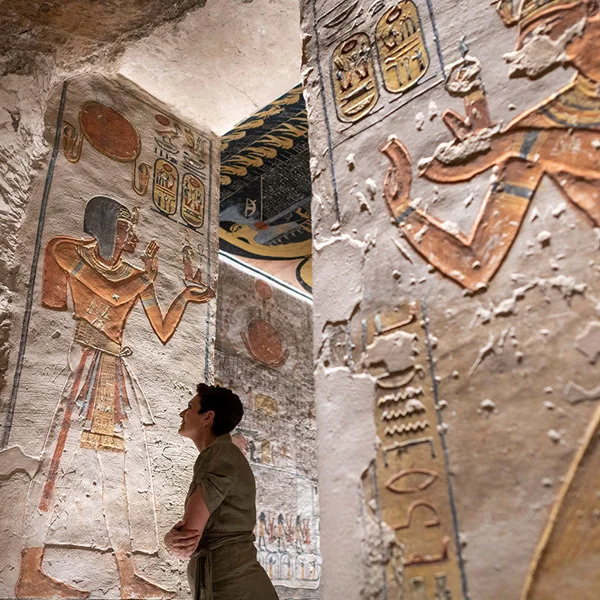
Explore the Valley of the Kings on the west bank of the Nile, where New Kingdom pharaohs were buried in tombs cut into the desert hills. Learn about royal burial beliefs at the necropolis associated with rulers including Tutankhamun.
Rather than building pyramids, these kings prepared hidden chambers for their journeys into the afterlife. Tomb decoration and the valley’s stark terrain make the beliefs behind ancient Egyptian funerary practices tangible.
Valley of the Queens
Visit the Valley of the Queens in the hills of Luxor’s west bank. Discover a burial ground used for royal wives, children and other family members, with an opportunity to enter a selection of tombs open to visitors.
More than 75 tombs lie in the valley, including the celebrated tomb of Nefertari. Access to individual tombs can vary, but the visit offers a perspective on royal family life and afterlife beliefs beyond the pharaohs’ own resting places.
Cairo Citadel & Alabaster Mosque
Ascend to Cairo’s Citadel for sweeping city views and visit the Great Mosque of Muhammad Ali, also known as the Alabaster Mosque. Step beneath its domes to appreciate the scale and detail of its interior.
Founded as a medieval fortress, the Citadel remained a seat of power for centuries. Muhammad Ali’s 19th-century mosque adds another chapter to the hilltop complex, connecting Cairo’s military history with the ruler often described as the founder of modern Egypt.
Grand Egyptian Museum
Explore the Grand Egyptian Museum with an Egyptologist and encounter treasures associated with Tutankhamun alongside artefacts spanning ancient Egyptian history. Highlights described for this tour include a towering statue of Ramses II and the reconstructed solar boat found near the Great Pyramid.
Located near Giza, the museum places individual objects within a much broader story, from early cultures to later eras. Expert interpretation helps reveal the craftsmanship and beliefs behind the collection.
Ancient Memphis
Visit the remains of Memphis, a capital of ancient Egypt, to see its colossal statue of Ramses II and an impressive alabaster sphinx. These surviving works hint at the importance of a city that once stood at the centre of royal and religious life.
Memphis flourished during the Old Kingdom and remained significant for centuries. Although much of the ancient city has vanished, its monumental sculpture offers a tangible introduction to Egypt’s earliest dynastic heartland.
Saqqara Step Pyramid
See the Step Pyramid of Djoser at Saqqara, an early monumental stone pyramid rising above the desert necropolis. Learn how its stacked form marked a decisive change in royal tomb building.
Designed under the direction of Imhotep in the 27th century BC, the pyramid predates the great pyramids at Giza. Viewing it in its wider funerary landscape reveals the experimentation and ambition behind one of architecture’s enduring landmarks.
Pyramids of Giza & Great Sphinx
Explore the Pyramids of Giza with an Egyptologist and stand before the Great Sphinx, its human face and lion’s body carved from limestone. The tour highlights also describe an opportunity to enter one of the pyramids.
Built for Old Kingdom rulers, the pyramids have stood on the plateau for more than four millennia. Seeing their immense blocks at close range reveals the scale of the builders’ achievement and the enduring significance of Egypt’s royal tombs.
Cairo Farewell Drinks & Canapés
Gather with your Travel Director and fellow travellers for drinks and canapés at your Cairo hotel. This hosted farewell offers space to share favourite discoveries from the Nile, Luxor and the Giza plateau.
It is a relaxed close to the women-only journey, bringing the group together away from the bustle of the city’s sites. Conversation and a shared toast are the focus, rather than a formal sightseeing programme.
Abu Simbel Temples
Visit the temples of Abu Simbel on an optional excursion from Aswan. See the colossal seated figures guarding the Great Temple of Ramses II and the nearby temple dedicated to Hathor and Queen Nefertari, both overlooking Lake Nasser.
Carved into rock in the 13th century BC, the temples were relocated in the 20th century to save them from the lake’s rising waters. This experience is at additional cost and bookable on tour.