Your itinerary
Day 1
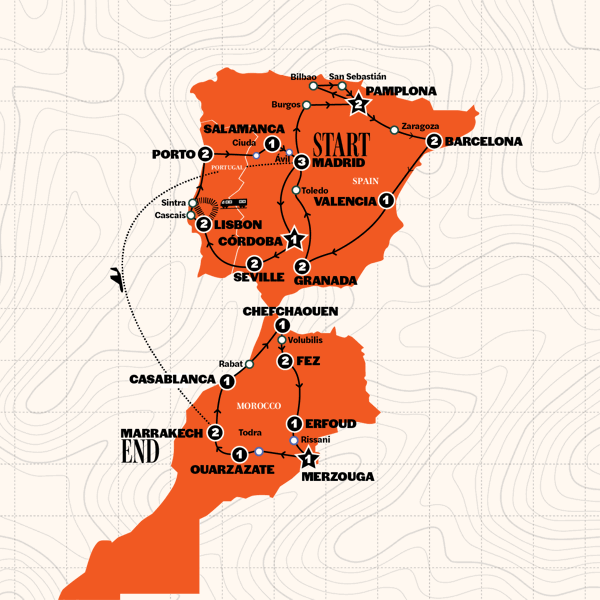
Day 1: Start Madrid
Meet the group in Madrid for a group dinner, then stay overnight at the hotel.
Meals: Dinner
Day 2
Day 2: Madrid to Pamplona via Burgos
Travel north from Madrid, stopping to explore medieval Burgos and its town square. Continue to Pamplona for a brief orientation tour and free time.
Meals: Breakfast
Day 3
Day 3: Pamplona (Including Bilbao and San Sebastián)
After breakfast, visit Bilbao, with free time to explore its architecture and the Museo Guggenheim. Continue to San Sebastián for its cobbled streets, beaches and pintxos, then return to Pamplona for the night.
Meals: Breakfast
Day 4
Day 4: Pamplona to Barcelona via Zaragoza
Travel from Pamplona to Zaragoza, where you can explore the old town, cathedral and traditional churros. Continue to Barcelona for the first of two nights and an included dinner at a local restaurant.
Meals: Breakfast,Dinner
Day 5
Day 5: Barcelona
Spend the day in Barcelona. You can join a guided bike tour, explore Gaudí’s Parc Güell or head to the Mediterranean coast.
Meals: Breakfast
Day 6
Day 6: Barcelona to Valencia
Travel to Valencia and explore the city on an orientation walk. An optional paella-making class is available in the evening.
Meals: Breakfast
Day 7
Day 7: Valencia to Granada
Leave Valencia for Granada, where Arab and Spanish influences meet. Join the group for an included dinner in the evening.
Meals: Breakfast,Dinner
Day 8
Day 8: Granada
Spend the morning exploring Granada independently, with an optional guided tour of the Albaicín and Capilla Real. Visit the Alhambra Palace in the afternoon to see its architecture and views over the city. An optional flamenco and sangria evening is available.
Meals: Breakfast
Day 9
Day 9: Granada to Madrid via Toledo
Travel to Madrid via Toledo, visiting its Gothic cathedral, El Greco’s house and historic streets. In Madrid, spend the evening at your leisure.
Meals: Breakfast
Day 10
Day 10: Madrid to Córdoba
Travel from Madrid to Córdoba. Explore this UNESCO World Heritage-listed city and visit the Mezquita, or Great Mosque of Córdoba. An included dinner follows in the evening.
Meals: Breakfast,Dinner
Day 11
Day 11: Córdoba to Seville
Travel to Seville for a guided walk past the river, Mudéjar palaces, aristocratic mansions and the city’s cathedral. An optional EatWith dining experience is available in the evening.
Meals: Breakfast
Day 12
Day 12: Seville
Enjoy free time in Seville. You can explore Barrio Santa Cruz, visit the Alcázar and wander the medieval lanes.
Meals: Breakfast
Day 13
Day 13: Seville to Lisbon
Travel west from Seville into Portugal, arriving in Lisbon. Spend the evening exploring its cobbled streets, trams and tiled buildings, with time to enjoy Portuguese food.
Meals: Breakfast,Dinner
Day 14
Day 14: Lisbon (Including Sintra)
Take the train from Lisbon to Sintra and explore its palaces, lanes and cafés; Quinta da Regaleira is a recommended stop. Return to Lisbon for a free afternoon exploring its neighbourhoods and cafés, with an optional seafood outing at a local restaurant.
Meals: Breakfast
Day 15
Day 15: Lisbon to Porto via Cascais
After breakfast, travel north via the coastal town of Cascais. Walk along its marina or join an optional resident-led street-art tour. Continue to Porto, where an optional traditional Portuguese singing show is available.
Meals: Breakfast
Day 16
Day 16: Porto
Enjoy a free day in Porto. Options include the beach, Livreria Lello, art museums, walks through the city’s streets or a group food tour.
Meals: Breakfast
Day 17
Day 17: Porto to Salamanca via Ciudad Rodrigo
Leave Portugal and stop for free time in the fortified border city of Ciudad Rodrigo. Continue to Salamanca for an orientation, with an optional activity about the women who shaped its history. Spend the evening exploring and finding food independently.
Meals: Breakfast
Day 18
Day 18: Salamanca to Madrid via Ávila
Travel from Salamanca to Madrid, stopping in Ávila to admire its preserved medieval walls and UNESCO-listed old city. In Madrid, an optional dinner of traditional food is available near Plaza Mayor.
Meals: Breakfast,Dinner
Day 19
Day 19: Madrid to Marrakesh
Fly from Madrid to Marrakesh. Spend the evening experiencing the city’s North African aromas and spices.
Meals: Breakfast,Dinner
Day 20
Day 20: Marrakesh to Casablanca
Take a sightseeing tour of Marrakesh, seeing the Koutoubia Mosque and Jemaa El-Fna; an optional visit to Bahia Palace is available. Travel to Casablanca and walk along La Corniche for coastal views.
Meals: Breakfast,Dinner
Day 21
Day 21: Casablanca to Chefchaouen via Rabat
Explore Casablanca and its Moorish buildings, with an optional visit to Hassan II Mosque. In Rabat, visit the Mohammed V Mausoleum and see Hassan Tower and the royal palace. Continue to Chefchaouen to explore the Blue City, Place Outa Hamam, the Kasbah and local markets.
Meals: Breakfast
Day 22
Day 22: Chefchaouen to Fes via Volubilis
After breakfast, travel toward Fes via Volubilis, where a local guide leads a walking tour of the UNESCO-listed Roman ruins. Continue through the Rif Mountains to Fes and check in to the hotel.
Meals: Breakfast
Day 23
Day 23: Fes
Explore Fes and learn about carpet-making, handicrafts and shopping in the medina. An optional Moroccan feast with live entertainment is available in the evening.
Meals: Breakfast
Day 24
Day 24: Fes to Erfoud
Drive toward Erfoud through the Atlas Mountains, stopping in Ifrane and Midelt. Arrive in the Sahara oasis town of Erfoud and enjoy dinner.
Meals: Breakfast,Dinner
Day 25
Day 25: Erfoud to Merzouga
Leave Erfoud for a home visit featuring Berber hospitality and Moroccan mint tea. Stop in Rissani for lunch and a possible swim, then continue to Merzouga. An optional visit to the Berber Music Center is available before an evening camel trek into the Sahara for sunset. Enjoy a traditional Berber dinner in a tent and stay overnight.
Meals: Breakfast,Lunch,Dinner
Day 26
Day 26: Merzouga to Ouarzazate via Todra Gorge
Travel along the route of the 1,000 kasbahs and have lunch at the Tinghir oasis. Continue to Todra Gorge for the chance to hike and visit a date palmeraie. Afterwards, you can visit Tatefy, a women’s cooperative near the Dades Valley known for its tea and baked goods. Continue to explore Ouarzazate.
Meals: Breakfast,Lunch,Dinner
Day 27
Day 27: Ouarzazate to Marrakesh
Travel back to Marrakesh, stopping at a women’s argan oil cooperative to learn traditional production methods. In Marrakesh, you have the chance to take a Moroccan cooking class with a local family and have a traditional hammam spa treatment.
Meals: Breakfast
Day 28
Day 28: Marrakesh
The tour ends in Marrakesh with farewells to the group.
Meals: Breakfast
What’s included
What’s not included
Additional information
Dining Summary
- 9 Dinner (D)
- 27 Breakfast (B)
- 1 Lunch (L)
FAQs
- London: A modular trip means fellow travellers will join and leave at various locations. There’ll be some goodbyes, sure, but there’ll also be plenty of hellos with new like-minded travellers.
- Marrakesh: Tipping’s a big deal in Morocco – it’s part of the culture and helps support locals (especially those working in tourism). During your trip, you’ll be expected to tip people like hotel staff, local guides, porters, and restaurant crews.
To keep it simple (and avoid the awkward maths), your Trip Manager will organise a tipping kitty. On Day 1, they’ll collect $70 USD (or local equivalent in MAD), to cover group service tips along the way.
Heads-up: this doesn’t include a tip for your Trip Manager.
Included Experience
- Pamplona: Your Trip Manager will escort you into the heart of the city and give a brief orientation talk. After that, you’re free to explore this quirky and colourful city in your own way.
- Bilbao: Home to world famous art museums and architecture that’s grander than grand. Today you’ll have plenty of time to explore Bilbao, taking in the mountains and the skyscrapers.
- San Sebastián: Where better to admire the sunset than on the beautiful beaches of San Sebastián? This resort town is known for its fantastic food too – so make sure you’re hungry!
- Barcelona: Enjoy an included dinner at Mescladis – a non-profit that’s all about social cohesion, doing their bit to enrich coexistence, with rights and opportunities for all.
- Granada: Probably the most Instagrammable palace that’s ever existed. Tour this Moorish marvel with an expert.
- Toledo: This medieval city is a cultural melting pot, with a mix of Spanish, Arabic and Jewish influences. Get some pics of the Alcázar Fortress and the gothic Cathedral.
- Córdoba: This ornate World Heritage site was built by the Moors after they conquered Iberia. And it’s still one of the world’s biggest mosques.
- Lisbon: Take an orientation in Lisbon’s ‘museum district’. See the Jerónimos Monastery, Belém Tower and the best places to taste a pastel de nata.
- Sintra: There are plenty of UNESCO heritage sites to see in this colourful Portuguese town.
- Lisbon: Get to grips with Portugal’s coastal capital. See all the sights, including Castelo de São Jorge, the Praca do Comércio, Rossio Sqaure and Praca da Figueira.
- Rabat: Stroll around the Moroccan capital and check out the Hassan Tower and Dar al-Makhzen: the official royal palace. (entry not included)
- Chefchaouen: Morocco’s ‘blue pearl’ is one of the world’s most Instagrammable places. Marvel at the medina of turquoise, azure and sky blue.
- Volubilis: See another side to colourful Morocco, as you explore the Ancient Roman ruins at this archaeological site.
- Fes: Get to know the city through the eyes of a local. See the Medina, Royal Palace, and visit a co-operative for handmade carpets.
- Erfoud: Stay at an authentic Moroccan hotel that’s like an oasis in the desert, with a pool, aircon, and sun loungers.
- Merzouga: Stay at a luxury desert camp, equipped with a pool, hot showers, air con, and a lounge area inside tents.
- Merzouga: Saddle up and get ready for a sand-filled adventure atop an actual camel. A total bucket list moment!
- Ouarzazate: Enjoy a traditional tea ritual with a nomad family. It’s a hallmark of Moroccan hospitality.
- Todra Gorge: Nestled in the divine beauty of the Dades Valley, we’ll meet the women of Tatefy to listen to their stories and enjoy their tea and cakes.
- Ouarzazate: Get to know the local women behind the production of Morocco’s ‘liquid gold’ and see the work being done by this social enterprise.
- Marrakesh: Step into the heart of the action in this bustling square. Get a taste of local life and do a bit of people watching.
Barcelona Guided Bike Tour
Join a guided bike tour of Barcelona for an active way to discover the Catalan capital. Cycling lets you cover more ground than a walk while staying close to the city’s streets and neighbourhood atmosphere.
Barcelona’s broad avenues and public spaces reflect generations of urban change, from its older centre to later planned districts. This optional guided activity is available at additional cost and bookable on tour.
Valencia Paella-Making Class
Make paella in Valencia, the Spanish city most closely associated with this rice dish. Join a hands-on class with fellow travellers and learn more about the ingredients and methods behind a local culinary tradition.
Paella grew from the agricultural culture around Valencia, where rice has long been cultivated. Preparing it here offers a practical connection to its place of origin. This optional class is available at additional cost and bookable on tour.
Salamanca Orientation Walk
Orient yourself in Salamanca, a university city renowned for its richly decorated stone buildings. Get acquainted with its historic centre and look out for the university, the cathedral complex and the shell-covered facade of the Casa de las Conchas.
Founded in the early thirteenth century, the University of Salamanca is among Europe’s oldest. The walk introduces a city shaped by centuries of scholarship, where carved details reward a closer look.
Berber Home Visit & Mint Tea
Visit a local family and share Moroccan mint tea during the journey towards the Sahara. The hosted visit offers an opportunity to experience hospitality in a home rather than at a sightseeing landmark.
Preparing and serving tea is an important social custom in Morocco, often signalling welcome and conversation. This encounter centres on the people behind that tradition and the unhurried ritual of sharing a glass together.
Operated By
Contiki
Madrid Welcome Dinner
Meet your fellow travellers over a welcome dinner in Madrid, Spain’s lively capital. This hosted gathering is a chance to get acquainted with the group over food and conversation.
Madrid’s dining culture makes a fitting introduction to the journey: evenings here are sociable affairs, with restaurants filling as the city’s streets come alive. The dinner offers a shared starting point before the tour explores Iberia and Morocco.
Burgos Medieval Centre
Explore the medieval centre of Burgos and pause in its handsome town square. This historic Castilian city offers a close look at the stone streets and civic spaces that grew along the pilgrimage route to Santiago de Compostela.
Burgos is especially known for its soaring Gothic cathedral, a UNESCO World Heritage Site. The stop focuses on the atmosphere of the old town; cathedral entry is not specified as part of the experience.
Pamplona Orientation Walk
Walk into the heart of Pamplona with your Trip Manager for a brief orientation of this colourful Navarrese city. Get your bearings among its compact streets and squares while hearing an introduction to the place.
Pamplona’s old centre retains the feel of a fortified town, though it is known worldwide for the San Fermín festival and its running of the bulls. The orientation provides context for a city with traditions beyond its famous festival.
Zaragoza Old-Town Walk
Roam Zaragoza’s casco antiguo, taking in the old town’s streets and prominent religious architecture. The city lies beside the Ebro River, and its historic centre brings together buildings from several chapters of Spanish history.
Zaragoza’s best-known landmark, the Basilica of Our Lady of the Pillar, dominates the city’s skyline. This is an opportunity to appreciate the layered character of the old town and perhaps try churros locally; landmark entry and food purchases are not specified as included.
Barcelona Dinner at Mescladís
Share an included dinner at Mescladís in Barcelona, a nonprofit food initiative that uses hospitality to bring people together. The group meal offers more than a table in the city: it introduces a local organisation with a social purpose.
Mescladís works to foster social inclusion and opportunities through food. Dining here connects Barcelona’s restaurant culture with the people and community projects behind it, giving the evening a distinctive sense of place.
Valencia Orientation Walk
Explore Valencia on an orientation walk through a Mediterranean city where historic streets meet an energetic contemporary culture. Follow your group through the city and get a feel for its public spaces and everyday rhythm.
Valencia is the birthplace of paella, a rice dish rooted in the surrounding agricultural landscape. Its long history as a trading port gives the city a character shaped by both inland traditions and the sea.
Expert-Led Alhambra Palace Tour
Tour Granada’s Alhambra with an expert, examining the intricate decoration and architecture of this celebrated palace complex. Look out across Granada from its hilltop setting while learning about the rulers who made it a seat of power.
Built and developed under the Nasrid dynasty, the Alhambra preserves a remarkable legacy of Islamic art in Spain. Its geometric ornament, courtyards and views make the visit a close encounter with Andalusia’s layered history.
Toledo Historic-Centre Visit
Discover Toledo’s historic centre, where medieval streets reveal the city’s Christian, Jewish and Muslim heritage. See the imposing Alcázar fortress and Gothic cathedral as you explore this hilltop city.
Toledo’s former role as an important cultural and political centre is visible in its densely layered architecture. The visit also introduces its connection to El Greco, the painter who made the city his home; entry to individual buildings is not specified.
Córdoba Mezquita Visit
Visit Córdoba’s Mezquita, the great Mosque–Cathedral at the heart of the city’s UNESCO-listed historic centre. Explore a building whose vast prayer hall and repeating arches speak to the scale and ambition of Islamic Córdoba.
The mosque was begun in the eighth century and expanded over generations; a cathedral was later established within it. Its architecture makes visible centuries of religious and cultural change in one extraordinary space.
Guided Seville City Walk
Join a guided stroll through Seville to appreciate the Andalusian capital’s river setting, historic palaces and aristocratic mansions. Take in the city’s monumental streetscape and the exterior presence of its vast cathedral.
Seville’s architecture reflects periods of Islamic rule and later Christian patronage; Mudéjar design is one of its most recognisable expressions. The walk focuses on the city’s atmosphere and history, without implying entry to its palaces or cathedral.
Lisbon Belém Orientation
Explore Lisbon’s Belém district on an orientation that takes in the Jerónimos Monastery and Belém Tower. Learn where to find a pastel de nata while getting acquainted with this landmark-rich area beside the Tagus River.
Belém is closely associated with Portugal’s maritime age, when voyages connected Lisbon with distant ports. Its grand monuments provide a striking setting for that history; entry to the monastery and tower is not specified as included.
Sintra Town Excursion
Travel to Sintra and explore its historic town, set among wooded hills west of Lisbon. Spend time among winding lanes, grand architecture and cafés in a place long favoured as a retreat from the capital.
Sintra’s cultural landscape is UNESCO-listed for its distinctive combination of romantic architecture and cultivated scenery. The organised excursion includes the journey and time in town; visits to specific properties, such as Quinta da Regaleira, are suggestions rather than included entries.
Central Lisbon Orientation
Get to know central Lisbon on an orientation featuring Praca do Comércio, Rossio Square and Praca da Figueira. See how the city’s broad squares and streets fit together, with Castelo de São Jorge forming part of its historic skyline.
Much of the lower city was rebuilt after the devastating 1755 earthquake. That planned streetscape contrasts with Lisbon’s older hillside quarters, making the orientation a useful introduction to the capital’s layered urban history.
Ávila Medieval Walls View
Stop to admire Ávila’s medieval walls, the defining landmark of this UNESCO-listed Castilian city. Take in the long line of stone ramparts and towers enclosing its historic centre.
Built largely from the late eleventh century onward, the fortifications are exceptionally well preserved and make the city’s defensive past easy to picture. This is a focused viewing stop rather than a stated walk along the walls or entry to the monuments inside them.
Marrakesh Sightseeing Tour
Discover Marrakesh on a sightseeing tour that takes in the exterior of the Koutoubia Mosque and Jemaa el-Fnaa. Observe the city’s busy streets and public spaces while getting an introduction to its sights and sounds.
The Koutoubia’s minaret has long been a landmark of Marrakesh, while Jemaa el-Fnaa is known for its shifting scene of vendors and performers. Together they offer a vivid introduction to the city’s public life.
Casablanca Corniche Walk
Walk along Casablanca’s Corniche and take in views of the Atlantic coast. This seafront promenade offers a different perspective on Morocco’s largest city, away from its busier inland streets.
Casablanca’s modern identity is closely tied to its port and ocean setting. The walk is a chance to feel the coastal atmosphere and see the city’s shoreline firsthand, without a scheduled entry to nearby landmarks.
Rabat Monuments Tour
Explore Rabat’s monumental landmarks, including the Mohammed V Mausoleum and Hassan Tower. See the exterior of Dar al-Makhzen, the royal palace, while learning how Morocco’s capital expresses its history through public architecture.
Hassan Tower is the surviving minaret of an ambitious twelfth-century mosque that was never completed. Nearby, the mausoleum honours King Mohammed V. The palace is viewed from outside; royal palace entry is not included.
Chefchaouen Blue Medina Walk
Explore Chefchaouen’s blue-painted medina, taking in Place Outa Hammam, the kasbah and local markets. Walk through lanes washed in shades of blue and observe the everyday activity around the town’s central square.
Set in the Rif Mountains, Chefchaouen is known for the distinctive colour of its streets as well as its compact old town. The visit offers time to notice the details behind its much-photographed appearance.
Volubilis Guided Roman Ruins Tour
Walk through Volubilis with a local guide and explore the remains of an ancient Roman city. Examine the layout of its streets and surviving structures in an archaeological landscape set among the hills of northern Morocco.
Volubilis flourished under Roman rule and is now a UNESCO World Heritage Site. Its ruins reveal a lesser-known chapter of Morocco’s history, with archaeological details that reward an expert-led visit.
Fes Medina & Carpet-Cooperative Visit
Discover Fes through the eyes of a local, seeing its medina and royal palace exterior while learning about the crafts associated with the city. Visit a cooperative to find out about handmade carpet production and the skills involved.
Fes is renowned for its historic medina and longstanding artisan traditions. This experience pairs the atmosphere of its old streets with an introduction to the people and techniques behind Moroccan handicrafts; palace entry is not specified.
Merzouga Camel Trek & Berber Dinner
Ride a camel into the Sahara near Merzouga and watch the evening light change across the dunes. The desert outing brings you onto the sand for sunset views rather than keeping the landscape at a distance.
A traditional Berber dinner in a tent adds a hosted cultural element to the experience. Together, the trek and meal offer a closer sense of the desert’s setting and the hospitality associated with it.
Todra Gorge & Date-Palm Oasis Exploration
Explore Todra Gorge, where steep rock walls rise above the river corridor. There is a chance to walk or hike in the area and visit a nearby date-palm grove, experiencing both the rocky landscape and its cultivated oasis.
The gorge lies on the edge of Morocco’s desert region, where water supports strips of greenery amid arid terrain. Its contrast of towering stone and palms makes this a distinctive scenic stop.
Tatefy Women’s Cooperative Visit
Meet the women of Tatefy, a local cooperative near the Dades Valley, and listen to their stories over tea and baked goods. This MAKE TRAVEL MATTER® experience centres on conversation and locally prepared refreshments.
The visit puts a human face to the region beyond its celebrated scenery. Spending time with the cooperative offers a direct connection with local women and their work, while enjoying the hospitality of a shared table.
Ouarzazate Exploration
Explore Ouarzazate, a southern Moroccan city associated with desert landscapes and international filmmaking. Get a feel for the city and the setting that has drawn productions to the region.
Ouarzazate sits near historic kasbah country and has served as a backdrop for films including Gladiator and Kingdom of Heaven. The experience is a city exploration; entry to film studios, sets or individual kasbahs is not specified.
Argan Oil Cooperative Visit
Visit a women’s argan oil cooperative and learn about traditional methods used to produce Morocco’s prized oil. See how the work is carried out and meet the women behind this local enterprise.
Argan oil comes from the kernels of a tree native to southwestern Morocco and is used in food and cosmetics. This MAKE TRAVEL MATTER® visit connects a regional craft with the livelihoods it supports.
Granada Albaicín & Royal Chapel Tour
Join a guided tour of Granada’s Albaicín and Royal Chapel. Explore the streets of the historic Muslim quarter and learn about the city’s past alongside a visit to the chapel associated with Spain’s Catholic Monarchs.
The Albaicín preserves the street pattern and atmosphere of Granada’s Islamic era, while the Royal Chapel speaks to the political changes that followed. This optional tour is available at additional cost and bookable on tour.
Granada Flamenco & Sangria Evening
Experience a flamenco performance with sangria during an evening out in Granada. Watch the interplay of singing, guitar and dance while sharing the occasion with your travel group.
Flamenco is an Andalusian art form built around rhythm and expressive performance, with roots in several communities and musical traditions. Seeing it in Granada brings the region’s performing culture into focus. This optional evening is available at additional cost and bookable on tour.
Seville EatWith Dining Experience
Join an EatWith dining experience in Seville for a hosted meal designed around sharing food and conversation. It is an opportunity to connect with a more personal side of the Andalusian capital’s food culture.
Seville’s dining traditions are deeply social, and a hosted feast offers a different perspective from eating independently at a restaurant. This optional experience is available at additional cost and bookable on tour; the precise menu and venue are not specified.
Cascais Community Street-Art Tour
Tour a Cascais neighbourhood’s street art with local residents, hearing how creative work is helping challenge old perceptions of the area. See murals and other urban artworks through the perspectives of people connected to the community.
This MAKE TRAVEL MATTER™ experience treats the streets as an evolving open-air gallery, with local voices providing context beyond the images themselves. The optional tour is available at additional cost and bookable on tour.
Traditional Portuguese Singing Show
Attend a traditional Portuguese singing show during your time in Porto. A live performance offers a chance to hear Portuguese musical expression rather than encounter it only through recordings or descriptions.
Vocal performance has a strong place in Portugal’s cultural life, and the intimacy of a singing show can bring its emotion and storytelling to the fore. This optional entertainment is available at additional cost and bookable on tour; the specific style and venue are not specified.
Porto Food Tour
Join a food tour in Porto to discover the city through its flavours with your group. The guided tasting experience offers a more focused introduction to local food than choosing a restaurant independently.
Porto’s culinary identity draws on northern Portuguese traditions as well as its long connection to trade along the Douro River. The tour offers a taste-led perspective on the city. It is optional, available at additional cost and bookable on tour; specific tastings are not listed.
Women of Salamanca History Tour
Learn about the women who shaped Salamanca on an optional history-focused tour. Explore the city from a perspective that adds to its familiar story of universities, cathedrals and carved stone facades.
Salamanca’s celebrated monuments often foreground institutions and rulers; this experience turns attention to women’s contributions to the city’s past. It is available at additional cost and bookable on tour. Specific stops and historical figures are not detailed in the itinerary.
Marrakesh Bahia Palace Visit
Visit Bahia Palace in Marrakesh for a closer look at one of the city’s historic residences. Explore its rooms and courtyards, where decorative craftsmanship provides a contrast to the bustle outside.
Developed in the nineteenth century, the palace reflects the tastes and status of powerful figures in Moroccan court life. Its architectural details make it a rewarding stop for design and history enthusiasts. This optional visit is available at additional cost and bookable on tour.
Casablanca Hassan II Mosque Visit
Visit Casablanca’s Hassan II Mosque, a monumental place of worship beside the Atlantic Ocean. The optional visit offers a closer look at the scale and craftsmanship of one of Morocco’s most recognisable modern landmarks.
Completed in the 1990s, the mosque combines traditional Moroccan decorative arts with an immense coastal setting. Its minaret is a defining feature of Casablanca’s skyline. This experience is available at additional cost and bookable on tour.
Berber Music Centre Visit
Visit a Berber music centre near Merzouga for an introduction to the region’s musical culture. The experience offers a cultural counterpart to the area’s desert scenery.
Amazigh, often called Berber, communities have diverse musical traditions across Morocco, shaped by local histories and occasions for performance. This optional visit is available at additional cost and bookable on tour. The itinerary does not specify a performance, workshop or particular instruments.
Marrakesh Family Cooking Class
Cook with a local family in Marrakesh and learn about Moroccan hospitality through a hands-on food experience. Preparing a dish together gives you a chance to connect with the people and customs behind the cuisine.
Moroccan home cooking is closely tied to shared meals, aromatic seasonings and generous hosting. This class offers a personal introduction to those traditions. It is optional, available at additional cost and bookable on tour; the dishes prepared are not specified.
Traditional Hammam Spa Treatment
Experience a traditional hammam treatment during your time in Marrakesh. This spa opportunity offers a quieter, restorative way to engage with a longstanding Moroccan bathing custom.
Hammams have historically served as places for washing and social life in Moroccan cities. A treatment introduces the warmth and ritual of this tradition in a contemporary visitor setting. This optional experience is available at additional cost and bookable on tour; the treatment details are not specified.