
Your itinerary
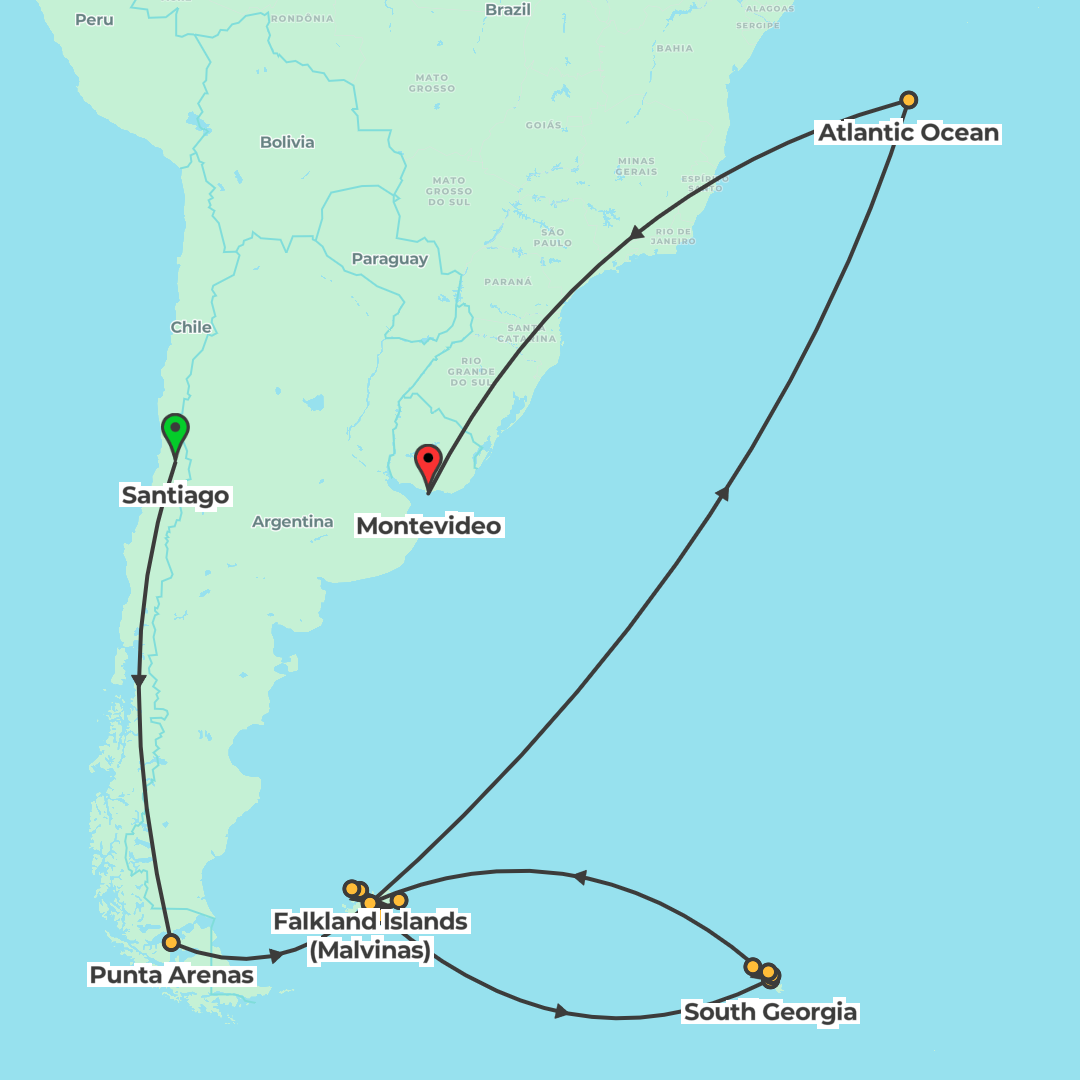
Day 1
Santiago
Arrive in Santiago. Explore Mercado Central, Plaza de Armas, the Presidential Palace, and the Sky Costanera viewpoint. Overnight hotel stay.
Day 2
Punta Arenas
Early flight from Santiago to Punta Arenas. Embark the expedition ship, settle in, and meet the Expedition Team.
Day 3
Cruising
At sea en route to the Falkland Islands. Visit the Science Centre; lectures on Antarctic history, science, climate change, and low‑impact travel; join Citizen Science. Time to relax in the hot tub and sauna and in the Explorer Lounge & Bar.
Day 4
Bleaker Island
Bleaker Island on the southeast coast of East Falkland. Around 40 breeding bird species recorded, including Magellanic, Southern Rockhopper, Macaroni, and Gentoo penguins, and a large imperial cormorant colony; Peale’s dolphins occur year-round.
Day 5
Cruising
At sea toward South Georgia. Briefings on the islands’ history and biology; microscope work on krill and phytoplankton in the Science Centre; onboard amenities, photo tips, and creative workshops.
Day 6
Cruising
Cruising
Day 7
Right Whale Bay/Salisbury Plain
South Georgia’s wildlife—nicknamed the ‘Serengeti of the Southern Ocean’—with large colonies of penguins and other seabirds. By mid‑March, penguin chicks form crèches and fur seal pups are active; Important Bird Area with albatrosses, petrels, shags, skuas, and terns. Plans are weather‑dependent; aim to spend four days exploring and try to reach Grytviken, Shackleton’s resting place.
Day 8
Drygalski Fjord, South Georgia/Gold Harbour
Drygalski Fjord, South Georgia; Gold Harbour.
Day 9
St Andrews Bay, South Georgia/Grytviken
St Andrews Bay, South Georgia; Grytviken.
Day 10
Stromness/Fortuna Bay, South Georgia
Stromness; Fortuna Bay, South Georgia.
Day 11
Cruising the South Atlantic Ocean
Sail from South Georgia toward the Falkland Islands over two days. Lectures on wildlife, history, geology, glaciology, and battles; guidance on low‑impact visiting; join Citizen Science projects.
Day 12
Cruising the South Atlantic Ocean
Cruising the South Atlantic Ocean
Day 13
Port Stanley
Explore Stanley and the Falklands’ green landscapes and white‑sand beaches rich in birdlife. Landings, hikes, and excursions as conditions allow; hope to visit albatross and penguin colonies, often alongside seals.
Day 14
Saunders Island/Carcass Island
Saunders Island: three peninsulas linked by narrows; first British settlement site; sheep farm today. Wildlife includes Gentoo, King, and Rockhopper (with occasional Macaroni) penguins, Imperial Shags, and Black‑browed Albatross around Mount Richards (457 m). Other birds: Black‑throated Finch, Ruddy‑headed Goose, Falkland Steamer Duck. Carcass Island.
Day 15
Sailing The Atlantic Ocean
Sea days between the Falklands and Montevideo. Watch for migrating whales and pelagic birds with the Expedition Team; talks and briefings; review photos; enjoy onboard amenities and contribute to Citizen Science.
Day 16
Sailing The Atlantic Ocean
Sailing The Atlantic Ocean
Day 17
Sailing The Atlantic Ocean
Sailing The Atlantic Ocean
Day 18
Montevideo
Disembark in Montevideo. Free time to walk the Rambla, explore Ciudad Vieja, and visit Mercado del Puerto.
What’s included
What’s not included
Additional information
Science Centre Lectures & Citizen Science at Sea
Discover polar science as you visit the onboard Science Centre and join expert lectures on Antarctica’s wildlife, geology, and the Southern Ocean. Hear how the team studies seabirds, marine mammals, and sea ice, and pick up practical guidance for responsible travel to minimise impact on fragile ecosystems.
Contribute to Citizen Science projects by photographing whale flukes for identification, logging cloud cover for climate studies, or examining krill and phytoplankton under microscopes. These hands-on sessions deepen understanding of the region’s food web and the impact of climate change and plastic pollution.
On-Deck Seabird and Whale Watching with Naturalists
Scan the horizon with your Expedition Team to watch for blows and breaching whales while albatross and giant petrels carve the air above the wake. With binoculars in hand, learn at-sea ID skills and capture the effortless glide of albatross on effortless wings as they track ocean winds.
Guides highlight behaviour patterns and migration routes across the South Atlantic, pointing out fin and humpback whales, Peale’s and hourglass dolphins, and agile prions and petrels. Pause for photos and reflection during golden hours when sea and sky merge into a luminous, moving panorama.
Bleaker Island Zodiac Landing & Penguin Colonies
Come ashore by Zodiac for a Zodiac landing on Bleaker Island, a long, low-lying isle on the Falklands’ southeast fringe. Walk sandy coves and tussac-fringed shores near bustling rookeries where gentoo and Magellanic penguins commute between nests and surf.
Naturalists guide you to a vast imperial cormorant colony and reveal the isle’s wind-and-wave origins—the breakers that gave Bleaker its name. Keep watch for shy Peale’s dolphins coursing along the bay and listen for the bray of penguins and the clatter of cormorant wings overhead.
Saunders & Carcass Islands Seabird Walks
Explore wild headlands and beaches on guided walks to colonies of black-browed albatross and rockhopper penguins on Saunders Island, where surf and cliffs frame dramatic nesting ledges. Follow farm tracks and gentle coastal paths across Carcass Island, alive with tame songbirds in tussac grass.
Hear about Saunders’ role as the Falklands’ first British settlement and Carcass’s status as a rodent-free sanctuary that shelters endemics like Cobb’s wren. These islands showcase the archipelago’s blend of working sheep farms and thriving seabird habitats, with time to pause for photos and reflection at sweeping viewpoints.
Salisbury Plain & Right Whale Bay King Penguin Encounters
Walk ashore on South Georgia to the soundscape of a vast king penguin colony, where tens of thousands of birds throng the beaches of Salisbury Plain and Right Whale Bay. Watch downy brown chicks huddle in crèches while sleek adults shuttle to and from the surf.
Guides explain breeding cycles, predator dynamics, and the island’s designation as an Important Bird Area. Expect fur seals lining the shore, skuas patrolling overhead, and shifting light on glaciers and peaks—epic wildlife theatre in a natural amphitheatre shaped by ice and ocean.
Gold Harbour Dawn Landing & Elephant Seals
Step ashore for a dawn landing at Gold Harbour, where wave-cut cliffs glow and the king penguins at the water’s edge greet first light. The beach can be crowded with snorting elephant seals, while light-mantled albatross wheel along the ridges.
Set beneath the crevassed face of the Bertrab Glacier, this amphitheatre heightens every sound—the brassy penguin calls, surf hiss, and bellowing seals. Your guides help navigate wildlife-safe distances and frame photographs as orange light washes over coastal grasses and basalt outcrops.
Drygalski Fjord Scenic Cruise beneath the Salvesen Range
Cruise the dramatic Drygalski Fjord at South Georgia’s southern tip, where sheer rock walls channel catabatic winds and brash ice crackles along the hull. The ship noses toward the luminous face of the Risting Glacier while peaks of the Salvesen Range rise in serrated profiles.
Naturalists interpret the fjord’s glacial geology and search cliffs for nesting light-mantled albatross. The scene shifts with weather—moody greys, sudden sunbreaks, curtains of spindrift—inviting quiet awe and pause for photos and reflection from open decks.
Grytviken Whaling Station, Museum & Shackleton’s Grave
Walk through the rust-red relics of Grytviken Whaling Station, where boilers and tryworks recall a boom era in polar industry. Visit the South Georgia Museum for exhibits on sealing, exploration, and conservation, then continue to the small cemetery to pay respects at Shackleton’s grave.
Guides trace the arc from early 20th-century whaling to the island’s modern protections. Step inside the wooden church, admire ship fittings repurposed ashore, and consider how endurance—of wildlife, landscapes, and explorers—defines South Georgia’s identity.
Shackleton Walk: Fortuna Bay to Stromness Guided Hike
Join a guided hike along the storied Shackleton Walk, tracing the final 6 km of the 1916 crossing from Fortuna Bay to Stromness. Cross a windswept saddle, pick your line across scree, and descend past tumbling waterfalls toward the rusting whaling station below.
Leaders recount the saga of Shackleton, Worsley, and Crean navigating without maps to summon rescue for the Endurance crew. Terrain is uneven and conditions variable, but the historic resonance and mountain-to-sea views capture the expedition spirit.
Port Stanley Town Walk & Whalebone Arch
Explore the Falklands’ capital along the Port Stanley waterfront, where colourful cottages, pubs, and jetties face the harbour. Visit the Christ Church Cathedral and Whalebone Arch, crafted from blue whale jawbones, and browse local shops for island wool and crafts.
Learn how maritime heritage and South Atlantic isolation shaped this community, from shipwrecks to modern fisheries. Those interested can stop by the Falkland Islands Dockyard Museum (time permitting) for exhibits spanning natural history and the 1982 conflict.
Polar Photography Sessions with the Expedition Photographer
Learn from the Expedition Photographer to refine technique in polar light—balancing exposure on ice, freezing motion of birds in flight, and composing vast seascapes. Get field shooting tips on respectful distances and behaviour to capture authentic wildlife moments.
In evening image clinics, review files, compare settings, and discuss storytelling approaches for penguin colonies, glaciers, and shipboard life. Whether using a smartphone or DSLR, these sessions help translate the drama of the Southern Ocean into compelling frames.
Sea Kayaking Adventure (Weather Permitting)
Slip a sea kayak into sheltered coves for a quiet, water-level perspective on kelp forests, porpoising penguins, and sculpted shorelines. Paddle in small groups with certified guides, gliding past bergy bits and listening to the creak and pop of ice.
This premium experience is offered in select locations when conditions allow. It is at additional cost and bookable on tour, with group size limited and all technical gear provided. A memorable way to feel the scale and stillness of the sub-Antarctic coast.
