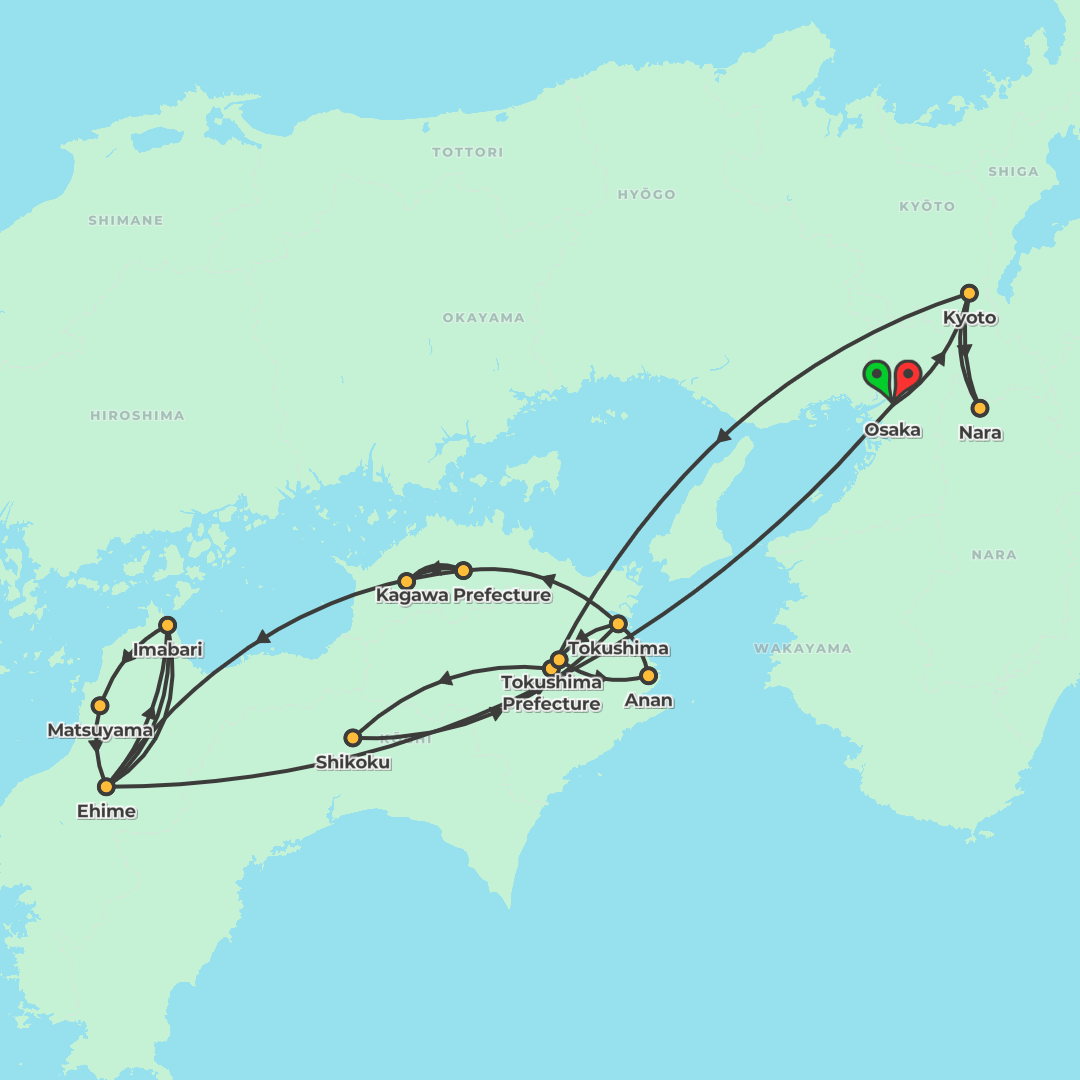
Your itinerary
Day 1
Arrive in Kyoto
Take the express train from Osaka Kansai Int. Airport to Kyoto City (approx. 70mins), then a local taxi to your first hotel. (approx. 10mins).
Overnight Kyoto.
Day 2
Explore Kyoto
Enjoy a rest day in the incredible city of Kyoto, famous for its Buddhist temples, tranquil gardens, and traditional teahouses. We recommend visiting the historical city of Nara, full of cultural treasures and expansive parks, located approx. 1hr from Kyoto city on the train.
Overnight Kyoto.
Meals: Breakfast
Day 3
Tokushima: Temples 1 - 3
Travel by long distance bus to Tokushima Prefecture (included) where you’ll begin your pilgrimage with a gentle introduction to the walks on Shikoku through quiet neighbourhoods of Tokushima. Visit three of the most eye-catching temples on whole trail – Temple 1 Ryozen-ji, Temple 2 Gokuraku-ji and Temple 3 Konsen-ji. Spend your first night as all pilgrims should – with a stay in a Shukubo Temple Lodging. There is also the option of staying at a traditional Ryokan for this first night.
Overnight Shukubo Temple Lodging or Ryokan, Tokushima.
Meals: Breakfast,Dinner
Day 4
Tokushima: Temples 11 - 12
Travel south by pre-booked and pre-paid taxi to Temple 11 Fujii-dera, a fascinating hillside temple complex. After time to explore Fujii-dera, your taxi will bring you to Ryusuian Temple, part-way up the mountain en-route to Shosan-ji. From there you walk up the rest of the mountain to Temple 12 Shosan-ji, then finally descend to the east. The walk is fairly strenuous, but very rewarding with beautiful scenery. Walk onwards to Yorii and board a bus to the small Onsen village of Kamiyama and your inn for the evening.
Overnight Minshuku Guesthouse or Ryokan, Kamiyama.
Meals: Breakfast,Dinner
Day 5
Tokushima: Temples 20 - 21
Travel by pre-paid taxi to one of the most beautiful and varied hikes on the entire Pilgrimage route. From Temple 20 Kakurin-ji the trail descends to the hamlet of Anan, crosses the Nakagawa River and climbs again to Temple 21 Tairyu-ji. End the day with a cable car ride with wonderful views over a cedar forest and the small town below. Travel by bus to your accommodation for the evening.
Overnight Minshuku Guesthouse or Ryokan, Tokushima.
Meals: Breakfast
Day 6
Kagawa: Temples 82 - 80
Leaving Tokushima, you’ll take the train, bus and a pre-booked and prepaid taxi to a rewarding hike in northern Kagawa Prefecture. Walk through lovely scenery and visit a fine collection of temples – Temple 82 Negoro-ji, Temple 81 Shiromine-ji and finally Temple 80 Kokubun-ji. Travel onwards by train for an overnight stay in the old hot-spring town of Kotohira Spa.
Overnight Ryokan (traditional Japanese inn), Kotohira Spa.
Meals: Breakfast,Dinner
Day 7
Ehime: Temples 57 to 58
Leaving Kagawa, travel by train and bus to Betsumyo in northern Ehime and begin your hike to Temple 57 Eifuku-ji. The walk gradually passes from urban townscape to rural farming communities before entering a forest with a steady climb to Temple 58 Senyū-ji. Visit Eifuku-ji and Senyū-ji and there is also an optional detour to Temple 56 Taisan-ji. Overnight at Senyū-ji in the Shukubo pilgrims’ lodgings at the temple, or alternatively stay in a western-style hotel in Imabari City.
Overnight Shukubo Temple Lodging or hotel, Imabari.
Meals: Breakfast,Dinner
Day 8
Ehime: Temples 59 onwards
Your walk continues with a gentle walk down the mountain from Senyū-ji, with the opportunity to explore small village settlements on the way. Return to the town of Imabari, with an optional paved town hike on to Temple 59 Iyo Kokubun-ji. Take the train from the end of your walk in Iyo-Tomita to Matsuyama, followed by a tram to Dogo Onsen.
Overnight Ryokan (traditional Japanese inn), Dogo Onsen.
Meals: Breakfast,Dinner
Day 9
Ehime: Temples 45 to 44
Take a pre-paid taxi from your ryokan to Temple 45 Iwaya-ji, a temple closely linked to Kōbō Daishi – the priest who founded Shingon Buddhism and Mount Koya. Climb the iconic ladder to his meditation spot, with its spectacular views over the surrounding region. From Iwaya-ji, enjoy a lovely forest hike to Temple 44 Daiho-ji before returning by bus and tram to Dogo Onsen in the evening.
Overnight Ryokan (traditional Japanese inn), Dogo Onsen.
Meals: Breakfast,Dinner
Day 10
Ehime: Temples 60 to 62
Your pilgrimage ends with a rewarding hike in the east of Ehime Prefecture. Travel by tram and bus to Ooto, then take a pre-paid taxi to reach the starting point. Walk to Temple 60 Yokomine-ji, Temple 61 Kōon-ji and onwards to Temple 62 Hoju-ji. The walk passes through a rural area of Shikoku and the temples are in lovely natural settings. After the walk, travel onwards by train to Osaka, arriving mid-evening for your final evening.
Overnight Osaka.
Meals: Breakfast
Day 11
Depart Osaka
Enjoy breakfast at your hotel before taking the train from Osaka Namba Nankai station to Osaka Kansai Airport (approx. 35mins).
Meals: Breakfast
What’s included
What’s not included
Additional information
Kakurin-ji to Tairyu-ji Forest Trail & Cable Car Descent
Day 5 opens with a pre-paid taxi to Temple 20 Kakurin-ji, then a varied hike crossing the Nakagawa River and winding up stone paths to Temple 21 Tairyu-ji. Here, halls perch among towering cryptomeria, and the air carries resin and moss. The route mixes shaded forest with village edges, inviting steady, meditative progress between ancient gates.
Cap the day by descending on the Tairyu-ji cable car, a serene glide above a sea of cedar tops, with views to the town below. This classic pairing—forest ascent, aerial descent—captures the contrast of the Shikoku trail: intimate paths under leaves and wide, wind-brushed panoramas that reveal the island’s rugged heart.
Kagawa Temple Circuit: Negoro-ji, Shiromine-ji & Kokubun-ji
On day 6, travel by train, bus and pre-booked taxi to northern Kagawa for a rewarding ridge-and-plain circuit linking Temple 82 Negoro-ji, Temple 81 Shiromine-ji and Temple 80 Kokubun-ji. Trails thread through pine and laurel, then ease onto lanes overlooking the Sanuki Plain, where tiled farmhouses and persimmon orchards patchwork the land.
Learn how Kagawa’s temples guarded coastal routes facing the Seto Inland Sea, where merchants and monks exchanged ideas for centuries. As evening falls, arrive in Kotohira Spa, a town famed for hot-spring hospitality. Enjoy the lilting clack of geta on lantern-lit streets and unwind in your ryokan’s baths before a refined dinner showcasing regional flavours.
Imabari Descent & Dogo Onsen Evening
Day 8 begins with a gentle descent from Senyu-ji, passing hamlets where vegetable plots and drying nets fill sunny yards. Return to Imabari and consider a short, paved town stretch if you wish before transferring by train to Matsuyama, then tram to the storied hot-spring quarter of Dogo Onsen.
As dusk falls, stroll arcaded streets where noren curtains sway and bathhouse steam curls into night air. Many ryokan offer communal hot-spring style baths; those who wander the district will sense why writers since the Meiji era praised Dogo’s curative waters and festival spirit. The evening is yours to soak in the lakeside atmosphere of Japan’s oldest celebrated onsen town.
Iwaya-ji Ladder Climb & Forest Way to Daiho-ji
On day 9, a pre-paid taxi brings you to Temple 45 Iwaya-ji, built beneath overhanging cliffs. Here you can climb the iconic ladder to Kobo Daishi’s meditation spot, a ledge with stirring views over the green folds of Ehime. The air is resinous, cicadas hum, and prayer flags snap against the rock.
From Iwaya-ji, follow a serene woodland path to Temple 44 Daiho-ji, where moss-clad lanterns and cryptomeria frame the precinct. The route embodies the pilgrimage’s rhythm—effort, contemplation, arrival—before your return by bus and tram to Dogo Onsen. Pause for photos and reflection as you close another spiritually rich stage.
Shojin-Ryori Evenings in Temples and Inns
Across the journey—especially on days 3–4 and 6–9—you’ll sit down to Shojin-Ryori Buddhist cuisine at shukubo, minshuku and ryokan. Expect lacquer trays of delicate preparations: sesame-dressed greens, mountain herbs, tofu simmered in dashi-style stock alternatives, pickles and clear soups. The flavours are subtle, seasonal and deeply comforting after a day on the trail.
These dinners illuminate the monastic principles behind the pilgrimage: balance, attentiveness and gratitude. With tatami underfoot and paper screens aglow, you’ll notice the quiet choreography of service and the aesthetic of restraint that defines Japan’s culinary heritage in temple settings.
Temple Morning Service with Monks
When staying in shukubo temple lodgings (notably after day 3 and day 7), there is often the chance to join the early morning service alongside resident monks (subject to temple schedule). In the half-light, the rhythmic cadence of sutra chanting fills the hall, punctuated by the thud of the mokugyo drum and the chime of handheld bells.
Sitting quietly with other henro, you’ll sense how daily liturgy underpins the 88-temple route. The service offers a rare window into living Buddhist practice—a contemplative counterpoint to the kilometres walked—before breakfast and the day’s onward stage.
Optional Detour: Temple 56 Taisan-ji
On day 7, walkers seeking extra distance can add a detour to Temple 56 Taisan-ji from the Eifuku-ji–Senyu-ji stage. The route follows quiet pavements and farmland before entering low woodland, revealing another facet of Ehime’s temple architecture and its ties to local communities.
This add-on is at additional cost if supplementary transport is required and is bookable on tour through your local agent, who will advise on timings and route notes. The detour deepens your appreciation of the henro’s layered geography, linking urban edges to forested hills in a single outing.
Optional Town Walk: Temple 59 Iyo Kokubun-ji
On day 8, after descending to Imabari, you may opt for a paved town hike to Temple 59 Iyo Kokubun-ji, the provincial temple for old Iyo. The approach passes workshops, neighbourhood shrines and groves of camphor before the tiled roofs of the precinct appear.
At additional cost if arranging extra local transport, this extension is bookable on tour and pairs urban textures with spiritual landmarks. It’s an engaging way to trace how pilgrimage routes thread through everyday life before transferring to Matsuyama and the Dogo Onsen quarter.
Optional Nara Day Trip from Kyoto
On day 2, enhance your rest day with a guided excursion to Nara, Japan’s first permanent capital. Visit Todai-ji’s Daibutsu (Great Buddha) within a vast wooden hall, wander among friendly deer in Nara Park, and admire the lantern-lit paths of Kasuga Taisha, where Shinto traditions still infuse daily rituals.
This experience is at additional cost and bookable on tour via your local agent, including rail tickets and guiding. The outing sets Kyoto’s temples in context, illuminating the Buddhist–Shinto tapestry that later shaped Kobo Daishi and the spiritual climate of the Shikoku pilgrimage.
Fujii-dera to Shosan-ji Mountain Pilgrimage & Kamiyama
On day 4, a pre-booked taxi delivers you to Temple 11 Fujii-dera, gateway to a rewarding ascent through cedar and cypress forests. Continue via Ryusuian and climb to Temple 12 Shosan-ji, one of the route’s celebrated tough sections, where quiet halls meet sweeping views across Tokushima’s valleys. Pause for photos and reflection before descending east to Yorii.
By evening, transfer to the rural onsen village of Kamiyama for your inn stay. The day’s effort is balanced by the unhurried rhythm of countryside life—woodsmoke on the air, river murmurs, and hot-spring style baths at the inn. This stage blends physical challenge with the timeless calm that defines Shikoku’s pilgrim mountains.
Tokushima Kick-Off: Temples 1–3 & Shukubo Night
On day 3, take the included coach to Tokushima and begin your pilgrimage on peaceful lanes leading to Temple 1 Ryozen-ji, Temple 2 Gokuraku-ji and Temple 3 Konsen-ji. Follow waymarkers between neighbourhood shrines and rice fields, pause to purify hands, sound the bell, and collect vermilion temple stamps as generations of pilgrims have done. The rhythm of chanting sutras and the scent of incense set a contemplative tone.
By late afternoon, settle into a Shukubo temple lodging. Sleep on tatami with futon bedding and dine on Shojin-Ryori Buddhist cuisine crafted from seasonal vegetables, tofu and mountain herbs. Learn how the 88-temple circuit honours Kobo Daishi (Kukai), the 9th-century founder of Shingon Buddhism, whose teachings shaped Shikoku’s spiritual landscape.
Ehime Ascent: Eifuku-ji to Senyu-ji & Temple Lodging
On day 7, begin near Betsumyo and trace a gentle transition from townscape to farm lanes and finally mountain forest. Visit Temple 57 Eifuku-ji, then climb to Temple 58 Senyu-ji, where views open towards the Seto Inland Sea on clear days. Bells echo softly across cedar groves as you step beneath vermilion gates and weathered eaves.
Tonight offers the rare chance to stay at Senyu-ji’s shukubo (or a hotel in Imabari). Over low tables, savour vegetarian dishes shaped by monastic restraint—silken tofu, sesame, seasonal mountain vegetables—before rolling out futons on tatami. The setting invites quiet reflection on the centuries-old henro tradition still alive in Ehime’s hills.
Eastern Ehime Rural Walk: Yokomine-ji, Koon-ji & Hoju-ji
Day 10 carries you by tram and bus to Ooto, then via pre-paid taxi to the trailhead for a classic rural section linking Temple 60 Yokomine-ji, Temple 61 Koon-ji, and Temple 62 Hoju-ji. Expect quiet farm roads, bamboo rustle, tea fields and shrines tucked beneath camphor trees as you pass between wooded hills and smallholdings.
This closing hike showcases the everyday spirituality of Shikoku—pilgrims bowing, families tending plots, incense drifting from open halls. After your final temple visit, connect by local trains to Osaka, arriving mid-evening with a deeper sense of the island’s landscapes and lore.