Your itinerary
Day 1
Day 1: Start Lima
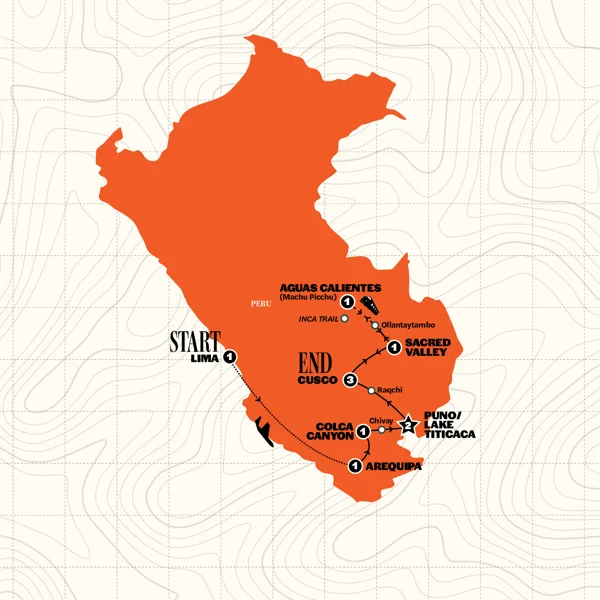
Explore Lima’s churches and catacombs in the morning, then visit the bohemian Barranco district and cross the Bridge of Sighs. Try ceviche and watch the sunset over the Pacific.
Meals: Dinner
Day 2
Day 2: Lima to Arequipa
Take the included morning flight to Arequipa, a city surrounded by volcanoes. Tour the city, including the UNESCO-listed Plaza de Armas. In the evening, sample local dishes such as Rocoto Relleno and Chupe de Camarones.
Meals: Breakfast
Day 3
Day 3: Arequipa to Colca Canyon
Leave Arequipa and travel through the Salinas and Aguada Blanca National Reserve towards Colca Canyon. Pass windswept landscapes and sandstone cliffs, stop for hot coca tea, and reach the trip’s highest point at 4,910 metres before seeing the canyon.
Meals: Breakfast,Lunch,Dinner
Day 4
Day 4: Colca Canyon to Puno
Visit Colca Canyon in the morning and look for Andean condors. Travel past villages, stop for lunch in Chivay, then continue across Peru’s high plains to Puno on Lake Titicaca. Settle into the hotel or explore town in the evening.
Meals: Breakfast,Lunch
Day 5
Day 5: Puno
Ride a triciclo to the port and take a boat across Lake Titicaca to Taquile Island, where you’ll meet local weaving groups and stop for lunch. Continue to the reed-built Uros Islands to meet residents, visit a fish farm and museum, and browse textiles and totora reed boats. Spend the night with locals at a homestay in Llachon Village.
Meals: Breakfast,Lunch,Dinner
Day 6
Day 6: Puno to Cusco via Raqchi
Leave Puno for Pukara and visit its museum of archaeological finds and ceramic bulls. Travel through the snow-capped La Raya area, where llamas may be seen. At Raqchi, take a guided visit of the Inca ruins, including the Temple of Wiracocha, then continue to Cusco for an evening of exploration.
Meals: Breakfast
Day 7
Day 7: Cusco
Spend a free day in Cusco shopping for artisan jewellery and woodwork, walking its cobblestone streets, or browsing San Pedro Market while trying cacao buds and coca leaf tea.
Meals: Breakfast
Day 8
Day 8: Cusco to Sacred Valley
Travel by private coach from Cusco to the Sacred Valley. Stop at a farm to see llamas, vicuñas and alpacas, watch local artisans weave, look for Inca agricultural terraces, and try the traditional game Sapo. Tour the Pisac and Ollantaytambo ruins with a local guide, then sample Chicha de Jora in Ollantaytambo. Explore the town’s shops and cafés beside the Urubamba River; Inca Trail hikers can buy last-minute supplies.
Meals: Breakfast
Day 9
Day 9: Sacred Valley to Aguas Calientes via Inca Trail
For the one-day trek, take a packed lunch and the train to KM104, then walk 13 kilometres along the Inca Trail to the Machu Picchu site, taking in views of Huayna Picchu before heading to Aguas Calientes. Travellers taking the train instead travel to Aguas Calientes in the afternoon. Reunite in town for the evening ahead of tomorrow’s Machu Picchu visit.
Meals: Breakfast,Lunch
Day 10
Day 10: Aguas Calientes to Cusco via Machu Picchu
Take a guided tour of Machu Picchu, including the Temple of the Three Windows and views of Huayna Picchu, followed by time to explore independently. Return by train to Cusco, where you can browse the markets and cobbled streets or try cuy.
Meals: Breakfast,Dinner
Day 11
Day 11: End Cusco
Have breakfast at the hotel before the tour ends in Cusco. Optional activities include a Rainbow Mountain hike or a massage. If choosing either, the itinerary recommends booking post-tour accommodation or a late-night return flight.
Meals: Breakfast
What’s included
What’s not included
Additional information
Dining Summary
- 4 Dinner (D)
- 10 Breakfast (B)
- 2 Lunch (L)
FAQs
- Lima: A modular trip means fellow travellers will join and leave at various locations. There’ll be some goodbyes, sure, but there’ll also be plenty of hellos with new like-minded travellers.
- Lima: Flexibility is key when you’re travelling in Peru. The itinerary will give you a good idea of what your trip is gonna look like. But routes, schedules, hotels & modes of transportation may be subject to change without prior notice because of local circumstances or events beyond Contiki’s control.
- Lake Titicaca: Please check the latest travel info from the Centers for Disease Control and Prevention if you’re travelling to Peru. We also recommend that you consult your local health clinic or doctor for more details.
- Lake Titicaca: The local currency of Peru is the Nuevo Sol (S/). ATMs are the easiest and most efficient way to get some cash – which you will need, since credit cards aren’t generally accepted. Your Trip Manager will recommend how much money to withdraw at each destination.
- Iguazú Falls: You’ll need to bring USD cash with you, as it’s the only way to pay for the Free Time Add-Ons on this trip. You’ll receive the cost of each option in your Welcome Email. Plus, we recommend you bring Visa and/or Master Card (American Express or Discover cards aren’t widely accepted).
- Iguazú Falls: You’ll usually receive a 10% service charge on your restaurant bill. But tipping isn’t a requirement. Either way, if you’re pleased with your service, a tip will always be appreciated! We recommend tipping 12% of the total bill.
- Lima: It depends on where you’re travelling to. Cities in Peru have lots of ATMs (just be careful of those sneaky fees). But you’re better off carrying cash when visiting rural places.
- Lake Titicaca: We recommend you don’t drink the tap water in Peru (even in hotels), because of the high mineral density. Don’t worry, though. We ain’t leaving you thirsty. Your Trip Manager will advise on where to fill your water bottle with safe drinking water.
- Parts of this trip go above 2800 metres (9200 feet) where it’s common for some travellers to experience shortness of breath, nausea or light-headedness. While it’s usually not severe in most cases, it’s always best to be prepared. That’s why we recommend that you carry your own medication and read a trusted health advisory for tips on how to combat altitude sickness. Plus, your Trip Managers will give you loads of helpful advice and before and during the trip.
- Iguazú Falls: Your Trip Manager brings the group together with all the info, fun facts and food recommendations you’ll ever need. Plus, they’ll ensure everything runs smoothly and address any issues. They’ll be there with you throughout the trip and will be your go-to person if you need anything. They’ll also fill you in on the cultural and historical context of the places you visit with some informal talks when relevant.
- Lake Titicaca: If you’ve selected to do the Inca trail one-day hike, you’ll be walking 13 km or 8 miles on foot for about 6-7 hours. This is a moderate hike with the highest elevation being 2,720m / 8,924 ft – so there’s no need to do any prior training as long as you’re relatively fit and active.There’s no road access during the hike, so you’ll have to complete the trek in its entirety once you start. Not sure what to bring? Check out your guest document for all the info.
- Iguazú Falls: Most places use similar plugs to the US and Europe, but it’s a good idea to bring a circular two-prong adapter just in case. No voltage converter is needed for devices like phones and laptops, but you may need one for high-powered devices (e.g., hairdryers).
- Lima: Peru’s climate varies by region – subtropical desert on the coast (AKA la Costa), rainy and tropical in the Amazon forest (AKA la Selva), and temperate in the Andes (AKA la Sierra), with cold peaks. Summers are wet in the mountains and dry on the coast. Annual temperatures range from 83°F (28°C) in the rainforest to 45°F (7°C) in the highlands. So pack accordingly!
- Machu Picchu:
You can bring 1 carry-on + 1 suitcase or backpack.
Internal flights are included, and your Trip Manager will have your tickets ready. You’re allowed 1 checked bag and 1 carry-on (think: small backpack, handbag, or laptop bag). Your checked bag size needs to be within the airline’s limits. And your carry-on can’t exceed 114 cm (45”). Got an overweight bag? You might have to pay a fee to the airline (usually US$ 25-100, so keep that in mind).
Train Option
On the train to Machu Picchu? You’re limited to 5kg of hand luggage. Don’t worry, we’ll hand you a duffle bag for the journey. Your main luggage and extras will be stored at the Cusco hotel. And don’t forget: you’ll need a passport (or a copy) to board the train!
One-Day Hike
For the hiking portion of this trip, we’ll sort you out with a duffle bag to pack your essentials. Just be sure to keep it all under 6kg (the train’s not a fan of big bags). On hike day, you’ll hop off the train at KM 104 and do your 13km trek with just your daypack. Meanwhile, your duffle rides the rails to Aguas Calientes and gets delivered straight to your hotel. Easy.
Once you’ve ticked Machu Picchu off your bucket list, the whole crew returns to Cusco. Here, you can hand over the duffel bag back to your Trip Manager. - Lima:
Safety: You’ll stay in expert-picked areas that are safe and convenient. While you’re on your own, it’s best to stick to safe areas, follow your gut & of course, use your common sense (avoid dark alleys, don’t leave valuables unattended, use crosswalks).
Water & Food: It’s best to avoid drinking tap water in any of these countries. Stick to bottled water (even for brushing your teeth!). You’ll have plenty of opportunities to purchase them on your trip.
Toilets: We’ll make a service stop along the way where you can use a toilet. But remember to toss used toilet paper in the trash, not the toilet (don’t wanna clog it up!)
WiFi/Cell Service: WiFi is available at most accommodations and restaurants, but it can be slow. It’s best to check with your phone provider about international plans.
- Machu Picchu: Keep it light but essential: comfy hiking boots, moisture-wicking clothes, layers for all conditions, a rain poncho, a small daypack, sun protection, water, energy snacks, a basic first aid kit, and any personal medications. Don’t worry tho, your Trip Manager will send a full list of things you should pack before your trip starts.
- Mexico City: You’ll now book and pay for your Free Time Add-Ons through WeTravel — a simple website link where you can browse all the FTAs, pick what you’re keen on, and pay directly by card, in any currency. You’ll get the link in your Welcome Email, usually 3–5 days before your trip starts. Once you’re in, it’s easy: check out the pics, descriptions and prices, add your chosen experiences to your cart, then check out online. You can book before your trip starts or while you’re on the road, up until each activity’s booking deadline.Missed the link? No stress. Your Trip Manager can share it with you on trip too.
Included Experience
- Lima: Get to know this magnificent clifftop city. It’s steeped in history and pretty architecture. But we’re all about the epic food.
- Lima: Sit tight as you swoop into Peru’s second biggest city. The views of volcanic peaks are rivalled only by the incredible food.
- Arequipa: Get to know the ‘white city’ better. Explore the highlights like Plaza de Armas and take some pics of the incredible backdrop of volcanoes.
- Colca Canyon: It’s a real ‘pinch yourself’ moment as you ramble around the Andean plateaus, discovering lakes, meadows, llamas and flamingos as you go.
- Colca Canyon: See these iconic volcanos IRL. Pics or it didn’t happen!
- Colca Canyon: Brave the lookout point at 3287m. Take in the unrivalled views and spot some Andean Condor birds.
- Colca Canyon: Experience life in this traditional Peruvian village in the Colca Canyon. It’s an epic 3277m above sea level!
- Puno: If you’ve secretly always wanted to hop on one of these, here’s your chance.
- Puno: Jump on a boat to hop around the reed islands in the world’s highest navigable lake (3657m). And stop off to meet the locals.
- Lake Titicaca: A humbling opportunity to get to know the local people on these reed islands in Lake Titicaca.
- Puno: Immerse yourself in culture by getting to know the locals.
- Puno: Stop off at a traditional Peruvian town and get a feel for local life. Step up your cultural knowledge at Pukara’s museum, packed with stories and artefacts from the region. Then take a quick wander through town to soak up the markets, colours, and everyday Andes energy.
- Raqchi: See the sights and learn the backstory of why the Incas built this temple for the deity Wiracocha.
- Raqchi: Unleash your spiritual side, as you explore the ancient Inca ruins known as Raqchi.
- Cusco: Graze on cancha or cacao nibs as you browse the local wares and see historical sights.
- Cusco: Your chance to pick up some mementos at San Pedro Markets and then see Cusco Cathedral, San Blas and Coricancha.
- Sacred Valley: See llamas IRL and learn how Indigenous communities use weaving to share stories, identity, and culture — a tradition passed down without written language (and help keep ancient skills alive by providing sustainable income for local artisans!) Your visit here will help support the United Nations Sustainable Development Goal 11: Sustainable Cities & Communities.
- Sacred Valley: See this former heartland of the Incan Empire and hike around the Pisac ruins.
- Sacred Valley: The sleepy town will give you a taste of local life in the Sacred Valley. Don’t forget to pick up some mementos at the market.
- Cusco: AKA ‘corn beer’. This ceremonial bevvy was the drink of choice for Incan nobility.
- Inca Trail: Embark on the journey of a lifetime. Together we’ll spend over 5 hours taking in the enchanting sites of this bucket list trek.
- Machu Picchu: It’s the moment you’ve been waiting for! Time to explore the Incan citadel with your new Contiki fam. #travelgoals
Operated By
Contiki
Lima Walking Introduction
Discover Peru’s capital on a walking introduction to Lima, a Pacific-facing city where Spanish colonial heritage meets contemporary Peruvian life. Take in the architecture and street atmosphere that give the city its character, with the coast providing a striking setting.
Lima is also the heart of Peru’s celebrated food culture. From ceviche to pisco sours, its flavours reflect the country’s coastal ingredients and layered culinary traditions, giving you a sense of place beyond the city’s historic facades.
Arequipa City Tour
Explore Arequipa on a city orientation tour centred on its Plaza de Armas and historic streets. Look for the pale volcanic stone buildings that give Peru’s second-largest city its nickname, the White City, and photograph the peaks rising beyond its rooftops.
Arequipa’s historic centre is UNESCO-listed, with architecture shaped by both Spanish colonial design and local building traditions. Its setting beneath the volcanoes makes the cityscape as compelling as the streets themselves.
Salinas and Aguada Blanca Highland Landscapes
Take in the high-altitude landscapes of Salinas and Aguada Blanca while travelling through the Andean reserve near Arequipa. Watch for camelids across open grasslands and look out over lakes, meadows and mountain scenery as the route climbs towards the Colca region.
The reserve protects a distinctive puna ecosystem, where wildlife lives amid thin air and wide horizons. Scenic pauses offer a closer look at a landscape shaped by volcanic peaks and adapted to life at altitude.
Colca Canyon Viewpoints and Condor Watching
Stand above the Colca Canyon at a lookout and scan the cliffs for Andean condors riding the thermals. Their wings can span around three metres, making a sighting particularly striking against the canyon’s immense scale.
Condors are wild, so sightings cannot be guaranteed. The viewpoint is rewarding in its own right: take time to absorb the deep valley, rugged slopes and high-Andean light that make Colca one of Peru’s most dramatic natural settings.
Colca Valley Village Visit
Experience a traditional village in the Colca Valley and get a closer look at daily life in Peru’s southern highlands. The visit brings a human scale to a region often admired for its canyon views, with settlement and farmland set against steep Andean terrain.
Communities have lived and cultivated crops in this valley for centuries, adapting to its elevation through terraced agriculture. The village stop offers a chance to appreciate that living heritage alongside the landscape.
Lake Titicaca Boat Excursion and Taquile Island
Ride a local triciclo to the port and travel by boat across Lake Titicaca to Taquile Island. Meet local weaving groups and spend time in a community known for preserving its textile traditions, with lunch during the island visit.
Taquile’s textile art is recognised by UNESCO as intangible cultural heritage. Patterns and garments carry social meaning as well as craftsmanship, offering insight into island life on South America’s largest freshwater lake.
Uros Floating Islands Community Visit
Step onto the floating islands of the Uros on Lake Titicaca and feel the spring of their woven reed surfaces underfoot. Meet residents, visit a fish farm and explore the local museum to learn how life works on islands built from totora reeds.
Totora is used for more than the islands themselves: it is also woven into boats and other everyday objects. The visit offers direct insight into a distinctive community and its continuing craft traditions.
Llachon Village Homestay
Stay with local hosts in Llachon Village on the shores of Lake Titicaca. Sharing a home setting offers time to connect with residents and experience a quieter side of the lakeside region beyond its better-known island visits.
A homestay is an opportunity to encounter everyday routines and hospitality at the lake. The high-altitude setting, close to the water and surrounding hills, gives the experience a character unlike a conventional hotel stay.
Pukara Museum and Town Visit
Visit Pukara’s small museum to see archaeological finds and learn about the region’s past. Spend time in town as well, observing its markets, colours and everyday life in the Andean highlands.
Pukara is associated with the ceramic bulls seen across southern Peru, often placed on rooftops as symbols of protection and prosperity. The museum and town together offer a compact introduction to local archaeology and a craft tradition that remains visible today.
Guided Raqchi Ruins and Temple of Wiracocha
Explore the Inca ruins at Raqchi with a local guide and included entry. See the remains of the Temple of Wiracocha while hearing how this extensive site served religious and other purposes within the Inca world.
The temple was dedicated to Wiracocha, an important Andean deity, and its surviving walls hint at the monument’s former scale. Guided interpretation brings context to the ruins and the traditions associated with this sacred place.
Cusco Sights and San Pedro Market
Get to know Cusco’s historic sights, including views of Cusco Cathedral and Coricancha, the former Inca temple site, and the streets of San Blas. Browse San Pedro Market’s local wares and food stalls for a feel for the city’s everyday rhythms.
Once the capital of the Inca Empire, Cusco still reveals Inca stonework beneath and alongside colonial buildings. Its markets and neighbourhoods make that layered history feel part of a living city.
Sacred Valley Camelid Farm and Weaving Visit
Meet llamas, alpacas and vicuñas at a Sacred Valley farm, then watch local artisans practise Andean weaving. See how fibres become textiles and hear how designs can express community identity and stories passed between generations.
Camelids have long provided materials central to highland life. Visiting working artisans offers a more personal understanding of this heritage, while supporting the continuation of traditional skills and local livelihoods.
Guided Pisac Ruins Visit
Walk through the Inca ruins at Pisac with a local guide, taking in terraces set high above the Sacred Valley. Explore the archaeological site and look across the valley to appreciate the scale and position of this former Inca settlement.
Pisac’s terraces show how Inca builders adapted steep slopes for cultivation. Their ordered lines remain one of the site’s most recognisable features, bringing together engineering, history and expansive mountain views.
Guided Ollantaytambo Ruins Visit
Explore the Ollantaytambo ruins with a local guide in the Sacred Valley. See monumental stonework and agricultural terraces above the town, with the Urubamba River and surrounding mountains framing the visit.
Ollantaytambo was an important Inca centre, and its surviving layout helps reveal how the Incas built within this mountain landscape. The town below remains inhabited, making the archaeological visit feel closely connected to life in the valley today.
Sacred Valley Chicha Tasting and Sapo Game
Taste homemade chicha de jora, a fermented maize drink, and try your hand at sapo, a traditional Peruvian tossing game. These informal activities offer a playful way to engage with customs beyond the Sacred Valley’s archaeological sites.
Chicha has deep roots in Andean culture and was consumed in Inca times, including at ceremonies. Sapo remains a familiar social game in Peru; sharing a round gives you a small but memorable glimpse of local pastimes.
One-Day Inca Trail Trek from KM 104
Hike the one-day Inca Trail from KM 104 towards Machu Picchu, covering approximately 13 kilometres on foot. Follow a mountain route to the citadel and take in your first views of the Inca site and the peak of Huayna Picchu.
This is the trek choice on the tour; travellers taking the alternative train route do not undertake the hike. It is a sustained walk at altitude with no road access once underway, rewarding active travellers with an arrival on foot.
Guided Machu Picchu Visit
Explore Machu Picchu with a guide, seeing features such as the Temple of the Three Windows and the unmistakable profile of Huayna Picchu. Enjoy time to take in the terraces, stone structures and mountain setting at your own pace.
Built in the 15th century during the height of the Inca Empire, the citadel is a UNESCO World Heritage Site. Its carefully fitted stonework and dramatic position above the Urubamba Valley make it one of Peru’s most significant historic places.
Rainbow Mountain Hike
Opt for a hike to Rainbow Mountain near Cusco to see bands of mineral-coloured rock set among high Andean peaks. The excursion offers a different mountain landscape from the Inca sites, with the walk itself a substantial part of the experience.
This activity is at additional cost and bookable on tour. It is suggested for the end of the trip, so allow extra time in Cusco or arrange a suitably late onward flight if you choose to take part.
Cusco Massage
Choose a massage in Cusco as a restorative option following time on the Inca Trail or at Machu Picchu. A treatment offers a chance to pause and ease tired muscles before leaving the Andean city.
This activity is at additional cost and bookable on tour. It is suggested for the end of the trip; consider booking extra accommodation or a late onward flight if you would like time to enjoy it.