
Your itinerary
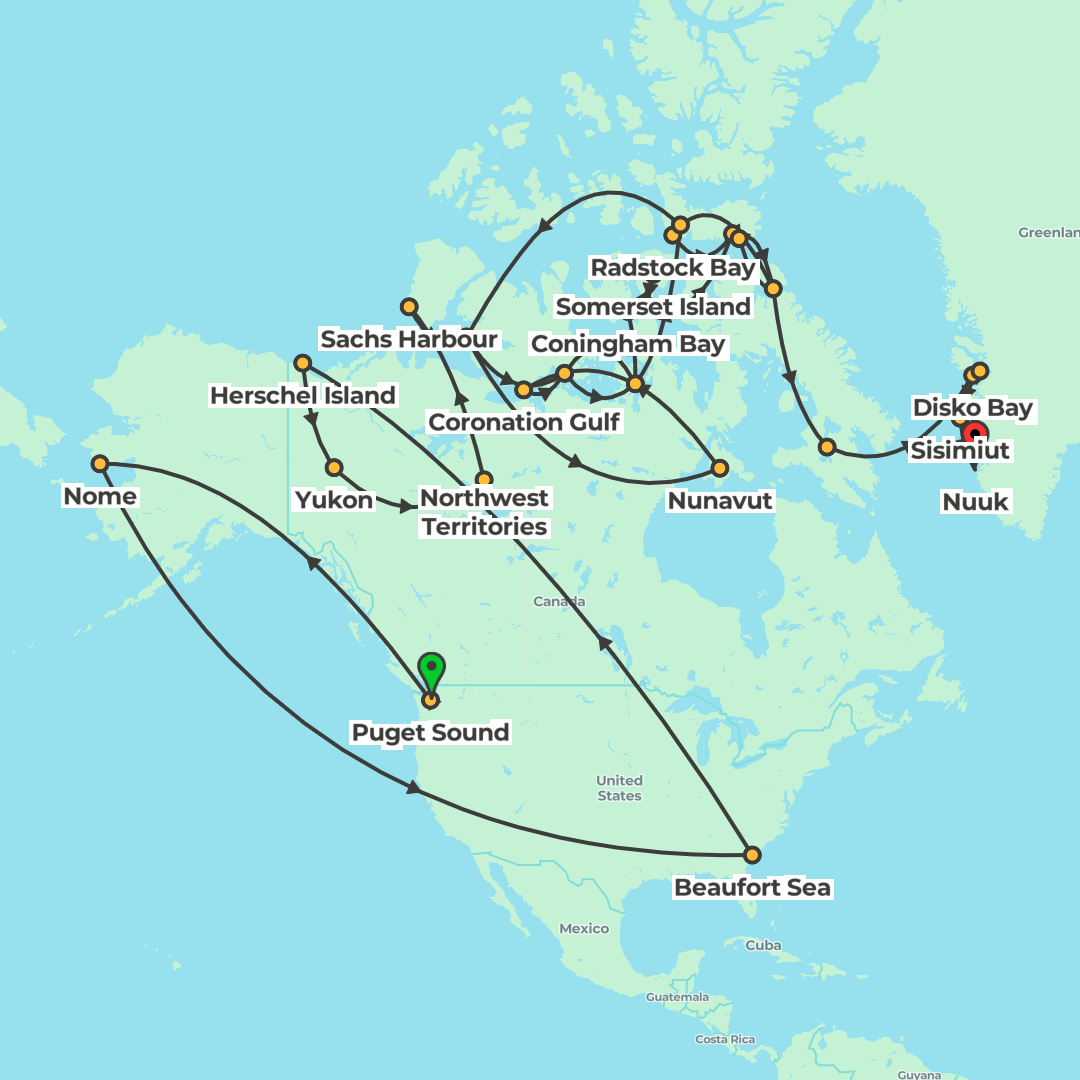
Day 1
Seattle, Washington
Arrive in Seattle and explore highlights such as Olympic Sculpture Park overlooking Puget Sound and Pike Place Market. Overnight in Seattle before tomorrow’s flight to Alaska.
Day 2
Nome, Alaska
Fly early from Seattle to Nome and embark your expedition ship. Nome’s Gold Rush heritage remains visible; it was linked with Wyatt Earp and later Roald Amundsen. Collect your expedition jacket, meet the team, and settle in.
Day 3
Cruising Beaufort Sea
At sea across the Beaufort Sea toward Amundsen Gulf. Join Science and Education talks on wildlife, glaciology, and history, learn from Inuit Cultural Ambassadors, and watch for bowhead and gray whales and Pacific walrus near Point Barrow. Transit highlights include the Bering Strait and the International Date Line.
Day 4
Cruising Beaufort Sea
Cruising Beaufort Sea
Day 5
Cruising Beaufort Sea
Cruising Beaufort Sea
Day 6
Cruising Beaufort Sea
Cruising Beaufort Sea
Day 7
Herschel Island, Yukon
Begin excursions in the Western Canadian Arctic, transiting Nunavut, Northwest Territories, and Yukon across Inuvialuit and Nunavut territories. Expect up to five shore days and four transit days with potential visits to Sachs Harbour, Smoking Hills, Ulukhaktok, Coronation Gulf, Cambridge Bay (Iqaluktuuttiaq), and Gjoa Haven (Uqsuqtuuk).
Day 8
Canadian Arctic
Canadian Arctic
Day 9
Ulukhaktok, Northwest Territories
Ulukhaktok, Northwest Territories
Day 10
At Sea
Today will be spent at sea
Day 11
Cambridge Bay, Nunavut
Cambridge Bay, Nunavut
Day 12
At Sea
Today will be spent at sea
Day 13
Gjoa Haven, Nunavut
Gjoa Haven, Nunavut
Day 14
At Sea
Today will be spent at sea
Day 15
Coningham Bay, Nunavut/Fort Ross, Nunavut
Attempt to navigate Bellot Strait, the 15‑nautical‑mile, half‑mile‑wide channel between mainland North America and Somerset Island that marks the divide between West and East; passage is ice and weather dependent.
Day 16
Canadian Arctic
Enter the Eastern Canadian Arctic near Somerset Island and Lancaster Sound (Tallurutiup Imanga). Weather and ice permitting, plan excursions over five days with potential visits to Fort Ross, Prince Leopold Island (Appait), Beechey Island (Iluvilik), Croker Bay, Dundas Harbour, and Pond Inlet (Mittimatalik).
Day 17
Canadian Arctic
Canadian Arctic
Day 18
Beechey Island, Nunavut/Radstock Bay, Devon Island
Visit Beechey Island off Devon Island in Barrow Strait, a key site in Arctic exploration where Franklin wintered in 1845–46; later used by Edward Belcher (1850) and visited by Roald Amundsen (1903). Declared a Territorial Historic Site in 1975. Continue to Radstock Bay, Devon Island.
Day 19
Croker Bay, Nunavut/Dundas Harbour, Devon Island, Nunavut
Croker Bay, Nunavut. Dundas Harbour, Devon Island, Nunavut.
Day 20
Pond Inlet, Nunavut
Explore Pond Inlet on northern Baffin Island, a predominantly Inuit community known for glaciers, mountains, and nearby Dorset and Thule archaeological sites. Renowned for Inuit printmaking and stone carving.
Day 21
Baffin Bay, Nunavut
At sea crossing Baffin Bay toward Greenland. Attend lectures on Arctic wildlife and exploration, contribute to Citizen Science (e.g., GLOBE cloud observations), engage with Cultural Ambassadors, or relax.
Day 22
Ilulissat (Jakobshavn)
Sail into Disko Bay for West Greenland highlights over three days. Visit Ilulissat at the UNESCO-listed Icefjord with iceberg views and walking trails; continue to Sisimiut, rich in Saqqaq-era history and qiviut crafts; and plan an exploration day in Evighedsfjord near Maniitsoq, the ‘Fjord of Eternity’ with deep waters and iceberg-calving glaciers.
Day 23
Sisimiut (Holsteinsborg)
Call at Sisimiut, just north of the Arctic Circle, where dogsled traditions meet a 4,500-year history. A major northern business center with a fishing economy, it’s noted for museum exhibits and qiviut garments.
Day 24
Evighedsfjorden
Evighedsfjorden
Day 25
Nuuk (Godthaab)
Trip concludes in Nuuk, Greenland’s compact capital of colorful wooden houses and contemporary architecture. Explore the cathedral, Hans Egede House, and the harbor before flying to Reykjavik.
What’s included
What’s not included
Additional information
Bering Strait & Beaufort Sea Wildlife Watch
Scan the horizon with the Expedition Team to watch for bowhead and gray whales, plume-spouting in cold, steel-blue seas. Keep a lookout for pacific walrus hauled out on drifting floes and for seabirds coursing the wind near Point Barrow, the northern tip of the United States.
Weather permitting, feel the pull of history as you sail the Bering Strait—a narrow gateway long used by Indigenous hunters and later by explorers—where currents and light make striking conditions for photography and wildlife spotting throughout the crossing to the Beaufort Sea.
Herschel Island (Qikiqtaruk) Landing: Whalers’ Heritage & Tundra Walk
Land by Zodiac at the protected shores of Qikiqtaruk Territorial Park, where historic buildings at Pauline Cove speak to the boom-and-bust era of Arctic whaling. Walk gently over spongy tundra with your guides, learning how permafrost and hardy plants shape life on the island.
Explore the Inuvialuit story preserved here—traditional travel routes, seasonal camps, and today’s stewardship of wildlife. With luck, spot shorebirds and the telltale prints of fox or musk ox while the wind carries the scent of salt and willow across the gravel beach.
Ulukhaktok Community Visit & Printmaking Traditions
Visit Ulukhaktok to meet artists whose internationally known works capture Arctic life in stonecut and stencil prints. At the community workshop, meet local artists and hear how the Holman printmaking tradition grew from small editions into a celebrated cultural voice.
Learn the stories behind patterned parkas, qajaq motifs, and drum dance scenes as you browse carvings and textiles. Conversations with residents illuminate subsistence practices and the rhythms of life in a remote hamlet facing the Amundsen Gulf’s shifting ice and light.
Cambridge Bay (Iqaluktuuttiaq) Visit & Arctic Research Insights
Walk the shoreline community of Cambridge Bay (Iqaluktuuttiaq), a hub for travel, fishing, and science in the Kitikmeot Region. Guides introduce the local heritage center and the town’s role in polar logistics while sharing everyday life in Nunavut.
Hear about the nearby Canadian High Arctic Research Station network and the saga of Amundsen’s Maud, once iced-in here before her repatriation to Norway. The mix of modern research and ancient knowledge offers a living portrait of adaptation on the Arctic tundra.
Gjoa Haven Heritage Walk: Amundsen & Inuit Traditions
Explore Gjoa Haven (Uqsuqtuuq), where Roald Amundsen wintered during his first successful transit of the Northwest Passage. At the Nattilik Heritage Centre, exhibits and guides share Inuit technologies—sleds, hunting tools, and clothing perfectly tuned to the polar environment.
Hear how oral histories preserved knowledge of the Franklin search and how community life follows the seasons—sea-ice travel, seal hunting, and storytelling that binds generations to land and sea. The town’s sheltered harbor and low, wind-swept tundra set a stark, beautiful scene.
Coningham Bay Polar Bear & Beluga Discovery
Keep cameras ready as you approach Coningham Bay, a shallow inlet where tides and currents concentrate belugas. In late season, the shoreline can draw polar bears attracted to stranded prey—an intense window into Arctic predator–prey dynamics.
Guides position the ship or Zodiacs for safe, respectful viewing while interpreting the ecology of beluga whales and sea-ice change. The scene—pale sandbars, glassy water, and white backs rolling in the swell—creates powerful wildlife moments in a remote corner of Nunavut.
Bellot Strait Ice Navigation between Somerset Island & Boothia Peninsula
Sail a legendary bottleneck as you transit the Bellot Strait, a 15-nautical-mile corridor cleaving Somerset Island from the Boothia Peninsula. Tidal rips, bergy bits, and narrow headlands make this a masterclass in ice pilotage and seamanship.
On deck, feel the scale of the Arctic Archipelago as cliffs tighten and currents race past the bow. Your Expedition Team recounts how Indigenous travel and later trading voyages used this shortcut, linking the western and eastern reaches of the Passage.
Fort Ross Hudson’s Bay Company Post
Step ashore at Fort Ross, the stark remains of a Hudson’s Bay Company post opened in 1937 and abandoned a decade later. Walk between weathered buildings, peering into storerooms that once held furs, tea, and staples ferried by ship and sled.
Guides trace the supply routes that threaded Bellot Strait and the realities of trading in a region where ice closes early and opens late. The silence, broken only by wind and gulls, underlines the human resilience required to live and work here.
Prince Leopold Island (Appait) Seabird Cliffs Zodiac Cruise
Bundle up for a Zodiac safari beneath the sheer walls of Prince Leopold Island (Appait), where hundreds of thousands of birds wheel and cry. These seabird cliffs in Lancaster Sound host thick-billed murres, black-legged kittiwakes, and northern fulmars in nesting season.
Naturalists explain why upwelling currents concentrate plankton and fish here, fueling this Arctic metropolis. The scale—dark rock streaked white, ledges stacked with life—makes for arresting photography and a visceral sense of nature’s abundance in a short polar summer.
Beechey Island Franklin Expedition Graves & Cairn
Come ashore at Beechey Island (Iluvilik) to view the Franklin Expedition graves and memorials, solemn markers from the fateful winter of 1845–46. Walk the gravel spit and feel the stillness where ships once lay frozen into the strait.
Guides recount search expeditions, from Parry and Belcher to Amundsen’s later visit, and how discoveries here reshaped understanding of those vanished crews. The weathered graves and memorials, the wind, and the Arctic light together evoke the endurance—and cost—of polar ambition.
Radstock Bay, Devon Island: Tundra Hike & Thule Sites
Go ashore at Radstock Bay on vast Devon Island, the world’s largest uninhabited island. Hike over patterned ground to low archaeological remains linked to the Thule culture, ancestors of today’s Inuit, set against a skyline of layered sedimentary hills.
Naturalists highlight hardy saxifrages, Arctic willow, and signs of musk ox while interpreting how families once moved seasonally through this landscape. The tranquility of the bay and the echo of past dwellings invite quiet reflection as you explore.
Croker Bay Tidewater Glacier Zodiac Cruise
Bundle into expedition gear for a Zodiac cruise among brash ice and bergy bits to the face of the tidewater glacier in Croker Bay. Listen for the thunder of calving and watch electric-blue crevasses glow in subdued polar light.
Your driver idles at a safe distance while naturalists discuss glacial flow, seal haul-outs on floes, and how freshwater melt shapes the bay’s ecology. The interplay of silence and sudden icefall sets a thrilling, photogenic scene.
Dundas Harbour, Devon Island: RCMP Post & Arctic Tundra
Walk across windswept tundra to the forlorn buildings of the RCMP post at Dundas Harbour, an outpost from the 1920s and ’30s established to signal Canadian sovereignty in the High Arctic.
Hear how patrols were conducted by dog team and how extreme isolation shaped daily routines. Among lichened stones and cotton grass, look for musk ox tracks and Arctic fox dens—signs that, though people left, the land remains very much alive.
Pond Inlet Community & Sirmilik Views
Experience Pond Inlet (Mittimatalik), a predominantly Inuit community framed by glaciers and sawtooth peaks. Meet local hosts and browse the cooperative for carvings and prints, then gaze across Eclipse Sound toward Sirmilik National Park and Bylot Island’s bird cliffs.
Guides share stories of narwhal migrations and sea-ice travel routes that converge here each season. The clarity of Arctic light, the bright houses, and the close presence of mountains make this one of Nunavut’s most photogenic settlements.
Disko Bay Whale & Iceberg Watch
Take your place on deck to scan Disko Bay for arching backs and tail flukes as humpbacks and minkes feed among vast ice sculptures. The drifting fleet of whales and icebergs sets an ever-changing stage in soft Arctic light.
Naturalists interpret the life cycle of ice discharged from Sermeq Kujalleq and the krill and capelin that draw whales into the bay. Photographers will relish mirrored reflections, blue strata, and the crackling fizz of ancient air escaping melting ice.
Ilulissat Icefjord UNESCO Walk to Sermermiut
Set out on a guided walk along the Sermermiut boardwalk to viewpoints over the Ilulissat Icefjord UNESCO World Heritage Site. Feel the wooden planks hum underfoot as you near the fjord’s edge, where skyscraper bergs drift from Sermeq Kujalleq, one of the fastest-flowing glaciers on Earth.
Guides share stories of ancient settlements once clustered here, where whales, seals, and seabirds sustained life for millennia. The soundscape—distant cracks and groans of ice—adds drama to sweeping views perfect for thoughtful pauses and photography.
Sisimiut Town & Qiviut Traditions
Explore colorful Sisimiut, just north of the Arctic Circle, where sled culture and seafaring meet modern industry. Visit the town museum and artisan workshops to learn about qiviut, the prized musk ox underwool spun into remarkably warm garments.
Wander old wooden houses painted in bright hues, with peaks and fjords as a constant backdrop. Conversations with residents reveal how dogsledding, fishing, and craftsmanship continue to anchor identity in Greenland’s fast-growing northern city.
Evighedsfjord (Fjord of Eternity) Glacier-Fed Fjord Cruise
Enter the dramatic corridor of Evighedsfjord (Fjord of Eternity), where steep walls funnel katabatic winds and calving glaciers feed deep, cobalt waters. From ship or Zodiac, trace waterfalls and polished rock sluices veined with snow.
Naturalists explain how ice caps above Maniitsoq carve this landscape, creating misty mountain passes and turquoise melt pools. The fjord’s shifting weather—sun shafts, fog curtains, echoing icefalls—makes it a highlight for photographers and lovers of raw, sculpted geology.
Nuuk City Highlights: Hans Egede House, Cathedral & Parliament
Discover Greenland’s capital on a guided orientation visiting the Hans Egede House, 18th-century home of the missionary who founded Nuuk; the red-painted Nuuk Cathedral overlooking the old harbor; and the bold, modern lines of the Parliament of Greenland.
Along the waterfront and in the historic quarter, learn how colonial-era buildings mix with contemporary architecture, reflecting a society balancing tradition and self-governance. Colorful houses, mountain backdrops, and maritime bustle frame a compact, compelling Arctic capital.
Optional Sea Kayaking in Arctic Waters
Glide quietly on a guided sea kayaking outing, using stable expedition kayaks to paddle among icebergs and along rocky shores in sheltered bays. With a small ratio of guides to paddlers, this immersive experience heightens the scale of cliffs, ice, and silence.
This is an optional, limited-capacity activity at additional cost, bookable on tour and operated when conditions allow. Routes vary by destination and weather; your guides select quiet coves and calm waters to maximize scenery, wildlife chances, and safety.
Citizen Science & Expedition Lectures at Sea
Engage your curiosity as you join a programme of expert lectures on Arctic wildlife, sea ice, and the great age of polar exploration. Between deck time and the observation lounge, meet our Cultural Ambassadors for perspectives on Inuit heritage and lifeways across the North.
Contribute observations to Citizen Science initiatives such as the GLOBE Program, recording clouds and sea conditions that feed real climate research. These sessions deepen what you see on deck—linking bowhead migrations, iceberg forms, and pack-ice dynamics to the stories of people who call the Arctic home.
