
Your itinerary
Day 1
Nuuk (Godthaab)
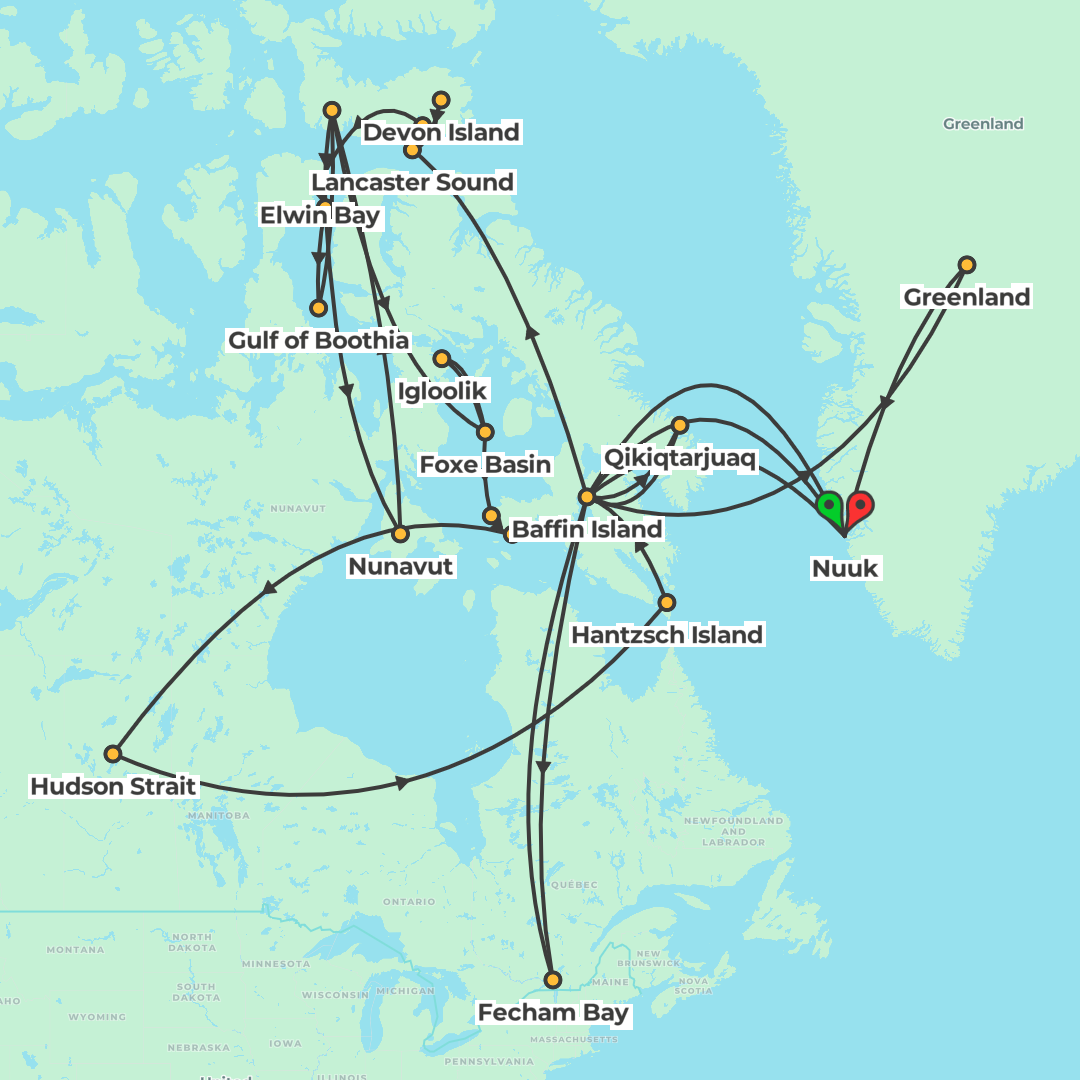
Gateway to the Greenlandic Arctic Flight from Reykjavik to Nuuk. Greenland’s compact capital is set along a deep fjord system framed by rugged mountains. Despite its small scale, the city is a vibrant centre of modern Greenlandic life. If time allows, you can explore the harbour, museums, and historic districts before embarkation. Nuuk is also where you start to feel the essence of the Arctic: ice, sea, and the mountainous peaks of Quassussuaq and Ukkusissat. Once on board, meet the Expedition Team, settle into your cabin, and we’ll begin the voyage north and west towards Baffin Island.
Day 2
Cruising
A day at sea As Nuuk fades into the distance, we begin our first sea passage into the waters of Baffin Bay. Look out for seabirds following the ship and watch as the landscape begins to shift. This is a time of orientation: both practical and environmental. With onboard lectures, you’ll get an introduction to ice navigation, wildlife patterns, and Arctic history, while the landscape slowly transforms from coastal Greenland into open polar seascape.
Day 3
Qikiqtarjuaq, Nunavut
Ice-carved coasts and living Arctic communitiesThe eastern edge of Baffin Island reveals some of the most dramatic scenery in the Arctic: steep mountains, deep fjords, and glaciers descending directly into the sea. Sea ice often lingers here, shaping access and movement throughout the region. In settlements such as Qikiqtarjuaq, life is in close connection with land and sea, where hunting, fishing, and travel remain guided by environmental conditions. Zodiac cruising and shore landings, where possible, offer encounters with this immense coastal landscape and its wildlife-rich waters.
Day 4
Kangok Fjord
Kangok Fjord
Day 5
Baffin Island, Nunavut
Baffin Island, Nunavut
Day 6
Fecham Bay
Fecham Bay
Day 7
Baffin Island, Nunavut
Science at seaTime at sea allows the scale of the region to settle in. Baffin Island’s vast coastline stretches behind while new regions approach ahead. Sea conditions can shift rapidly, from open water to scattered ice, requiring constant observation and adaptation. Onboard life continues with lectures and sessions that bring the Arctic environment into focus: how ice forms, how ecosystems function, and how navigation in these waters is shaped by nature rather than fixed routes.
Day 8
Dundas Harbour, Devon Island, Nunavut/Croker Bay, Nunavut
Gateway to the Northwest Passage Lancaster Sound is one of the most important waterways in the Arctic. It’s a historic entry point into the Northwest Passage. We’ll pass towering cliffs and deep channels along the coast of Devon Island, which is the largest uninhabited island on Earth. Conditions permitting, we may visit Beechey Island, an important historical site associated with early Arctic exploration, including Sir John Franklin’s 1845 expedition.
Day 9
Elwin Bay, Prince Regent Inlet, Nunavut
Elwin Bay, Prince Regent Inlet, Nunavut
Day 10
Exploring Canada’s High Arctic
Into the shifting iceSailing deeper into the Canadian High Arctic, the environment becomes more enclosed and remote. Prince Regent Inlet and the Gulf of Boothia are defined by long, quiet waterways, low-lying tundra, and the first patches of sea ice forming in the late Arctic autumn. With a little luck and patience, wildlife such as ringed or bearded seals may make an appearance along the ice edges.
Day 11
Exploring Canada’s High Arctic
Exploring Canada’s High Arctic
Day 12
Igloolik, Nunavut
Wide seas and Inuit homelandsFoxe Basin opens into a vast, shallow sea bordered by low tundra and distant, broken coastline. It feels open and exposed: water and sky blending at the horizon, with few landmarks to hold onto. Over these few days, you move through a landscape shaped by long Thule and Inuit presence. Over 100 stone cairns called ‘inuksuit’ line the tundra at Enukso Point, some dating back 2,000 years. In Igloolik, a small hamlet literally translating as ‘there is a house here’, it’s easy to see how life remains closely tied to sea ice, hunting, and the seasonal rhythm of the land.
Day 13
Foxe Basin
Foxe Basin
Day 14
Harkin Bay/Inuksuk Point
Harkin Bay; Inuksuk Point
Day 15
Cape Dorset, Nunavut
Where Arctic meets Atlantic influenceAt the gateway between the Canadian Arctic and North Atlantic, Hudson Strait separates Baffin Island from northern Quebec. It’s known for strong tides, powerful currents, and fast-changing weather as wind funnels through the channel. September and October are when the Arctic starts to shift; you begin to see drifting fragments of sea ice reappearing: sometimes remnants of older ice carried in on currents and in sheltered areas, the first thin new ice forming at the surface. It’s not winter yet, but you’re watching it arrive in real time. We aim to call at Kinngait (Cape Dorset), one of Nunavut’s most important cultural communities, internationally known for Inuit printmaking and sculpture. Zodiac cruising and shore visits bring you close to a working Arctic coastline.
Day 16
Cruising Hudson Strait
Cruising Hudson Strait
Day 17
Hantzsch Island
Hantzsch Island
Day 18
Cruising
The long return through open waterss the circumnavigation nears completion, time at sea becomes reflective. The Arctic landscapes of Baffin Island gradually recede as we move back toward Greenland. Ice becomes less dominant, replaced by longer stretches of open water and broader ocean conditions. This is the perfect time to relax on board, perhaps chat with new friends in the Explorer Lounge & Bar, and catch up on any lectures you may have missed. If you haven’t tried the hot tubs yet, now’s your moment.
Day 19
Nuuk (Godthaab)
Return to Greenland’s capitalOur voyage concludes in Nuuk, marking the completion of our circumnavigation around Baffin Island. Say a fond farewell to the ship, Expedition Team, crew, and fellow travellers as you step ashore for the final time. Nuuk feels like a metropolis after the remote Arctic communities you’ve visited, yet it remains closely tied to its fjord setting. Colourful houses line the water’s edge, where fishing boats, modern infrastructure, and cultural institutions sit side by side, reflecting a city balancing tradition with contemporary Greenlandic life. Take time to explore the harbour, museums, or nearby historic areas before you fly to Reykjavik, which brings your full Arctic journey to a close.
What’s included
What’s not included
Additional information
Arctic Lecture Program & Science Sessions
While at sea, join expert-led lectures that decode Arctic wildlife and sea ice, the human story of exploration, and the history of the Northwest Passage. Learn how navigation is shaped by nature here—by wind, current, and pack ice rather than fixed routes.
Between talks, step onto open decks to practice seabird ID and horizon scanning with the team. Short workshops introduce field techniques, from reading floe edges to observing marine mammals responsibly.
Qikiqtarjuaq Zodiac Cruise & Shore Landing
Launch by Zodiac along Baffin Island’s east, tracing ice-carved fjords beneath steep Baffin mountains. Guides position the craft to read currents and ice, pausing where upwellings attract seals and seabirds and the light sculpts glacier-polished rock.
Conditions permitting, step ashore to feel the scale of this coastal world where travel, hunting, and seasons remain linked to the sea. Learn how community life in Qikiqtarjuaq adapts to lingering drift ice and changing weather patterns.
Kangok Fjord Zodiac Exploration
Trace calm water between sheer walls on a guided Zodiac as you weave through brash ice and mirrors of sky. Your driver finds sheltered coves for photography, inviting you to pause for photos and reflection amid towering fjord scenery and drifting bergy bits.
Discuss the glacier that carved this channel and the rock’s striations, evidence of ancient ice in motion. The stillness carries only the slap of small waves and the soft clink of ice against the hull.
Devon Island: Dundas Harbour Ruins & Croker Bay Glacier Cruise
Step ashore on the world’s largest uninhabited island to visit the Royal Canadian Mounted Police outpost ruins at Dundas Harbour. Low tundra, quiet graves, and weathered buildings evoke early patrols that connected distant Arctic communities.
Later, board Zodiacs to nose through brash ice at Croker Bay toward a tidewater glacier face. Listen for cracks and pops, and watch for kittiwakes working the nutrient-rich meltwater line where the glacier meets the sea.
Beechey Island: Franklin Expedition Historic Site (Conditions Permitting)
Visit Beechey Island, a stark strand at the gateway to the Northwest Passage, where memorials and graves from the Franklin expedition of 1845 rest on the wind-scoured shore. Guides interpret timelines, findings, and the enduring mysteries.
Walk carefully on the pebble spit to absorb the scale of 19th-century exploration. The Arctic silence, broken only by surf and wind, frames a sobering chapter in polar history.
Elwin Bay Cliffs Zodiac Cruise, Prince Regent Inlet
Explore by Zodiac beneath sheer sandstone cliffs that shelter nesting seabirds. The team positions the boat for safe views of ledges alive with life and the sculpted scree fans that meet the cold sea.
Hear how geology and currents concentrate food along cliff bases, drawing murres and gulls in season. Keep watch along the shoreline for movement—a fox on patrol or seals hauled out on ice if conditions align.
Ice-Edge Wildlife Watch: Prince Regent Inlet & Gulf of Boothia
From deck and Zodiac, scan the ice edges where life gathers—ringed and bearded seals surfacing along new skim ice and floes riding quiet swells. Guides explain leads, polynyas, and how predators track openings in the pack.
The hush of these quiet, far-north waterways invites patience. With binoculars ready, learn to read subtle cues on the water—ripples, birds working a line, sudden breath in the cold air.
Igloolik Community Visit & Inuit Culture
Go ashore in Igloolik to meet community hosts and hear how Inuit lifeways shaped by sea ice continue today. Walk the hamlet’s shoreline, noting sled routes, working boats, and storied names that map generations to the land.
Discover the meaning behind Igloolik—“there is a house here”—and how seasonal rhythms guide hunting, travel, and celebration. Respectful conversations bring nuance to Arctic history and contemporary life.
Inuksuk Point Stone Cairns Walk (Harkin Bay Landing)
Land by Zodiac at Harkin Bay and walk among more than a hundred inuksuit at Inuksuk Point. These ancient wayfinding markers rise from the tundra like silhouettes, each with a purpose—guidance, hunting aid, or message across time.
On the windswept Foxe Peninsula, your guide shares how stone, skyline, and memory intertwine in Inuit culture. Photographs capture forms against the sea, but it’s the quiet significance that lingers.
Kinngait (Cape Dorset) Inuit Art & Shore Visit
Go ashore in Kinngait to learn why it is renowned for Inuit printmaking and sculpture. Meet local guides, hear about stone selection and themes drawn from daily life and wildlife, and, if schedules align, visit an artists’ co-operative to see works in progress.
From mid-century prints to contemporary carvings, Kinngait’s artistry has traveled worldwide. Shore time also reveals a working Arctic coastline—boats, tides, and the rhythm of a creative community.
Foxe Basin Ice & Walrus Watch
From the bow and observation decks, watch shallow polar sea light play across drift ice while scanning for walrus haul-outs. Guides point out floe edges and resting pans where these powerful pinnipeds gather.
Learn how the basin’s broad shelf nurtures rich bivalve beds that feed walrus, and why tides and wind constantly redraw the ice map. Quiet patience often rewards with distant grunts, tusks, and whiskered faces.
Hudson Strait Scenic Transit & Wildlife Watch
Cross the channel that funnels weather and tide between Baffin Island and northern Québec. Feel the ship work powerful tides and wind funnels while you frame open strait vistas and scan active seabird flyways.
Guides explain how Atlantic and Arctic waters meet here, shaping fast currents and shifting fronts. It’s a moving classroom for reading sea states, cloud banks, and the anatomy of a high-latitude passage.
Hantzsch Island Migratory Bird Sanctuary Cruise
Circle the base of Hantzsch Island Migratory Bird Sanctuary by Zodiac to hear the living roar of crowded bird cliffs. Guides keep a respectful distance while you study flight lines of auks and gulls stitching the air above black-green water.
Geology, nutrients, and wind create ideal nesting ledges in this remote corner of Hudson Strait. Late-season light and weather lend drama to the rock, sea, and wingbeat choreography.
Sea Kayaking in Polar Waters
Slip into a drysuit, settle your spray skirt, and paddle in a small group with a polar guide among ice pans and sheltered coves. Kayaks offer a hush that brings you closer to the soft clink of ice and the texture of glacier-scored rock.
This is an optional activity at additional cost, bookable on tour and strictly weather- and safety-dependent. Group size is limited to keep the experience quiet, focused, and nimble.
Small-Group Photography Zodiac Masterclass
Join the expedition photographer for targeted field time, refining composition, exposure, and ice-metering while chasing dramatic Arctic light. With fewer guests aboard, the driver can reposition for texture on sea ice, cliff lines, and wildlife at ethical distances.
This workshop is an optional add-on at additional cost, bookable on tour and subject to conditions. It suits keen beginners and enthusiasts looking to elevate polar imagery without missing core landings.
Nuuk Harbour Orientation & Expedition Briefing
Begin your voyage in Greenland’s capital as you meet the Expedition Team and receive a thorough safety and Zodiac briefing. From deck, take in Nuuk’s colourful waterfront set against mountain-backed fjords, where small fishing boats and modern life share the deep inlet.
Get a clear picture of the sailing plan toward Baffin Island, sea-ice expectations, and wildlife protocols. This focused introduction anchors the expedition mindset—respect for weather, ice, and communities—before casting off into Greenland’s grand fjord system.
