What’s included
What’s not included
Additional information
Itinerary
In Flanders Fields
LeShuttle to Calais and on to our first stop, Vimy Ridge Memorial, Canada’s largest national memorial found overseas and unveiled by Edward VIII in July 1936. The gleaming marble monument honours 60,000 Canadians who gave their lives in France, many during the successful battle for Vimy Ridge, a seven-kilometre ridge with important views over the Allied lines. Our next visit is the Arras Memorial in the Faubourg d’Amiens British Cemetery, which commemorates a further 35,942 soldiers who died in the Arras district with no known grave.
We then stop in the historic city of Arras itself, famous for the UNESCO-listed Gothic tower which overlooks the town square, before we cross into Belgium to check into the Alize Hotel in Mouscron.
In Flanders Fields
- We visit various locations around Ypres and Passechendaele, the scenes of some of the biggest battles in the First World War. The area serves as a place of pilgrimage and memorial, and our guide leads us to several different places to pay our respects. We start with Sanctuary Wood Museum, one of the few places on the Ypres Salient where a British trench system can be seen, discovered and preserved by a farmer who returned to reclaim his land after the war. Be sure to take in the battlefield relics and objects of interest inside the museum, such as a British Army cook’s wagon.
- Next is Hooge Crater, created by a massive mine explosion detonated by British forces on 19th July 1915 during the Battle of Hooge. The site now houses a museum, which features a rich collection of artefacts, photographs and displays that bring the history of the war and the battle fought here to life.
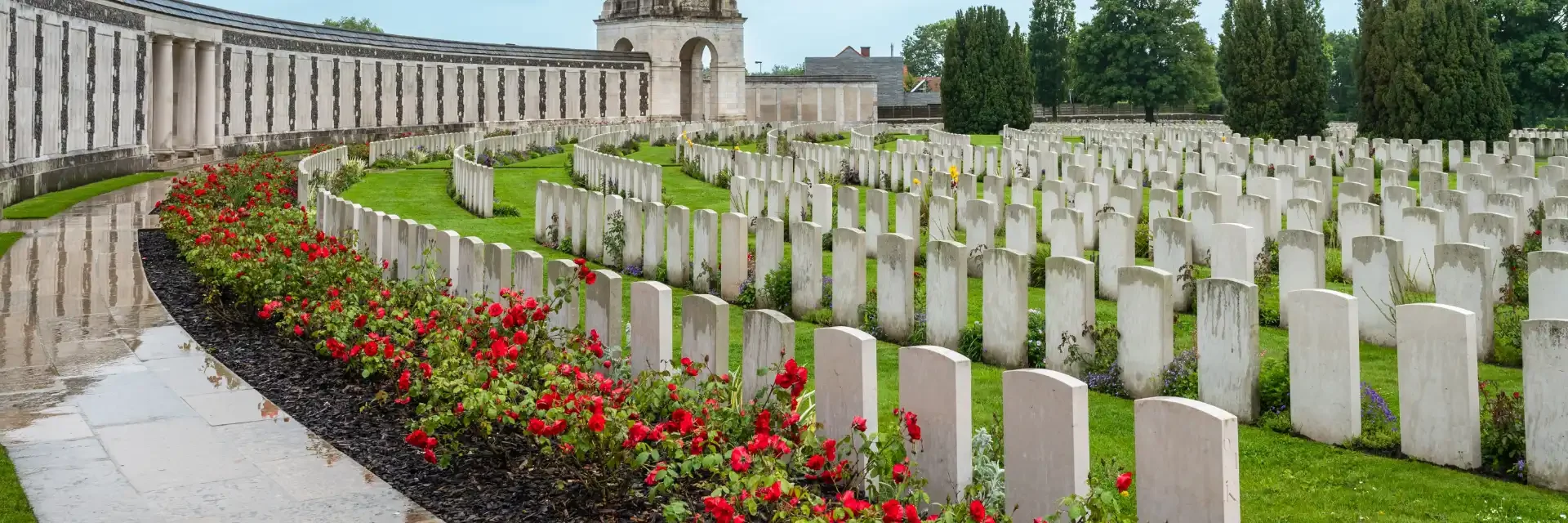
- We then head to Tyne Cot Cemetery. The largest Commonwealth Cemetery on the Western Front, it is located in what was once the Ypres Salient, a strategically significant location where French, Belgian, German and Commonwealth soldiers fought almost continuously during World War One. Originally honouring 343 fallen soldiers, the site was largely expanded after Armistice Day on 11th November 1918, mainly by concentrating graves from the surrounding battlefields and smaller cemeteries. Although 11,961 servicemen were eventually laid to rest here, a staggering 8,373 of the burials are sadly unidentified, with a further 34,991 names forever etched onto the Memorial to the Missing.
- Passchendaele Canadian Memorial, our next stop, commemorates the valiant efforts of the Canadian Corps during the Battle of Passchendaele in 1917. The site marks a pivotal moment where Canadian forces played a crucial role in capturing the ridge after weeks of relentless fighting in treacherous conditions. Now surrounded by landscaped grounds, the memorial offers a serene place to pause and reflect on the sacrifices made by the soldiers.
- We then head into central Ypres where there is free time to find dinner at leisure, before our last visit of the day to the Menin Gate. This is where the city’s daily act of remembrance, The Last Post, is played in honour of those who fell in the Ypres Salient from 1914-1918. At exactly 8pm every evening, the police stop traffic around the memorial to let the buglers complete the world-famous fanfare.
In Flanders Fields
- After breakfast, we explore key sites of the Somme, beginning with the medieval town of Peronne on the River Somme, well known for its Museum of the Great War, which, as we see, documents the military, social and cultural effects of WWI. Following time for lunch, we move on to Lochnagar Crater, once the Western Front’s deadliest square mile. The large crater was formed when a mine detonated underneath the German front line on 1st July 1916, caused by the British Army’s 179th Tunnelling Company Royal Engineers (nicknamed ‘The Moles’). This explosion signified the start of the Battle of the Somme, and this day was to become the bloodiest day in the history of the British Army, with 57,000 casualties.
- We continue to the Beaumont-Hamel Newfoundland Memorial Park, the largest protected battlefield site of the Somme area, with harrowing trench lines and shell holes visible on both sides. It’s also one of the few places where no-man’s land can be seen in a preserved natural state, and the extensive park is also home to a visitor centre, cemeteries and memorials, including the Caribou statue, the symbol of the Newfoundland Regiment. Apart from the Vimy Ridge Memorial, this is the only National Historic Site of Canada located outside North America and, as of September 2023, is recognised as a UNESCO World Heritage Site.
- Next, we head to Thiepval Memorial to the Missing of the Somme, which commemorates 72,337 British and South African servicemen who were killed on the Somme battlefields between July 1915 to February 1918. Seven Victoria Cross recipients are honoured here, and on top of the red-brick arch, a French inscription reads “Aux armées Francaise et Britannique l’Empire Britannique reconnaissant: To the French and British Armies, from the grateful British Empire.” Please note that entrance to the museum here is not included.
In Flanders Fields
We check out of our hotel and begin our journey home. En route, we return to Ypres for a morning at leisure for you to spend as you wish. You may like to enjoy a spot of shopping, a relaxed meal or choose to visit the In Flanders’ Fields Museum, located in the historic Cloth Hall. Through interactive exhibits, personal stories and a vast collection of artefacts, the museum provides a comprehensive look at the war’s impact on the region and its people, with a unique poppy bracelet system that personalises the experience by connecting guests to specific wartime stories. Later, we continue to Calais for our journey home on LeShuttle.
Beaumont-Hamel Newfoundland Memorial Park
Explore Beaumont-Hamel Newfoundland Memorial Park, where preserved trenches, shell holes and the ground between opposing lines reveal the shape of a Somme battlefield. The bronze Caribou memorial honours the Newfoundland Regiment, which suffered devastating losses here on 1 July 1916.
Unlike many former battlefields, much of this landscape remains recognisable. Its cemeteries and memorials invite a closer understanding of the distances soldiers faced and the lasting significance of the site to Newfoundland.
Thiepval Memorial to the Missing of the Somme
Visit the Thiepval Memorial to the Missing, the immense brick-and-stone arch that overlooks the Somme battlefields. Its piers record the names of more than 72,000 British and South African servicemen who died in the area and have no known grave.
Designed by Sir Edwin Lutyens, the memorial also commemorates the shared efforts of the British and French armies. Its commanding position and walls of individual names give form to losses that cannot be marked by graves. Museum admission here is not included.
Canadian National Vimy Memorial
Visit the Canadian National Vimy Memorial, whose pale stone towers rise above the ridge captured by Canadian forces in April 1917. Walk the memorial grounds and take in the wide views that made this high ground strategically important.
The monument honours Canadians who served and died in France during the First World War; its walls bear the names of those with no known grave. The scale of the site offers space for reflection on Canada’s wartime sacrifice.
Arras Memorial
Pay your respects at the Arras Memorial within the Faubourg d’Amiens Cemetery, where stone colonnades record the names of Commonwealth servicemen who died in the Arras sector without a known grave. The visit brings individual names into focus amid the cemetery’s ordered rows.
Arras was the centre of a major Allied offensive in 1917. Here, the human cost of the fighting is conveyed not through a battlefield panorama, but through the memorial’s long sequence of inscriptions.
Historic Arras Visit
Explore the centre of historic Arras, a northern French city known for its broad squares and distinctive arcaded facades. Look towards the UNESCO-listed belfry, which rises above the Town Hall and recalls the civic pride of this former trading centre.
The city’s Flemish-influenced architecture offers a different perspective on a region often viewed through its battlefields. Rebuilt after extensive First World War damage, its squares retain a strong sense of local life and architectural continuity.
Sanctuary Wood Museum & Preserved Trenches
Walk through the preserved British trench system at Sanctuary Wood, one of the few surviving trench sites around the Ypres Salient. Its uneven ground and narrow passages give a tangible sense of how soldiers occupied this contested landscape.
Inside the Sanctuary Wood Museum, examine battlefield relics and wartime objects, including a British Army cook’s wagon. The trenches were preserved by a farmer who returned to his land after the war, giving the site an unusually direct connection to its aftermath.
Hooge Crater Museum
Visit the Hooge Crater Museum near Ypres to examine artefacts, photographs and displays from the fighting on the surrounding Salient. The collections place everyday military objects alongside the larger story of a battlefield repeatedly fought over.
Nearby Hooge Crater was created by a British mine explosion in July 1915. Seeing the museum at the site of the fighting helps connect the physical landscape with the experiences of those who served there.
Tyne Cot Cemetery & Memorial
Walk among the graves at Tyne Cot Cemetery, the largest Commonwealth war cemetery in the world. Its rows of headstones extend across ground fought over during the battles around Ypres, while the memorial walls carry thousands of names of those still missing.
Many of the people buried here remain unidentified. The cemetery’s vast scale and quiet view across the former Ypres Salient make it a particularly powerful place to consider the losses of the Passchendaele campaign.
Passchendaele Canadian Memorial
Pause at the Passchendaele Canadian Memorial, set in landscaped grounds close to the village and ridge that Canadian forces captured in 1917. The restrained stone monument provides a place to consider what was won across terrain once churned by shellfire and rain.
The Battle of Passchendaele became synonymous with mud, attrition and heavy losses. This memorial honours the Canadian Corps’ role in the final advance and gives the surrounding fields a deeper historical meaning.
Menin Gate & Last Post Ceremony
Stand beneath Ypres’ Menin Gate Memorial for the Last Post ceremony, a daily act of remembrance performed by buglers at 8pm. Traffic falls silent as the notes sound beneath the arch, whose walls bear the names of Commonwealth soldiers missing from the Ypres Salient.
The gate stands on a route soldiers took towards the front. That connection, together with the ceremony’s continuing local tradition, makes this a moving communal tribute rather than a conventional monument visit.
Péronne Museum of the Great War
Explore the Museum of the Great War in Péronne, set beside the town’s medieval castle near the River Somme. Its exhibits examine military life alongside the social and cultural effects of the conflict, offering context for the surrounding battlefield sites.
Objects and displays illuminate experiences on different sides of the front, from soldiers’ equipment to civilian life. This broader view of the First World War helps reveal how the fighting reshaped communities as well as landscapes.
Lochnagar Crater
Stand at the edge of Lochnagar Crater, a vast depression left by a British mine detonated beneath German positions on 1 July 1916. Its scale makes the underground preparations for the Battle of the Somme strikingly visible.
The explosion marked the opening of an offensive whose first day became the bloodiest in British Army history. Looking across the crater offers a stark sense of the battlefield’s violence and of the tunnellers’ role in the assault.
In Flanders Fields Museum, Ypres
Choose to visit the In Flanders Fields Museum inside Ypres’ historic Cloth Hall. Interactive exhibits, personal accounts and wartime objects explore how the First World War affected both the battlefields around the city and the people who lived among them.
A poppy-bracelet system connects visitors with individual wartime stories, making the wider history more personal. This museum visit is optional, at additional cost and bookable on tour.