
Your itinerary
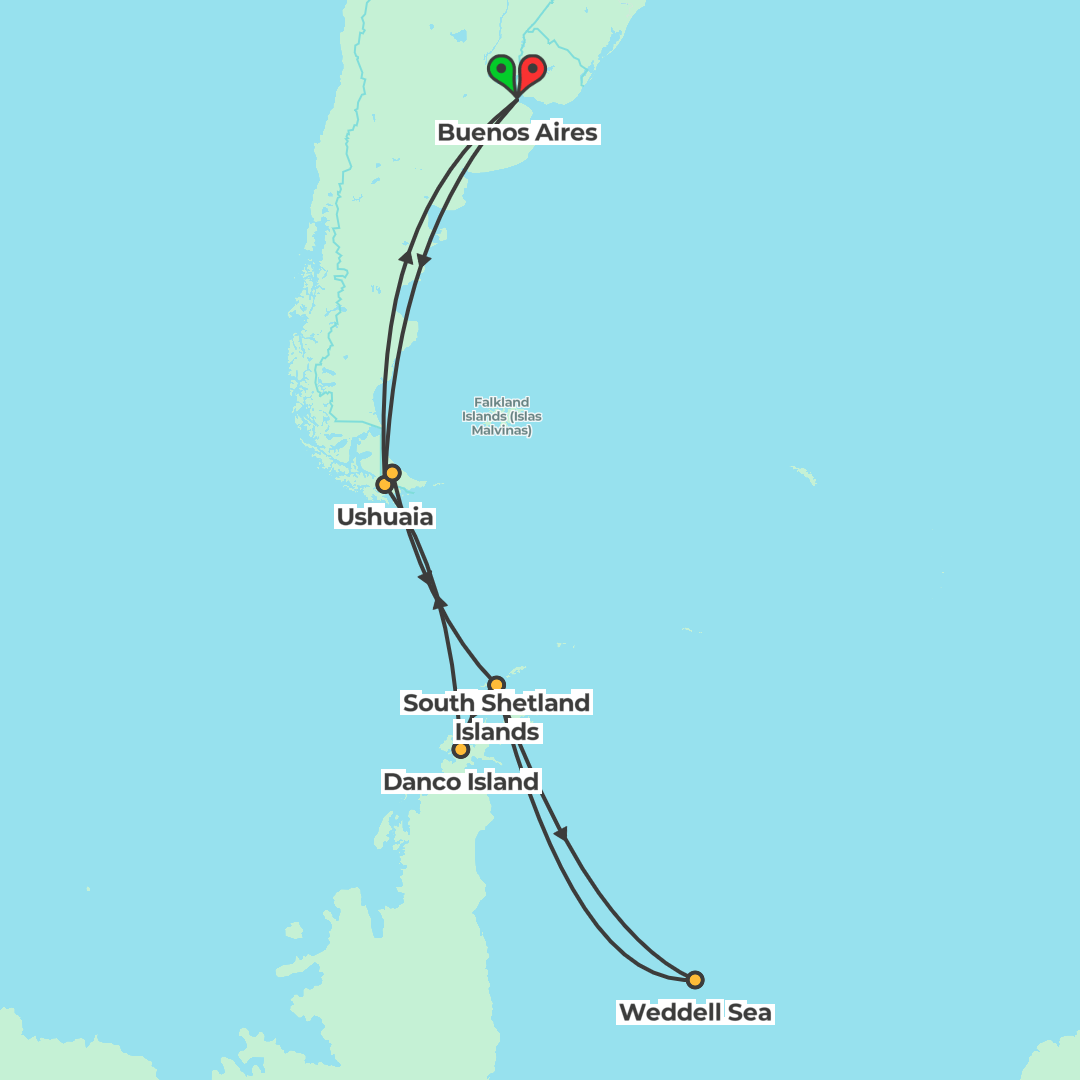
Day 1
Buenos Aires
Enjoy an overnight stay in Buenos Aires. Explore the city’s European-Latin flair, try parrillas for Argentine steak, and experience the tango. Optional extra nights or a Pre-Programme are available.
Day 2
Ushuaia
Early morning flight to Ushuaia, capital of Tierra del Fuego. Embark your hybrid-powered expedition ship, attend a briefing with the Expedition Team, settle into your cabin, and set sail.
Day 3
Drake Passage Seas
Cross the Drake Passage. Visit the onboard Science Centre, attend lectures on Antarctica’s history, science and environmental topics, join Citizen Science projects, and enjoy the spa, dining venues and the Explorer Lounge & Bar.
Day 4
Drake Passage Seas
Drake Passage Seas
Day 5
South Shetland Islands
Experience Antarctica’s glaciers, icebergs and wildlife including penguins, leopard seals, whales and seabirds. The Captain adapts plans to conditions; across the coming days aim to spend at least one day in the South Shetland Islands, Antarctic Sound, Gerlache Strait, and the Penola Strait or Lemaire Channel. Onboard lectures continue.
Day 6
Antarctic Sound
Navigate Antarctic Sound, gateway to the Weddell Sea. Possible visits include Hope Bay, Paulet Island and Brown Bluff. Wildlife may include Adelie and Gentoo penguins, Kelp Gulls, Cape and Snow Petrels, and skuas. Look for tabular icebergs calved from the Larsen Ice Shelf.
Day 7
Sailing on the Weddell Sea
Sailing on the Weddell Sea
Day 8
Deception Island, South Shetland Islands
Deception Island, South Shetland Islands
Day 9
Danco Island
Danco Island
Day 10
Danco Island
Danco Island
Day 11
Penola Strait
Penola Strait
Day 12
Penola Strait
Penola Strait
Day 13
Danco Island
Danco Island
Day 14
Drake Passage Seas
Head north across the Drake Passage toward Ushuaia. Visit the Science Centre, contribute to Citizen Science and species identification, or relax in the spa, hot tubs and Explorer Lounge & Bar.
Day 15
Drake Passage Seas
Drake Passage Seas
Day 16
Ushuaia
Disembark in Ushuaia and fly back to Buenos Aires. Optional Post-Programme available for extended time in the city.
What’s included
What’s not included
Additional information
South Shetland Islands Zodiac Landing & Penguin Colonies
On day 5, make your first Antarctic landfall in the South Shetland Islands. If conditions allow, you’ll board Zodiacs for an expedition landing at sites such as Half Moon Island, Deception Island’s flooded caldera, or the shores of King George Island. Walk among penguin colonies, listen to the bray of gentoos and the clatter of chinstraps, and scan for Weddell and fur seals hauled out along the pebbled beaches.
These islands were a magnet for 19th-century sealers and later a waypoint for polar science. Volcanic geology meets drift ice and black-sand crescents, creating a dramatic amphitheatre for close, respectful wildlife encounters. Your guides will share fieldcraft tips and IAATO guidelines so you can enjoy a free moment for photos and quiet observation while leaving only footprints in the snow.
Antarctic Sound Tabular Icebergs & Historic Sites
On days 6 and 8, we venture into the Antarctic Sound, a corridor famed for vast tabular icebergs calved from the Larsen Ice Shelf. Stand at the rail as great slabs drift past, their azure crevasses glowing in low light. When seas and ice permit, we’ll cruise by Zodiac among brash ice and may attempt landings at Brown Bluff, Paulet Island or Hope Bay to witness Adélie and gentoo penguin rookeries.
The Sound recalls the 1902 Swedish Antarctic Expedition, whose ship Antarctic was crushed by ice, forcing the team to overwinter on Paulet. Your guides trace these stories against a raw geologic stage: Brown Bluff’s rust-toned tuff and towering basalt cliffs. Keep binoculars ready for skuas and snow petrels and pause for photos and reflection amid the silence of drifting floes.
Gerlache Strait Scenic Cruising & Whale Spotting
On days 9 and 13, we thread the mountain-ringed waterways of the Gerlache Strait, a realm of mirror-calm seas and sculpted bergs. From deck or Zodiac, look for humpback whales lunge-feeding amid krill slicks as light fractures across hanging glaciers. Shore operations may bring you to snow-lined bays where cormorants nest on black cliffs and the ice underfoot crackles faintly with each step.
This was the stage for Adrien de Gerlache’s Belgica expedition, where a young Roald Amundsen first learned polar craft during the 1898 overwintering. The strait’s sheltered microclimate often grants superb visibility—ideal for photography and to pause for photos and reflection on how early explorers read ice and weather. Your team interprets behavior, geology, and history to deepen every sighting.
Penola Strait or Lemaire Channel Ice Corridor
On day 10, conditions permitting, we navigate the Penola Strait or the famed Lemaire Channel, sometimes called the “Kodak Gap.” Steep granite walls, misty mountain passes, and floes stippled with penguins frame glass-smooth water that mirrors peaks and clouds. Zodiacs stand ready for ice-edge cruising while seals sprawl on floes and terns quarter the leads.
Penola honours the vessel of the 1934–37 British Graham Land Expedition, while Lemaire memorializes a Belgian explorer—a lineage that threads through this voyage. Narrowness heightens the drama: bergs tilt and whisper, glaciers calve in distant booms, and the ship eases forward with delicate turns. This is a photographer’s masterclass in light and scale—an hour to pause for photos and reflection amid Antarctica’s cathedral calm.
Onboard Enrichment Lectures & Naturalist Briefings
Across sea days and evenings, join your specialists in the Science Center for expert-led lectures on wildlife behavior, ice dynamics, and the human stories of the south. Get hands-on with charts and specimens, and learn IAATO landing etiquette and fieldcraft for respectful, close encounters. These sessions sharpen your eye so you can better identify seabirds, seals, and penguins in the field.
Talks trace a line from Shackleton and Scott to today’s research stations, setting your sightings within the ecology of the Southern Ocean. Expect lively Q&As, daily recaps, and practical photography tips that enrich what you experience ashore. The result is an informed immersion—knowledge that turns every iceberg, call, and footprint into part of a larger Antarctic narrative.
Buenos Aires Tango Evening & Parrilla Flavors
On day 1, slip into porteño nightlife with an optional evening that pairs an authentic parrilla dinner with a live tango performance or guided visit to a neighborhood milonga. Feel the pulse of a bandoneón as couples wheel through tight embraces, and taste grass-fed Argentine beef alongside Malbec in a warm, wood-paneled salon.
The dance was born in immigrant barrios like San Telmo and Almagro, its melancholy lyrics and precise footwork now recognized as UNESCO Intangible Heritage. Your host interprets codes and traditions so you can read the floor like a local and soak in the city’s nocturnal mood. This experience is at additional cost and bookable on tour, subject to availability.
Buenos Aires City Extension (Pre- or Post-Program)
Expand your time in the Argentine capital with a curated stay that explores Recoleta Cemetery and its marble mausoleums, the color-washed lanes of La Boca’s Caminito, verdant Palermo parks, and the acoustics of Teatro Colón. Guided walks trace Belle Époque facades, cafés hum with porteño conversation, and museum visits frame the city’s European roots and Latin soul.
Perfect before day 1 or after day 16, the extension balances set visits with time to enjoy a free afternoon for galleries, markets, or riverfront strolls at Puerto Madero. Expect thoughtful hotel choices, transfers, and local insight from expert guides. This program is at additional cost and bookable on tour (post-program), with pre-booking recommended for pre-tour stays.
Drake Passage Crossing & Seabird Watching
On days 3–4, and again on days 14–15, we cruise the Drake Passage, where the Atlantic, Pacific, and Southern oceans converge. Join the naturalists on the observation decks to spot albatross and petrels riding katabatic winds, or find a quiet perch to feel the ship rise and fall with long, rolling swells. Between wildlife watches, you’ll prepare for landings and Zodiac operations with gear checks and briefings.
Named for Sir Francis Drake, this storied corridor marks the Antarctic Convergence, a life-rich boundary where cooler waters sink beneath warmer seas. Lectures illuminate Southern Ocean ecology and exploration lore, from early sealing voyages to the first scientific soundings. The passage is a rite of approach—an elemental prologue that sharpens anticipation for the white continent ahead.
Buenos Aires to Ushuaia Flight, Embarkation & Beagle Channel Sail-Out
On day 2, board an early flight south and watch the landscape shift from the Pampas to the snow-streaked Andes before landing in Ushuaia, the capital of Tierra del Fuego. At the pier, you’ll embark your hybrid-powered expedition ship, meet the team, and receive a detailed Expedition briefing before settling into your cabin. As lines are cast, step out on deck to trace the Beagle Channel alongside kelp-fringed shores and wheeling seabirds.
The channel takes its name from HMS Beagle, the survey ship that carried Charles Darwin. Glaciated ridges loom above hidden estancias and lonely lighthouses, setting an expeditionary tone as Patagonia falls astern. This atmospheric sail-out often unfolds toward evening, inviting you to pause for photos and reflection while the ship’s wake knits silver across the strait.
