Your itinerary
Day 1
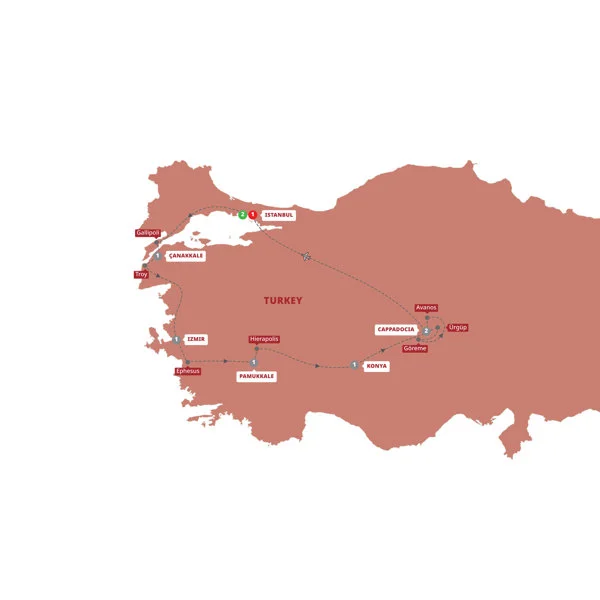
Day 1: Welcome to Istanbul
Arrive in Istanbul and transfer to your hotel. Spend the day exploring, then meet your Travel Director and travel companions for dinner.
Meals: Dinner
Day 2
Day 2: Discover Colorful Istanbul
Visit Topkapi Palace, Hagia Sophia, the Byzantine Hippodrome and the Blue Mosque. Join a MAKE TRAVEL MATTER® Experience at the museum of Classical Turkish Music, then explore the Grand Bazaar.
Meals: Breakfast
Day 3
Day 3: Journey to Gallipoli and Çanakkale
Visit Lone Pine Cemetery and the Gallipoli battlefields, and pause at Anzac Cove and Chunuk Bair to commemorate those lost in World War I. Stay in Çanakkale and dine at the hotel.
Meals: Breakfast,Dinner
Day 4
Day 4: Off to Troy and Izmir
Explore the archaeological site of Troy, including its nine layers of civilization and replica wooden horse. Travel to Demircidere for a Be My Guest experience: meet local women, visit the village bakery and enjoy lunch made with fresh, homegrown produce. Continue to Izmir, settle into your seaside hotel and dine together in the evening.
Meals: Breakfast,Lunch,Dinner
Day 5
Day 5: Admire the Ruins of Ephesus and on to Pamukkale
Explore ancient Ephesus, including the Library of Celsus, Temple of Artemis, House of the Virgin Mary, Temple of Hadrian and Great Theater. Visit a local carpet emporium to learn about Turkish carpet weaving. In Pamukkale, relax in the thermal pools at your hotel.
Meals: Breakfast,Dinner
Day 6
Day 6: Onwards to Hierapolis and Konya
Visit the ancient ruins of Hierapolis, then continue to Konya and visit the Mevlana Museum and Mausoleum. Dine at your hotel in the evening.
Meals: Breakfast,Dinner
Day 7
Day 7: Continue to Cappadocia
Travel to Cappadocia, stopping to see a 13th-century caravanserai and the underground city of Saratli on the ancient Silk Road. Learn about traditional pottery making in Avanos. You may join an optional Whirling Dervishes ceremony, followed by dinner at a local restaurant. Stay in a hotel hewn from the surrounding rock.
Meals: Breakfast
Day 8
Day 8: A Day to Explore Spectacular Göreme
Rise early to watch hot air balloons over Cappadocia’s valleys and rock formations at sunrise. Visit the Göreme Open-Air Museum and its rock-hewn churches and ancient wall paintings, then explore the fairy chimneys of Paşabağ. Learn about pottery making in Avanos and enjoy traditional pottery kebabs during dinner at a local restaurant.
Meals: Breakfast,Dinner
Day 9
Day 9: Return to Istanbul
Take a short flight from Cappadocia to Istanbul. You may join an optional Traditional Bosphorus Cruise. In the evening, join your Travel Director and fellow companions for dinner.
Meals: Breakfast,Dinner
Day 10
Day 10: Farewell Istanbul
Say farewell to Turkey and your fellow travellers, then prepare to depart for the airport for your flight home.
Meals: Breakfast
What’s included
What’s not included
Additional information
Istanbul Welcome Dinner
Meet your Travel Director and fellow travellers over an included dinner in Istanbul. Share introductions and settle into the atmosphere of a city whose neighbourhoods stretch across both Europe and Asia.
Istanbul’s position on the Bosphorus has made it a meeting place for cultures and cuisines for centuries. This hosted meal offers a welcoming setting to get to know the people travelling with you.
Topkapi Palace
Explore Topkapi Palace, the former residence and administrative centre of the Ottoman sultans. Walk through its courtyards and take in views across the Bosphorus from its commanding position on Istanbul’s historic peninsula.
For nearly four centuries, decisions shaping an empire were made within these walls. The palace’s layered architecture and ceremonial spaces reveal how imperial life combined governance, household traditions and carefully staged displays of power.
Hagia Sophia, the Hippodrome & Blue Mosque
Visit Hagia Sophia and the Byzantine Hippodrome in Istanbul’s historic centre, where chariots once raced before vast crowds. View the Blue Mosque, distinguished by its six minarets and blue Iznik tiles.
These neighbouring sites bring Byzantine and Ottoman history into unusually close focus. Hagia Sophia’s monumental architecture reflects centuries of religious and political change, while the former Hippodrome recalls the public spectacle of Constantinople.
Dede Efendi House & Private Turkish Music Concert
Visit the restored house of composer Dede Efendi in Istanbul, now a museum preserving traditional instruments and architecture. Hear a private performance by Music Conservatory students and experience classical Turkish music in an intimate setting.
Dede Efendi remains a defining figure in Ottoman classical music. This MAKE TRAVEL MATTER® visit supports opportunities for young performers and the safeguarding of musical and architectural traditions through the work of the TURKEV association.
Istanbul Grand Bazaar
Wander the covered lanes of the Grand Bazaar, browsing stalls filled with ceramics, spices and keepsakes in one of Istanbul’s most storied trading places. The bustle of shopfronts and conversation makes the market an experience in its own right.
Founded in the Ottoman era, the bazaar grew into a network of streets beneath vaulted roofs. Its long-standing culture of trade offers a vivid connection to Istanbul’s role between East and West.
Gallipoli Battlefields & War Cemeteries
Visit Anzac Cove, Lone Pine Cemetery and Chunuk Bair on the Gallipoli peninsula. Walk through battlefield landscapes and pause at memorial sites honouring those who fought and died here during the First World War.
The 1915 campaign holds profound meaning for Turkey, Australia and New Zealand. The peninsula’s coves and ridges give a tangible sense of the terrain faced by soldiers, making this a reflective encounter with shared and sometimes painful history.
Ancient Troy & the Wooden Horse
Explore the archaeological site of Troy and see the replica wooden horse recalling the legendary siege. Examine the remains of a settlement whose successive layers reveal many centuries of occupation.
Homer’s stories of Priam, Hector, Paris and Helen gave Troy a place in the literary imagination, while excavation uncovered a complex real history beneath the legend. The visit offers a rare chance to consider myth and archaeology side by side.
Demircidere Village Bakery & Be My Guest Lunch
Meet the women of Demircidere, visit the village bakery to see bread being made and sample it with homemade wine. Explore a family garden before sharing a locally hosted lunch prepared with seasonal produce.
Conversation around the table opens a window onto this Turcoman community’s Alevi traditions and the opportunities its women are creating for girls. The food, garden and personal stories make the visit a close encounter with rural life.
Ephesus Ancient City
Explore the ruins of Ephesus, including the Library of Celsus facade, the Temple of Hadrian and the Great Theatre. See the remains associated with the Temple of Artemis as you discover the scale of this ancient city.
Ephesus flourished under Greek and Roman rule and became a major centre of commerce and culture. Its streets and surviving monuments make the civic ambitions of the ancient Mediterranean strikingly visible.
House of the Virgin Mary
Visit the House of the Virgin Mary near Ephesus, a small stone building set on a wooded hillside. Spend time at a place of pilgrimage associated by tradition with Mary’s final years.
The site is meaningful to visitors of different faiths, and its quiet setting contrasts with the monumental ruins nearby. Its significance rests in religious tradition rather than a definitive historical account, inviting a thoughtful visit.
Turkish Carpet-Weaving Visit
Visit a local carpet emporium to learn about the intricate heritage and artistry of Turkish carpet weaving. Look more closely at the patterns and skilled handwork behind a textile tradition found across the country.
Carpets have long served as practical furnishings and expressions of regional design. This cultural visit adds context to the colours, motifs and craftsmanship seen in Turkish homes and markets; it is not presented as a requirement to purchase anything.
Hierapolis Ancient City
Explore the ruins of Hierapolis, the ancient city beside Pamukkale’s mineral-rich thermal springs. Walk among its remains and imagine the visitors who came here seeking rest and renewal.
Founded in antiquity and developed under Roman rule, Hierapolis was closely tied to the warm waters rising through the surrounding limestone landscape. Its archaeological setting connects the region’s natural features with a centuries-old culture of bathing and healing.
Mevlana Museum & Mausoleum
Visit the Mevlana Museum and Mausoleum in Konya, housed within a former lodge of the Mevlevi order. Discover the legacy of the poet and spiritual teacher Rumi in a place central to Mevlevi heritage.
Konya’s association with Rumi has endured for centuries. The museum offers insight into the devotional traditions and ideas of the Mevlevi order, including the spiritual context behind the whirling ceremony for which its dervishes are widely known.
Avanos Pottery-Making Experience
Learn about traditional pottery making in Avanos, a Cappadocian town known for its ceramics. Discover how local craftspeople shape and decorate clay into the vessels and wares associated with the area.
Avanos sits beside the Kizilirmak River, whose clay has long supported the town’s pottery tradition. The visit brings a human craft into focus amid Cappadocia’s dramatic geology. Pottery making appears twice in the itinerary, but is listed here as one experience.
Cappadocia Sunrise Balloon Viewpoint
Watch hot-air balloons from a panoramic viewpoint as sunrise brings colour to Cappadocia’s valleys and rock formations. Enjoy time to take photographs of balloons drifting above the fairy chimneys.
The spectacle draws its character from the region’s volcanic landscape, shaped by erosion into ridges, cones and winding valleys. This is a ground-based viewing experience, not an included balloon flight; balloon activity depends on suitable weather conditions.
Cappadocia Pottery Kebab Dinner
Taste traditional pottery kebab at a local restaurant in Cappadocia. The regional dish is cooked in a sealed clay vessel, linking the meal to the area’s long-established ceramic craft.
Known locally as testi kebabi, it brings together slow cooking and the practical artistry of pottery. This included dinner offers a distinctive taste of Central Anatolia rather than a routine hotel meal, with the clay vessel at the centre of the experience.
Whirling Dervishes Ceremony & Local Dinner
Witness a Whirling Dervishes ceremony during your time in Cappadocia, followed by dinner at a local restaurant. Observe the measured movement and music of a practice associated with the Mevlevi Sufi tradition.
The ceremony carries spiritual meaning beyond its visual grace and is best approached as a cultural and devotional experience. This Optional Experience is at additional cost and bookable on tour; participation is not included in the standard itinerary.
Traditional Bosphorus Cruise
Cruise the Bosphorus for a waterside view of Istanbul’s skyline, with palaces, minarets and waterfront neighbourhoods along the strait. The changing perspectives reveal how closely the city’s landmarks are tied to the water.
For centuries, this passage has connected the Black Sea and the Sea of Marmara while marking the meeting of Europe and Asia. This Optional Experience is at additional cost and bookable on tour.
Silk Road Caravanserai & Saratli Underground City
See a 13th-century caravanserai associated with the ancient Silk Road and explore the underground city of Saratli in Cappadocia. These contrasting sites reveal how people travelled across the region and made use of its rock landscape.
Caravanserais offered shelter along long-distance trading routes, while Cappadocia’s excavated spaces provided places to live and seek protection. Together, they illuminate the resourcefulness shaped by Central Anatolia’s geography and history.
Göreme Open-Air Museum & Pasabag Fairy Chimneys
Explore the Goreme Open-Air Museum to see rock-hewn churches and surviving wall paintings. Discover the fairy chimneys of Pasabag, where erosion has sculpted Cappadocia’s volcanic rock into distinctive forms.
The churches reveal the region’s Byzantine Christian heritage, while Pasabag shows the natural processes behind its unusual landscape. Together, the sites make clear how generations of inhabitants adapted to, and found meaning within, the terrain.