Your itinerary
Day 1
Day 1: Welcome to Kraków
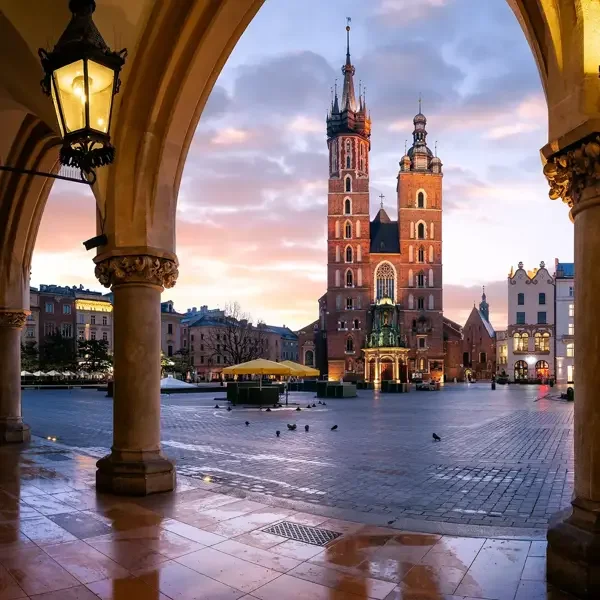
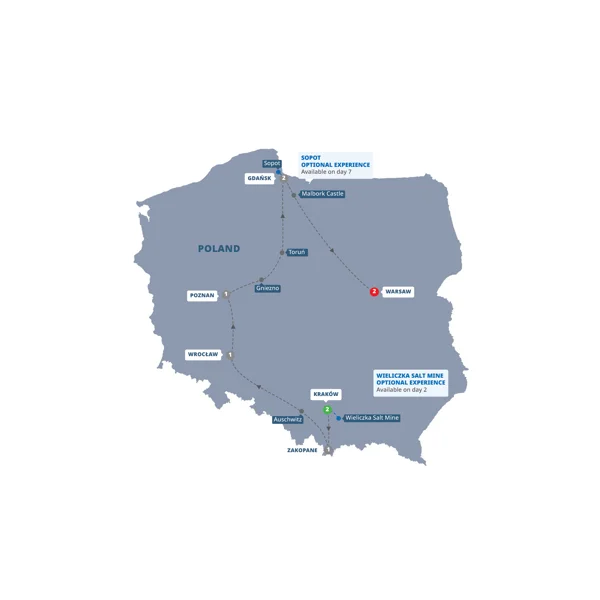
Arrive in Kraków, a former royal capital shaped by Gothic towers, merchant halls and the broad sweep of Rynek Główny. Meet your Travel Director and join your small group for a walk through the Old Town, passing the Sukiennice Cloth Hall, long central to Kraków’s trading life, and listening out for the hejnał sounded from St. Mary’s Church. Continue across the surrounding streets before sitting down to dinner together, a chance to get to know one another and raise a glass to the start of your journey through Poland.
Meals: Dinner
Day 2
Day 2: The Sights of Kraków
Spend the morning at leisure, with the option to join a visit to the Wieliczka Salt Mine, a UNESCO-listed network of chambers carved from rock salt since the Middle Ages. Later join your Local Specialist to visit Kazimierz, where streets, squares and synagogues reflect the district’s long Jewish heritage. Then ascend Wawel Hill to view Wawel Castle and visit the cathedral, long associated with Poland’s monarchy, before a walk through Kraków’s atmospheric Old Town.
Meals: Breakfast
Day 3
Day 3: Into the Tatras and Zakopane
Travel south into the Tatra Mountains, following the rising landscape towards Zakopane, a town known for its carved timber houses and Highlander traditions. On arrival, join your Travel Director for an orientation along Krupówki Street, noting the late-19th-century Zakopane Style of wooden architecture and the market stalls selling Góralski craftwork. Spend the rest of the day getting to know the town, perhaps visit the Tatra Museum’s ethnographic displays, take the funicular up Gubałówka Hill for mountain views, or browse local craft shops. In the evening, sit down to dinner with Highlander music and dance, a Góral tradition that anchors the region’s cultural identity.
Meals: Breakfast,Dinner
Day 4
Day 4: Auschwitz Memorial and On to Wrocław
Travel north from Zakopane to Oświęcim for a moving visit to the Auschwitz Memorial and Museum with a Guide Educator. Continue through Silesia and follow the Oder River towards Wrocław, a city shaped by shifting borders and a long academic tradition. On arrival, join your Local Specialist for a walk through the Old Town to view the facades around the Rynek and the flower stalls of Plac Solny. You’ll also see Wrocław’s cheeky bronze gnomes, a symbol of the city, positioned across the centre.
Meals: Breakfast
Day 5
Day 5: North to Poznań
Continue north to Poznań, a city shaped by trade routes and early Polish statehood. Later, join your Local Specialist for a walking tour through the centre, taking in the town hall, market square and the streets that define the Old Town. Along the way, you’ll see facades rebuilt after wartime damage and gain a clearer sense of how the city’s mercantile past still shapes its layout. Your evening is then free for dinner, with time to choose from the restaurants and bars around the square and adjoining streets.
Meals: Breakfast
Day 6
Day 6: Through Gniezno to Toruń
Travel east to Gniezno for a visit to the cathedral, long associated with Poland’s early rulers. View the Gniezno Doors, cast in the 12th century and known for their bronze reliefs depicting the life of St. Adalbert, before continuing to Toruń, a medieval town shaped by Hanseatic trade. Join your Local Specialist to explore the Old Town’s brick facades and Teutonic history. Later, enjoy free time to explore at your own pace before travelling north to Gdańsk, where the evening offers time to get acquainted with the city.
Meals: Breakfast
Day 7
Day 7: Gdańsk and the Baltic Coast
Spend the morning with your Local Specialist exploring Gdańsk, moving through the medieval centre shaped by Hanseatic trade and along the Motława waterfront. Continue for a MAKE TRAVEL MATTER® Experience at the European Solidarity Centre and the Gdańsk Shipyards, where you’ll meet a former shipyard worker connected to the 1980 strikes and walk through original shipyard areas linked to the Solidarity movement. Later, free time allows further independent exploration, or an Optional Experience to the seaside town of Sopot.
Meals: Breakfast
Day 8
Day 8: Malbork Castle and Discover Warsaw
Leave Gdańsk for Malbork to visit the castle with your Local Specialist, viewing the brick fortifications built by the Teutonic Order and the courtyards that outline its medieval complex. Continue across northern Poland towards Warsaw, a city rebuilt after the Second World War and shaped by its contrasting districts. The evening is free to explore the surrounding districts, whether stepping into the reconstructed Old Town, walking part of the Royal Route, or viewing the Palace of Culture and Science from its central square. You may also choose to join an Optional Experience featuring a Chopin recital in an intimate Warsaw venue.
Meals: Breakfast
Day 9
Day 9: Warsaw City Highlights
Explore Warsaw with your Local Specialist, beginning at the Monument to the Ghetto Heroes in the Muranów district before continuing into the Old Town. Walk through reconstructed streets around Castle Square and the market area, where post-war rebuilding restored the historic centre after widespread destruction. Later, visit the Neon Museum in the iconic Palace of Culture and Science for a guided introduction to a different side of the city’s 20th-century history through signs preserved from the cold war. In the evening, join your group for a final dinner in a local restaurant, marking your last night together in Poland.
Meals: Breakfast,Dinner
Day 10
Day 10: Farewell Warsaw
Transfer to the airport, taking time to say goodbye to your Travel Director and small group as your journey through Poland comes to an end.
Meals: Breakfast
What’s included
What’s not included
Additional information
Dining Summary
- 3 Dinner (D)
- 9 Breakfast (B)
How You'll Travel
- Business class coach with extended leg room
- Top-rated dining, from farm-to-table to local restaurants
- 4 & 5-star stays
Authentic Dining
- Kraków: Share a first dinner with your small group in a local restaurant, enjoying regional dishes and relaxed conversation that marks the beginning of your travels together.
- Zakopane: Enjoy dinner accompanied by Góral Highlander music and dance, with performers using regional instruments such as the fiddle and shepherd’s flute. You’ll hear the sharp, rhythmic patterns typical of the Tatra Highland.
- Warsaw: Come together for a final dinner in Warsaw, sharing regional dishes in a local restaurant. It’s a straightforward moment to reflect on the journey and spend time with your small group before departing Poland.
Highlander Dinner with Góralski Music in Zakopane
Sit down to a regional feast in the Tatra foothills, where performers strike up Góralski music and dance on fiddle and shepherd’s flute. Sample mountain dishes as rhythms quicken and boots stamp to the sharp, syncopated patterns of the Highlands.
Between courses, learn how melodies, costumes and call-and-response songs preserve a living culture shaped by herding routes and misty mountain passes. It’s a warm, convivial evening that connects plate, place and tradition.
Auschwitz-Birkenau Memorial & Museum Guided Visit
Visit the Auschwitz-Birkenau Memorial and Museum with a Memorial Guide Educator, walking through preserved barracks, guard towers and the perimeter fences. This is a solemn encounter with the site of the former German Nazi concentration and extermination camp.
Engage with careful interpretation that foregrounds personal testimonies and archival evidence. The experience emphasizes remembrance and reflection, offering historical context while preserving the dignity of those whose lives were taken here.
Gniezno Cathedral & 12th-Century Bronze Doors
Visit Gniezno Cathedral, cradle of Polish Christianity, to study the monumental Gniezno Doors cast c.1175. Their finely worked bronze panels narrate episodes from the life of St. Adalbert, set within Romanesque frames.
Inside, chapels and crypts trace the cathedral’s ties to Poland’s earliest rulers and archbishops. Your Local Specialist reveals how dynastic rituals and medieval artistry intersect in this enduring spiritual landmark.
Malbork Castle: Fortress of the Teutonic Order
Walk with a Local Specialist through the brick ramparts of Malbork Castle, among Europe’s largest medieval fortresses. Trace the cloisters of the High Castle, the chapter house and the Middle Castle’s Great Refectory, reading the defensive logic of walls and moats.
Learn how the Teutonic Order’s 13th- and 14th-century building program forged a power base on the Nogat River. Restorations reveal monastic precision and Gothic detail at a scale rarely seen.
Warsaw City Highlights: Ghetto Heroes Monument & Old Town
Explore Warsaw with a Local Specialist, beginning at the Monument to the Ghetto Heroes in Muranów before continuing to Castle Square and the Old Town. Reconstructed after WWII, its colorful facades and alleys embody a remarkable urban revival.
Hear how shifting borders, wartime destruction and post-war debates shaped today’s capital. From the Royal Route to market courtyards, the narrative spans resilience, memory and a forward-looking cityscape.
Warsaw Neon Muzeum Guided Visit
Visit the Neon Muzeum with a museum specialist for a vivid look at Cold War-era visual culture. Restored signs from shops, cinemas and streets glow once again, their typography and color telling a playful counter-story to austere times.
Housed in a post-industrial setting in the Praga district, the collection reveals how designers smuggled optimism into daily life through light. It’s a fresh lens on Warsaw’s 20th-century history and design ingenuity.
Kraków Welcome Dinner in a Local Restaurant
Gather with your small group for a relaxed first evening over regional cuisine—perhaps pierogi, zurek or slow-braised bigos. Share introductions and travel hopes as Kraków’s Old Town hums beyond the doorways of vaulted cellars and townhouse dining rooms.
Your Travel Director sets the scene for the journey ahead, highlighting culinary traditions and neighborhood character. It’s a convivial start that pairs local flavors with warm conversation.
Warsaw Farewell Dinner
Come together on your final evening for a shared meal featuring seasonal Polish dishes and contemporary twists on classics. Raise a toast as you reflect on the journey, from medieval squares to Baltic shipyards and revitalized city districts.
Stories, favorite moments and future travel ideas flow easily at the table. The mood is celebratory yet unhurried—a fitting close to days woven with history, culture and convivial company.
Wieliczka Salt Mine (Optional)
Descend into the UNESCO-listed Wieliczka Salt Mine to wander tunnels and chambers carved from rock salt since the Middle Ages. Marvel at chapels, including the subterranean St. Kinga’s Chapel, where chandeliers and reliefs gleam with crystalline detail.
A specialist guide explains mining techniques, saline lakes and the legends that salt inspired. This is an optional excursion at additional cost, bookable on tour, and a spectacular counterpoint to Kraków’s streets above.
Sopot Seaside Excursion (Optional)
Travel to the elegant Baltic resort of Sopot to walk the wooden pier (Molo), breathe sea air and browse seaside cafés along Monte Cassino Street. Photograph the Grand Hotel’s facade and the curve of the sandy shoreline.
Hear stories of interwar spa culture and today’s coastal leisure scene while enjoying time to linger by the water. This is an optional excursion at additional cost, bookable on tour.
Chopin Recital in Warsaw (Optional)
Settle into an intimate salon for a live Chopin piano recital, performed by a Polish artist. Nocturnes, mazurkas and polonaises unfold in close quarters, drawing out the lyrical phrasing and poetic rubato that define the composer’s voice.
Your host shares context on Warsaw’s ties to Chopin and the salon culture that nurtured his early career. This is an optional experience at additional cost, bookable on tour.
Kraków Walking Tour: Kazimierz, Old Town & Wawel Cathedral
Explore Kraków with a Local Specialist, moving from the lanes of Kazimierz—rich with synagogues and Jewish heritage—to the cobbles of the Old Town. Ascend Wawel Hill to step inside Wawel Cathedral, burial place of Polish kings, poets and statesmen beneath a soaring dome and chapels from successive dynasties.
Trace stories of royal coronations, Europe’s oldest universities, and the life of Karol Wojtyla—later Pope John Paul II—who served here as Archbishop. Conclude amid guild halls and facades that reveal Kraków’s layered architectural past.
Zakopane Orientation on Krupówki Street
Walk Zakopane’s lively Krupówki Street with your Travel Director, where timber-fronted shops display Highlander woodcarving, woollens and smoked oscypek cheese. Spot facades in the distinctive Zakopane Style, a 19th-century interpretation of local carpentry infused with national-romantic motifs.
Feel the mountain-town rhythm as you pass market stalls and cafés set against Tatra peaks. Hear how seasonal festivals, shepherd traditions and alpine architecture continue to shape daily life in Poland’s highland capital.
Operated By
Insight Vacations
Kraków Old Town Orientation Walk & Rynek Glówny
Stroll with your Travel Director on an introduction to Kraków’s medieval heart, centring on the vast Rynek Glówny. Take in the arcaded Sukiennice Cloth Hall and listen for the hejnal bugle call from St. Mary’s Church while noting the townhouses and lanes that radiate from the square.
Hear practical tips and local insights as you get your bearings amid café-lined streets and horse-drawn carriages. This concise overview sets the tone for deeper exploration of a city once at the crossroads of royal patronage and mercantile trade.
Wroclaw Old Town Walk: Rynek, Plac Solny & Dwarfs
Join a Local Specialist to traverse Wroclaw’s Rynek, one of Central Europe’s most atmospheric squares, ringed by pastel facades and the Gothic Town Hall. Continue to Plac Solny, where florists sell blooms day and night, and keep an eye out for the city’s whimsical bronze gnomes.
Hear how frontier trade, a renowned university and post-war rebuilding have shaped the city’s identity. The dwarfs, born from 1980s street protest, now map a playful trail through layers of history.
Poznan Old Town & Renaissance Town Hall
Walk Poznan with a Local Resident, pausing in the market square to admire the Renaissance Town Hall, rebuilt in the 16th century by Giovanni Battista di Quadro. Explore restored facades and the tight-knit lanes that connect to the university quarter.
Unpack the city’s mercantile roots and early role in Polish statehood. If you pass near noon, look up for the town hall’s mechanical goats—an endearing nod to local lore and timekeeping traditions.
Torun Gothic Old Town Walk
Explore Torun’s UNESCO-listed core with a Local Specialist, where Hanseatic brickwork, gabled warehouses and the Leaning Tower line streets planned in the Middle Ages. Pause in the market square to read the facades shaped by merchant pride.
Hear of Teutonic Knights, river trade on the Vistula and the city’s association with Nicolaus Copernicus. The scent of gingerbread often lingers here—an artisanal craft that has flavored Torun’s story for centuries.
Gdansk Old Town & Waterfront Walking Tour
Discover Gdansk with a Local Specialist along the Motlawa waterfront to the medieval Crane (Zuraw), then into the Long Market (Dlugi Targ), Neptune Fountain and the Green and Golden Gates. From the harborfront, a viewpoint opens towards Westerplatte, where WWII’s first shots were fired.
Learn how Hanseatic wealth shaped merchant houses and guildhalls, later meticulously restored after wartime damage. The city’s layered identity—Germanic, Polish, maritime—animates every arch and cobblestone.
European Solidarity Centre & Gdansk Shipyards (MAKE TRAVEL MATTER)
Encounter modern history where it happened, meeting a former worker to explore the Gdansk Shipyards and European Solidarity Centre. Walk through original areas like the BHP Hall and Gate No. 2 while hearing first-hand accounts of the 1980 strikes linked to Lech Walesa.
Engaging exhibits illuminate the Solidarity movement’s role in reshaping Europe. Your visit supports educational outreach aligned with UN Sustainable Development Goal 4: Quality Education, ensuring these stories continue to inform future generations.