Your itinerary
Day 1
Start Quito
Begin your adventure in Quito, the first city to be designated a World Heritage site, recognised for its remarkably preserved historic centre.
Upon arrival at Quito International, you’ll be met by our local representative, who takes you to the hotel, acts as your point of contact while in the capital, and provides you with all the information you need about flying to the Galápagos.
Relax this evening, we fly to the Enchanted Islands tomorrow morning!
Upgrade to a suite today – speak to your sales representative for more details
Day 2
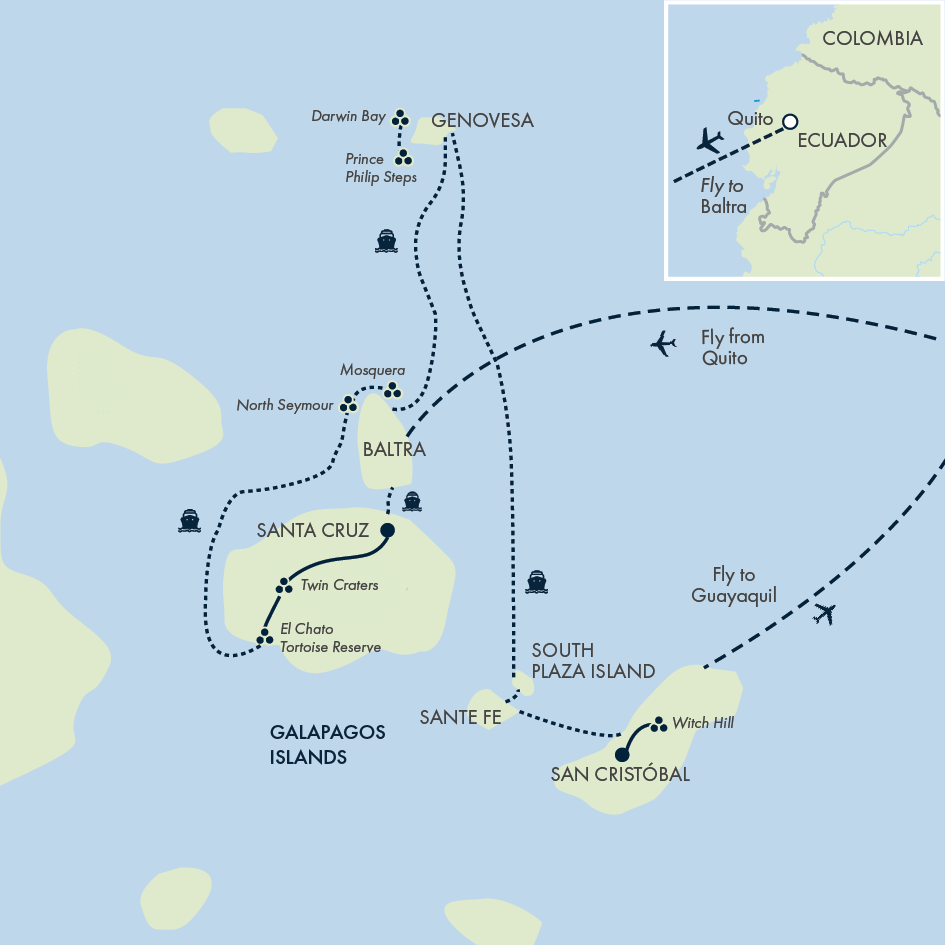
Fly to Baltra Airport on the Galapagos and Santa Cruz highlands
Morning flight to Galapagos
You take a transfer to Quito Airport this morning and fly to Baltra Airport in the Galapagos Islands. Upon arrival, pass through the airport inspection point to make sure no foreign plant or animals are introduced to the island and to pay the national park entrance fee. Your guide will meet you, help you collect your luggage and escort you on a short bus ride to the harbour where a dinghy waits to take you to the yacht.
Afternoon: El Chato Tortoise Reserve and Twin Craters (Santa Cruz)
The native scalesia forest of El Chato Tortoise Reserve is the best place to search for Galapagos giant tortoises in their most authentic setting. Despite the interesting breeding centres – where you are guaranteed to find tortoises in their corrals – there is nothing better than to observe them in their wild environment. Though it can be quite moist and muddy, your visit may turn into an adventurous quest.
The Twin Craters are found on either side of the road leading to Puerto Ayora. These impressive formations are not volcanic craters but were formed by magma domes, which hardened on the outside while the lava continued flowing inside, leaving huge and empty magma chambers that eventually collapsed, leaving two large holes. The craters lie within a lush scalesia cloud forest, a high-altitude plant species endemic to the Galapagos. This area is also home to the carpenter finch, which uses tools to search for food. You may also see the vermilion flycatcher, a small, red-breasted bird.
Note: Breakfast is boxed
Meals: Breakfast,Lunch,Dinner
Day 3
North Seymour and Mosquera
Morning: North Seymour
North Seymour is an uplifted (as opposed to volcanic) island and therefore is generally flat and strewn with boulders. There are good nesting sites here for a large population of magnificent frigate birds. Blue-footed boobies perform their courtship dance in the more open areas and swallow-tailed gulls perch on the cliff edges. Despite the tremendous surf that can pound the outer shore, sea lions haul out onto the beach and can be found bodysurfing.
Afternoon: Mosquera
Galapagos sea lions are true beach lovers and Mosquera has coral white-sand beaches that contrast with the blue water to attract numerous sea lions. During a beach walk, you can observe several species of waders and sanderlings. Between the rocks, red clip crabs play hide and seek while you try to get the perfect photo. If you are lucky, you may even encounter yellow-crowned night herons or even a red-footed booby.
Meals: Breakfast,Lunch,Dinner
Day 4
Genovesa Island
Morning: Darwin Bay (Genovesa)
Inside the submerged caldera of Genovesa lies Darwin Bay, with a diameter of more than 1mi (1.5km) and a depth of almost 650ft (200m). The small area will surprise you repeatedly, as you walk along a coral-sand beach, crossing barren lava formations and creeks, passing tidal pools, shrubs and following the cliff tops. With these peaceful surroundings, every species occupies its ecological niche without disturbing others. Whimbrels and wandering tattlers forage actively along the surf, next to resting Galapagos sea lions. Impressive frigatebirds and red-footed boobies nest in the mangroves, where you can also see vocalists such as the yellow warbler, Darwin’s finches and the Galapagos mockingbird. Uniquely, two subpopulations of the same species of large cactus finch differ in their singing.
Afternoon: Prince Phillip’s Steps (Genovesa)
Before landing, you take a dinghy ride along the eastern arm of the caldera with a chance to admire the 80ft (25m) high walls. Sometimes, a Galapagos fur seal is resting or a seabird is nesting on one of the ledges at the base. You then have to hike and overcome the steep stairs from the landing dock to a bush of palo santo shrubs on top. Red-footed boobies use these scarce nesting places, so they don’t have to nest on the rocky ground. Upon arriving at the edge of the rim, the bushes open up and you can enjoy panoramic views, a strong sea breeze and the amazing flying skills of countless seabirds. Following the exposed rim, you first pass nazca boobies and finally reach the extensive storm petrel nesting places, where, if you’re lucky, you can spot the well-camouflaged short-eared owl hunting for food.
Meals: Breakfast,Lunch,Dinner
Day 5
South Plaza and Santa Fe
Morning: South Plaza
Enjoy an unforgettable guided walk on South Plaza, the best place to encounter endemic Galapagos land iguanas – patient and photogenic models. You can also look for some of the unique hybrids between the male marine iguanas and female land iguanas. Arriving at the upper rim, you’re 75ft (20m) above the waves splashing against the foot of the cliffs. Clouds of petrels, storm petrels, shearwaters and brown noddies make spectacular flights and sometimes look like they’re walking on the waves. Take your binoculars and don’t miss the red-billed tropicbirds with their graceful long tails and spectacular mating fights. These cliffs are also a nesting place for the endemic swallow-tailed gull.
Afternoon: Santa Fe
In the southeastern part of the Galapagos, this island was formed from an uplift instead of a volcanic origin, which is why it is mostly flat. Some say this could be the oldest island in the archipelago. Santa Fe is the home of several endemic species, including the Galapagos hawk, Galapagos snake, Galapagos mockingbird, rice rats, and one of the two species of land iguanas on the islands. After disembarking in the beautiful, clear waters, you will be in contact with one of the many sea lion colonies here. Along the trail, many salt bushes can be seen as well as giant prickly pear cacti; gigantism is a characteristic of oceanic islands. Although there is little vegetation on Santa Fe, it has two breath-taking beaches inhabited by sea turtles. At the foot of the mountain, you can also discover a small colony of Galapagos penguins.
Meals: Breakfast,Lunch,Dinner
Day 6
Disembark San Cristobal; fly to Guayaquil and end
Morning: Witch Hill (San Cristobal)
Witch Hill is the remains of a tuff cone and one of the first sites visited by Charles Darwin. It has an impressive landscape, where it is often possible to see coastal and migratory birds, including pelicans, blue-footed boobies and swallow-tailed gulls, plus sea lions and marine iguanas. At times, the lagoon is completely dry and salt deposits lie at the bottom. The people of Puerto Baquerizo Moreno used to use the lagoon as a salt mine.
Afternoon transfer to San Cristobal Airport
Assisted by the naturalist guide and some crew members, the dinghy will bring you and your luggage to San Cristobal, where we take the airport shuttle. From here, we fly to Guayaquil where it’s possible to connect with international flights this evening from 6pm onwards.
Meals: Breakfast
What’s included
What’s not included
Additional information
Food
All breakfasts, four lunches and four dinners are included.
On-board meals are plentiful with a wide choice of international and local cuisine. Breakfasts will usually consist of cheese, meats, eggs, cereal, toasts, yoghurts and fruits. Snacks are provided mid-morning and mid-afternoon. For lunches and dinner, soup usually precedes the main course.
Alcoholic drinks are available on board (approximately US$4 per beer, US$35 for a bottle of wine, around US$8 for selected cocktails) and the crew request you do not bring your own alcohol with you. Drinking water, tea, coffee and juice is freely available at no additional charge.
Vegetarians and vegans can be well catered for on this trip; please inform us before departure of any special dietary requests so our local team can be well prepared.
North Seymour Island Seabird Colonies Walk
Walk the lava-strewn trails of North Seymour Island, an uplifted plate of ancient seabed now bustling with life. Watch magnificent frigatebirds inflate crimson throat pouches, and admire the comic grace of the blue-footed booby courtship dance. Sea lions often haul out nearby, barking over the surf.
Your guide points out swallow-tailed gulls perched on low cliffs and explains how tectonic uplift shaped this flat, boulder-studded landscape. Expect superb photography as wind, waves and wildlife combine along the island’s rugged shore.
Mosquera Islet Sea Lion Beach Walk
Stroll the coral-white sand of Mosquera Islet, a narrow sandbar famed for its relaxed Galápagos sea lions. Wander past tide pools alive with scarlet crabs and scan the shoreline for waders and sanderlings while surf whispers across the beach.
Between lava rocks, look for yellow-crowned night herons and, on occasion, a passing red-footed booby. Your naturalist shares insights into island ecology and the delicate balance sustaining these charismatic mammals and shorebirds.
Genovesa: Darwin Bay Mangroves & Seabird Colony Walk
Land on the coral sands of Darwin Bay inside Genovesa’s flooded caldera and follow a trail through mangroves and lava shelves thrumming with birdlife. See nesting red-footed boobies and watch frigatebirds glide on thermals above the sheltered bay, where sea lions rest on quietly lapping shores.
Your guide interprets this serene ecosystem as whimbrels forage by the surf and warblers flit among mangroves. Listen for the differing songs of large cactus finch subpopulations, a living showcase of evolution in action.
Genovesa: Prince Philip’s Steps Cliff-Top Hike
Climb the steep cliff stairs at Prince Philip’s Steps (El Barranco) to reach a breezy plateau of palo santo scrub. From the rim, savour panoramic views over the caldera as Nazca boobies nest along the path and tropicbirds streak past on elegant tails.
Continue across lava flats towards dense storm petrel colonies, scanning for the well-camouflaged short-eared owl. Your naturalist weaves geology and behaviour into each stop, revealing how life thrives along this exposed edge of the sea.
Genovesa Caldera Panga Ride beneath the Cliffs
Glide by inflatable dinghy to take a panga (dinghy) ride beneath the sheer Genovesa caldera walls. Scan the ledges for seabird nesting sites and watch for dozing Galápagos fur seals tucked into shadowed crevices at the waterline.
Your guide explains the formation of this sunken volcano and points out photography angles as the cliffs rise nearly 25m overhead. Gentle swells, echoing bird calls and shifting light create a cinematic encounter with the island’s wild architecture.
South Plaza Island Cliff Walk & Land Iguanas
Follow a guided loop across South Plaza Island, home to photogenic Galápagos land iguanas and striking sea cliffs. From the upper rim, watch waves explode below while petrels and noddies ride the wind; red-billed tropicbirds trace elegant arcs over the blue channel.
Your naturalist highlights possible hybrid iguanas and nesting sites for the endemic swallow-tailed gull. With binoculars ready, this compact island delivers concentrated wildlife viewing and cliff-top drama in a single, superb walk.
Santa Fe Island Landing & Giant Opuntia Cactus Trail
Disembark in clear turquoise water for a close encounter with a bustling sea lion colony before setting out along Santa Fe Island’s trail. Pass saltbush and stands of giant Opuntia prickly pear cacti, where the endemic land iguana often browses fallen pads and flowers.
Your guide helps you look for Galápagos hawks and mockingbirds, and with luck you may glimpse penguins offshore. Learn how ancient uplift shaped this mostly flat island and how isolation fostered its remarkable endemism.
San Cristóbal: Witch Hill Beach & Tuff Cone
Visit Witch Hill (Cerro Brujo), the eroded remains of a volcanic tuff cone landscape rising above a sweeping pale beach. Scan volcanic ledges for pelicans while blue-footed boobies and swallow-tailed gulls patrol the shoreline; sea lions and marine iguanas often lounge near the surf.
Walk to the salt lagoon once quarried by early settlers as your guide recounts Darwin’s 1835 landfall on San Cristóbal. This coastal stop blends stark geology, birdlife and human history in one evocative setting.
Guided Snorkelling Sessions in the Galápagos
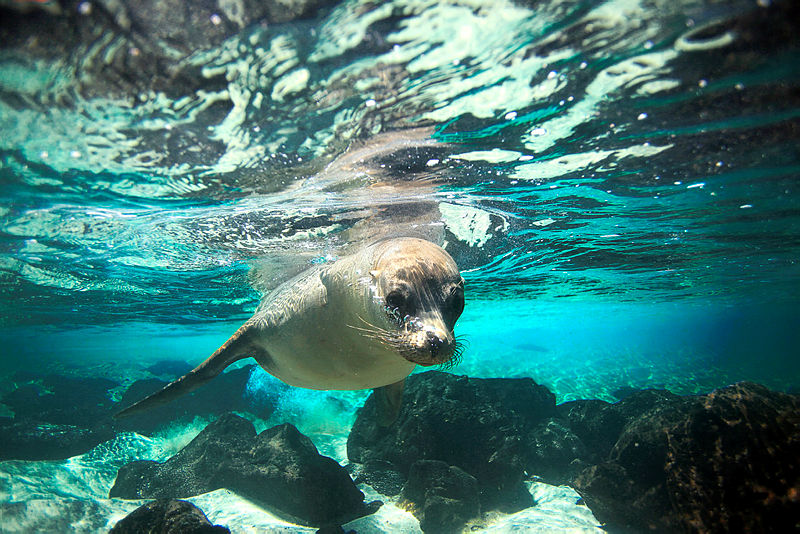
Slip into clear Pacific water for a guided snorkelling session in sheltered bays and rocky coves. Drift over basalt reefs as near-tame sea lions twirl past, watch marine iguanas grazing on algae, and admire schools of reef fish flashing electric colour against black lava.
Sites vary by day and conditions—often around Darwin Bay, Mosquera or Santa Fe—and all equipment is provided on board (mask, snorkel and fins). Your guide sets an easy pace while sharing pointers on respectful wildlife encounters.
Onboard Naturalist Briefings & Conservation Talks
Each evening, meet your Naturalist Guide for concise evening briefings that preview tomorrow’s landings, safety notes and species to watch for. Learn how to recognise booby plumage stages, identify finch beaks and interpret sea lion behaviour from an expert storyteller.
Short talks illuminate Galápagos National Park rules and conservation stories—from invasive species control to nesting success—adding depth to every shore excursion. These sessions turn daily sightings into a coherent narrative of evolution, geology and protection.
Santa Cruz Highlands: El Chato Giant Tortoise Reserve & Los Gemelos
Explore the highlands on a guided walk through the El Chato Tortoise Reserve, where you can observe Galápagos giant tortoises in their natural habitat. Move quietly among lava tunnels and lush scalesia cloud forest, listening for finches and warblers while your guide explains behaviour, ecology and ongoing conservation.
Continue to the dramatic Los Gemelos (Twin Craters), vast sinkholes created by collapsed magma chambers. The surrounding forest shelters Darwin’s finches and the vivid vermilion flycatcher; this is a perfect place to pause for photos and reflection amid mist-laced foliage and mossy branches.