Your itinerary
Day 1
Day 1: Quito
Arrive at any time. Arrival transfer included.
There are no planned activities, so check into the hotel and enjoy the city. A G Adventures representative will greet you at the hotel and brief the group on the various aspects of the tour.
TRANSPORT: Look! Up in the sky! It’s a bird! It’s a plane! It’s… yup, it is a plane, actually.
ACTIVITY: The adventure begins today. Feel free to explore, but make sure you’re back in time to meet the group. Your G Representative will review the details of your tour.
Day 2
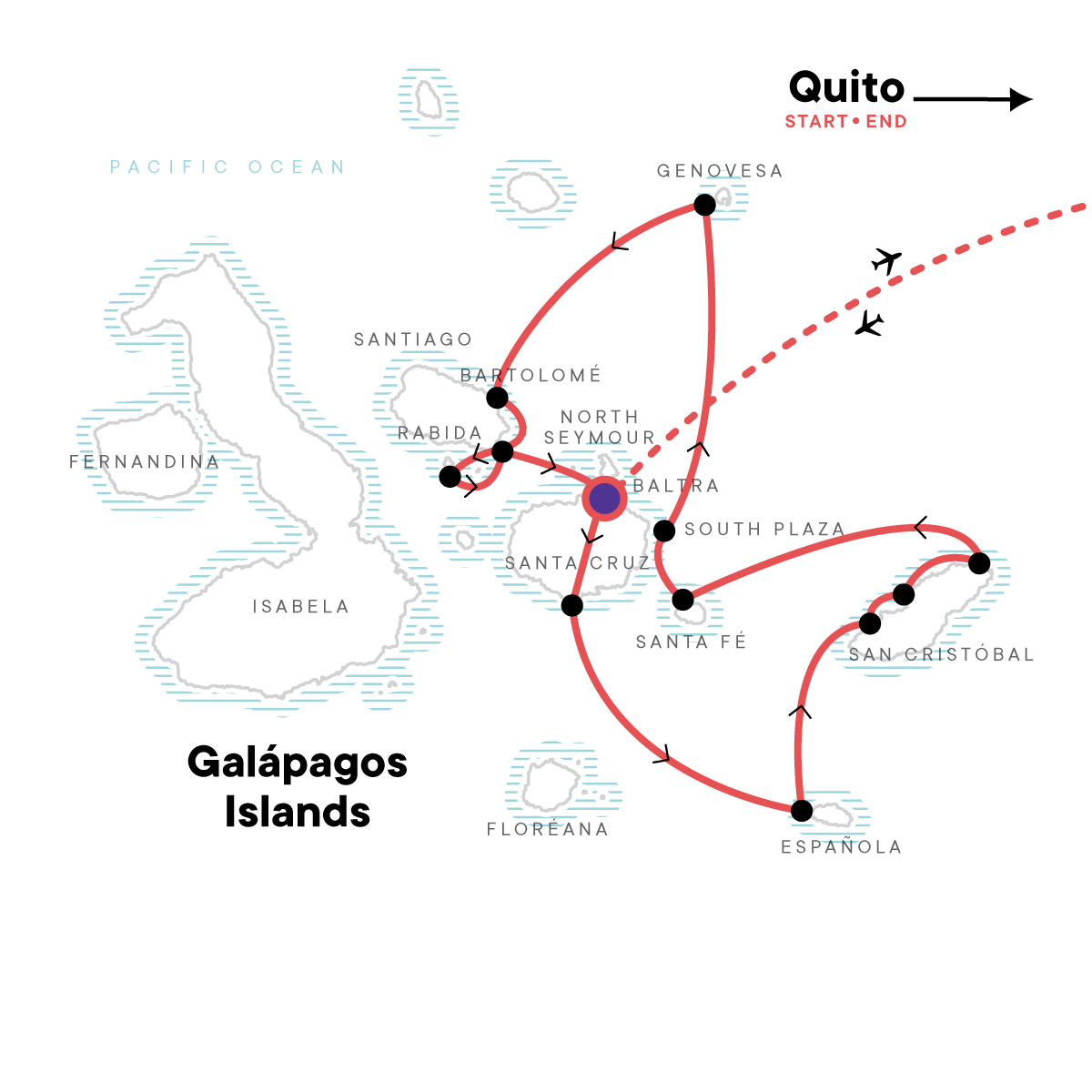
Day 2: Quito / Puerto Ayora
Transfer early to the airport for the flight to the Galápagos Islands. Upon arrival, meet the Naturalist Guide and cross to Santa Cruz islands to visit the highlands and the Charles Darwin Research Station before boarding the boat in the late afternoon from Puerto Ayora.
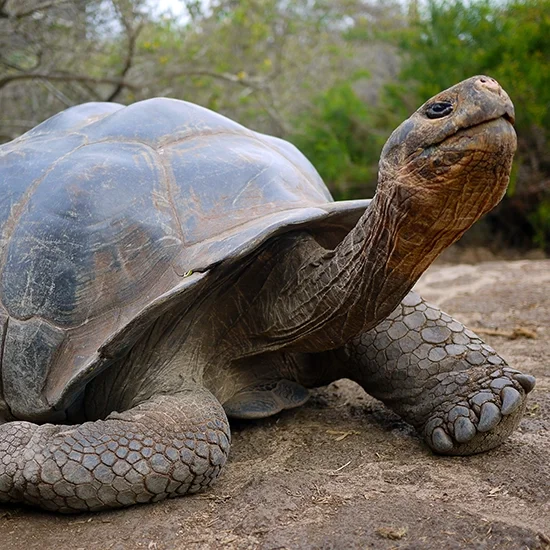
After arrival in Baltra, visit of the highlands of Santa Cruz Island for a special opportunity to view the islands’ most famous reptile: the giant tortoises in their wild habitat. What a privilege to see an endangered species roving in this lush environment! The vegetation of the area includes the Scalesia Forest (an endemic giant daisy tree) and birds such as the vermilion flycatcher will delight everyone with its scarlet feathers against an emerald green forest. Look for Darwin’s finches, particularly the famous Woodpecker Finch. We will then visit the Fausto Llerena Breeding Center and Charles Darwin Research Station to learn first hand of the conservation and research efforts in the islands. There, you’ll see several subspecies of adult tortoises, lots of hatchlings, and learn of the repatriation programs that are saving several subspecies of tortoises and iguanas from extinction.
TRANSPORT: Look! Up in the sky! It’s a bird! It’s a plane! It’s… yup, it is a plane, actually.
ACTIVITY: Head to Santa Cruz’s verdant highlands. This is a perfect place to hike through the grounds and see giant tortoises in their natural environment, before savouring an included lunch.
ACTIVITY: Visit Fausto Llerena Breeding Center a great place to observe many species of tortoises. Brought back from the brink of extinction, see the famous Galápagos tortoise up close – a corral houses adult tortoises, and a nursery cares for the young until around age three when their shells have hardened.
This area also houses the Charles Darwin Research Station, a scientific organization initiated in 1964, which works to preserve the Galápagos’ ecosystem through the conservation efforts of scientists, researchers, and volunteers. While the offices themselves are not open to visitors, the research station provides a study location for international scientists and environmental education for the local community.
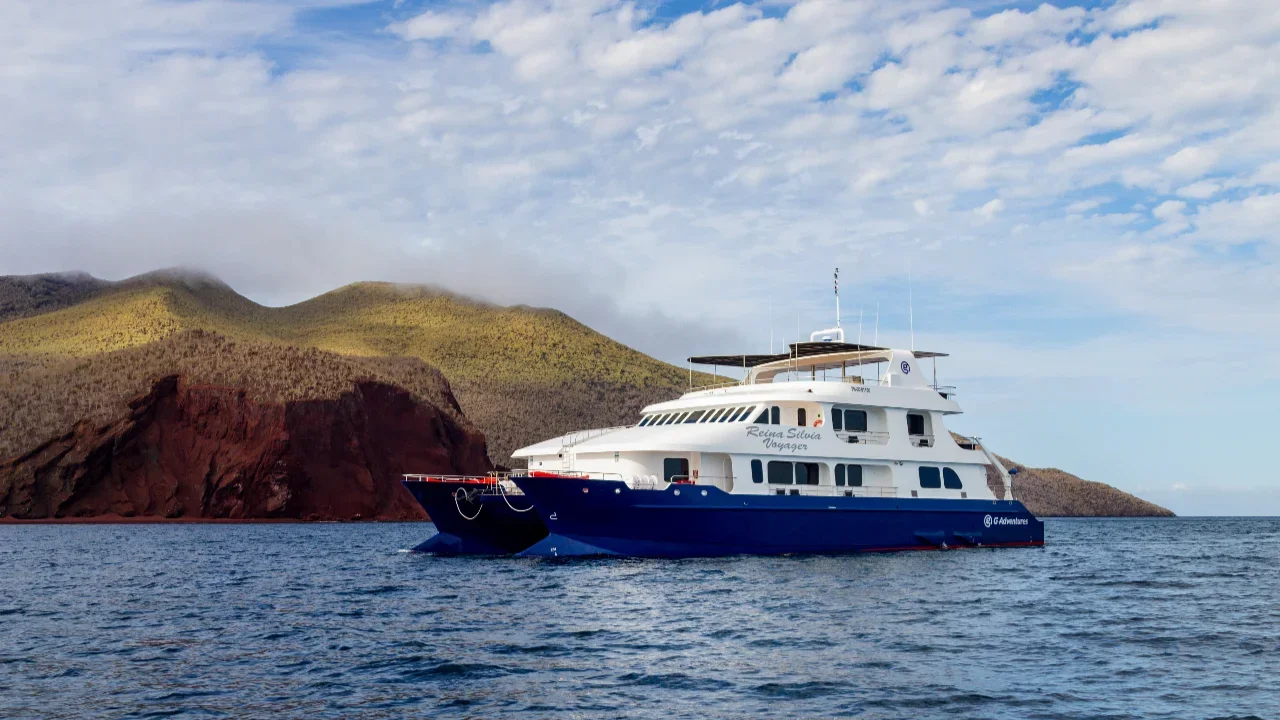
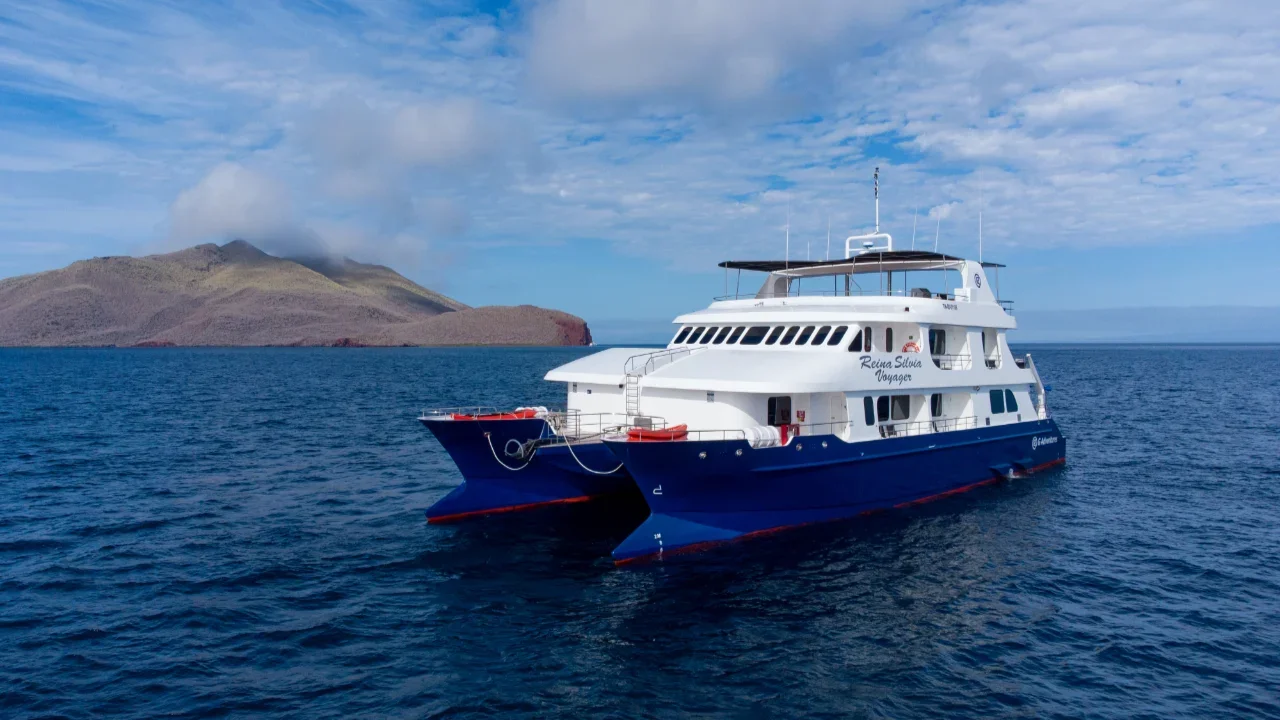
TRANSPORT: The Reina Silvia Voyager is just as elevated as the name implies. This modern catamaran offers increased stability when cruising the waters of the Galápagos Islands. Enjoy the view from the spacious sun deck, Jacuzzi, or private balconies (available with most cabins).
Meals: Breakfast,Lunch,Dinner
Day 3
Day 3: Española: Gardner Bay / Punta Suárez
Enjoy the day on Española Island, one of the oldest in the archipelago. Visit the white sandy beach of Gardner Bay and the bird colonies of Punta Suárez. Take guided walks to observe wildlife and have free time for swimming or snorkelling.
Spend part of the day visiting spectacular Gardner Bay. Walk across a lovely white sand beach amongst a busy sea lion colony and nesting sea turtles (seasonal). Later, take some time exploring the Punta Suárez visitor site, on the north-western corner of the island. Here, birds are everywhere—underfoot, on the trail, overhead, diving into the sea, taking off from cliffs, sitting quietly, and if the timing is right, engaging in ritual mating dances or hatching eggs. As the panga driver guides us in through the surf to the landing, sea lions are often seen “hanging 10” on the waves. A great tangle of marine iguanas, stretched out in the sun on the beach, are usually present when we arrive.
ACTIVITY: Visit Gardner Bay’s magnificent white sandy beach and spectacular landscapes. This incredible place is home to sea lions, hood mockingbirds, Nazca boobies, waved albatross, red-billed tropic birds, lava lizards, Galapagos hawks, and blue-footed boobies. Be sure to explore the beautiful turquoise water and its incredible sea life.
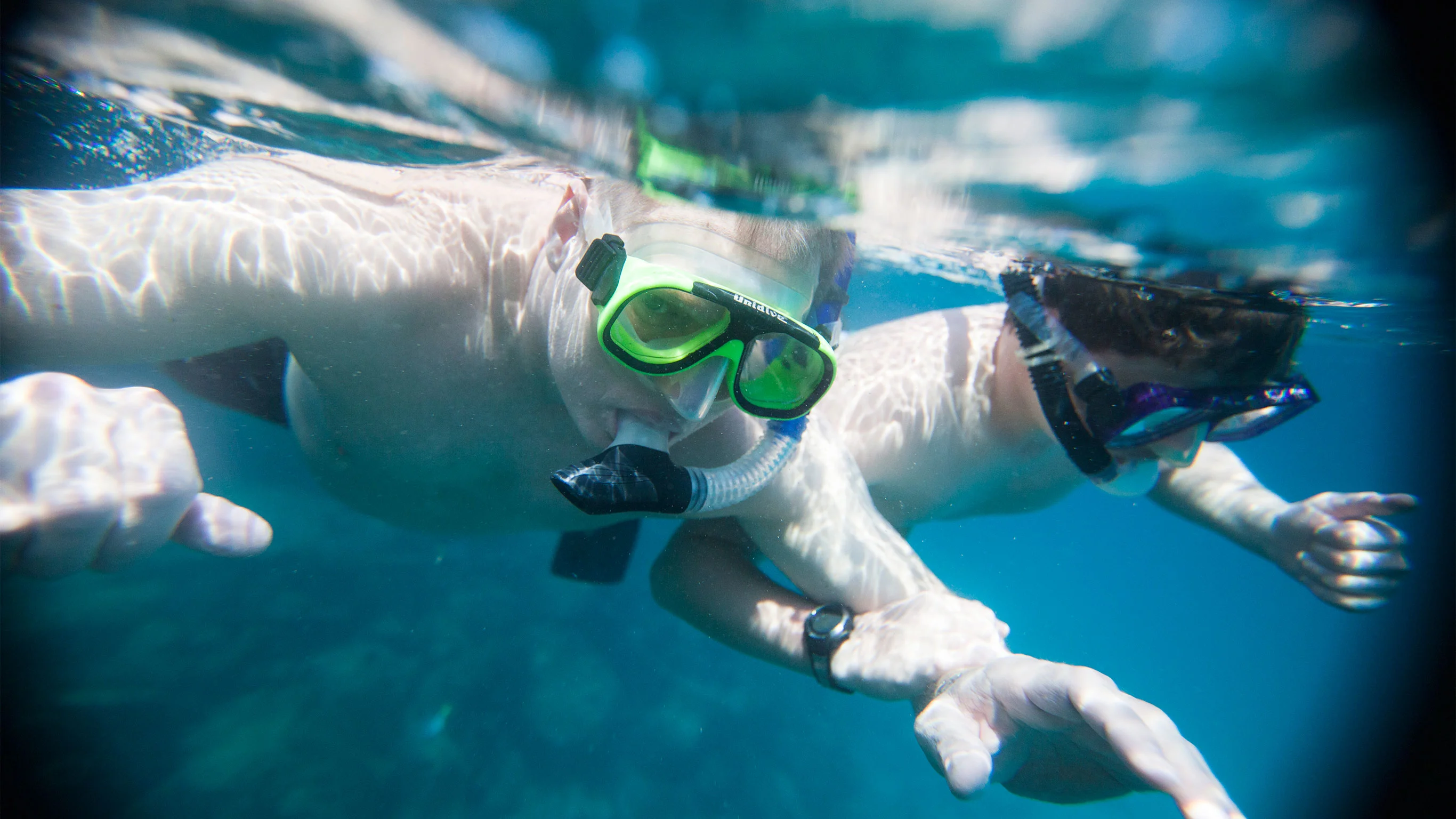
ACTIVITY: Strap on your snorkel and if conditions allow, see an abundance of sea life including; young sea lions and large schools of surprisingly big tropical fish, including yellow-tailed surgeonfish, king angelfish, and bump-head parrot fish.
ACTIVITY: Visit Punta Suárez, one of most rich wildlife landing sites in the Galápagos. Be greeted by surfing young sea lions on arrival. Head to the trail to find many species of nesting sea birds, and, if lucky, see the waved albatross. Follow the path up to a cliff for great views over the ocean, and watch sea birds gliding in the wind.
TRANSPORT: The Reina Silvia Voyager is just as elevated as the name implies. This modern catamaran offers increased stability when cruising the waters of the Galápagos Islands. Enjoy the view from the spacious sun deck, Jacuzzi, or private balconies (available with most cabins).
Meals: Breakfast,Lunch,Dinner
Day 4
Day 4: San Cristobal: Cerro Dragon / Punta Pitt
Land at Punta Pitt in the morning for a walk to observe the wildlife and spectacular scenery here. In the afternoon continue on to Cerro Dragon on San Cristóbal to observe sea lions and enjoy the beach before travelling to the dramatic Kicker Rock to see the steep vertical stone walls rising from the ocean. The beauty makes for memorable sunset views.
Start the day walking along a trail on Punta Pitt that winds up through eroded volcanic tuff formations to a plateau where there’s a spectacular view of the island, and Islote Pitt. Along the trail are endemic plants and wildlife unique to San Cristobal, such as the San Cristobal mockingbird and the San Cristobal lava lizard. All three boobies (blue-footed, red-footed and Nazca) are known to nest here, at Islote Pitt which is a small islet near the anchorage. Blue-footed boobies can often be seen plunge-diving for fish while frigate birds soar overhead.In the afternoon, head to Cerro Dragon to visit the white sand beach there and observe Sea Lions. Finish the day, with a navigation around the spectacular Kicker Rock. This striking rock formation is located a couple hours off the western shore of San Cristobal. Jutting out of the water, the rocks stand vertically at hundreds of feet above the ocean divided by a small channel.
TRANSPORT: The Reina Silvia Voyager is just as elevated as the name implies. This modern catamaran offers increased stability when cruising the waters of the Galápagos Islands. Enjoy the view from the spacious sun deck, Jacuzzi, or private balconies (available with most cabins).
ACTIVITY: Visit a white sandy beach on the island where it is possible to watch sea lions in their natural habitat.
ACTIVITY: Enjoy amazing wildlife watching and interesting geological formations on this fascinating expedition. Arrive at a quiet cove on the eastern tip of San Cristóbal to explore Punta Pitt. Made up of volcanic tuff substrate, it’s the only site in the Galápagos where it’s possible to see three species of boobies and two species of frigatebirds.
Meals: Breakfast,Lunch,Dinner
Day 5
Day 5: Santa Fe / South Plaza
Visit Santa Fé island for a chance to mingle with the iguanas. Continue to South Plaza for some great bird watching opportunities and views from the oceanside cliffs.
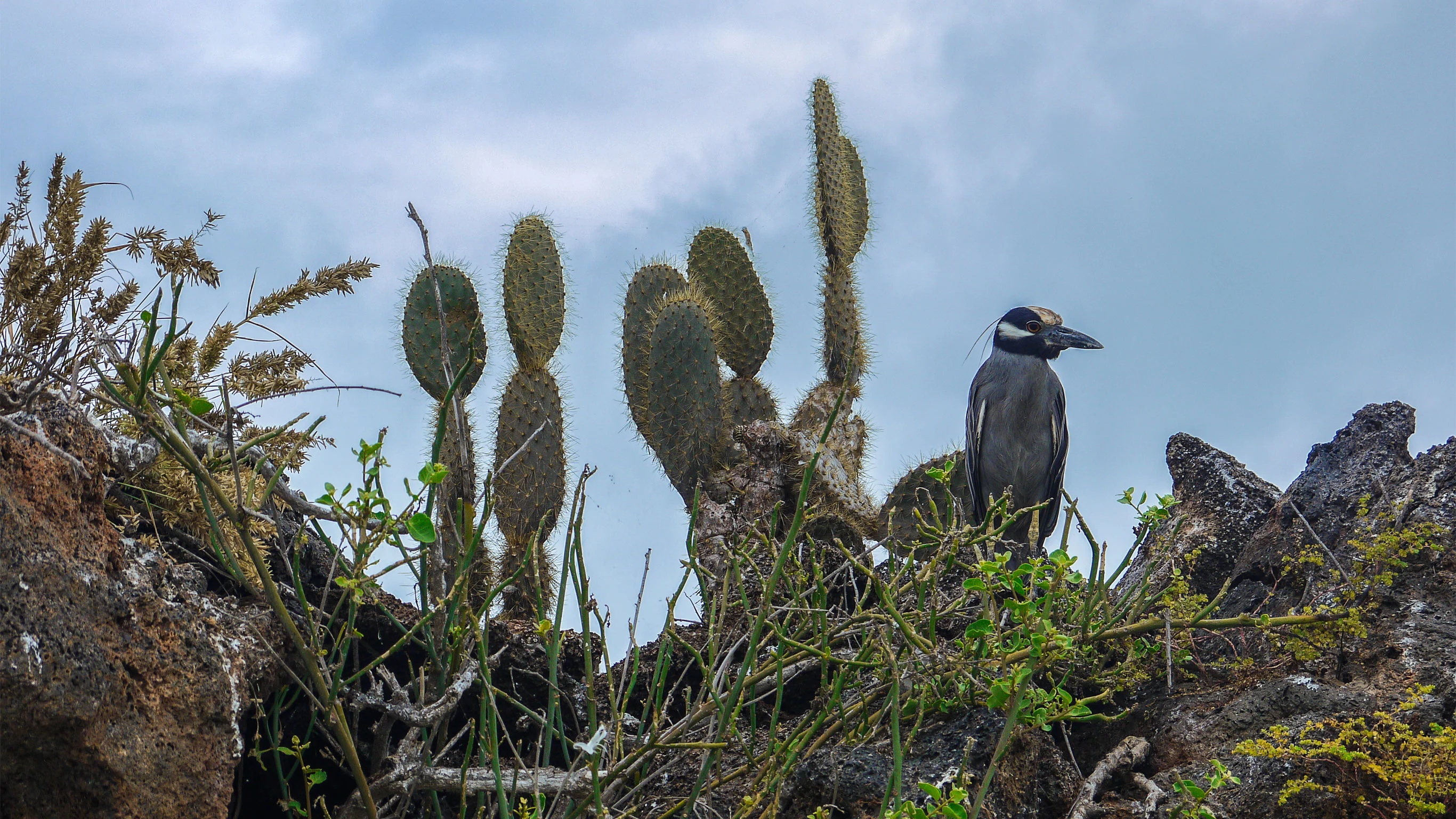
Today, spend time visiting fascinating Santa Fé, home to a small population of very large land iguanas, and the largest of the Opuntia cacti. The lagoon is ideal for swimming and snorkeling; sea lions and colorful fish are in abundance here, as well as the occasional sea turtle. Later, visit South Plaza, a small, but very rewarding island to visit. Here you see an array of endemic land iguanas munching on Opuntia blossoms and leaves. On the upper edge, at the windward side, Swallow Tailed Gulls nest. Watch these beautiful birds maneuver in the tricky air currents as they set up to land on the cliff face. From the bluff you can see schools of Yellowtail Mullet, occasionally a shark, and lots of birds flying back and forth.
ACTIVITY: Visit Santa Fé for amazing wildlife watching and snorkelling opportunities. Hike towards the cliffs along the island’s northern shore to view the forest of giant prickly pear cactus (Opuntia), which is home to endemic land iguanas. It is also one of the best locations to see sea turtles, sea lions, and maybe even get a glimpse of a whitetip reef shark from the panga.
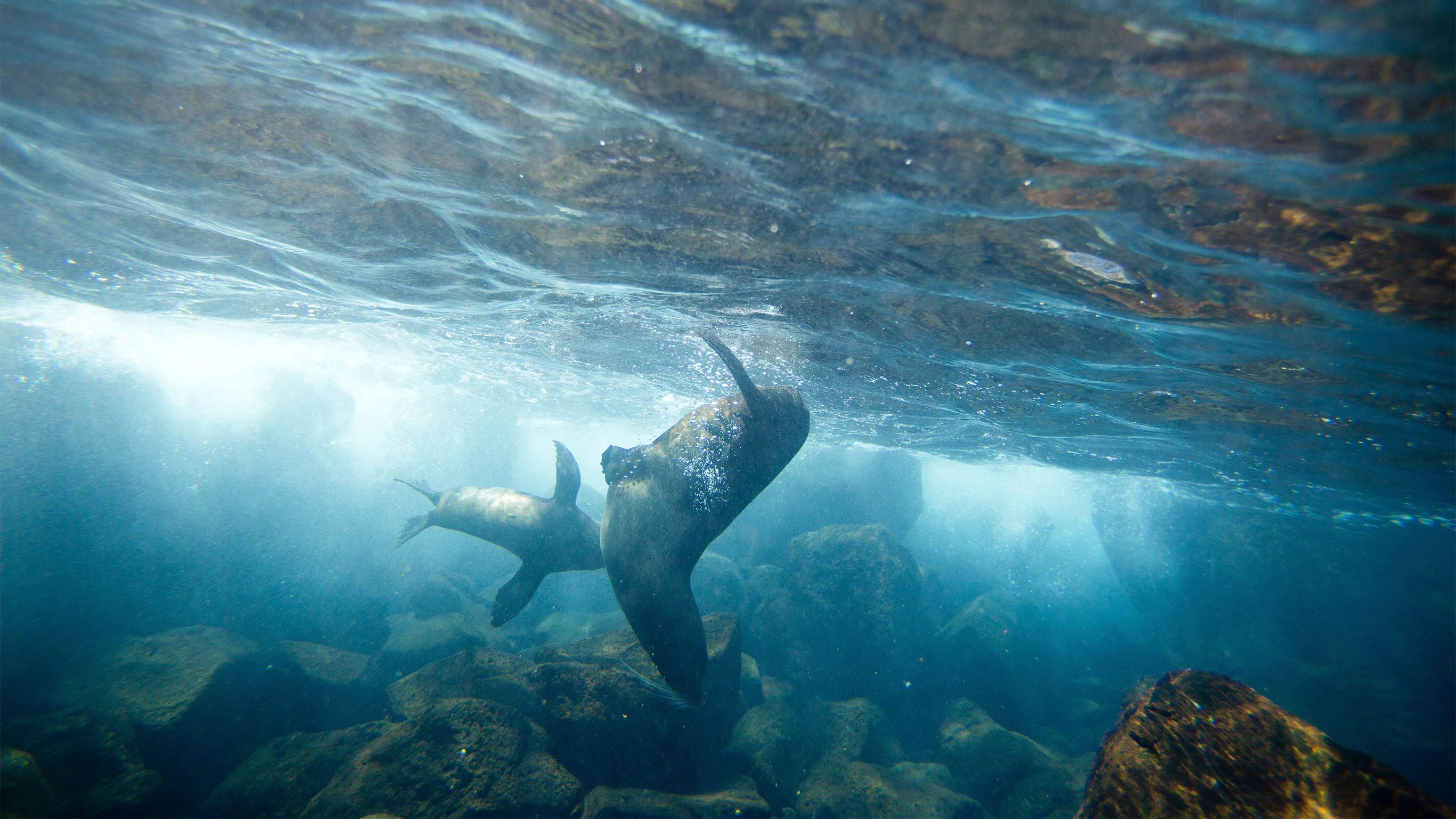
ACTIVITY: Enjoy some amazing snorkelling right off the beach in Santa Fé. Swim with playful sea lions, and search for sea turtles, rays, and reef sharks while getting great views of large schools of brightly coloured tropical fish.
ACTIVITY: MORNING Take to the crystal blue waters off Santa Fe island with a provided Kayak this morning. Get up close and personal with the areas rugged coastlines, and spot a huge variety of aquatic life in the shallow water below.
ACTIVITY: Visit South Plaza, one of the smallest islands in the Galápagos, which has one of the largest populations of land iguanas. Walk along a path through a cactus forest and view a combination of dry and coastal vegetation on this lively island, home to a wide range of fauna, including incredible birdlife. Spot red-billed tropicbirds and indigenous swallow-tailed gulls resting on the cliffs, and sea lions playing in the waters.
TRANSPORT: The Reina Silvia Voyager is just as elevated as the name implies. This modern catamaran offers increased stability when cruising the waters of the Galápagos Islands. Enjoy the view from the spacious sun deck, Jacuzzi, or private balconies (available with most cabins).
Meals: Breakfast,Lunch,Dinner
Day 6
Day 6: Genovesa: Darwin Bay / El Barranco
Visit Darwin Bay and marvel at the sheer number of birds along the many trails. Head to El Barranco in the afternoon to see the many types of boobies, including red-footed boobies.
In the morning, visit the white-sand coral beach of Darwin Bay which winds through mangroves filled with land and marine birds. See Nazca boobies, red-footed boobies and swallow-tailed gulls, and further down the path, observe tidal pools where sea lions swim playfully. In the afternoon, visit El Barranco (also known as Prince Phillip’s Steps), which is a steep, rocky path that leads up to a high cliff-face. If you’re lucky, catch a glimpse of red-footed boobies, short-eared owls, Nazca Boobies, storm petrels, Galapagos swallows, and Galapagos doves, as you enjoy the magnificent views.
ACTIVITY: Walk along the white coral sands of Darwin Bay surrounded by bustling sea birds. Follow the trail and see nesting frigatebirds, gulls, and boobies. Be sure to bring your camera to take some snaps of your new feathered friends.
ACTIVITY: Visit this sunken caldera for a great snorkelling opportunity. See large schools of tropical fish swarming near the vertical walls, and, if lucky, see manta rays, white-spotted eagle rays, sea lions, and hammerhead sharks.
ACTIVITY: MORNING Traverse along the white sand beaches of Darwin Bay, and explore the mangroves that surround the crystal waters.
ACTIVITY: Visit “El Barranco” aka Prince Phillip’s Steps located on the southern tip of the island for an amazing wildlife watching opportunity. Hike up the steps to see a sea bird colony that is full of life including the breeding grounds for red-footed boobies and masked boobies.
TRANSPORT: The Reina Silvia Voyager is just as elevated as the name implies. This modern catamaran offers increased stability when cruising the waters of the Galápagos Islands. Enjoy the view from the spacious sun deck, Jacuzzi, or private balconies (available with most cabins).
Meals: Breakfast,Lunch,Dinner
Day 7
Day 7: Santiago / Bartolomé
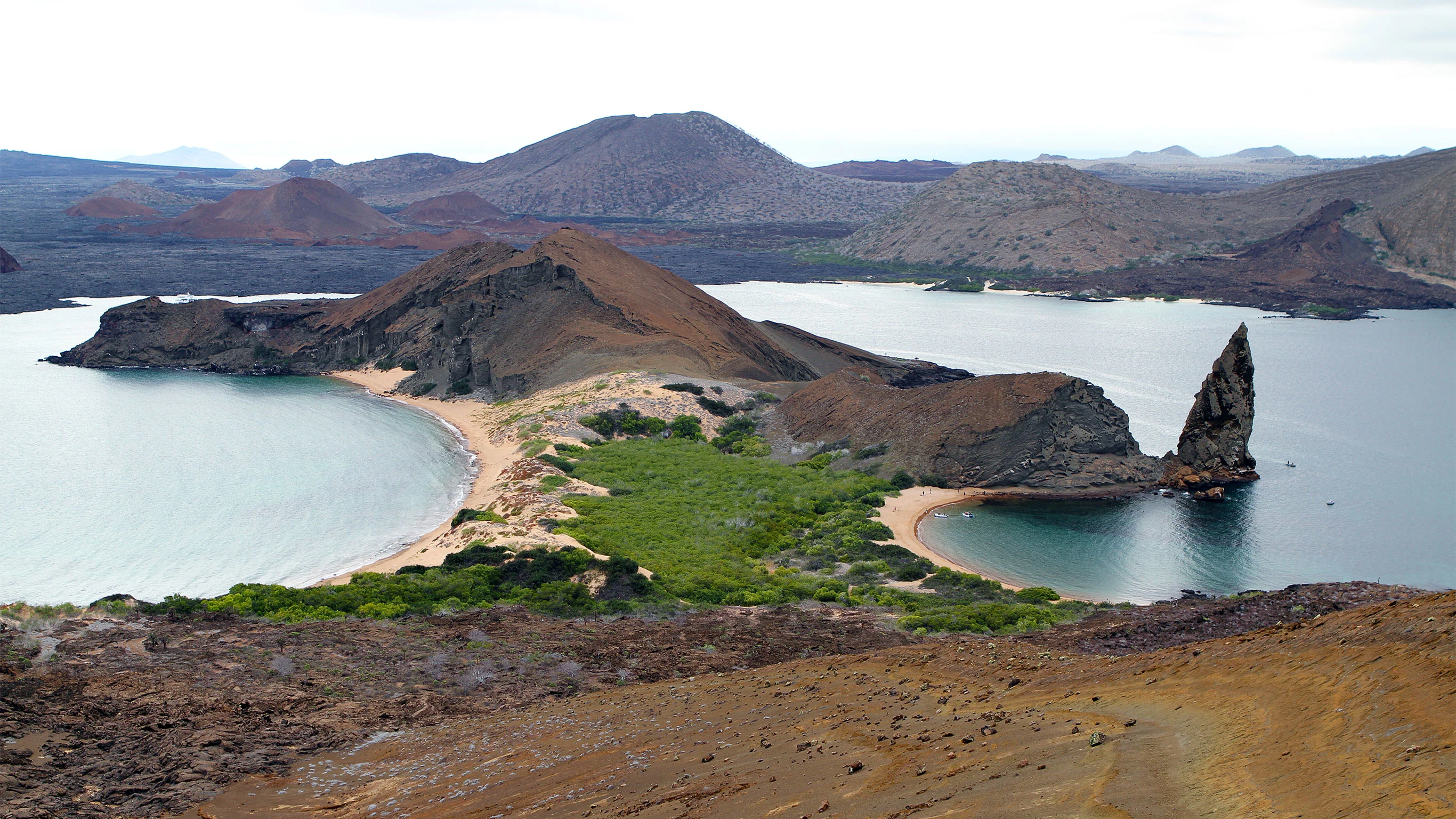
Visit Sullivan Bay on Santiago Island to witness the giant lava formations contrasting the white-coral-sand beach. Continue to Bartolomé for a guided walk to see the island’s dramatic volcanic features and the iconic Pinnacle Rock.
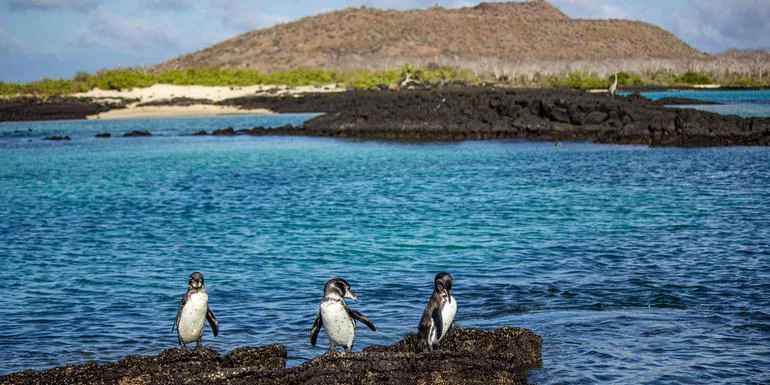
The morning visit heads to Sullivan Bay on Santiago Island, located on the southeast part of the island. This place is interesting for its geology because the area has elevations in form of small volcanoes, formed by the lava flows. Later, head to Bartolomé Island, home of the famous Pinnacle Rock. This is an exceptional place to observe volcanic island geology and to snorkel. Among the many colorful species you will see Bi-color Parrotfish, Streamer Hogfish, and Flag Cabrilla. Sometimes you get a special treat—a penguin “snorkeling” right around you in hunt of fishy treats. The long climb up the wooden steps to the pinnacle of this cinder cone takes you through cinders and rough volcanic formations, a veritable moonscape. The lower slopes are graced with a light sprinkling of the delicate, silvery Taquilia, a ground hugging plant adapted to this harsh spot. On top you will enjoy the spectacular view of Bartolomé, Santiago, and several other nearby islands.
TRANSPORT: The Reina Silvia Voyager is just as elevated as the name implies. This modern catamaran offers increased stability when cruising the waters of the Galápagos Islands. Enjoy the view from the spacious sun deck, Jacuzzi, or private balconies (available with most cabins).
ACTIVITY: Take the opportunity to swim and snorkel along the shore, home to one of the most iconic volcanic rock formations on the islands. Home to Galápagos penguins, friendly sea lions, sea turtles, and a huge variety of fish, Bartolomé and its surrounding waters are a fantastic place to explore the natural wonders of the Galápagos.
ACTIVITY: Visit Sullivan Bay on Santiago Island to see one of its star natural attractions – striking and fascinating giant lava formations. Very few plants have managed to survive on this island due to its harsh environment and relatively new lava flow. Enjoy a walk along the lava formations before coming to a white-coral sand beach, where abundant Sally Lightfoot crabs and sea lions gather on shore.
ACTIVITY: Enjoy a cool dip after exploring Sullivan Bay on foot. Grab a snorkel and discover many species of fish and other marine life in the shallow waters. Keep an eye out for turtles, rays, and large schools of colourful fish.
ACTIVITY: Hike to Bartolomé’s summit for a stronger perspective of the islands’ not-too-distant volcanic origins, and enjoy a panoramic view – it’s one of the best among the islands! See other Galápagos Islands in the distance as well as Pinnacle Rock, the island’s famous towering landmark.
Meals: Breakfast,Lunch,Dinner
Day 8
Day 8: Rábida / Chinese Hat
Spend the morning exploring the red sand beaches and salt water lagoons of this tiny island. Look for wading flamingos and nesting pelicans before heading out to do some snorkelling. In the afternoon, discover the lava flows and lava tunnels on the small island of Chinese Hat. After, enjoy a refreshing dip in turquoise waters. Search for fish and sea turtles in the protected bay.
Rabida is a “small red island,” the colour of the volcanic cinders.The red beach is usually well populated with sea lions and pups. At times the low salt bushes are loaded with nesting California Brown Pelicans. Just behind the beach, in a brackish lagoon, see Bahamas White-cheeked Pintail Ducks, migratory shore and wading birds, and Greater Flamingos. Flamingos need the presence of a dozen or two other flamingos to stimulate their synchronous mating dance. If our timing is right, we will be able to observe this highly entertaining ritual as well as two species of boobies nest along the cliffs. Later, travel to Sombrero Chino, a tiny island just off the southeast tip of Santiago. Its name (Chinese Hat) describes the island’s shape. Though centrally located, it is one of the least visited sites in the area. Patches of pahoehoe lava, cracked lava and lava tubes can be found on the island. If you’re up for a walk, a path leads to some spectacular views of the waves crashing below. White-tipped sharks frequent the area, as do the playful Galapagos Penguins and sea lions.
ACTIVITY: Arrive at a red sand beach at Rábida to explore its trails. A short trail leads to a saltwater lagoon; another trail goes past the lagoon to the interior, where the revered palo santo trees grow. (When burned, the branches of this tree give off a pleasing aroma and ward off mosquitoes.)
ACTIVITY: Grab a snorkel and discover many species of fish and other marine life. Keep an eye out for white-tip sharks and sea lions.
ACTIVITY: MORNING Explore the red sand coastlines of Rabida island, and keep an eye out for Sea Lion colonies sunning themselves on the beach.
ACTIVITY: Explore Chinese Hat’s beautiful landscape and view many geological formations such as lava tubes and lava flows. Don’t forget to bring your snorkel gear!
ACTIVITY: Snorkel right from the white-coral sand beach and come face to face with playful sea lions and large schools of tropical fish. Keep an eye out for marine iguanas and penguins.
ACTIVITY: AFTERNOON Get a closer look at Chinese Hat Island’s many geological lava formations. Your kayak will give you access to many areas not visible from land, so take your time to marvel at these natural wonders.
TRANSPORT: The Reina Silvia Voyager is just as elevated as the name implies. This modern catamaran offers increased stability when cruising the waters of the Galápagos Islands. Enjoy the view from the spacious sun deck, Jacuzzi, or private balconies (available with most cabins).
Meals: Breakfast,Lunch,Dinner
Day 9
Day 9: Baltra / Quito
Disembark the boat at Baltra to transfer to the airport and catch the flight back to Quito. Upon arrival, transfer to the hotel and joy one final night on the town.
Additional Information: G Adventures strongly recommends not booking departure flights on the day the group returns to Quito. Local flight times are often subject to change and could potentially cause issues if delayed. We recommend booking flights on the last day of the tour as noted on the Full itinerary page.
Meals: Breakfast
Day 10
Day 10: Quito
Depart at any time.
Meals: Breakfast
What’s included
What’s not included
Additional information
Meals Included
9 breakfasts, 7 lunches, 7 dinners
Group Size
16
Solo Travellers
Meals
Eating is a big part of traveling. Travelling with G Adventures you experience the vast array of wonderful food that is available out in the world. On our Galapagos yachts, food is included, plentiful and made of fresh local ingredients. Dining is casual, tables are unassigned and the dining room is capable of seating the entire passenger compliment at one time. There is always a selection of different meals available, and vegetarians will find plenty of options. Special dietary requirements can be accommodated with advance notice, please advise us at time of confirmation. Coffee, tea and water are all provided free of charge. All other beverages, alcoholic and non-alcoholic are not included and can be purchased at the bar.
Minimum Age
You must be 18 to travel unaccompanied on a G Adventures tour. For minors travelling with a guardian over 21 years old, the minimum age is 12.
Local Dress
Important Notes
1. It is important to note that for landings in Galapagos we use zodiacs/pangas for “wet” or “dry” landings where you might have to wade ashore in shallow water. This will require you to be able to safely navigate the terrain on uneven ground, to lift your leg over the side of a Zodiac/pangas, and stand throughout the landing with no place to sit. Our team is there to assist you if needed but having good mobility is important for your safety and enjoyment. Please also note that the yacht does not have an elevator and thus staircases must be used to move between decks. Additionally, some snorkeling activities will take place in open water and you will need to go up and down small ladders from the panga.
2. G Adventures requires your passport number, full name and date of birth at the time of booking. Please make sure you give this information to your travel agent.
3. Once you have confirmed your booking please give us your international flight details and advise us if you have any important issues such as allergies, special diets, etc.
4. The Ecuadorian government currently levies a Galapagos Islands Park entry fee of $200 USD per person ($100 USD for children under 12 years old). This is payable at the airport upon arrival in the park. It is not included in the cost of the tour, and must be paid in CASH. This fee funds Park maintenance and supervision in Galapagos, as well as ecological study, conservation and infrastructure development in Ecuador’s other National Parks. Entry fees and the funds they generate for the National Park System are among measures taken by the Ecuadorian government to protect its natural heritage.
5. The Governing Council of the Special Regime of Galapagos has introduced a system for obtaining Transit Control Cards. These cards cost $20 USD per person. To facilitate your entry to the islands, we will provide the cards during your Welcome Briefing. No prior information is required to be completed by you in advance. Please ensure you have the fee available in cash at that time.
Retain this card along with your passport as you will be required to present this upon arrival to the Galapagos Islands. Please note that this applies to all tourists entering the Galapagos Islands and is a supplement to the existing entry fee to the National Park and is not controlled by tour operators or travel agencies. It is the first of a number of initiatives to track, control and maintain the sustainable tourism targets set out by the Galapagos National Park and the Ecuadorian government in an attempt to preserve the fragile environment of the archipelago.
6. Please note that the rooming on our Galapagos yachts is done on a first-come, first-serve basis, and we are not able to guarantee the specific cabin you will receive on board. The cabins are comfortable and clean, all with private bathrooms. Due to the specific location of the cabins on board, the window sizes vary as well as the noise at times when the boat is navigating, given the proximity of the cabin to the engine room. Our friendly and competent crew will ensure the smooth and comfortable journey for the duration of your tour.
COMBO TRIP
Please note that this tour combines with other G Adventures tours. As such, the staff and some travel companions on your tour may have previously been traveling together with G Adventures, prior to Day 1 of your tour. Likewise, some staff and travel companions may be continuing together on another G Adventures tour, after your trip concludes.
Group Leader
CEO (Chief Experience Officer)/Naturalist Guide while in the Galápagos Islands (certified by the Galápagos National Park Authority), local G Adventures Rep in Quito.
About Accommodation
For further details of the vessel layout like deck plans, cabin specifications and additional photos, please see the following link to our Galapagos cruising landing page: https://www.gadventures.com/travel-styles/cruising/galapagos
What to Take
You are permitted to bring a baggage maximum of 50 pounds/23 kg. This size limit ensures your bag will be able to be stored safely but we highly recommend packing light. Additionally, bring with you items that need to be carefully transported, like your (laptop, cellphones, tablets and medicines) If you don’t wish to take all of your luggage with you to Galapagos, please ensure you have an extra bag you can leave behind at hotel storage and pickup on your return.
Please note that Galapagos is a protected National Park so your luggage will be checked before arrival and departure to and from the islands. Don’t bring any food, seeds or other organic material that could affect the delicate ecosystem of the islands.
Please do not bring any alcoholic beverages aboard, as your boat has a bar offering a variety of alcoholic drinks and prices are reasonable.
LUGGAGE ALLOWANCE ON THE BOAT: We recommend travellers to bring a maximum of 50 pounds/23 kg for their luggage. We will accept luggage types onboard, however if you are a single traveller sharing with another traveller, it is especially important to keep in mind that you will share the storage space in cabins. It is best to pack light. Luggage storage facilities are available at the start hotel for anything you do not need while you are exploring the Galapagos. A good size daypack is also essential.
Please note that the electric outlets on this boat are 110v and will have 2 flat prongs. If necessary, please bring an adaptor with you for your electric devices, ie, battery chargers.
Spending Money
Every traveller is different and therefore spending money requirements will vary. Some travellers may drink more than others while other travellers like to purchase more souvenirs than most. Due to the remoteness of the Galapagos islands, onboard our vessels, there is no credit card machines therefore only cash is accepted. It is important that you withdraw enough cash for the duration of your trip. Once in the islands, ATM machines are extremely limited and unreliable. Please consider your own spending habits when it comes to allowing for drinks, shopping and tipping. Please also remember the following specific recommendations when planning your trip. We would also recommend to contact your local bank prior to your departure to see if international withdrawals can be done with no issues.
San Cristóbal: Punta Pitt Hike & Kicker Rock Sunset Navigation
On day 4, land at Punta Pitt for a steady hike over eroded tuff to a plateau with sweeping views. This is the archipelago’s only site to observe all three booby species—blue-footed, Nazca and red-footed—along with displaying frigatebirds. Your naturalist explains nesting habits and how currents shape feeding patterns.
Later, cruise past the sheer tuff spires of Kicker Rock (León Dormido) as the light softens. Vertical walls rise from cobalt water cut by a narrow channel, a haunting silhouette for sunset over the Pacific. It’s a scenic navigation that frames San Cristóbal’s volcanic drama and the productive seas that sustain its birdlife.
Santa Fé Bay Snorkel & Kayak with Land Iguanas; South Plaza Clifftop Walk
On day 5, slip into Santa Fé’s sheltered bay to snorkel with playful sea lions and reef fish, then paddle a kayak along rugged lava shores where green sea turtles glide in clear shallows. Ashore, follow a trail past towering Opuntia cactus to spot the island’s hefty pale land iguanas basking on warm rock.
In the afternoon, land on South Plaza, a small uplifted islet brushed in red sesuvium and dotted with cactus. Walk the clifftop to watch swallow-tailed gulls and tropicbirds ride tricky currents while sea lions call from below. The contrasting palettes—turquoise water, black lava, and saffron lichens—make this a day for scenic viewing and photography.
Genovesa: Darwin Bay Mangroves & Prince Philip’s Steps Colony
On day 6, land on the white coral sands of Darwin Bay inside a flooded caldera. A gentle path threads mangroves alive with frigatebirds and red-footed boobies, while tidal pools host curious sea lions. Between walks, snorkel beneath the caldera walls amid clouds of reef fish and, if conditions allow, passing rays.
In the afternoon, climb Prince Philip’s Steps (El Barranco) to a lava plateau where short-eared owls hunt among petrels. Your guide interprets this extraordinary seabird metropolis—courtship displays, nesting strategies, and how nutrient-rich upwelling fuels such density—before you pause for photos and reflection along the wind-buffed rim.
Santiago: Sullivan Bay Pahoehoe Lava Walk & Snorkel
On day 7, land at Sullivan Bay to traverse a striking expanse of fresh-looking pahoehoe lava, its ropy textures, pressure ridges and hornitos telling the story of a 19th-century flow. Few plants survive here; the stark beauty and coastal views make a dramatic contrast to the lush highlands seen earlier.
After the walk, cool off with a snorkel over pale sand and lava ledges. Watch for Sally Lightfoot crabs on shore and reef fish—parrotfish, sergeant majors—cruising the shallows. Your guide links the black rock underfoot to the hotspot volcanism that built the Galápagos archipelago.
Bartolomé: Pinnacle Rock Summit Trail & Snorkelling with Penguins
Also on day 7, climb the boardwalk to Bartolomé’s panoramic summit for a sweeping view of Pinnacle Rock, golden tuff cones and the dark sweep of Sullivan Bay’s lava beyond. Your naturalist explains how ash, cinders and time sculpted this classic silhouette.
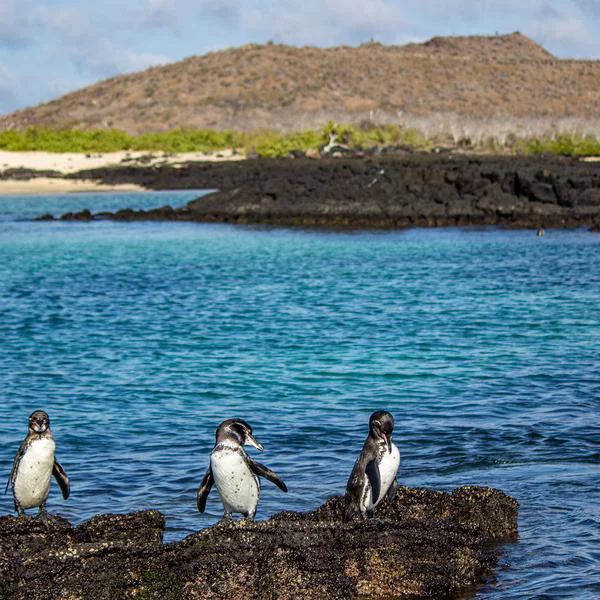
Back at sea level, snorkel the clear shallows below Pinnacle Rock. This is one of the best places to see the Galápagos penguin—the only penguin found north of the equator—alongside sea turtles and darting schools of reef fish. The combination of geology and wildlife makes Bartolomé a perennial favourite.
Rábida: Red Sand Beach, Brackish Lagoon & Coastal Snorkel
On day 8, land on Rábida’s cinnamon-red sand, coloured by iron-rich volcanic cinders. A short path leads to a brackish lagoon where, season permitting, greater flamingos sift for shrimp beside white-cheeked pintails. Along the coast, watch brown pelicans nest low in saltbush and sea lions doze near the surf line.
Then slip into the water for a snorkel along lava ledges, scanning for rays, reef fish and the occasional white-tip reef shark. Your guide highlights how erosion and mineral content create Rábida’s distinctive hue and the food web that supports its waders and pelicans.
Chinese Hat (Sombrero Chino): Lava Coast Kayak & Snorkel
Later on day 8, circle tiny Chinese Hat, a perfect tuff cone fringed by collapsed lava tubes and pahoehoe. Conditions permitting, paddle a kayak along the calm, protected shoreline for close views of penguins perched on black rock and sea lions porpoising beside your bow.
Drop into the water to snorkel over white sand and basalt, watching for marine iguanas grazing algae and sea turtles cruising the shallows. Your guide points out how wave action and cooling lava sculpted the island’s hat-like profile—an elegant finale to a day of geology and wildlife.
Galápagos Catamaran Cruising & Zodiac (Panga) Landings
Throughout days 2–9, travel aboard the modern catamaran to cruise the Galápagos Islands in comfort between remote visitor sites. Daily zodiac (panga) rides bring you to beaches, rocky shelves and sheltered coves for wet and dry landings, with your guide setting the rhythm for hikes, snorkels and kayaking.
From the sun deck, watch misty mountain passes of cloud over island summits and trace the silhouette of distant cones. Evenings feature naturalist briefings that prepare you for the next day’s landing, deepening your understanding of evolution, currents and volcanic origins that bind this remarkable archipelago together.
Española: Gardner Bay Beach & Punta Suárez Seabird Cliffs
On day 3, step ashore at Gardner Bay, a ribbon of white coral sand frequented by a boisterous sea lion colony. Stroll among resting iguanas and curious mockingbirds, then snorkel the turquoise bay where king angelfish, surgeonfish and young sea lions swirl in the clear surge.
In the afternoon, follow the rocky trail at Punta Suárez, home to nesting Nazca and blue-footed boobies and, seasonally, the waved albatross. Watch a natural blowhole send spray skyward and pause for photos and reflection along the cliffs as tropicbirds shear the wind below. Your guide weaves in geology and behavior, bringing this wildlife-rich island to life.
Santa Cruz Highlands Giant Tortoises & Scalesia Forest
On day 2, cross from Baltra to Santa Cruz and drive into the lush highlands to walk among wild giant tortoises. Trails wind through misty pastures and the emerald canopy of the Scalesia cloud forest, where vermilion flycatchers flash red against green and Darwin’s finches chatter in the shrubs. Your guide helps you read tracks, gauge age by shell rings, and keep respectful distance.
This verdant zone reveals the Galápagos’ striking microclimates, rising from arid coast to cool, damp uplands in a short span. Hearing the slow rustle of a tortoise through grass is a quiet thrill—an intimate, wildlife encounter that connects you to the archipelago’s conservation story.
Fausto Llerena Breeding Center & Charles Darwin Research Station
Later on day 2 in Puerto Ayora, visit the Fausto Llerena Breeding Center to see juvenile and adult tortoises from several islands and learn how head-starting programs return them to the wild. Continue to the Charles Darwin Research Station to hear how scientists, rangers and volunteers safeguard fragile habitats and control invasive species.
Displays trace the legacy of research since the 1960s and the enduring symbolism of tortoises in island ecology. As you stroll shaded paths by prickly pear cactus and lava rock, your naturalist frames the Galápagos’ role in shaping modern science and why sustained, community-driven conservation remains vital today.
Quito Arrival Transfer & Welcome Briefing
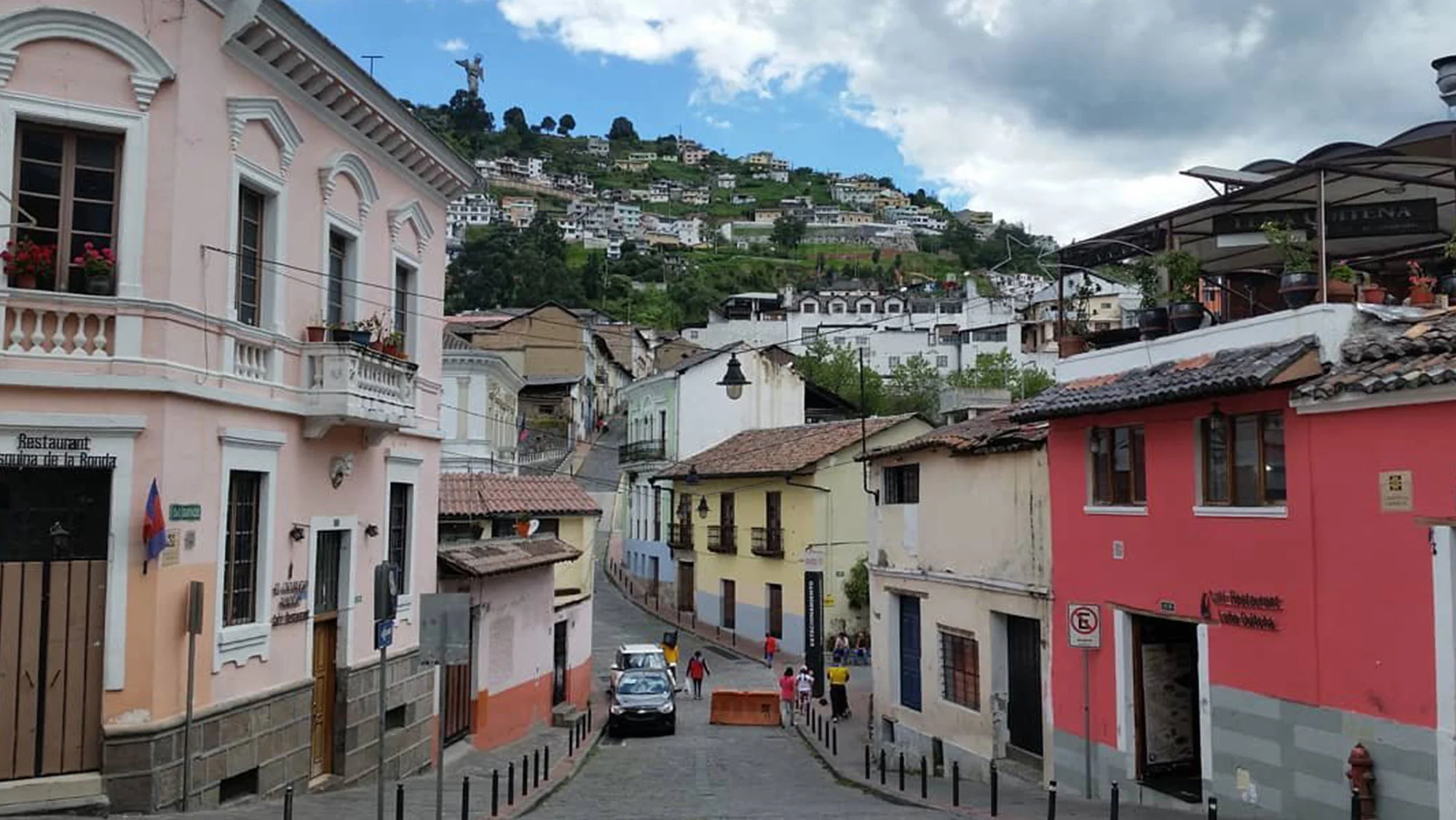
On day 1, settle into Quito with an included airport transfer, then meet your CEO Naturalist Guide and fellow travellers at the hotel for a relaxed orientation. Your host will review the journey from Andean capital to the Galápagos, share packing and wildlife tips, and outline tomorrow’s early flight. The rest of the evening is yours to enjoy a free evening and adjust to Quito’s cool, high-altitude air.
Quito’s historic centre is a UNESCO World Heritage Site, framed by volcanic peaks and colonial church spires. Your briefing sets the tone for the expedition ahead—small-group camaraderie, expert-led wildlife encounters, and deliberate respect for the fragile ecosystems you’re about to visit.