
Your itinerary
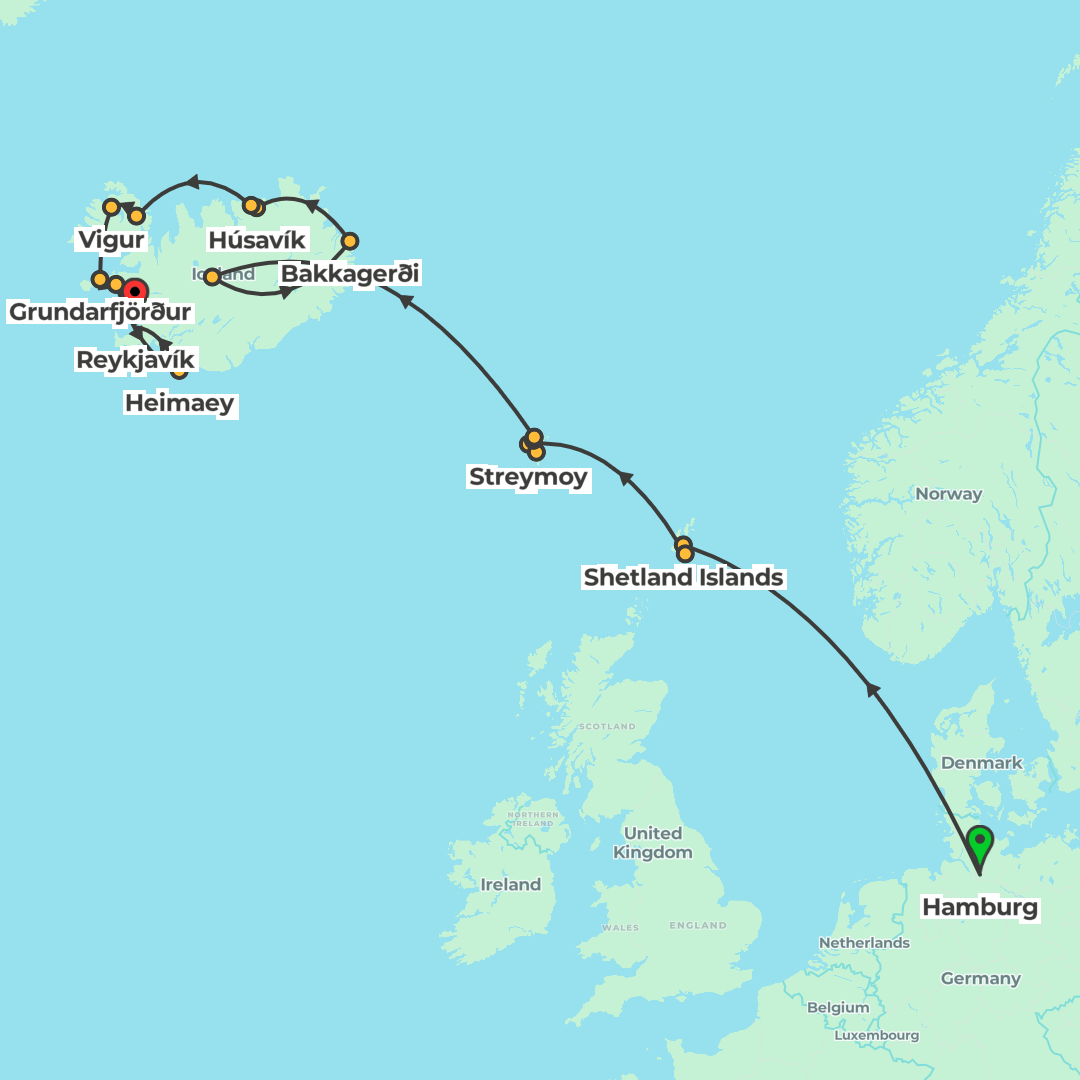
Day 1
Hamburg
Your adventure beginsYour journey starts in Hamburg, the second-largest city in Germany and one of the greenest urban areas in Europe. There’s much to see and do in Hamburg. If you have time, you’ll find many attractions in the old town district of Altstadt, including the St Nikolai Memorial and the historic street of Deichstraße. Hamburg is also home to several UNESCO World Heritage Sites, including Chilehaus and the world’s largest historic warehouse complex in Speicherstadt. Art lovers should head to Kunsthalle, the nation’s foremost art museum. Once you embark MS Fridtjof Nansen, you’ll have time to meet the crew and Expedition Team and settle in as we set sail.
Day 2
Cruising
Relax at seaAs we sail from Hamburg towards Norway’s Lysefjord, your expert Expedition Team will introduce what lies ahead with lectures in the Science Center on the wildlife, geology, and culture we’ll encounter along the way. A day at sea gives you plenty of time to get acquainted with the ship and simply relax. Watch the scenery unfold from the deck, settle into the Explorer Lounge & Bar, or unwind in the panoramic sauna or hot tub.
Day 3
Lysefjord
Witness the drama of these famous fjordsWith a backdrop of cloud-shrouded mountains and tumbling waterfalls, of small farms and jade-green waters, we’ll explore one of the world’s most breathtaking fjords. Wind, rain, or shine, head to the deck to take it all in: glide past narrow passages and soak in dramatic scenery that reveals itself from every angle. In autumn, drifting mist and shifting light create an especially memorable atmosphere. If conditions allow, you may also have the chance to hike to Preikestolen, ’The Pulpit Rock’, one of Norway’s most iconic natural landmarks. Rising high above the fjord below, it’s worth every step of the climb.
Day 4
Lerwick, Shetland Islands
Explore Scotland’s northernmost townWelcome to the Shetland Islands. Lerwick, the capital, is a friendly, Victorian-influenced fishing town set in beautiful scenery. Navigate its narrow lanes on foot to discover little shops selling local whiskies, woollen sweaters, and fudge, then head to the old waterfront for the Shetland Museum, home to Pictish carvings and intricate lace shawls. Nearby, Fort Charlotte and the regal town hall are worth a look. Keep your binoculars handy: grey and common seals bask along Lerwick’s beaches, and red-throated divers, redshanks, and curlews are often spotted from the shore.
Day 5
Thorshavn
A visit to Streymoy in the Faroe IslandsFounded by Norsemen in the 10th century, Tórshavn, Thor’s Harbour, is one of Northern Europe’s oldest capitals, set on Streymoy, the largest of the Faroe Islands. Wander through cobbled alleyways lined with colourful turf-roofed houses, or visit the local museums to learn about the city’s origins and the islands’ flora, fauna, and geology. A short walk out of town brings you to Svartafoss, where a waterfall tumbles over mossy rocks. Along the seafront, look out for eider ducks and the distinctive Faroese starling with its beige-tipped wings.
Day 6
Oyndarfjørður
The Faroese way of lifeHidden in a narrow fjord on the island of Eysturoy, Oyndarfjørður is a small village far from the Faroe Islands’ well-trodden paths. A handful of families live here among turf-topped hills and weathered boathouses, and visitors are welcomed into the quiet rhythms of everyday Faroese life. Walk alongside the streams that cut through the settlement, meet locals whose families have been here for generations, and learn how traditions have been shaped by centuries of isolation, fishing, and life at sea. It’s one of the most genuine encounters with the Faroes you can have.
Day 7
Cruising
Heading to the ‘Land of Ice and Fire’With Iceland on the horizon, make the most of this time at sea to enjoy at your leisure. Watch for seabirds and whales from the observation deck, unwind in the panoramic sauna, or settle in with a drink as the anticipation builds. In the Science Centre, the Expedition Team will share what to expect from the days ahead, with lectures on the landscapes, wildlife, and culture we’ll encounter. Photography enthusiasts can also pick up tips on capturing wildlife and dramatic scenery from our onboard expert.
Day 8
Bakkagerði
Exploring the fjord-cut coastlineIceland’s east coast is cut by deep fjords, lined with tumbling waterfalls and bird-filled cliffs. Quiet villages dot the shoreline, including Bakkagerði, known as Iceland’s puffin capital, where nearby platforms at Hafnarhólmi let you watch Atlantic puffins nesting in their thousands. Beyond the birds, this is a landscape steeped in folklore and drama. We might visit Álfaborg, the legendary ‘elf rock’ said to house the queen of the ‘hidden people’ – huldufólk – and look up at the jagged Dyrfjöll peaks and colourful rhyolite mountains framing the fjord. Thanks to our Zodiacs, we can reach stretches of this coastline that are otherwise inaccessible, exploring Iceland in true expedition style.
Day 9
Husavik
Iceland’s best whale watching spotToday you’ll discover Húsavík, a charming fishing town and one of the best places in the world to see whales. It looks out over Skjálfandi bay, where humpback and minke whales, white-beaked dolphins, harbour porpoises, and even the elusive blue whale are regularly spotted. On shore, the Whale Museum brings you closer to these giants, while the Exploration Museum tells a more unexpected story: in the 1960s, NASA sent 32 Apollo astronauts to train in the lunar-like lava fields nearby, preparing them to collect rock samples on the Moon. For something more relaxing, soak in the geothermal waters at GeoSea overlooking the bay, or end the day with a beer at the local microbrewery.
Day 10
Vigur Island
Explore one of Iceland’s wildest islandsA serene sail through the Westfjords brings us to Vigur, a tiny island isolated beneath vast skies and surrounded by seabirds. Life here follows a slower rhythm, shaped by the sea, the seasons, and generations of tradition. Wander between historic buildings, watch puffins and eider ducks at close range, and learn how the island’s small community still practises the centuries-old craft of eiderdown collection. Keep watch on the water too: whales are often spotted in the surrounding fjords.
Day 11
Grundarfjørdur
Visit Iceland in miniatureSnæfellsnes is a peninsula of dramatic coastlines, volcanic peaks, lava fields, black sand beaches, and traditional fishing villages, all set beneath the glacier-capped Snæfellsjökull volcano. It inspired Jules Verne’s book, Journey to the Centre of the Earth, and it’s often called Iceland in miniature because almost every landscape the country is known for can be found here in one compact stretch of coast. From our port in Grundarfjörður, overlooked by the iconic Kirkjufell mountain, you can join excursions around the peninsula or explore the surroundings on foot.
Day 12
Heimaey Island
Discover the town that defied a volcanoOur first stop is Heimaey, the only inhabited island in the Westman Islands, off Iceland’s south coast. In 1973 an eruption nearly buried the town, and the island still carries the evidence. Visit Eldheimar, a museum built around an excavated house frozen mid-disaster, then hike to Stórhöfði, where around eight million puffins nest each summer, or climb Mount Eldfell for views of the town from the volcano that almost destroyed it.
Day 13
ReykjavÍk
Disembark in ReykjavíkYour expedition ends in Reykjavík, a city that rewards a longer look. Stroll Laugavegur for independent shops and coffee, take in the striking Hallgrímskirkja church, or lose an afternoon in the city’s galleries and museums. If you can, we highly recommend staying an extra night. This marks the end of your time with us for now, but we hope it won’t be the last.
What’s included
What’s not included
Additional information
Lerwick Heritage Walk & Shetland Museum
Explore on foot as you walk Lerwick’s narrow lanes, passing stone cottages, knitwear boutiques, and the salt-licked waterfront. Continue to the harbor to visit the Shetland Museum, where maritime relics, Pictish stones, and lacework chart life on the edge of the North Atlantic.
Stroll to Fort Charlotte for commanding views and keep binoculars ready along the shore: grey and common seals often haul out, while red-throated divers and curlews feed in sheltered bays.
Tórshavn Old Town Tinganes Walk
Wander through Tórshavn’s cobbled alleys to Tinganes, the historic headland of governance framed by turf-roofed houses and red timber warehouses. The sea air mingles with heather and peat as you wander cobbled lanes between sheltered inlets and boat sheds.
Hear how the Faroese capital grew from a 10th-century assembly of Norse seafarers into a modern cultural hub. Nearby paths lead to Svartafoss and bird-rich shores where distinctive Faroese starlings flicker their beige-tipped wings.
Oyndarfjørður Village Visit & Fjordside Walk
Step into a secluded fjord settlement to meet local families and trace footpaths past weathered boathouses and turf-capped cottages. Streams stitch through the village, and sea-salted wind carries the hush of the Atlantic.
Learn how life here has been guided by fishing, seamanship, and centuries of isolation. This intimate encounter reveals the Faroese way—resourceful, close to nature, and shaped by the rhythms of tide and season.
Bakkagerði Puffin Platforms & Borgarfjörður Eystri Zodiac Landing
Go ashore by Zodiac to watch Atlantic puffins from the wooden platforms at Hafnarhólmi, one of Iceland’s most accessible seabird colonies. Cliff ledges chatter with life as waves carve the fjord’s volcanic ramparts.
Explore a landscape steeped in folklore at Álfaborg, the storied “elf rock,” while the jagged Dyrfjoll peaks and colorful rhyolite slopes frame the village. This is Iceland’s Eastfjords at their most vivid—wildlife, geology, and myth in one compact cove.
Húsavík Whale Museum & Exploration Museum
Visit the acclaimed Húsavík Whale Museum to encounter skeletons, soundscapes, and research that illuminate these giants of Skjálfandi Bay. Exhibits deepen appreciation for humpbacks, minkes, and the ocean they inhabit.
Continue to the Exploration Museum to trace Apollo astronauts’ 1960s training in Iceland’s lunar-like lava fields. The connection between fire, ice, and space exploration brings a surprising new lens to North Iceland’s volcanic story.
Vigur Island Seabird Sanctuary & Eiderdown Tradition
Land on Vigur, a tiny Westfjords isle where fields meet sea and lanes thread past historic farm buildings. Walk quietly among nesting grounds to see puffins and eider ducks at remarkably close range.
Hear how families sustainably gather the centuries-old eiderdown tradition, refining one of the world’s lightest natural insulators. Keep watch offshore—calm fjords can suddenly ripple with whales and porpoises on their feeding runs.
Grundarfjörður Seaside Walk & Kirkjufell Viewpoints
Stroll the harbor and shoreline of Grundarfjorður, taking in classic views of Kirkjufell, the arrowhead mountain mirrored in quiet coves. Easy coastal paths reveal sea stacks, driftwood, and photogenic angles across the Snæfellsnes Peninsula.
Learn why this coast is called “Iceland in miniature,” where lava fields, fishing traditions, and glacier-capped horizons fit into one sweeping panorama—an ideal setting for pause for photos and reflection.
Heimaey Volcano & Eldheimar Museum
Discover the Eldheimar museum, built around a home entombed by ash during the 1973 eruption. Immersive exhibits reveal how residents fought lava flows to save their harbor and town.
Step onto fresh lava fields to walk the lava and absorb views toward Mount Eldfell’s crater and bird-filled cliffs. This is a compelling portrait of resilience on the Westman Islands—the town that defied a volcano.
Expedition Lectures & Science Center
Join expedition lectures led by naturalists, historians, and geologists in the ship’s Science Center. Sessions unpack seabird ecology, volcanic forces, and human stories that shape the North Atlantic.
Engage in hands-on displays and citizen-science projects, from plankton sampling to seabird counts, and meet your Expedition Team to discuss landscapes, wildlife behavior, and the latest forecasts for landings and Zodiac operations.
Open-Deck Wildlife Watching & Photography Tips
Head to the rail to watch for seabirds and whales—kittiwakes in spiraling flocks, fulmars skimming swells, and the sudden spout of a humpback. Naturalists help identify species while scanning the horizon together.
Refine your craft during an onboard photography workshop, learning to work with shifting light, spray, and distance. Compose sleek silhouettes against misty horizons and capture the scale of cliffs, fjords, and open ocean.
Preikestolen (Pulpit Rock) Hike
Lace up to hike to Preikestolen, a granite pulpit perched 604 meters above Lysefjord. The trail weaves across slickrock and pine-scented heath to a sheer granite cliff with vertiginous views across the fjord’s silver ribbon.
This challenging outing is weather-dependent and guided for safety. It is at additional cost and bookable on tour; good boots, layers, and fitness are essential. Time atop the plateau invites a quiet pause for photos and reflection.
Skjálfandi Bay Whale Watching Cruise (Húsavík)
Take to the water to cruise Skjálfandi Bay with a naturalist team, scanning for flukes and blows as you search for humpback whales, minke whales, and white-beaked dolphins amid mountain-framed seas.
Guides share behavior insights and responsible viewing practices while you suit up against the North Atlantic breeze. This experience is at additional cost and bookable on tour; sightings vary with season and sea conditions.
Snæfellsnes Peninsula Highlights Tour (from Grundarfjörður)
Circle the coast by coach to the basalt arches of Arnarstapi sea cliffs, the wave-lashed Djúpalónssandur black-sand beach, and viewpoints revealing the glacier-capped Snæfellsjokull.
Hear stories linking this volcanic landscape to Jules Verne’s Journey to the Centre of the Earth and local fishing lore. This guided circuit is at additional cost and bookable on tour; short walks on uneven ground reward photographers with wide Atlantic panoramas.
Stórhöfði Puffin Cliffs Hike (Heimaey)
Hike across exposed headlands to Stórhofði, where ocean winds meet green slopes riddled with puffin burrows. On clear days, sea stacks and neighboring isles punctuate the horizon.
A local guide shares seabird ecology and safe viewing etiquette at seasonal platforms. This outing is weather-dependent and at additional cost and bookable on tour; puffin presence peaks in summer, when the cliffs are at their most lively.
Lysefjord Scenic Cruising & Pulpit Rock Views
Cruise deep into Norway’s most dramatic waterway as you cruise the Lysefjord, gliding beneath near-vertical cliffs draped with tumbling waterfalls. From open decks, scan for mountain farms clinging to ledges and the mirror-bright, jade-green water shaped by ancient ice.
Look up to the sheer slab of Preikestolen (Pulpit Rock), a colossal pulpit soaring above the fjord. Light and weather transform the scene by the minute, rewarding photographers with shifting moods and time to pause for photos and reflection.
