
Your itinerary
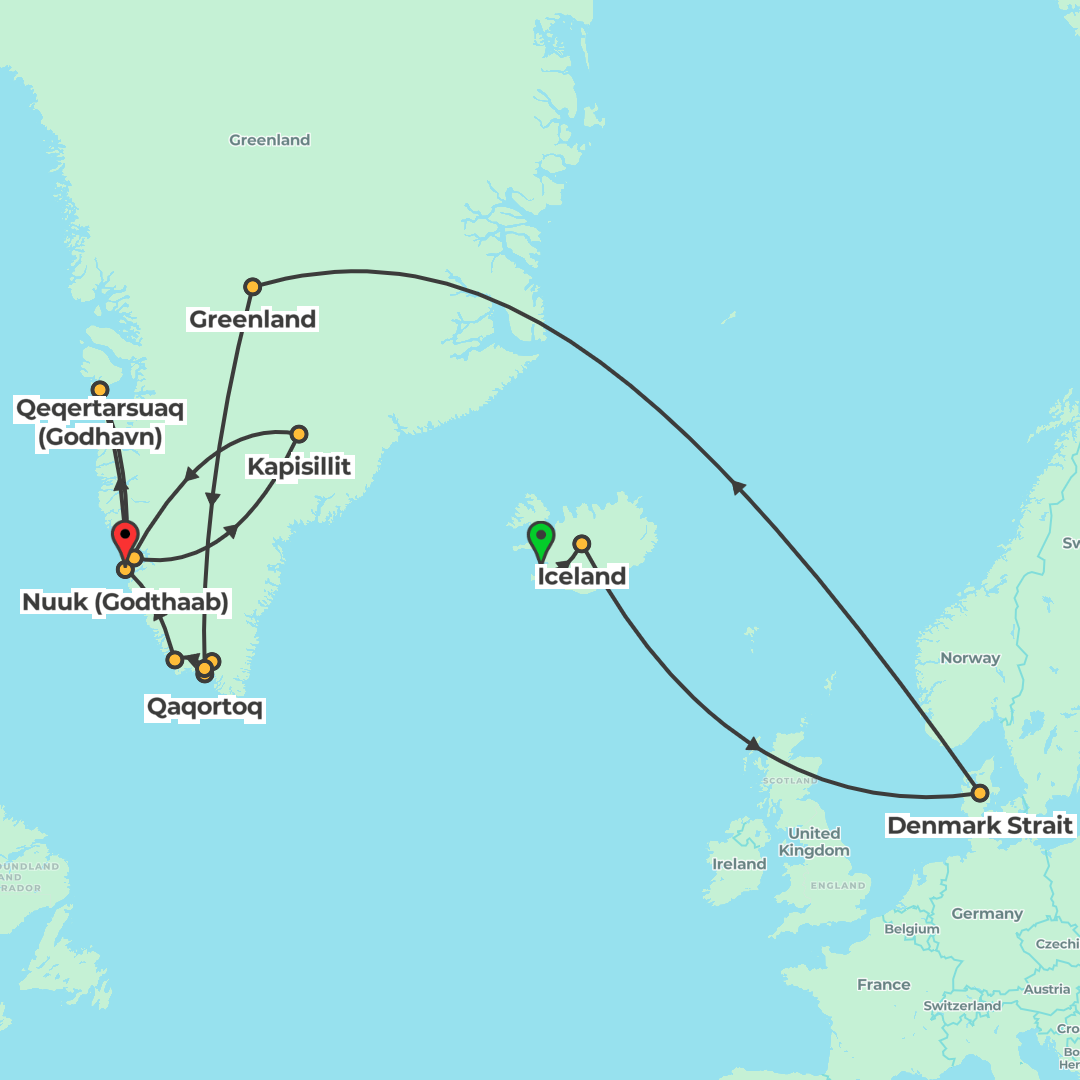
Day 1
Reykjavík
Explore Reykjavík: walk Laugavegur, visit Hallgrímskirkja Church and the Reykjavík Art Museum. An optional Pre-Programme to Iceland’s natural highlights is available.
Day 2
Cruising Denmark Strait
Sail from Iceland toward Greenland across the Denmark Strait. Relax on board, watch for whales and seabirds, mingle in the lounge or use wellness facilities, and attend Expedition Team presentations on visiting Arctic environments and communities; book excursions and learn a few words of Greenlandic.
Day 3
Cruising Denmark Strait
Cruising Denmark Strait
Day 4
Prince Christian Sound
Begin expedition-style exploration of southern Greenland’s fjords, channels and islands, adapting to weather and ice. Potential landings include Norse ruins and majestic fjords with icebergs, plus community visits such as Qaqortoq and Erik the Red’s farm at Brattahlid; enjoy the rugged mountain landscapes of the southern fjords.
Day 5
Qaqortoq (Julianehaab)
Arrive in Qaqortoq, the largest town in southern Greenland. Rising steeply above a fjord with views of Lake Tasersuag, mountains, sea and icebergs, Qaqortoq has prehistoric roots, Norse and Inuit history, and was founded in 1774. It developed as a seaport and trading hub for fish and shrimp processing, tanning, fur production, and ship maintenance.
Day 6
Qassiarsuk
Visit Qassiarsuk (Brattahlid) to see Erik the Red’s manor foundations, the site of the first Christian church in North America (physiographically), a Norse graveyard with remains of 144 colonists, and Hans Lynge’s bronze sculpture of Erik the Red.
Day 7
Narsaq
Narsaq
Day 8
Ivigtut
Travel north along the wild coast between southern fjord systems and Nuuk, marked by high mountains, deep turquoise fjords and limited inside passages. Seek the ghostly mining town of Ivittuut, once a vital cryolite source and now frequented by shy musk oxen, and watch for seabirds and whales during landings and on-board wildlife watches.
Day 9
Kvanefjord
Kvanefjord
Day 10
Qeqertarsuaq (Godhavn)
Qeqertarsuaq (Godhavn)
Day 11
Kapisillit
Explore the Nuup Kangerlua fjord system near Nuuk, including the Nuuk Isfjord, connected waterways, and surrounding ice-capped peaks. This region of the Norse Western Settlement includes old ruins and small settlements—some abandoned like Qornoq, others active like Kapisillit (88 inhabitants). Weather permitting, reach the icy headwaters and visit a village, with opportunities for nature landings, expedition-boat cruising and wildlife watching.
Day 12
Nuuk (Godthaab)
Nuuk (“the cape”), Greenland’s first town (1728) and current capital, holds about 30% of the country’s population. Highlights include Inuit ruins, Hans Egede’s home, the parliament, Church of Our Saviour, the National Museum’s traditional dress collection and Qilakitsoq mummies, and the Northern Lights–inspired Katuaq Cultural Center.
Day 13
Nuuk (Godthaab)
Bid farewell to the ship, crew and Expedition Team in Nuuk. Visit the national museum, shop and try local cafes and restaurants in the compact capital, then fly back to Reykjavík to conclude your expedition.
What’s included
What’s not included
Additional information
Prince Christian Sound Scenic Transit
On day 4, cruise Prince Christian Sound, the sinuous, glacier-carved waterway famed for cliffs that rise like ramparts and narrows that squeeze to a few hundred meters. Ice floes drift past as waterfalls thread down polished gneiss walls, and the colorful houses of Aappilattoq cling to a tiny ledge beneath serrated peaks.
Named for Prince (later King) Christian VII, the Sound links the Irminger and Labrador Seas and channels cold, blue light that makes granite and ice shine. The hush is striking—save for the crack of calving ice—and the air carries a clean, mineral chill. This is a natural corridor where navigation and scenery align: a time to pause for photos and reflection and feel the ship thread the Arctic stonework.
Qaqortoq Town Walk & “Stone & Man” Sculpture Trail
On day 5, step ashore for a guided walk through Greenland’s southern hub. From the harbor, wander to the Old Town Square and fountain, then follow lanes of colorful houses to discover the open-air gallery of “Stone & Man” sculptures—granite and bedrock carved by artists into faces, figures and motifs that appear from stairways and hill paths.
Founded in 1774 as a trading post, Qaqortoq blends maritime life with creative energy. Your guide weaves stories of Norse traces in nearby fjords and modern Greenlandic culture—language, fishing and education—while highlighting quiet viewpoints for harbor panoramas. Expect a gentle pace with time to pause for photos and reflection among art, harbor sounds and the scent of the cold sea.
Qassiarsuk (Brattahlíð) Norse Heritage Visit
On day 6, go ashore at Qassiarsuk—known to the Norse as Brattahlíð—for a guided exploration of Erik the Red’s farmstead. Walk among archaeological remains and faithful reconstructions, then step into Tjodhilde’s Church, a small turf-and-timber chapel commemorating Greenland’s earliest Christian community.
Here, the Norse arrived in the late 10th century, farming at the edge of the ice. Today the site forms part of the UNESCO-listed Kujataa farming landscape, where Norse and Inuit traditions meet. Your guide connects sagas with the land—pastures, fjord, and distant ice cap—so you can sense how settlers once read seasons and sea routes in this quiet pocket of South Greenland.
Narsaq Village Walk & Fjord Lookouts
On day 7, stroll through Narsaq’s hillside streets to the waterfront, church and small museum (if open), with stops to meet local artisans working with soapstone and bone. From gentle viewpoints above town, soak in the lakeside and fjord panorama as blue ice drifts below and green meadows meet the water.
Narsaq sits where Norse traces and modern Greenlandic life overlap—lamb farms dot nearby valleys while fishing boats buzz the harbor. Your guide shares stories of seasonal rhythms and the riches of the surrounding geology, pointing out good spots to pause for photos and reflection of icebergs, painted houses and distant mountain silhouettes.
Ivittuut Ghost Town & Cryolite Mine Remnants
On day 8, walk the abandoned lanes of Ivittuut (Ivigtut), the world’s only major cryolite mine, now a weathered ghost town of rusting machinery and empty frames. With your guide, trace the rim of the old pit and explore workshops where mineral blocks once left for global smelters.
Ivittuut’s cryolite was vital for aluminum production and gave the site strategic importance during World War II. Nearby Grønnedal served as a naval base guarding the fjords. Among lichened timbers and scrap-metal textures, you’ll read a chapter of industrial Greenland—an atmospheric place to pause for photos and reflection on boom, bust and the raw forces that shaped this coast.
Kvanefjord Glacier Scenery & Zodiac Cruising
On day 9, the ship threads into Kvanefjord, where steep walls, veined with waterfalls, funnel toward bright glacier faces. From the outer decks, watch bergy bits turn in turquoise pools; conditions permitting, you’ll board Zodiacs to explore the brash-ice margin at a respectful distance.
Your team interprets the story etched in rock—Ice Age scouring, polished bedrock and the grinding pace of present-day ice. Listen for the rip and roar of calving while seabirds work the upwelling water. This is a day of misty mountain passes, ice textures and shifting light—ideal for close study or simply to pause for photos and reflection on the living Arctic landscape.
Qeqertarsuaq Town & Kuannit Basalt Cliffs Walk
On day 10, land on Disko Island for a guided amble through Qeqertarsuaq (Godhavn) before continuing along a coastal path to the Kuannit basalt cliffs. In summer, angelica and wildflowers fringe the trail, black-sand coves catch the swell and hexagonal lava columns rise from green meadows.
Born of ancient eruptions, Disko’s volcanic layers meet the cold energy of Disko Bay, where whales often feed in nutrient-rich waters. Your guide points out rock textures, Arctic Station research history and sheltered lookouts, leaving moments to pause for photos and reflection among sea sounds, bird calls and the steady breath of the bay.
Kapisillit Settlement Visit & Salmon River Walk
On day 11, visit tiny Kapisillit, a settlement of colorful homes tucked deep in a branching fjord. Follow a gentle track from the harbour toward the valley to walk beside the salmon river, Greenland’s only known Atlantic salmon spawning ground, where clear water braids through tundra and willow.
Your guide shares stories of remote community life—supply boats, small-scale hunting and the rhythms of the short summer. The fjord’s stillness and near-silence invite a slower pace; watch for arctic terns and driftwood along the shore, and take time to pause for photos and reflection with mountains layered across the water.
Narsap Sermia Glacier Approach in Godthåbsfjord
On day 12, navigate Nuup Kangerlua (Godthåbsfjord) to the luminous face of Narsap Sermia. From the rail, study the deep blue of crevasse shadows and aquamarine meltwater pools; where conditions allow, join a Zodiac cruise along the ice margin at a safe distance to feel the scale in crisp, echoing air.
Your team explains glacial flow, tidewater calving and the life that thrives in cold, mineral-rich water. It’s a sensory day—crackle of brash ice, seabirds lifting from floes, and the glacier’s breath rolling across the fjord—made for patient observation and a moment to pause for photos and reflection.
Nuuk City Highlights & National Museum
On day 13, explore Nuuk, Greenland’s lively capital framed by mountains and sea. A short orientation takes in the Old Colonial Harbor, the hilltop statue of Hans Egede, the modern Parliament and the wave-like facade of Katuaq Cultural Center, inspired by the Northern Lights.
Continue to the Greenland National Museum, home to the famed Qilakitsoq mummies and exquisite traditional dress that reveal lifeways shaped by ice, wind and sea. With context from your guide—from mission station to contemporary city—you’ll understand why “Nuuk” means “the cape,” and still have time to enjoy a free afternoon by the waterfront cafes before disembarkation formalities.
Hvalsey Church Ruins Boat Trip (from Qaqortoq)
On day 5, opt to join a boat trip to Hvalsey, the best-preserved Norse site in Greenland. Land near a green meadow and walk to the roofless stone church, its walls still standing against fjord winds, with farm ruins scattered across the slope.
Here, a wedding recorded in 1408 marks the last written echo of Greenland’s Norse colony. Your guide unpacks the site’s archaeology and daily life at the edge of the Arctic. This experience is at additional cost and bookable on tour; sea conditions determine routing and timing. Expect lingering moments to pause for photos and reflection amid stone, grass and sea.
Disko Bay Whale Watching by RIB (Qeqertarsuaq)
On day 10, suit up and head out by RIB to seek whales along Disko Island’s coast. Skim past bird-lined cliffs and drift among bergy bits while scanning for the blow of humpbacks, minkes or fins as they surface to feed in the rich waters of Disko Bay.
Your skipper angles the bow for respectful views and good light as naturalists explain behaviors and migration. The low eye-level vantage makes each encounter intimate—fluke prints on the water, spouts catching the sun. This excursion is at additional cost and bookable on tour; sightings, of course, vary with the sea and the season.
Sea Kayaking Among Icebergs (Narsaq)
On day 7, slip into a dry suit, take a paddle briefing and kayak among brash ice and small bergs near Narsaq’s serene coastline. Glide at a quiet, seal-level pace as Arctic terns chatter overhead and the colors in the ice shift from milky white to electric blue.
Guides manage distances and conditions for a calm, sightseeing-focused outing, sharing tips on ice safety and local ecology. It’s a contemplative way to experience the fjord’s scale and silence. This active adventure is at additional cost and bookable on tour; routing and duration depend on weather and sea state.
Nuuk Helicopter Flightseeing: Icefjord & Ice Cap
On day 13, lift off on a panoramic helicopter flight over Nuup Kangerlua, tracing sinuous fjords, turquoise meltwater lakes and the white horizon of Greenland’s Ice Cap. From the air, glacier tongues, crevasse fields and rocky nunataks arrange into a striking map of ice and stone.
Pilots narrate key features while circling for views and photographs—an exhilarating vantage on the landscapes you’ve explored by sea. This flight is at additional cost and bookable on tour; routing varies with weather and air-traffic control, ensuring the best conditions for safe, scenic viewing.
Kaffemik Home Visit in Kapisillit
On day 11, step into a local home for a warm Greenlandic kaffemik—a traditional gathering with coffee, cakes and conversation. Sit shoulder-to-shoulder as hosts share stories of seasonal life, hunting, fishing and community in a settlement where mountains meet the fjord.
Observe treasured beadwork and family photographs, discover everyday customs and taste simple homemade treats that anchor celebrations across Greenland. This cultural experience is at additional cost and bookable on tour; group size is limited to keep the setting personal and respectful of the hosts.
Sea Days: Enrichment Talks & Wildlife Watch
On days 2 and 3, settle into the rhythm of the voyage with a program of enrichment lectures that illuminate Greenland’s geology, Norse and Inuit history, and polar wildlife. Join informal photography sessions to hone technique for ice and wildlife, and meet the team for expedition briefings that set the scene for landings ahead.
Between sessions, wrap up on deck to scan the waves for whales and seabirds. Northern fulmars trace the wake; kittiwakes, guillemots and the occasional puffin flick by; minke or humpback whales sometimes surface in the swell. The open ocean becomes part classroom, part observatory—an easy place to enjoy a free afternoon while keeping watch with binoculars and hot drinks.
Reykjavík Embarkation & Evening Sail-away
On day 1, embark in Reykjavík, settle into your cabin and meet your Expedition Team during a concise safety and itinerary briefing. As the lines are cast, head on deck to sail out of Faxaflói Bay, gliding past the angular glass of the Harpa Concert Hall, the shoreline sculpture of Sun Voyager and views toward Mt. Esja. Keep your camera ready for seabirds wheeling in the evening light.
The capital’s name—“smoky bay”—recalls geothermal steam that once greeted the first settlers. That same volcanic energy warms the city even today. As the ship eases toward open water, breathe the briny air and watch Reykjavík’s painted rooftops recede; on clear evenings, the distant ice-clad peaks can appear in soft Arctic twilight to pause for photos and reflection.
