Your itinerary
Day 1
Day 1: Oxford, the Cotswolds and Bath
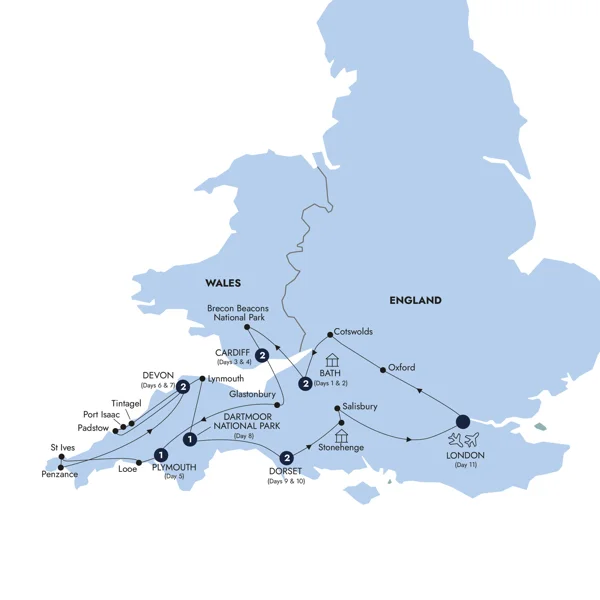
Pickup from the hotel in London and travel along the Great West Way to Oxford. Continue through the Cotswolds, stopping in Stow-on-the-Wold, then travel to Bath. Enjoy a city orientation and a traditional Sunday roast dinner.
Meals: Dinner
Day 2
Day 2: Bath through the years
Enjoy a relaxed start at the hotel, then explore Bath and visit its Roman-built baths. Free time to learn about Jane Austen, who made Bath her home.
Meals: Breakfast
Day 3
Day 3: Brecon Beacons National Park
Travel to Cardiff via the Brecon Beacons. Choose an Insight Choice activity: forage for edible and medicinal plants with a Local Expert, or visit a local kitchen garden. Enjoy a Farm-to-Table pub lunch before continuing to Cardiff.
Meals: Breakfast,Lunch
Day 4
Day 4: Cardiff
Enjoy a relaxed start, then join your Travel Director for an orientation of Cardiff, including Principality Stadium, Wales Millennium Centre, Pierhead Building and The Senedd. The rest of the day is at leisure.
Meals: Breakfast
Day 5
Day 5: Glastonbury Abbey and Plymouth
Visit the historic ruins of Glastonbury Abbey, an 8th-century monastery and Grade I listed building. Continue to Plymouth, known for its cobbled streets, gin distilleries and connection to the Mayflower.
Meals: Breakfast
Day 6
Day 6: Exploring the Southwest
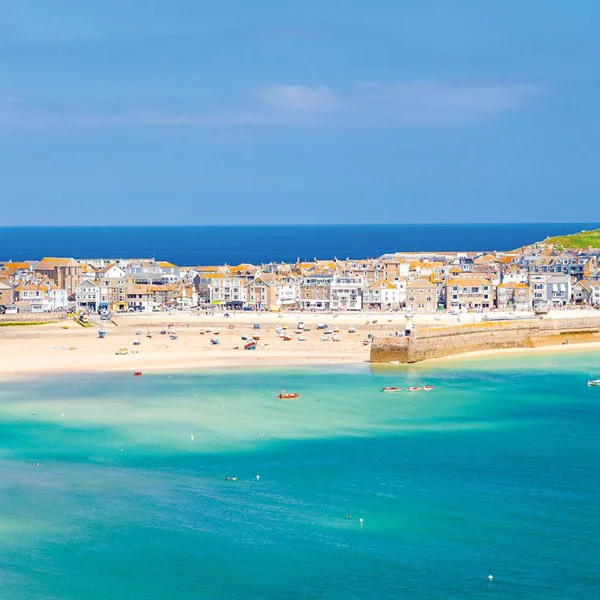
Visit the coastal town of Looe, then continue to St. Ives, where art galleries, surf shops and fashion boutiques line the streets. Travel on to Penzance, made famous by the comic opera The Pirates of Penzance.
Meals: Breakfast
Day 7
Day 7: Legends of Cornwall
Visit Tintagel, associated with the legend of King Arthur, then travel to Port Isaac for a village orientation. Continue to Padstow for lunch at leisure, with the option to try traditional fish and chips, before returning to Barnstaple.
Meals: Breakfast
Day 8
Day 8: Breathtaking National Parks
Stop in Lynmouth before visiting Exmoor National Park. Optional experience: take a guided tour of Dunster Castle and explore its gardens and ancient watermill in your free time. Lunch is at leisure in Exmoor, then continue to Bovey Castle in Dartmoor National Park. Dinner with fellow travellers at the hotel.
Meals: Breakfast,Dinner
Day 9
Day 9: Country houses of Dorset
Visit Athelhampton, a 500-year-old Tudor manor house. Join Estate Manager Owen for a walk through the estate, then explore the Elizabethan gardens at leisure. Enjoy Devonshire high tea with freshly baked scones and sandwiches.
Meals: Breakfast,Dinner
Day 10
Day 10: Jurassic Coast and Weymouth
Visit Lulworth Cove on the Jurassic Coast. Stroll on the beach or learn about the geology at the Visitor Center. Travel to Weymouth for free time; an optional visit to Nothe Fort is available. In the evening, enjoy dinner featuring local cuisine and wine.
Meals: Breakfast,Dinner
Day 11
Day 11: Salisbury and Stonehenge
Visit Salisbury Cathedral and see its original copy of the Magna Carta, then travel to Stonehenge. Continue to the London hotel, where the tour ends.
Meals: Breakfast
What’s included
What’s not included
Additional information
Dining Summary
- 4 Dinner (D)
- 10 Breakfast (B)
- 1 Lunch (L)
Whats Included NOT IN USE
- Hand sanitizer is freely available on board for you to use throughout the day.
Insight Experiences
- Puddletown: Visit the Manor House of Athelhampton and join an Estate Manager Owen on a guided tour to discover the beautiful Tudor architecture and Elizabethan-style gardens.
Operated By
Insight Vacations
How You'll Travel
- Business class coach with extended leg room
- Top-rated dining, from farm-to-table to local restaurants
- 4 & 5-star stays
Oxford University Town
Explore Oxford’s historic university streets, where centuries-old colleges and libraries give the city its celebrated skyline of spires. See the architecture that has made Oxford a centre of learning for more than eight centuries.
Its stone courtyards and scholarly atmosphere offer a distinctive introduction to England’s academic heritage. This is an opportunity to see the university town, rather than a visit inside a specific college.
Cotswolds Villages and Stow-on-the-Wold
Discover the honey-coloured stone villages of the Cotswolds and see Stow-on-the-Wold, a historic market town set amid the region’s rolling countryside. Its winding streets and traditional buildings capture a landscape shaped by centuries of rural life.
The area’s distinctive limestone gives cottages and market squares their warm colour. In season, nearby fields add broad sweeps of green and gold to this characteristically English setting.
Bath City Orientation
Discover Bath’s Roman and Georgian heritage on a city orientation taking in the graceful Royal Crescent, Pulteney Bridge and Bath Abbey. See how elegant terraces and monumental civic buildings frame this compact, walkable city.
Bath grew around its thermal springs before becoming a fashionable Georgian resort. Its unusually coherent architecture and historic spa landscape have earned the city UNESCO World Heritage status.
Traditional Roast Dinner in Bath
Taste a traditional British roast dinner in Bath, sharing a familiar Sunday custom with your fellow travellers. This hearty meal brings one of England’s best-known dining traditions to the table.
The roast has long been associated with gathering family and friends. Enjoying it in Bath adds a convivial local dimension to a stay in a city better known for its Roman baths and Georgian streets.
Roman Baths
Explore the Roman Baths at your own pace, viewing the Great Bath, Sacred Spring, temple remains and museum displays of objects discovered on the site. Thermal water still flows through this remarkably preserved ancient complex.
Built around a natural hot spring nearly 2,000 years ago, the baths reveal how Roman Britain combined public bathing with worship of the goddess Sulis Minerva. The surviving stonework makes that history unusually tangible.
Brecon Beacons Foraging Walk — Insight Choice
Join a Local Expert for a foraging walk in the Brecon Beacons, exploring the landscape while learning to identify edible and traditionally medicinal plants. This is one of two included Insight Choice activities; travellers select the experience that interests them.
The region’s sandstone uplands support a varied plant life. Expert guidance brings the smaller details of its natural environment into focus and offers a closer connection to the Welsh countryside.
Brecon Beacons Kitchen Garden — Insight Choice
Visit a local kitchen garden in the Brecon Beacons for a closer look at fresh, seasonal aromatics. This is one of two included Insight Choice activities, offered as an alternative to the guided foraging walk.
See how a cultivated garden reflects the seasons and supplies ingredients close to where they are grown. The visit offers a gentler way to connect with the region’s plants and its approach to local food.
Brecon Beacons Farm-to-Table Pub Lunch
Enjoy a farm-to-table lunch at a traditional Welsh pub, with a seasonal menu built around local ingredients. The meal offers a taste of the Brecon Beacons region in a relaxed setting.
Choosing produce from nearby sources connects the table to the surrounding landscape and supports responsible consumption. It is a chance to experience regional flavours as part of an everyday local tradition.
Cardiff City Orientation
Join your Travel Director for a Cardiff landmarks orientation, seeing Cardiff Castle, Principality Stadium, Wales Millennium Centre, the Pierhead Building and the Senedd. Together, these sites introduce the Welsh capital’s sporting, cultural and political life.
The waterfront buildings of Cardiff Bay speak to the city’s transformation from a major coal-exporting port. Nearby, the stadium underscores the place rugby holds in Welsh national identity.
Glastonbury Abbey
Visit the ruins of Glastonbury Abbey, a historic monastic site whose surviving walls and open grounds evoke its former scale. Explore a place closely associated with medieval pilgrimage and stories of King Arthur.
The abbey’s origins reach back to the early medieval period, and it became one of England’s wealthiest monasteries before its dissolution in the 16th century. Its Grade I listed remains preserve both history and legend.
Plymouth Maritime Orientation
See Plymouth Hoe and the Citadel on an orientation with your Travel Director, with the historic Barbican and Mayflower Steps also among the highlights. These waterfront sites trace the city’s long relationship with the sea.
Plymouth’s harbour has witnessed centuries of naval and transatlantic travel. The Mayflower Steps commemorate the 1620 voyage associated with the Pilgrims, while the Barbican retains the character of an older port district.
Looe Coastal Visit
Explore Looe’s working harbour and coastal streets in this Cornish town, with time to take in the beach, waterfront and local shops at your own pace. Fishing boats and the sheltered estuary remain central to its character.
Looe became a popular holiday destination in the Victorian era, yet its maritime setting still feels closely tied to daily life. The contrast between sandy shore and active harbour gives the visit its appeal.
St Ives and Penzance Coastal Towns
Discover two contrasting Cornish towns: St Ives’ gallery-lined streets and Penzance’s maritime setting. In St Ives, see the seaside streets known for art galleries and independent shops; in Penzance, encounter a town long linked to seafaring.
St Ives has drawn artists for generations, attracted by its coastal light. Penzance also lives in popular imagination through Gilbert and Sullivan’s comic opera The Pirates of Penzance.
Tintagel and Arthurian Cornwall
Take in Tintagel’s dramatic Cornish setting, a place bound to the legend of King Arthur. See the rugged maritime landscape that has helped make the village and its headland enduring subjects of story.
Local lore identifies Tintagel as Arthur’s birthplace, though the legend is distinct from its documented history. The visit brings Cornwall’s coastal scenery and medieval imagination together without requiring entry to Tintagel Castle.
Port Isaac Village Orientation
Join an orientation around Port Isaac, taking in stone-fronted buildings and views of the Cornish coastline. Bring a camera for the steep lanes and harbour setting of this small fishing village.
Port Isaac’s maritime character has also made it a familiar location on British television. Its tightly clustered houses and working coastal heritage give the village a sense of place beyond its screen appearances.
Lynmouth and Exmoor National Park
See the coastal town of Lynmouth and travel through Exmoor National Park, where wooded valleys, open moorland and a dramatic shoreline meet. The changing scenery offers a broad view of southwest England’s protected landscapes.
Exmoor’s mixture of habitats distinguishes it from a typical upland park. Its coast and interior support a long tradition of rural life, with settlements such as Lynmouth set closely against the surrounding terrain.
Athelhampton House, Gardens and Devonshire Tea
Join Estate Manager Owen for a guided visit to Athelhampton House in Dorset, discovering its Tudor architecture before exploring the Elizabethan-style gardens. Enjoy a traditional Devonshire tea with freshly baked scones and sandwiches.
This 500-year-old manor offers a close look at the craftsmanship and grounds of an English country estate. The garden visit and tea make the experience as much about its atmosphere as its history.
Lulworth Cove and the Jurassic Coast
Visit Lulworth Cove on the Jurassic Coast, where a sheltered, curved bay reveals the effects of the sea on layers of coastal rock. Walk beside the pebbled shore or explore the geology displays at the visitor centre.
The wider Jurassic Coast is a UNESCO World Heritage Site recognised for its exceptional record of Earth’s history. Lulworth makes that story visible in the shape of the landscape itself.
Weymouth Seaside Visit
Explore Weymouth’s seaside streets at your own pace, taking in the waterfront atmosphere of this Dorset resort town. There is time to browse, stroll and perhaps try a piece of traditional seaside rock.
Weymouth’s popularity as a resort grew during the Georgian period, and its coastal setting remains the draw. This unhosted town visit provides a flexible contrast to the tour’s guided historic sites.
Dorset Farm-to-Table Dinner
Share a farm-to-table dinner celebrating Dorset produce, with local cuisine and wine providing a fitting taste of the region. The meal is a hosted opportunity to gather with fellow travellers rather than a routine dinner stop.
Dorset’s farming and coastal traditions give its food a strong sense of place. Seasonal ingredients bring the surrounding countryside into focus and offer a flavour-led way to reflect on the journey through southwest England.
Salisbury Cathedral and Magna Carta
Step inside Salisbury Cathedral to admire its Gothic architecture and 123-metre spire, the tallest in Britain. In the Chapter House, view one of the four surviving original 1215 copies of the Magna Carta.
Completed largely in the 13th century, the cathedral is one of England’s most coherent examples of Early English Gothic design. Its Magna Carta manuscript connects the visit to a foundational document in the history of law and liberty.
Stonehenge
Walk around Stonehenge’s prehistoric stone circle and see the scale and arrangement of its standing megaliths on Salisbury Plain. The monument invites close observation of a site whose original purposes remain the subject of research and debate.
Built in stages during the Neolithic and Bronze Age, Stonehenge has stood for millennia. Its engineering, landscape setting and enduring mystery make it one of Britain’s most significant ancient places.
Dunster Castle Guided Tour
Step beyond the ropes on a guided tour of Dunster Castle’s historic rooms, with time to explore its gardens and ancient watermill independently. Set above the village of Dunster, the property offers views across the surrounding Exmoor landscape.
The castle’s long history is reflected in a building shaped by successive generations. This optional experience is at additional cost and bookable on tour.
Nothe Fort
Explore Nothe Fort in Weymouth, including its atmospheric tunnels and ramparts overlooking the coast. The optional visit offers a closer look at the town’s military past alongside broad views of its maritime setting.
Built in the 19th century to defend the harbour, the fort preserves spaces once used for coastal defence; its so-called ghost tunnel adds a layer of local storytelling. This optional experience is at additional cost and bookable on tour.