Your itinerary
Day 1
Day 1: Welcome to Bangkok
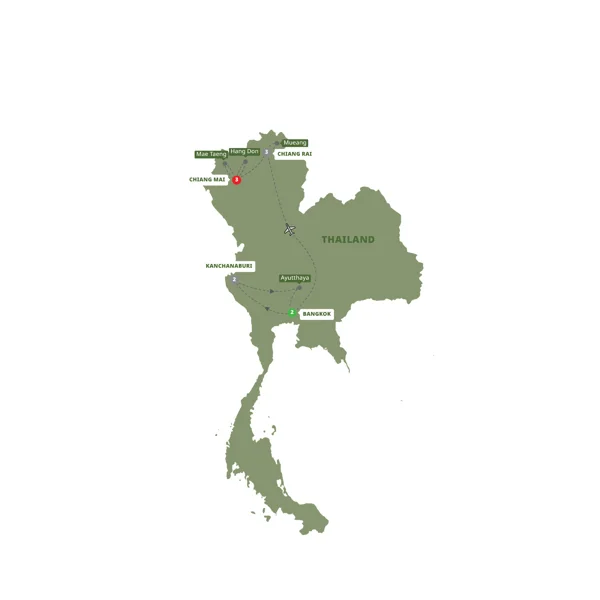
Arrive in Bangkok and transfer to your hotel. Settle in before meeting your Travel Director and small group for dinner at a local rooftop restaurant overlooking the city skyline.
Meals: Dinner
Day 2
Day 2: Explore Bangkok
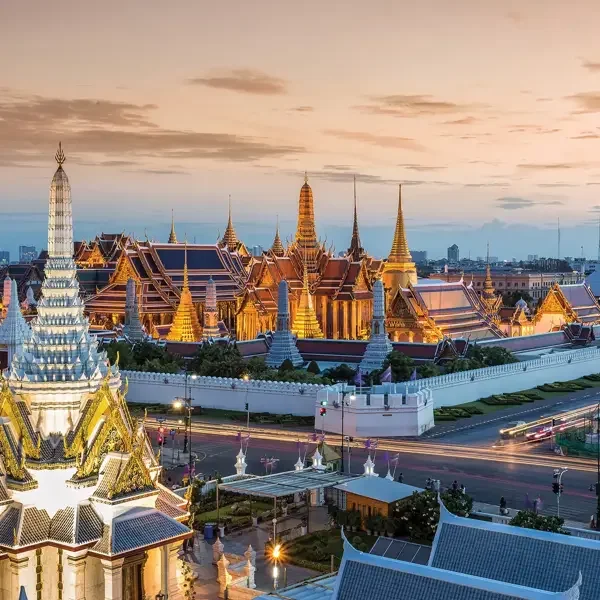
Visit Pak Khlong Talat flower market and make a traditional floral garland with local vendors. At Wat Pho, present your garland as an offering, meet a monk and receive a blessing. Continue by tuk tuk to the Grand Palace and visit Wat Phra Kaew, the Temple of the Emerald Buddha. Return to your hotel for leisure time; optional activities include exploring markets, sampling street food, rooftop city views or an evening dinner cruise aboard the Manohra.
Meals: Breakfast
Day 3
Day 3: Relaxation and Royalty in Bangkok
Option to join morning tai chi in Lumpini Park or visit Jim Thompson House on an Optional Experience. Cruise along the Chao Phraya River and through the canals of Thonburi, passing waterside communities. Visit the Royal Barge Museum, then continue to Wat Arun for sunset before returning to your hotel.
Meals: Breakfast
Day 4
Day 4: Kanchanaburi by Train and Boat
Travel to Kanchanaburi and visit the Bridge over the River Kwai. Ride a local train along the historic Death Railway, crossing the Wang Po Viaduct. Visit the Thailand-Burma Railway Museum and War Cemetery, where more than 6,000 Allied prisoners of war are buried. Transfer to a local pier and take a longtail boat to FloatHouse River Kwai Resort, where you stay in a floating villa and have dinner at the hotel.
Meals: Breakfast,Dinner
Day 5
Day 5: Hellfire Pass
Travel to Hellfire Pass and learn about this section of the Thailand-Burma Railway, cut by hand through rock during the Second World War. Visit the Hellfire Pass Memorial Museum, with photographs and personal accounts of prisoners of war and Asian laborers who worked on the railway. Return to your hotel for leisure time. Optional Experience to Sai Yok Yai Waterfall and Lawa Cave.
Meals: Breakfast,Dinner
Day 6
Day 6: Ayutthaya and off to Chiang Rai
Visit UNESCO-listed Ayutthaya, the former capital founded in 1350, and see its monasteries and royal temples. At Wat Mahathat, see the Buddha head held within the roots of a Bodhi tree. Travel to Bangkok Airport for your flight to Chiang Rai, then settle into your hotel and have dinner together.
Meals: Breakfast,Dinner
Day 7
Day 7: Chiang Rai
Visit a tea estate to learn about Thai tea, its ingredients and growing conditions, and local production. See green tea and first flush black tea being processed, compare tea brewed with mineral and RO water, and try brewing your own. Sample forest honey, tea and homemade pastries, then have a late lunch at a local restaurant. Return to your hotel or choose an Optional Experience to the Golden Triangle and the House of Opium.
Meals: Breakfast,Lunch
Day 8
Day 8: Onwards to Chiang Mai
Travel to Chiang Mai, stopping at the White Temple in Chiang Rai. On arrival, have a traditional khao soi lunch at a local restaurant. Choose to walk along the old town walls and streets or visit the Lanna Folklife Museum. Rejoin your group and a Local Specialist at Wat Chedi Luang, then enjoy a free evening.
Meals: Breakfast,Lunch
Day 9
Day 9: Explore the Thai Countryside
Travel to Hang Dong and meet Mr Prapat and his family at their village home. Receive a local mohom scarf, walk through the family gardens to see herbs and cooking ingredients, and join a hands-on cooking session. Share the Farm-to-Table lunch you prepare with the family. Return to Chiang Mai for leisure time; options include the night market, handicraft shops and coffee spots around Nimmanhaemin, or an Optional Experience spa massage.
Meals: Breakfast,Lunch
Day 10
Day 10: Chiang Mai Elephants
Visit Elephant Nature Park, a rescue and rehabilitation center with a no-riding policy, and learn about the elephants, their care and habitat. Have lunch at the sanctuary, then return to the hotel for an afternoon at leisure. In the evening, ride the cable car to Wat Phra That Doi Suthep and see its golden pagoda overlooking Chiang Mai. Have dinner at 137 Pillars House in the Wat Ket district.
Meals: Breakfast,Lunch,Dinner
Day 11
Day 11: Farewell Chiang Mai
After breakfast, transfer to the airport for your onward flight.
Meals: Breakfast
What’s included
What’s not included
Additional information
Dining Summary
- 5 Dinner (D)
- 10 Breakfast (B)
- 4 Lunch (L)
How You'll Travel
- Top-rated dining, from farm-to-table to local restaurants
- 4 & 5-star stays
- Business class coach with extended leg room, and select flights
Authentic Dining
- Bangkok: Sit down to dinner at the hotel and take in your first views across Bangkok from the rooftop.
- Chiang Mai: Try khao soi, one of northern Thailand’s best-known dishes, made with egg noodles in a rich coconut curry broth and topped with crisp noodles. Long associated with Chiang Mai, it reflects the flavors and culinary traditions that define the region.
- Chiang Mai: Meet Mr Prapat and his family for a hosted village visit outside Chiang Mai, where you’ll join a hands-on cooking class using herbs and ingredients from the garden. As you prepare northern Thai dishes together, you’ll see how home cooking remains closely tied to local produce and family tradition.
- Chiang Mai: Enjoy your creations with the locally produced ingredients, which might include coconut-infused noodle soup and red and green curries (you’ll make the pastes from scratch) Sit down with Mr Prapat and his family for a farm-to-table lunch served in their village home. Shared around the family table, the meal reflects northern Thai hospitality and offers a direct experience of how food brings family and guests together in everyday village life.
- Chiang Mai: Come together for dinner at 137 Pillars House, a restored teak residence in Chiang Mai’s Wat Ket district with roots in the 19th-century teak trade. Set around the historic Baan Borneo house, it preserves the timber architecture and grounds of a former trading compound for one last meal with your small group.
Premium Experience
- Bangkok: Meet a Buddhist monk at Wat Pho and receive a traditional blessing, a practice still part of Thai Buddhist life today. After presenting your offering, you’ll take part in a temple ritual observed for protection, good fortune and respect.
- Bangkok: Visit Wat Arun, one of Bangkok’s best-known riverside temples, in time for sunset. Rising above the Chao Phraya River, its central prang is decorated with porcelain and colored ceramics, giving this important Bangkok landmark a distinctive silhouette as the light begins to change.
- Chiang Rai: Visit a tea plantation in Chiang Rai and see how another side of northern Thailand is shaped by the land. Learn about the history of Thai tea, watch green tea and first flush black tea being processed, then compare tastings, try brewing your own and sample local honey, homemade pastries and tea ice cream along the way.
Trafalgar Choice
- Chiang Mai: Walk along Chiang Mai’s old town walls and explore the streets of the former Lanna capital from within its historic center. This route reveals how the city’s temples, gates and old layout still shape Chiang Mai today.
- Chiang Mai: Visit the Lanna Folklife Museum for a closer look at the history, culture and traditions of the former Lanna Kingdom. Housed in Chiang Mai’s former Provincial Court, the museum explores everyday life, craftsmanship, belief and identity in northern Thailand.
Grand Palace & Temple of the Emerald Buddha
Travel by tuk tuk to the Grand Palace and explore the walled royal complex at the heart of Bangkok. Visit Wat Phra Kaew, the Temple of the Emerald Buddha, within its grounds and see one of Thailand’s most revered Buddhist images.
Established in 1782, the palace served as the official royal residence until 1925 and remains a setting for major ceremonies. Its richly ornamented buildings offer a close look at the craftsmanship and traditions associated with the Thai monarchy.
Sai Yok Yai Waterfall & Lawa Cave
Visit Sai Yok Yai Waterfall, one of the best-known natural sights in Sai Yok National Park, and explore Lawa Cave with its limestone formations and underground chambers. The excursion offers a look at the landscapes beyond Kanchanaburi’s wartime sites.
Flowing water, forest surroundings and the cave’s enclosed spaces make this a varied nature-focused outing in the River Kwai region. It is an optional experience at additional cost, bookable on tour.
Operated By
Insight Vacations
Bangkok Rooftop Welcome Dinner
Meet your Travel Director and small group over dinner at a Bangkok rooftop restaurant. Take in views across the city skyline as you get to know your fellow travellers and share your first meal in Thailand.
The elevated setting offers a perspective on a capital where temple spires, royal landmarks and contemporary towers stand side by side. It is a hosted introduction to the people travelling with you and the city you are here to explore.
Bangkok Flower Market, Wat Pho & Monk Blessing
Make a traditional phuang malai garland with local vendors at Bangkok’s Pak Khlong Talat flower market, surrounded by stalls of fresh blossoms. Bring your handmade offering to Wat Pho, meet a Buddhist monk and receive a blessing.
Explore one of the city’s oldest and largest temple complexes, home to the 46-metre Reclining Buddha. Floral offerings and blessings remain part of Thai Buddhist life, giving this visit a connection to the worship practised here today.
Morning Tai Chi in Lumpini Park
Join morning tai chi in Lumpini Park, where Bangkok residents gather to exercise among lawns, trees and walking paths. The gentle movements offer a chance to experience a quieter side of the capital as its daily routines get underway.
Established as a public park in central Bangkok, Lumpini is a valued outdoor space amid the surrounding streets and towers. Practising alongside locals makes this an active encounter with city life rather than a conventional sightseeing stop.
Wat Arun at Sunset
Visit Wat Arun at sunset on the bank of Bangkok’s Chao Phraya River. Look closely at the temple’s central prang, whose surface is decorated with pieces of porcelain and coloured ceramics, and watch its silhouette change in the evening light.
Known as the Temple of Dawn, Wat Arun is one of the capital’s defining riverside landmarks. Its setting connects the architecture to the waterway that has long shaped movement, trade and daily life in Bangkok.
Hellfire Pass & Memorial Museum
Visit Hellfire Pass, a rock cutting made by hand for the Thailand–Burma Railway in 1943. At the Hellfire Pass Memorial Museum, photographs and personal accounts document the experiences of prisoners of war and Asian labourers who worked on the line.
The exposed cutting gives physical scale to the difficulty of the work, while the memorial provides space to consider its human cost. It is among the most direct and moving places to learn about Kanchanaburi’s wartime history.
Ayutthaya Historic Temples & Wat Mahathat
Explore the UNESCO-listed ruins of Ayutthaya, Thailand’s former capital, where monastery remains and royal temples hint at the scale of the old Siamese kingdom. At Wat Mahathat, see the Buddha head held within the roots of a tree.
Founded in 1350, Ayutthaya became a major trading capital with connections across Asia, Europe and the Middle East. Its weathered brick structures and surviving religious images reveal both the city’s former influence and the passage of time.
Traditional Khao Soi Lunch in Chiang Mai
Taste khao soi at a local Chiang Mai restaurant, sampling one of northern Thailand’s signature dishes. Egg noodles sit in a rich coconut curry broth beneath a topping of crisp noodles, bringing contrasting textures to each bowl.
Closely associated with Chiang Mai, khao soi offers a flavour-led introduction to the city’s food traditions and regional identity. This included lunch is an opportunity to try a distinctive local speciality in the place where it is most closely celebrated.
Wat Chedi Luang with a Local Specialist
Explore Wat Chedi Luang with a Local Specialist in Chiang Mai’s Old City. Its vast brick chedi, completed in 1481, dominates the temple grounds and makes this one of the city’s most significant religious landmarks.
The temple once housed the Emerald Buddha, an image now enshrined in Bangkok. Standing beside the centuries-old structure offers a sense of Chiang Mai’s importance as a Lanna capital and of the Buddhist heritage still present in its historic centre.
Hang Dong Village Home Visit & Farm-to-Table Cooking
Meet Mr Prapat and his family at their village home in Hang Dong, outside Chiang Mai. Receive a traditional Lanna welcome and a mohom scarf, walk through the family gardens, and prepare northern Thai dishes using local herbs and ingredients.
Share the farm-to-table lunch you have helped make while your hosts talk about village life. Cooking and eating together reveal how family hospitality, garden produce and familiar recipes connect in everyday northern Thai food traditions.
Wat Phra That Doi Suthep at Sunset
Visit Wat Phra That Doi Suthep as evening approaches, riding the cable car to this sacred mountainside temple above Chiang Mai. See its golden pagoda and look out across the city as the light changes.
One of northern Thailand’s most important Buddhist sites, Doi Suthep draws worshippers as well as visitors. Its hilltop position brings together religious significance, gilded temple architecture and a broad view of the former Lanna capital below.
Farewell Dinner at 137 Pillars House
Share a farewell dinner at 137 Pillars House with your small group in Chiang Mai’s Wat Ket district. Dine amid the setting of a restored teak residence rather than a conventional restaurant.
The property is centred on the historic Baan Borneo house, whose roots lie in the area’s 19th-century teak trade. Its preserved timber architecture and grounds give the meal a sense of place, offering a setting in which to reflect on the people and experiences of the journey.
Manohra Dinner Cruise in Bangkok
Dine aboard the Manohra while cruising Bangkok’s Chao Phraya River. Enjoy a meal on the water and watch the city’s riverside landmarks and evening lights from the boat.
The river has long been central to Bangkok’s life, linking temples, neighbourhoods and royal sites along its banks. This dinner cruise combines that waterside perspective with an evening dining experience. It is an optional experience at additional cost, bookable on tour.
Jim Thompson House
Visit Jim Thompson House in Bangkok to explore the former home of the American entrepreneur associated with the revival of Thai silk. See its collection of Thai art within a residence assembled from traditional teak buildings.
The house offers a close look at craftsmanship, collecting and the story of Thailand’s silk industry in the 20th century. This is an optional experience at additional cost, bookable on tour for travellers interested in art and design.
Golden Triangle & House of Opium
Explore the Golden Triangle in northern Thailand and visit the House of Opium to learn about the region’s opium history. The museum, opened in 1989, provides context for a border area long associated with trade across mainland Southeast Asia.
This outing pairs a well-known geographical setting with a closer examination of a difficult chapter in the region’s past. It is an optional experience at additional cost, bookable on tour.
Chiang Mai Spa Massage
Choose a spa massage in Chiang Mai for a dedicated pause from sightseeing. A treatment offers time to slow down and enjoy a restorative experience during your stay in northern Thailand.
Massage is a familiar part of Thailand’s wellness culture, making this a way to spend personal time in the city. The itinerary does not specify a particular spa or treatment style. This is an optional experience at additional cost, bookable on tour.
Chao Phraya River Cruise & Royal Barge Museum
Cruise the Chao Phraya River and Thonburi’s canals to see waterside communities from the water. Visit the Royal Barge Museum to view the ornate vessels used in Thailand’s royal processions.
The canals reveal a side of Bangkok shaped by river travel, with homes and neighbourhood life close to the banks. At the museum, elaborate carvings and ceremonial decoration show how these barges transform a journey on the river into an expression of royal tradition.
Bridge over the River Kwai & Death Railway Train Ride
Visit the Bridge over the River Kwai in Kanchanaburi and ride a local train along the historic Death Railway. The journey crosses wooden viaducts, including the Wang Po Viaduct, on a surviving section of the wartime line.
Built during the Second World War by prisoners of war and Asian labourers, the Thailand–Burma Railway carries a history far heavier than its scenery suggests. Seeing the bridge and travelling the line brings its engineering and human cost into focus.
Thailand–Burma Railway Museum & War Cemetery
Explore the Thailand–Burma Railway Museum in Kanchanaburi to learn about the construction of the wartime railway and the people forced to build it. At the nearby Kanchanaburi War Cemetery, pause among the graves of more than 6,000 Allied prisoners of war.
Together, the museum and cemetery place individual lives within the wider history of the Second World War in Southeast Asia. This is a reflective visit centred on remembrance, evidence and the lasting consequences of the railway’s construction.
Longtail Boat Arrival at FloatHouse River Kwai
Travel by longtail boat to FloatHouse River Kwai Resort, a riverside retreat reached only by water, and settle into a floating villa. The boat approach reveals the river landscape from a perspective unavailable on the road.
Staying directly on the River Kwai makes the setting part of the experience: water moves beneath the villa, while the surrounding banks offer a quieter view of Kanchanaburi beyond its historic sites. This is distinctive accommodation rather than a routine hotel stop.
Chiang Rai Tea Estate Tasting & Brewing
Visit a Chiang Rai tea estate to learn how the region’s growing conditions and local communities shape production. See green tea and first-flush black tea being processed, compare guided tastings and try brewing your own tea.
Comparing tea made with mineral and purified water brings the details of flavour into focus. Forest honey and homemade pastries add local tastes to an experience grounded in the landscape, skills and livelihoods behind northern Thailand’s tea.
Chiang Rai White Temple
Visit Wat Rong Khun, the White Temple, Chiang Rai’s best-known contemporary landmark. Examine its brilliant white exterior and mirrored details, which catch the light and distinguish it from Thailand’s older temple architecture.
Created by Thai artist Chalermchai Kositpipat and opened to visitors in 1997, the site uses Buddhist imagery through a distinctly modern artistic vision. Its intricate surfaces and symbolic design make it as much an encounter with contemporary Thai creativity as a temple visit.
Chiang Mai Old City Walls Walk — Choice Experience
Walk beside Chiang Mai’s old city walls and explore streets within the historic centre on this included choice experience. Notice how surviving gates, temples and the city’s old layout still shape movement through the former Lanna capital.
Chiang Mai was founded as a Lanna capital in the late 13th century. Seeing its historic core on foot offers a closer sense of how the kingdom’s urban design remains visible within a lively modern city. Choose this walk or the included Lanna Folklife Museum visit.
Lanna Folklife Museum — Choice Experience
Visit Chiang Mai’s Lanna Folklife Museum on this included choice experience for a closer look at the history and traditions of northern Thailand. Displays explore everyday life, craftsmanship, beliefs and the cultural identity of the former Lanna Kingdom.
Housed in the city’s former Provincial Court, the museum places regional traditions within a historic Chiang Mai building. It offers an indoor, culture-focused alternative to the included Old City walls walk; travellers choose one of these two experiences.
Elephant Nature Park Rescue Sanctuary
Visit Elephant Nature Park near Chiang Mai, a rescue and rehabilitation centre with a no-riding policy. Observe elephants, hear about their individual stories and learn how the sanctuary supports their ongoing care in a more natural setting.
This MAKE TRAVEL MATTER® Experience places animal welfare at the centre of the visit. Seeing the elephants’ behaviour while learning about their rescue offers a considered way to engage with one of Thailand’s most recognisable animals; lunch at the sanctuary is included.