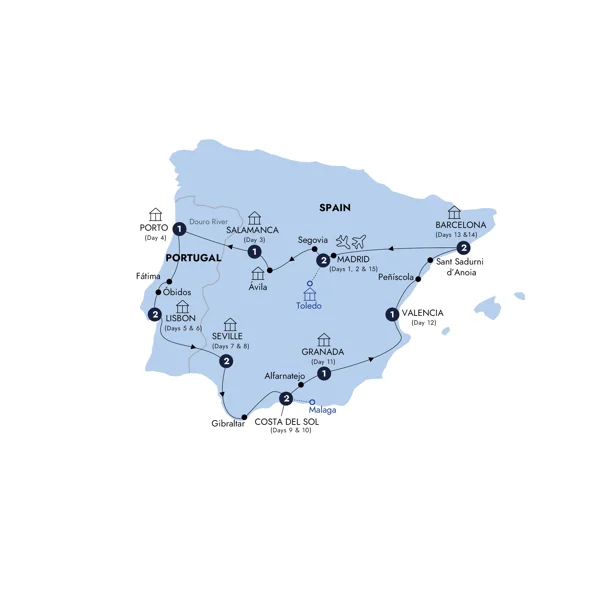
Your itinerary
Day 1
Day 1: Welcome to Madrid
Join your Travel Director and fellow travelers for dinner in a local restaurant, with typical madrileño flavors.
Meals: Dinner
Day 2
Day 2: Madrid of the Bourbons
With a Local Expert, visit Madrid’s historic neighborhoods and drive through the Old Quarter to discover the city’s origins. Visit the Prado Museum with an art historian, viewing works by Velázquez, Goya, Titian, Rubens and others.
Meals: Breakfast
Day 3
Day 3: Segovia and Golden Salamanca
Visit Segovia and walk its medieval streets with a Local Expert. See the Alcázar and Roman aqueduct, then travel west past the ancient walls of Ávila to Salamanca. Take a guided sightseeing tour of Salamanca, including Plaza Mayor, the cathedral and 16th-century university buildings.
Meals: Breakfast
Day 4
Day 4: Porto, Grande Dame on the Douro
Cross the Portuguese border to Porto. Visit the Vila Nova de Gaia wine stores, walk among the casks and taste port wines, including tawny and vintage styles. Continue exploring Porto, with its colorful houses, tiled churches and iconic bridges.
Meals: Breakfast,Dinner
Day 5
Day 5: Holy Fátima, Ancient Óbidos and Lisbon
Continue to Fátima, a renowned pilgrimage site, then travel to the fortified town of Óbidos and walk its medieval streets. You can stop for a tasting of locally made cherry liqueur. Continue to Lisbon; an optional evening experience is available at a family-run restaurant serving traditional Portuguese seafood.
Meals: Breakfast
Day 6
Day 6: Lisbon and the Age of the Great Discoveries
Sightsee with a Local Expert along Lisbon’s Lower Town avenues and around Pombal Square. Visit Belém, try Pastéis de Belém at a traditional patisserie, view the Monument to the Discoveries and Belém Tower, and visit the National Coach Museum. The afternoon is at leisure, with an optional experience to the Portuguese Riviera.
Meals: Breakfast
Day 7
Day 7: A scenic drive to Seville
Depart Portugal and travel through the Algarve, pausing in a town for leisure time and lunch. Cross into Spain and continue through Andalucía to Seville, arriving by late afternoon. The evening is at leisure.
Meals: Breakfast
Day 8
Day 8: Free Time and Flamenco in Seville
Enjoy a relaxed start or choose an optional visit to Pilatos Palace or the Alcázar of Seville and nearby Plaza América. Stroll through the Santa Cruz Quarter with a Local Expert and visit Seville Cathedral. In the evening, visit the Cristina Heeren Foundation for a flamenco lesson and performance.
Meals: Breakfast
Day 9
Day 9: Head for Gibraltar and the Costa del Sol
Travel south to Gibraltar. With a Local Expert, visit the Rock of Gibraltar and St. Michael’s Cave. Continue along the Costa del Sol to Torremolinos.
Meals: Breakfast
Day 10
Day 10: At Leisure on the Costa del Sol
Enjoy a day at leisure on the Costa del Sol. Relax by the Mediterranean, stroll along the promenade, try local restaurants or consider exploring Málaga.
Meals: Breakfast,Dinner
Day 11
Day 11: Dining with Locals and the Alhambra
Travel to Alfarnatejo, walk its town center and see the 18th-century Iglesia del Santo Cristo de Cabrilla. Visit the region’s oldest olive grove and a rural mill-factory for an olive-oil tasting with farmer bread. Share lunch with a local family, then continue to Granada and visit the Alhambra Palace with a Local Expert.
Meals: Breakfast,Lunch
Day 12
Day 12: On to Valencia
Travel to Valencia and pass through the Old City to see its ancient gates and the City of Arts and Sciences. Free time may include a stroll to the Cathedral and El Miguelete. Meet a chef at a family-run restaurant for a paella cooking demonstration, then eat the dish at dinner.
Meals: Breakfast,Dinner
Day 13
Day 13: Along the Coast to Peñíscola and on to Barcelona
Follow the coast to Peñíscola to view its castle, then continue along the Costa Dorada to the cava bodegas at Sant Sadurní d’Anoia. Enjoy a light lunch and cava tasting before continuing to Barcelona.
Meals: Breakfast,Lunch
Day 14
Day 14: Barcelona Sightseeing
With a Local Expert, drive along Passeig de Gràcia and through the Eixample district. Visit the Sagrada Família and see its nave, pillars, vaulting and stained-glass windows. If tickets are unavailable, visit the Hospital de Sant Pau and admire the exterior of the Sagrada Família. Join fellow travelers for dinner at a local restaurant.
Meals: Breakfast,Dinner
Day 15
Day 15: Depart for Madrid
Transfer from Barcelona to Madrid and bid farewell to your journey across Spain and Portugal.
Meals: Breakfast
What’s included
What’s not included
Additional information
Operated By
Insight Vacations
Dining Summary
- 5 Dinner (D)
- 14 Breakfast (B)
- 2 Lunch (L)
How You'll Travel
- Business class coach with extended leg room
- Top-rated dining, from farm-to-table to local restaurants
- 4 & 5-star stays
Insight Experiences
- Madrid: Visit the Prado Museum with an art historian who places key works within their historical setting. With your historian’s expert guidance, you’ll examine paintings by Velázquez, Goya, Titian and Rubens, noting their connection to royal patronage and the broader European tradition. Learn how the museum, founded in 1819, became a principal repository for Spain’s royal collections and major works from across the continent.
- Granada: Visit the Alhambra Palace with a Local Expert and walk through its courtyards, carved plasterwork and palace rooms from the Nasrid period. You’ll see how water channels, gardens and intricate detail define the complex, and how this hilltop site shaped Granada’s cultural and political story for centuries.
Madrid Welcome Dinner
Share a welcome dinner with your Travel Director and fellow travellers at a local Madrid restaurant. Typical madrileño flavours, food and wine provide an introduction to the Spanish capital around a shared table.
Madrid’s dining culture is sociable and unhurried, making this an opportunity to meet the group and hear about the places you will explore. The hosted meal is included in your tour.
Madrid Old Quarter with a Local Expert
Explore Madrid’s Old Quarter with a Local Expert, tracing the capital’s growth from a medieval citadel into the centre of Habsburg Spain. See its compact streets, market squares and civic buildings while learning how successive rulers reshaped the city.
The district’s street pattern offers a contrast to Madrid’s later grand avenues. Your expert connects the surviving urban layout with the people and institutions that established the foundations of the modern capital.
Prado Museum with an Art Historian
Visit the Prado Museum with an art historian and examine works by Velázquez, Goya, Titian and Rubens. Expert commentary places the paintings within the history of Spanish royal patronage and the wider European artistic tradition.
Founded in 1819, the Prado holds works drawn from Spain’s royal collections. Seeing its galleries with a specialist reveals connections between artists, courts and changing ideas about portraiture, faith and power.
Segovia Historic Centre, Alcázar and Roman Aqueduct
Walk Segovia’s medieval streets with a Local Expert and view the Alcázar, a fortress documented from the 12th century. At the Roman aqueduct, look up at the ranks of granite arches that once carried mountain water into the city.
Segovia brings Roman engineering, medieval defences and royal history into a compact historic centre. Your expert explains how each era shaped the city visible today; the Alcázar is viewed rather than entered.
Salamanca Guided Historic Centre Tour
Explore Salamanca’s historic centre with a Local Expert, admiring the arcaded Plaza Mayor, cathedral and university buildings. Look closely at the warm sandstone facades and the intricate Plateresque detail associated with the city.
Salamanca rose to prominence through its university, founded in the 13th century and among Europe’s oldest. Its scholarly heritage remains visible in streets and squares where academic buildings stand alongside monuments of civic and religious life.
Vila Nova de Gaia Port Cellars and Tasting
Visit the port wine cellars of Vila Nova de Gaia, across the Douro from Porto. Walk past casks used for ageing and taste port while learning what distinguishes styles such as Ruby, Tawny and Vintage.
Gaia has been a centre of port storage and export for centuries. The cellar visit connects wines produced in the Douro Valley with the blending practices, ageing conditions and trading houses that brought them to international tables.
Fátima Sanctuary Visit
Explore the Sanctuary of Fátima, a major place of Catholic pilgrimage associated with reported apparitions in 1917. See the Basilica of Our Lady of the Rosary, the Chapel of the Apparitions and the broad esplanade where pilgrims gather.
The scale of the complex reflects Fátima’s significance to worshippers from around the world. Its open spaces and devotional sites offer insight into a living pilgrimage tradition, whether your interest is spiritual, historical or architectural.
Óbidos Medieval Walk and Ginja Tasting
Walk inside the medieval walls of Óbidos, following narrow lanes past whitewashed houses and small churches. Sample ginja, the local sour-cherry liqueur often served in a small cup.
Óbidos has roots in an earlier Roman settlement and later became associated with Portugal’s queens after a 13th-century royal wedding gift. Its preserved street pattern and fortified setting give the tasting a sense of place beyond the drink itself.
Lisbon and Belém Guided Sightseeing
Explore Lisbon with a Local Expert, travelling through the Lower Town and its broad, ordered avenues. In Belém, view the Monument to the Discoveries and Belém Tower beside the Tagus River.
The Lower Town’s layout reflects rebuilding after the devastating 1755 earthquake. Belém tells a different story: its riverside monuments recall the maritime voyages that connected Portugal with distant parts of the world. The listed landmarks are viewed during sightseeing, not entered.
Pastéis de Belém Tasting
Taste pastéis de Belém in the Lisbon neighbourhood that gives the pastries their name. Bite through crisp layers of pastry to a soft custard filling, traditionally finished with a dusting of cinnamon.
The Belém bakery has made its version since 1837 using a closely guarded recipe. Sampling a pastry here connects a familiar Portuguese treat to the place and baking tradition from which it became known.
Lisbon National Coach Museum
Visit Lisbon’s National Coach Museum to examine an exceptional collection of horse-drawn royal carriages. See how coaches used for ceremony and diplomacy varied in size, ornament and craftsmanship from the 16th to the 19th centuries.
These vehicles were expressions of status as well as transport. Details of their construction and decoration reveal changing court tastes and the elaborate public rituals of European monarchies.
Seville Santa Cruz Quarter Guided Walk
Walk Seville’s Santa Cruz quarter with a Local Expert, navigating narrow lanes, small plazas and enclosed courtyards. The guided route reveals the historic street pattern of the district associated with the city’s medieval Jewish community.
Santa Cruz’s close-set buildings create welcome shade in the Andalusian heat. Its surviving layout offers a way to understand the neighbourhood’s earlier social and cultural life within the wider history of Seville.
Seville Cathedral Visit
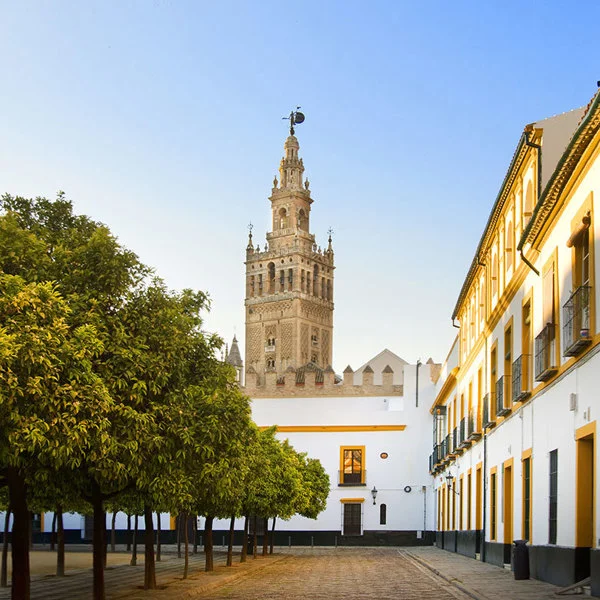
Step inside Seville Cathedral, recognised as the world’s largest Gothic cathedral. Walk through its vast nave and chapels, and see the Giralda, the tower that began as the minaret of a 12th-century Almohad mosque.
Completed in the 16th century, the cathedral stands on the site of that earlier mosque. Its scale, layered architecture and association with Christopher Columbus illuminate Seville’s religious and maritime history.
Cristina Heeren Foundation Flamenco Lesson and Performance
Meet students at Seville’s Cristina Heeren Foundation, learn a few basic flamenco steps and watch a performance. The encounter brings you close to the interplay of guitar, singing and dance that gives flamenco its expressive force.
The foundation teaches and helps preserve this Andalusian art form while training young artists. This MAKE TRAVEL MATTER® visit supports its educational work, so the experience connects a live performance with the discipline behind it.
Rock of Gibraltar and St. Michael’s Cave
Explore the Rock of Gibraltar with a Local Expert and visit St. Michael’s Cave, known for its limestone formations. Look out across the Strait towards the meeting of Atlantic and Mediterranean waters, and watch for Gibraltar’s Barbary macaques.
The Rock has long been identified with one of the ancient Pillars of Hercules. Its dramatic position explains both its strategic history and the far-reaching views towards the Spanish coast and, in clear conditions, North Africa.
Alfarnatejo Village Walk
Walk through the centre of Alfarnatejo, a small whitewashed village set among the mountains of inland Andalusia. See the 18th-century Iglesia del Santo Cristo de Cabrilla and take in the quieter scale of village life.
With fewer than 500 residents, Alfarnatejo offers a different perspective from Spain’s larger historic cities. Its simple streets and mountain setting provide a grounded introduction to the rural community you visit.
Andalusian Olive Mill and Oil Tasting
Visit a rural olive mill and taste regional olive oils with locally made bread. Compare the flavours of different oils while hearing how harvest timing, soil and the age of olive trees can influence what reaches the table.
Olive cultivation is a longstanding part of Andalusia’s agricultural landscape. Seeing the mill and tasting its produce makes the link between local groves, traditional food and a staple of Mediterranean cooking tangible.
Home-Cooked Lunch with an Alfarnatejo Family
Join a local family in Alfarnatejo for a home-cooked Andalusian lunch. In a small group, share dishes made with fresh regional produce and enjoy conversation around the table.
The meal offers a personal view of how food is prepared and shared in this mountain village. Hearing your hosts’ stories gives the flavours a local context that a restaurant meal alone could not provide.
Granada Alhambra with a Local Expert
Explore the Alhambra with a Local Expert, discovering palace spaces, intricate decoration, courtyards and gardens. Look for carved plasterwork, flowing water and the carefully composed views that define this hilltop complex above Granada.
Developed as a citadel and royal seat under the Nasrid rulers from the 13th century, the Alhambra is a landmark of Islamic art in Spain. Its architecture reveals how beauty, privacy and political power were expressed through space and detail.
Valencia Old City and City of Arts and Sciences Orientation
Get your bearings in Valencia’s Old City as your Travel Director points out surviving medieval gateways and the street pattern shaped by centuries of growth. See the contrasting architecture of the City of Arts and Sciences during the city orientation.
The two areas frame Valencia’s changing identity: historic gates recall its fortified past, while the modern cultural complex reshaped part of its contemporary skyline. This is an orientation and sightseeing experience, not a stated visit inside the complex.
Valencian Paella Cooking Demonstration and Dinner
Meet a chef in a family-run Valencia restaurant for a paella cooking demonstration, then sit down to eat the finished dish. See how the pan’s heat, rice, stock and order of ingredients contribute to its texture and flavour.
Paella has deep roots in the Valencia region. The demonstration reveals the attention needed to build its layers of flavour and prized socarrat crust, turning dinner into a closer look at a local culinary tradition.
Peñíscola Castle View
See Peñíscola’s 14th-century castle rising above the old town on a limestone headland. Its position divides the shoreline, making the fortress a landmark against the Mediterranean.
The castle’s coastal setting shows why this was a defensible site as well as a striking place to build. It also appeared in the film El Cid. This experience is a view of the castle; entry is not specified.
Sant Sadurní d’Anoia Cava Bodega, Tasting and Lunch
Visit a cava bodega in Sant Sadurní d’Anoia for a light lunch paired with a tasting of Catalan sparkling wines. Learn how traditional-method bottle fermentation and ageing on the lees contribute to cava’s character.
This vineyard area has supplied cava producers since the 19th century. Tasting where the wine is made connects its bubbles, structure and flavour to the practices and landscape of one of Spain’s best-known sparkling-wine centres.
Barcelona Modernista Sightseeing
Explore Barcelona with a Local Expert, travelling along Passeig de Gràcia and through the orderly grid of the Eixample. See the district’s distinctive Modernista buildings, wrought-iron details and changing skyline as the Sagrada Família comes into view.
The route makes Barcelona’s urban design part of the experience. Its broad avenues and inventive facades reveal how architects and planners transformed the city during a period of rapid growth.
Sagrada Família Visit
Visit Gaudí’s Sagrada Família with a Local Expert and look up into its tree-like columns and soaring vaults. Stained-glass windows cast shifting colour across the basilica’s interior, revealing how architecture and light work together.
The basilica remains one of Barcelona’s defining architectural projects. If entry is unavailable because of a special event or ticket restrictions, the tour instead visits the Art Nouveau Hospital de Sant Pau and views the Sagrada Família’s exterior with the expert.
Barcelona Farewell Dinner
Gather with your fellow travellers for a farewell dinner in Barcelona. A shared meal in the Catalan capital offers a hosted occasion to exchange memories and conversation with the group.
Rather than a routine hotel meal, this local restaurant dinner marks the close of your exploration of Spain and Portugal. It is an opportunity to revisit favourite places, flavours and encounters around the table.
Lisbon Portuguese Seafood Dinner
Choose an optional seafood dinner at a family-run Lisbon restaurant known for traditional Portuguese cooking. The hosted restaurant experience offers a way to explore the country’s close culinary relationship with the Atlantic.
Seafood is central to many Portuguese tables, with preparations that let fresh ingredients speak for themselves. This Optional Experience is at additional cost and bookable on tour; the specific menu is not stated.
Portuguese Riviera Excursion
Explore the Portuguese Riviera on an optional excursion from Lisbon. This stretch of Atlantic coast is associated with beaches and surf as well as resorts with a long history of fashionable visitors.
The outing provides a coastal contrast to Lisbon’s streets and monuments, with scenery shaped by the meeting of land and ocean. Specific stops are not stated. This Optional Experience is at additional cost and bookable on tour.
Seville Pilatos Palace Visit
Choose an optional visit to Pilatos Palace in Seville and explore its architectural elegance. This historic residence brings together decorative traditions associated with Andalusia’s layered cultural past.
Its palace setting offers a closer look at the city beyond its great cathedral and public squares. The visit is one of the alternative optional activities offered in Seville and is at additional cost and bookable on tour.
Seville Alcázar and Plaza América
Choose an optional excursion to explore the Alcázar of Seville and nearby Plaza América. The royal palace complex showcases Seville’s layered architectural heritage, while the plaza’s pavilions recall the 1929 Ibero-American Exposition.
Together, the two sites offer contrasting perspectives on the city’s past: centuries of royal use and an ambitious 20th-century international event. This alternative Seville Optional Experience is at additional cost and bookable on tour.