Your itinerary
Day 1
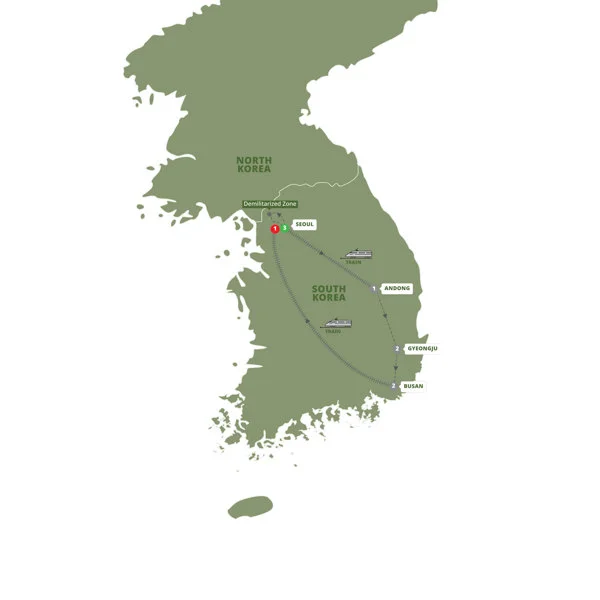
Day 1: Touch Down in Seoul
Arrive in Seoul and take time to settle in and explore. Meet your fellow travellers and Travel Director for a barbecue dinner.
Meals: Dinner
Day 2
Day 2: Explore Cultural Seoul
Watch the Changing of the Guard at Gwanghwamun Gate and visit Gyeongbokgung Palace. Explore Insadong Street, with time to choose and pay for lunch. In the afternoon, take a food tour of Gwangjang Market, sampling nokdujeon, tteok-bokki and kimchi.
Meals: Breakfast
Day 3
Day 3: Into Korea’s Demilitarised Zone
Visit the Korean Demilitarised Zone by military shuttle with a Local Specialist. Explore the Third Infiltration Tunnel and Dora Observatory, where views towards North Korea are weather permitting, and visit Unification Village. Have lunch at a local restaurant. An Optional Experience to the War Memorial of Korea is available.
Meals: Breakfast,Lunch
Day 4
Day 4: Buddhist Heritage in Andong
Travel by high-speed train from Seoul to Andong. Visit Bongjeongsa Temple and Dosan Seowon Confucian Academy, and cross Woryeonggyo Bridge. In the evening, share a hosted dinner at Jongbu Kim Do-Eun’s home, featuring recipes inspired by the Joseon-era cookbook Soowoonjapbang.
Meals: Breakfast,Dinner
Day 5
Day 5: Explore Historic Andong
Explore Hahoe Village and walk to Buyongdae Cliff for views over the village. Visit the Hahoe World Mask Museum and watch the Hahoe Mask Dance Show, with the opportunity to meet performers and try some dance moves. Continue to Gyeongju and stay at Lahan Select Hotel.
Meals: Breakfast,Lunch
Day 6
Day 6: Discover Ancient Korea in Gyeongju
Visit Bulguksa Temple and Seokguram Grotto. Explore the Daereungwon royal tombs, Woljeonggyo Bridge, and the gardens of Donggung Palace and Wolji Pond.
Meals: Breakfast
Day 7
Day 7: Onwards to Busan
Travel from Gyeongju to Busan. Ride the Skyline Park Sky Capsule and visit Haedong Yonggungsa Temple. Visit the United Nations Memorial Cemetery and walk the coastal trails of Dongbaekseom Island. An Optional Experience night cruise from Haeundae is available.
Meals: Breakfast
Day 8
Day 8: Sea Views, Rice Wine and Markets in Busan
Explore Gamcheon Cultural Village and ride the Songdo Sea Cable Car, 86 metres above the ocean. Visit Gukje Market, with time to buy lunch from street stalls or shop for souvenirs. Meet makgeolli master Yoo Cheong-gil and learn about traditional rice wine over a tasting.
Meals: Breakfast
Day 9
Day 9: High Speed Return to Seoul
Take the high-speed train from Busan to Seoul. Spend the afternoon at leisure, or choose an Optional Experience: a walking tour of Hongdae or a K-pop dance class. In the evening, join your Travel Director and fellow travellers for a traditional Korean dinner.
Meals: Breakfast,Dinner
Day 10
Day 10: Farewell Seoul
Say goodbye to Seoul and head home.
Meals: Breakfast
What’s included
What’s not included
Additional information
Dining Summary
- 3 Dinner (D)
- 9 Breakfast (B)
- 2 Lunch (L)
Iconic Experience
- A hands-on dining experience that’s as much about the atmosphere as it is the food. You’ll sizzle up meats like bulgogi, galbi or pork belly right at the table, paired with a spread of banchan (side dishes) like kimchi and pickled vegetables. A favourite across South Korea and beyond, it’s a must-try meal that brings people together over bold flavours and good company.
- Seoul: Step into the past at Gyeongbokgung Palace for the Changing of the Guard but this is no ordinary ceremony — it’s a full display of royal tradition, just as it was centuries ago in the days of the Joseon Dynasty. Expect guards in colourful uniforms, traditional weapons in hand, and the rhythmic beats of drums in a ceremony once held to protect the king.
- Seoul: Join a tasting tour through the buzzing Gwangjang Market, one of the capital’s oldest and liveliest street markets. Snack your way through crispy nokdujeon, bite-sized mayak gimbap, spicy tteokbokki, and of course, Korea’s iconic kimchi — this is street food at its best.
- Seoul: Step into history at the Korean Demilitarised Zone, one of the world’s most heavily guarded borders. A powerful experience offering you a rare glimpse into Korea’s divided past and hopes for the future.
- This centuries-old performance mixes humour, history and tradition with bold masks and sharp satire. You’ll be right in the action, watching the stories unfold before meeting the performers for a private lesson — learning the moves and getting a real feel for this unique Korean tradition.
- Hahoe Village, a UNESCO World Heritage Site, has been home to the Ryu clan for over 600 years. Tucked into a bend of the Nakdong River, its thatched and tile-roofed houses sit beneath a 600-year-old tree, believed to protect the village. It’s a true step back into Korea’s past.
- Gyeongju: Discover the UNESCO-listed Bulguksa Temple, a masterpiece of Silla-era Buddhist architecture, home to intricate pagodas and national treasures. Nearby, see the Seokguram Grotto, where a 3.5-metre-tall granite Buddha has stood since 774 AD, regarded as one of the finest in the world.
- Busan: Glide above the coastline on the Skyline Park Sky Capsule, a colourful elevated railway with panoramic views over Busan’s waterfront. Sit back and watch the city and ocean unfold from this fun, retro-style ride.
- Busan: Explore the colourful streets of Gamcheon Cultural Village, where a once-forgotten hillside settlement has become a lively mix of murals, cafes and local art shops. Built by Korean War refugees in the 1950s, this vibrant neighbourhood is now one of Busan’s most unique and creative spots to visit.
- Busan: Soar 86 metres above the sea on the Songdo Sea Cable Car, gliding from Songnim Park to Amnam Park with unbeatable views over Songdo Beach and the coastline. Sit back and enjoy a whole new perspective of Busan’s stunning waterfront.
How You'll Travel
- Selected hotel dinners plus a locally hosted meal
- 4-star stays
- Deluxe coach and train travel
Gwangjang Market Street-Food Tour
Taste your way through Gwangjang Market, one of Seoul’s oldest markets, on a hosted street-food tour. Sample local favourites such as crisp nokdujeon mung-bean pancakes, spicy tteokbokki, bite-sized gimbap and kimchi amid the bustle of food stalls.
Vendors prepare dishes in view of their customers, filling the aisles with the sounds of sizzling griddles and conversation. It is a chance to experience Korean food as a lively, everyday market tradition.
Busan Night Cruise from Haeundae
Cruise Busan’s coastline after dark on an optional outing from Haeundae. Watch the illuminated city skyline from the water, with Gwangan Bridge among the evening’s distinctive sights.
The sea offers an open view of Busan’s waterfront lights and high-rises, creating a different impression of the coastal city from its daytime streets and beaches. This night cruise is at additional cost and bookable on tour.
Operated By
Trafalgar
Seoul Korean Barbecue Welcome Dinner
Gather for a Korean barbecue dinner in Seoul with your Travel Director and fellow travellers. Cook meats at the table and share them alongside banchan, the small side dishes that are central to a Korean meal.
From kimchi to pickled vegetables, the contrasting flavours make this a lively introduction to local dining. The shared grill and conversation are as much a part of the experience as the food.
Gyeongbokgung Palace & Changing of the Guard
Watch the Changing of the Guard at Gwanghwamun Gate, where colourful uniforms, traditional weapons and drumbeats evoke royal ceremony. Step inside Gyeongbokgung Palace, the largest of Seoul’s five grand palaces, to explore its courtyards and historic buildings.
Founded in 1395, the palace was a seat of power for the Joseon dynasty. Its gates and spacious grounds offer a vivid sense of the rituals and architecture that shaped Korea’s royal capital.
Insadong Street
Explore Insadong Street in central Seoul, browsing a neighbourhood known for traditional tea houses, galleries and Korean craft shops. Its lanes offer a closer look at the art and everyday objects that sit alongside the capital’s contemporary culture.
Calligraphy supplies, ceramics and handmade goods reflect Insadong’s long association with artists and collectors. There is time to choose your own lunch and take in the street’s mix of heritage storefronts and busy city life.
Changdeokgung Palace
Visit Changdeokgung Palace, one of Seoul’s Joseon-era royal residences. Discover a palace noted for the way its halls and courtyards sit within the natural contours of their surroundings.
Built in the early 15th century, Changdeokgung served generations of Korean rulers and is now a UNESCO World Heritage Site. Its architecture offers a distinct perspective on royal life, complementing the imposing ceremonial spaces of Seoul’s other grand palaces.
Korean Demilitarised Zone Visit
Explore the Korean Demilitarised Zone with a Local Specialist, travelling by military shuttle to sites connected with the division of the peninsula. Enter the Third Infiltration Tunnel and look across the border from Dora Observatory when weather permits.
A visit to Unification Village adds a view of daily life near one of the world’s most closely guarded borders. Together, these places give tangible context to the Korean War, its unresolved legacy and hopes for reunification.
Bongjeongsa Temple & Dosan Seowon Academy
Visit Bongjeongsa Temple near Andong, a Buddhist site with centuries of history and a hall regarded as Korea’s oldest surviving wooden building. Explore Dosan Seowon Confucian Academy, where the influential scholar Yi Hwang, known as Toegye, taught.
These contrasting settings reveal two traditions that shaped Korean thought: Buddhist practice and Confucian learning. Temple architecture and the academy’s restrained buildings make that heritage visible in the landscape around Andong.
Woryeonggyo Bridge
Walk across Woryeonggyo Bridge in Andong, a long wooden pedestrian bridge spanning the Nakdong River. Take in views over the water and surrounding hills while discovering the poignant local story that inspired its design.
The bridge is associated with a tale of devotion between husband and wife. Its timber walkway offers a quieter perspective on Andong, connecting the region’s scenery with a story that remains part of its cultural identity.
Andong Be My Guest Dinner
Join host Jongbu Kim Do-Eun for a home-hosted dinner in Andong. Share dishes inspired by Soowoonjapbang, a Joseon-era cookbook preserved through generations, and discover flavours rooted in the region’s culinary heritage.
Rather than a conventional restaurant meal, this Be My Guest experience places traditional recipes in a personal setting. Conversation with your host brings the history of the food closer, showing how family knowledge helps keep longstanding Korean dishes alive.
Hahoe Village & Buyongdae Cliff
Wander through UNESCO-listed Hahoe Village, where thatched and tile-roofed houses preserve a Joseon-era settlement within a bend of the Nakdong River. Walk to Buyongdae Cliff for a broad view of the village and its distinctive river setting.
Associated with the Ryu clan for more than six centuries, Hahoe remains a place of living Confucian and folk traditions. Seeing its lanes and rooftops from above reveals why its historic layout is so closely tied to the landscape.
Hahoe World Mask Museum & Mask Dance Experience
Explore the Hahoe World Mask Museum to see the expressive masks associated with Korean performance traditions. Watch a Hahoe mask dance show, meet the performers and try some of the movements yourself.
Hahoe’s mask dance uses humour, character and satire to tell stories about social life. The museum and performance together show how carved faces, rhythmic movement and storytelling have kept this distinctive Andong tradition in the public eye.
Bulguksa Temple & Seokguram Grotto
Explore Bulguksa Temple, a celebrated example of Silla-period Buddhist architecture, and visit nearby Seokguram Grotto to see its granite Buddha and carved figures. Both UNESCO-listed sites sit in the hills outside Gyeongju.
Created during the Silla kingdom’s cultural flowering, the temple’s stone pagodas and the grotto’s sculpted sanctuary express Buddhist ideals through remarkably different forms. Their craftsmanship makes Gyeongju’s religious and artistic heritage especially tangible.
Daereungwon Tomb Complex
Walk among the royal tombs of Daereungwon in Gyeongju, where great grass-covered burial mounds rise from the heart of the city. Their scale offers an immediate sense of the power and ceremony surrounding Silla rulers.
Gyeongju was the Silla kingdom’s capital for centuries, and its ancient tombs remain among its most recognisable sights. Exploring the grounds reveals how the city’s royal past is woven into its present-day landscape.
Woljeonggyo Bridge & Donggung Palace
Admire Woljeonggyo Bridge, a reconstructed Silla-era crossing in Gyeongju, and explore the grounds of Donggung Palace and Wolji Pond. Ornate bridge architecture and the palace garden setting offer two views of the ancient capital.
Donggung formed part of a royal complex, while Wolji Pond was created as a landscaped setting for the Silla court. Together with the restored bridge, these sites evoke the kingdom’s interest in ceremonial spaces, water and carefully composed scenery.
Busan Skyline Park Sky Capsule
Ride the Skyline Park Sky Capsule along Busan’s waterfront in a colourful cabin on an elevated track. Watch the coastline, sea and cityscape unfold from a leisurely vantage point above the shore.
The retro-style ride offers a playful way to experience Busan’s relationship with the water. Its broad windows keep the changing views in focus, from the curve of the coast to the busy urban landscape behind it.
Haedong Yonggungsa Temple
Visit Haedong Yonggungsa Temple, a Buddhist complex set beside the sea near Busan. Descend its stone steps to see pagodas and temple buildings framed by rocky coastline and breaking waves.
Unlike many Korean temples tucked into mountain valleys, Haedong Yonggungsa faces the open water. That coastal setting gives its shrines a distinctive atmosphere, with the sound of the sea accompanying a visit grounded in Buddhist heritage.
United Nations Memorial Cemetery & Dongbaekseom Island
Pause at the United Nations Memorial Cemetery in Busan, which honours people who died while serving in the Korean War. Walk the carefully tended grounds and reflect on the international lives connected to the conflict.
Explore the coastal paths of Dongbaekseom Island, known as the Island of Camellias, for views of Busan’s shoreline and skyline. The two visits reveal contrasting sides of the city: a place of remembrance and a lively coastal setting.
Gamcheon Cultural Village
Explore Gamcheon Cultural Village, following steep lanes between brightly painted houses, murals, cafés and small art shops on a Busan hillside. Its terraces and viewpoints reveal a colourful neighbourhood shaped by the slope above the city.
The settlement grew in part as a home for Korean War refugees in the 1950s. Community art projects have since transformed its streets, making this both a creative destination and a place with a layered local history.
Songdo Sea Cable Car
Ride the Songdo Sea Cable Car above Busan’s waterfront, travelling between Songnim Park and Amnam Park. Look down over Songdo Beach and out across the water as the cabins glide high above the coastline.
The crossing gives you a perspective that ground-level sightseeing cannot: the sweep of the bay, the shape of the shore and the city rising behind it. It is a scenic encounter with Busan’s maritime landscape.
Gukje Market
Explore Gukje Market in Busan, moving through a maze of stalls and shops selling everyday goods alongside tempting street food. Browse the busy lanes and choose from local lunch options at your own expense.
The market expanded in the years following the Korean War, when trade helped families rebuild their livelihoods. Its crowded passages remain a place to observe Busan’s commercial energy and the rhythms of local shopping.
Geumjeongsanseong Makgeolli Brewery & Tasting
Meet makgeolli master Yoo Cheong-gil at his Busan brewery and taste traditionally made Korean rice wine. Hear from the sixth-generation producer about the craft behind makgeolli and how its character differs from mass-produced versions.
Yoo is South Korea’s only officially recognised makgeolli master. This MAKE TRAVEL MATTER® visit supports the preservation of a local tradition as he seeks a new generation to carry it forward.
Traditional Korean Farewell Dinner
Share a traditional Korean dinner in Seoul with your Travel Director and fellow travellers. Gather around the table for a hosted meal that celebrates the flavours encountered across South Korea.
Korean dining places particular value on dishes shared among companions, making this a fitting setting for conversation. It is an opportunity to reflect together on the country’s royal heritage, regional traditions and contemporary life over one final meal.
War Memorial of Korea
Visit the War Memorial of Korea in Seoul on an optional excursion. Explore exhibitions examining the Korean War, the country’s broader military history and the human consequences of conflict.
The museum adds depth to a visit to the Demilitarised Zone by placing the division of the peninsula in historical context. This experience is at additional cost and bookable on tour for travellers who would like to explore the subject further.
Hongdae Walking Tour
Walk through Hongdae on an optional tour of one of Seoul’s most creative neighbourhoods. See street art and independent shops while getting a closer look at the youth culture associated with the area around Hongik University.
Hongdae’s streets reflect a contemporary, expressive side of the capital that contrasts with its royal palaces and traditional markets. This guided walking experience is at additional cost and bookable on tour.
K-pop Dance Class
Learn K-pop dance moves with a local instructor in Seoul during an optional class. Practise choreography inspired by Korean pop hits and experience the precision and energy behind the performances.
K-pop is one of South Korea’s most visible contemporary cultural exports, and learning a routine offers a hands-on way to engage with it. No stage is needed to appreciate the coordination involved. The class is at additional cost and bookable on tour.