Your itinerary
Day 1
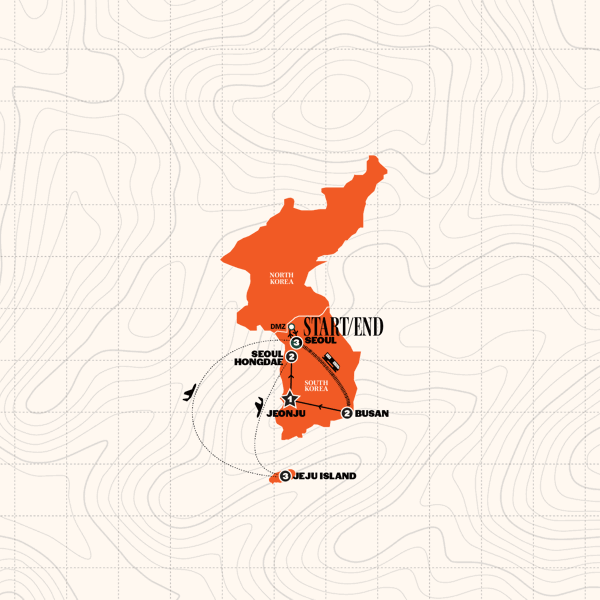
Day 1: Start Seoul
Meet your crew in the afternoon in a central location. Enjoy free time to explore Insadong Hanok Village, then regroup for Korean fried chicken; beer is available if you like.
Day 2
Day 2: Seoul and DMZ
Travel early to the Korean Demilitarized Zone (DMZ) for a semi-private peace tour with a local guide, using a military shuttle. Visit the 3rd Infiltration Tunnel, Dora Observatory and Unification Village; views into North Korea from the observatory depend on the weather. Return to Seoul for a free evening. Access to DMZ sites may change or be restricted or cancelled depending on conditions and military controls.
Meals: Breakfast
Day 3
Day 3: Seoul
Take a Seoul city tour, visiting Gyeongbokgung Palace and dressing in traditional Hanbok. Stop in Gangnam, then visit Seongsu to browse its shops and cafes and have the chance to get lunch. If the weather allows, head to Yeouido Hangang Park for a riverside picnic with music and convenience-store ramen.
Meals: Breakfast
Day 4
Day 4: Seoul to Busan
Travel from Seoul to Busan by high-speed train. The evening is free to relax with your group.
Meals: Breakfast
Day 5
Day 5: Busan
Spend the day exploring Busan, including Haeundae beach, coastal walks and city views. A local guide shows the group Busan sights, including Gamcheon Village, and there is a visit to the international market for lunch, with fish dishes available. In the evening, take a private yacht trip with snacks and music.
Meals: Breakfast
Day 6
Day 6: Busan to Jeonju
Travel from Busan to Jeonju, stopping at a traditional Hanok with mountain views; BTS filmed a music video there, and there is time to visit the onsite café and art gallery. In Jeonju, visit places featured in BTS music videos and try candy made famous by “Squid Game.” Enjoy a traditional bibimbap lunch, then explore the traditional village, its crafts and food, and learn about traditional Korean crafts and culture.
Meals: Breakfast,Lunch
Day 7
Day 7: Jeonju to Seoul - Hongdae
Return to Seoul and stay in Hongdae, known for its shops, eateries and nightlife. Visit a local Buddhist temple and take part in traditional practices, which may include tea making, meditative art and Sutra script writing; activities may vary by departure. There is an opportunity to attend a Korean baseball game.
Meals: Breakfast
Day 8
Day 8: Seoul - Hongdae
Join an optional Korean cooking class and an optional K-pop dance class. The rest of the day is free to explore, shop or try street food. In the evening, share a Korean BBQ dinner with the group.
Meals: Breakfast,Dinner
Day 9
Day 9: Seoul - Hongdae to Jeju Island
Travel to the airport and take an included flight to Jeju Island. Check into the hotel near Tap-dong Plaza, then spend the evening at leisure exploring the markets and local food.
Meals: Breakfast
Day 10
Day 10: Jeju Island
Explore eastern Jeju with a local guide and Trip Manager. Take a short hike to Seongsan Sunrise Peak and visit the Haenyeo Museum to learn about the island’s female divers and folklore. Later, choose to relax on a beach, take an ATV ride on the trails or have Black Pork Korean BBQ.
Meals: Breakfast
Day 11
Day 11: Jeju Island
Take a guided hike along Jeju’s Olle Trail and visit the O’Sulloc Tea Museum. There is an option to dive and explore the sea with local Haenyeo, or Women of the Sea.
Meals: Breakfast
Day 12
Day 12: Jeju Island to Seoul
After breakfast, take an included flight from Jeju Island to Seoul. The trip finishes at 12:00 at Gimpo International Airport.
Meals: Breakfast
What’s included
What’s not included
Additional information
Dining Summary
- 11 Breakfast (B)
- 1 Lunch (L)
- 1 Dinner (D)
FAQs
- Bangkok: A modular trip means fellow travellers will join and leave at various locations. There’ll be some goodbyes, sure, but there’ll also be plenty of hellos with new like-minded travellers.
- Seoul: Free Time Add-Ons are special activities Contiki organizes in addition to the trip. They aren’t mandatory (but we do highly recommend them!) and can be done during your free time. Payment for Free Time Add-Ons can only be made in cash, using the local currency – Korean Won (KRW) You can check out the prices on the trip page of the website. Payment will generally be collected on night one after kickstart.Please note: The ‘Attend a Baseball Game’ Free Time Add-On can be pre-booked with your booking agent up to 5 working days before the trip starts. It will also be available to book with your Trip Manager at Kickstart. But seating with the group cannot be guaranteed.
- Seoul:
Other than all the standard stuff like jeans, trousers, jumpers and t-shirts, here are some things you should consider packing:Rainproof jacket
Comfy walking shoes & sandals
Swimwear & towels
Personal medication & motion sickness tablets
Travel adaptors
Insect repellent and sunscreen
Smart casual clothing for high-end restaurants or night clubs - Seoul: South Korea uses the South Korean Won (?). Local currency is readily available through cash machines, which will be available in most regions we travel to on this trip.
- Seoul: In South Korea, power plugs and sockets (outlets) of type C and F are used. The standard voltage is 220 V at a frequency of 60 Hz.
- Seoul:
South Korean culture and society is a unique blend of tradition and modernity. Ingrained within its rich culture is a deep sense of community and the utmost respect for elders. Here are some things to keep in mind:Revealing clothing can be viewed as culturally insensitive off the beach. Shorts are generally fine (as long as they aren’t too short). In terms of behaviour, public displays of affection between men & women are considered shocking in some places.
Although cities like Seoul boast dynamic gay districts such as Jongno and Itaewon, public displays of affection, especially same sex, can attract stares and, in some situations, outright discrimination.Smoking is common in South Korea. But it’s illegal to smoke in public places. There are specific smoking zones across the cities where smoking is permitted.
English isn’t widely used in South Korea, so a translation app can be quite helpful. And your Trip Manager or Local Guide can give you some tips on words you can try. - Seoul: If your local service provider doesn’t have an international pack, you can buy a SIM card &/or handset at any mobile phone shop and some convenience stores. ‘Top up’ credit vouchers are available at most phone shops, local post offices or at the airport. Most areas have 4G coverage, but major cities will have 5G.
- Seoul: South Korean Soul trips operate from March to November. Usually, Spring (April to June) and Autumn (September to November) are considered the best times to visit because of the pleasant weather.
- Seoul: Tipping isn’t customary in South Korea (and can sometimes be considered rude sometimes!). So, please check with your Trip Manager or Local Guide if you’re unsure whether a tip would be appropriate or not. You’re welcome to tip your Contiki Team if you love our service too!
- Seoul: Yep, public transport is excellent in South Korea. And if you’re planning to explore the city in your free time, it’s best done via metro and bus (since taxis are quite expensive!). You can purchase a T-Money travel card at the airport or convenience stores in Seoul. These cards can be used on the bus or train and can be topped up as often as needed. Your Trip Manager can assist with pointing out locations near the start hotel to purchase a T Money travel card if needed.
- Jeju Island: On our trips, you can bring one bag or suitcase with a max weight of 15kg (33lbs). Please note you’ll be responsible for getting their own luggage on and off the coach and train from Seoul to Busan.
- Jeju Island: The trip officially finishes at 12pm on Day 12 at Gimpo International Airport. So, you can book flights home from this airport at any time in the evening. You’ll have to arrange your own transfer if you’re planning on catching your flight from Incheon Airport.
Included Experience
- The DMZ: The DMZ remains an active Military installation, and we’ll visit for a Peace Tour which includes the 3rd Infiltration Tunnel, the Dora Observatory (where you can see over into North Korea if the weather is right) and then to the Unification Village. The tour is semi-private with a local guide, and we’ll travel through the zone in a military shuttle.
- Seoul: Of all the traditional Korean experiences (and believe us, there are a lot of ’em) this might just be the coolest. Don’t miss your chance to visit the Gyeongbokgung Palace, one of 5 Royal Palaces in Seoul from the old ruling dynasty. We’ll also dress up in the Traditional Hanbok dress too.
- Seoul: We’ll hit the Gangnam District, made famous by Psy, for a bit of shopping, browsing and posing in front of the Gangnam hands. Don’t miss coffee served by robots, or your chance to order an ice block from one of the many vending machines. Gangnam is home to lots of K-Wave stars too so keep your eyes peeled (and have your autograph book at the ready).
- Seoul: Once home to hand-made shoe craftsmen, Seongsu is now one of Seoul’s most exciting shopping districts where you’ll find small cafes, pop-up shops and beautiful green space AKA Seoul Forest. You and your crew will have the chance to get lunch here, plus pick up some souvenirs for your fave folks back home.
- Seoul: One end of the country to the other in just two-and-a-half hours? With superfast Wi-Fi and spectacular views? That’s right, you can’t explore South Korea without getting on a high-speed train.
- Busan: Our local guide will show us Busan’s best spots. For lunch, you’ll get to visit the international market where you’ll find a plethora of different fish dishes from across the continent.
Busan is famous for being one of the only regions not to fall to the North Koreans during the war in the 50s. The Gamcheon Village was settled by refugees during the Korean War; it’s since had a refresh and is now known for it’s bright coloured buildings and awesome art school vibes. - Jeonju: On our way to Jeonju, we’ll stop off at a traditional Hanok and bask in the mountain views. BTS filmed a music video here too, so this is the perfect place to follow in their footsteps. You’ll also have a chance to check out the onsite café and art gallery before we make our way to Jeonju.
- Jeonju: We’ll tuck into a traditional bibimbap that Jeonju is famous for. Served warm in a brass bowl, with chilli on the side.
- Seoul: This afternoon, we’ll slow things down and take time to learn about the local Buddhist practices here in Seoul. We’ll partake in a few of them too, such as tea making and Sutra script writing. That’s right, culture never felt so calm. Please note: Exact temple activities could change depending on departure.
- Seoul: One final night. One final meal together. It HAS to be the world’s most popular Korean cuisine – that’s right, it’s BBQ time. The perfect chance to reminisce with great Korean food and even greater people.
- Seoul: We’ll zip through the skies on an included flight towards Jeju Island.
- Jeju Island: We’ll hop on our coach and head to the eastern part of Jeju Island with a local guide & your Trip Manager. Get ready to see jaw-dropping views of the island after a short hike to the Seongsan Sunrise Peak
- Jeju Island: Take a scenic hike along the rolling hills and lush landscapes of Jeju Island with a local guide. One for your bucket list!
- Jeju Island: Swing by the O’Sulloc Tea Museum for a quick dive into Korean tea culture and the story behind O’Sulloc (a famous, traditional Korean tea). Feel free to snap a few pics and grab tea-themed treats or gifts for the crew back home (or, let’s be real, yourself).
- Jeju Island: We’ll make our way back to where it all began – Seoul with another included flight.
Operated By
Contiki
Seoul Welcome Gathering & Korean Fried Chicken
Meet your travel crew in central Seoul over a shared Korean fried chicken meal. It is a relaxed introduction to the group, with the option to enjoy a beer alongside one of the country’s favourite casual dishes.
Korean fried chicken is prized for its crisp coating and varied sauces, from sweet-spicy to soy-garlic. Sharing a plate offers a taste of the lively neighbourhood dining culture that makes an evening out in Seoul feel distinctly local.
DMZ Peace Tour
Explore the Korean Demilitarized Zone with a local guide on a semi-private peace tour. Travel through this active military area by shuttle to see the Third Infiltration Tunnel, look towards North Korea from Dora Observatory when visibility allows, and visit Unification Village.
The borderland offers a sobering perspective on the division of the Korean Peninsula and the lives shaped by it. Access is controlled by the South Korean military; individual sites or the entire visit may be restricted or cancelled without notice.
Gyeongbokgung Palace & Hanbok Experience
Visit Gyeongbokgung Palace in Seoul and dress in a traditional hanbok for a closer encounter with Korea’s royal heritage. Explore the palace setting, with its grand gates, ceremonial courtyards and elegant traditional architecture.
Founded in 1395, Gyeongbokgung was the principal palace of the Joseon dynasty and remains one of Seoul’s defining historic sites. Wearing hanbok brings the colours and silhouettes of traditional dress into a setting once reserved for royal ceremony and court life.
Gangnam District Visit
Explore Seoul’s Gangnam district, a centre of contemporary shopping and Korean pop culture. Browse its busy streets and pause by the Gangnam Style hands sculpture, a playful landmark linked to Psy’s globally recognised song.
Gangnam’s polished storefronts, cafés and inventive vending machines offer a contrast to Seoul’s royal palaces and older neighbourhoods. The visit gives you a look at the fast-moving consumer culture and entertainment scene associated with this part of the capital.
Seongsu Neighbourhood Visit
Discover Seongsu, a Seoul neighbourhood where former workshops sit alongside independent cafés, small shops and pop-up spaces. Browse the district with your group and take in the mix of industrial streets and contemporary design.
Once associated with handmade shoe production, Seongsu has become a showcase for the city’s creative businesses. Its workshop heritage remains part of the streetscape, giving this shopping district a different feel from Gangnam’s gleaming avenues.
Guided Busan Discovery & Gamcheon Culture Village
Discover Busan with a local guide, including its international market and Gamcheon Culture Village. Browse market stalls offering seafood dishes from across the region, and see Gamcheon’s closely packed, brightly painted houses and hillside artworks.
Busan remained a vital refuge during the Korean War, and Gamcheon was settled by people displaced by the conflict. Its later transformation through community art adds another layer to the village’s story, beyond the colour and coastal-city views.
Busan Private Night Yacht Cruise
Cruise Busan’s waterfront by private yacht with your group, enjoying snacks and music as the city lights come on. From the water, take in a different perspective on this busy port city and its illuminated shoreline.
Busan’s identity has long been tied to the sea, from its working harbour to its popular beaches. A night cruise pairs that maritime setting with the energy of the modern city, making it a sociable experience rather than a standard sightseeing stop.
Mountain-View Hanok Visit
Visit a traditional hanok on the journey towards Jeonju and take in its mountain setting. The stop also offers a chance to see a location used in a BTS music video, with an on-site café and art gallery to explore.
Hanok architecture is known for its timber framework, tiled roofs and close relationship with the surrounding landscape. Here, the traditional building and mountain views provide a setting that connects Korean design heritage with contemporary pop culture.
Jeonju Bibimbap Lunch
Taste traditional Jeonju bibimbap in the city celebrated for this Korean dish. Served warm in a brass bowl with chilli on the side, the meal brings together rice and colourful toppings for you to mix to your taste.
Jeonju has a longstanding reputation for food and is recognised as a UNESCO Creative City of Gastronomy. Sampling its signature bibimbap in the city itself makes this more than a routine lunch: it is an introduction to local culinary pride.
Jeonju Hanok Village & Traditional Crafts
Explore Jeonju Hanok Village and spend time learning about traditional Korean crafts and culture. Walk among tiled-roof houses, discover the crafts on display and experience the character of a neighbourhood known for preserving hanok heritage.
Jeonju’s traditional streets offer a tangible contrast to South Korea’s largest cities. An overnight stay in a local hanok guest house adds a further sense of place and an opportunity to experience Korean hospitality in this historic setting.
Seoul Buddhist Temple Practices
Visit a Buddhist temple in Seoul and take part in traditional practices in a calm setting. Activities may include tea preparation, meditative art or writing Buddhist sutra passages, offering a hands-on introduction to practices centred on attention and reflection.
Buddhism has shaped Korean art and spiritual life for centuries. This hosted experience makes space to engage with that heritage beyond sightseeing. The exact temple activities can vary by departure, so the practices offered may differ from those described.
Group Korean BBQ Dinner
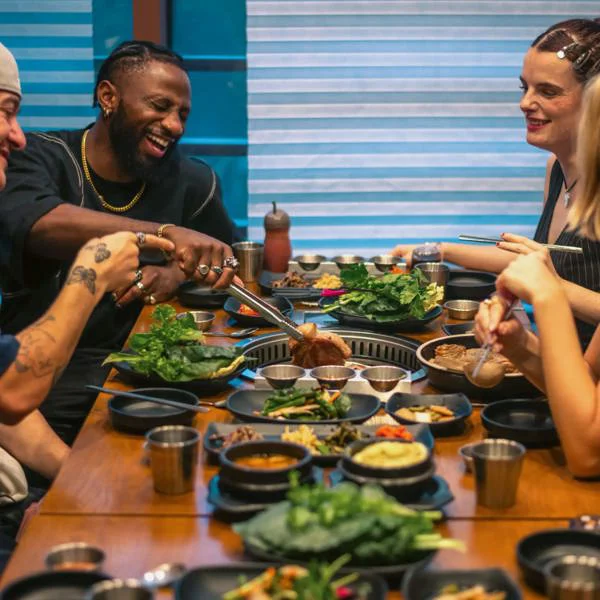
Share a Korean BBQ dinner with your travel group in Seoul. Gather around the table for a sociable meal built around grilled food, conversation and the lively atmosphere that makes Korean barbecue a popular way to dine together.
The experience is as much about company as cuisine: cooking and sharing food at the table encourages everyone to linger. It offers a taste of a familiar Korean dining tradition and a chance to reflect on the places explored across the mainland.
Seongsan Ilchulbong Sunrise Peak Hike
Hike to Seongsan Ilchulbong on eastern Jeju with a local guide and your Trip Manager. The short climb rewards you with broad views over the coastline, surrounding sea and the crater rim of this landmark volcanic cone.
Known as Sunrise Peak, Seongsan Ilchulbong was formed by volcanic activity beneath the sea and is part of Jeju’s UNESCO-listed volcanic landscape. Its steep green slopes and open coastal outlook reveal the forces that shaped the island.
Jeju Haenyeo Museum
Visit the Haenyeo Museum on Jeju Island to learn about its women divers and the traditions surrounding their work. Explore the story of the haenyeo, who harvest marine life by diving without breathing apparatus.
The haenyeo tradition has been passed between generations and is recognised by UNESCO as intangible cultural heritage. The museum provides context for their demanding relationship with the sea, as well as the folklore and community life connected to this distinctive Jeju practice.
Guided Jeju Olle Trail Hike
Walk a section of the Jeju Olle Trail with a local guide, taking in the island’s rolling hills and lush scenery on foot. The guided hike gives you time to notice the changing landscape rather than simply viewing it from a vehicle.
Jeju Olle is a network of walking routes created to connect travellers with the island’s coast and countryside. Its paths offer an active way to experience Jeju’s volcanic terrain, open views and quieter natural spaces.
O’Sulloc Tea Museum Visit
Visit the O’Sulloc Tea Museum on Jeju for an introduction to Korean tea culture and the O’Sulloc brand. Learn about tea in an island setting, with time to browse tea-themed treats and gifts.
Jeju’s mild, maritime environment has helped make it an important setting for green tea cultivation in South Korea. This short museum visit adds a different flavour to the island’s volcanic scenery, highlighting a cultivated landscape and a tradition enjoyed in everyday life.
Attend a Korean Baseball Game
Attend a baseball game in South Korea for a taste of one of the country’s most spirited spectator sports. Watch the action alongside local fans and experience the organised chants, songs and cheering that give Korean ballparks their distinctive atmosphere.
This is an optional experience at additional cost, bookable on tour with your Trip Manager. It may also be pre-booked through your booking agent up to five working days before departure; seating with the group cannot be guaranteed.
Korean Cooking Class
Get hands-on in a Korean cooking class in Seoul and learn how to prepare local favourites. Rather than only tasting Korean food in restaurants, practise the techniques and flavour combinations behind dishes you can recreate at home.
Food is a vivid entry point into Korean culture, from shared preparation to the balance of seasonings at the table. This class is an optional experience at additional cost and is bookable on tour, subject to availability.
K-pop Dance Class
Join a K-pop dance class in Seoul and try some of the coordinated moves associated with Korea’s global music scene. The session offers an active, participatory way to engage with K-pop beyond listening to its songs or visiting its shopping districts.
Choreography is central to K-pop performance, with synchronised movement helping turn songs into instantly recognisable routines. This is an optional experience at additional cost, bookable on tour for travellers who want to give it a go.
Jeju ATV Trail Adventure
Ride an ATV along trails on Jeju Island for a more energetic way to experience its outdoor landscapes. This activity swaps a walking pace for an off-road ride through the island’s scenery.
Jeju’s terrain was shaped by volcanic activity, giving its countryside a character unlike that of mainland South Korea. The ATV adventure is an optional experience at additional cost and is bookable on tour. Your Trip Manager can advise on availability and any participation requirements.
Jeju Sea-Diving Experience
Explore the sea around Jeju on an optional diving experience inspired by the island’s haenyeo, or women divers. Entering the water offers a more direct perspective on the marine environment that has long supported coastal communities here.
The haenyeo are known for harvesting seafood through breath-hold diving, a demanding practice passed down through generations. This is an optional experience at additional cost, bookable on tour. Ask your Trip Manager about availability, conditions and requirements before taking part.