
Your itinerary
Day 1
Santiago
The sights of Santiago de Chile Welcome to Santiago, Chile’s bustling capital. With its colonial-era architecture, award-winning restaurants and fascinating museums, it’s the perfect place to start your expedition cruise. There’s a lot to see, from the Mercado Central to the Plaza de Armas and the Presidential Palace. Check out the Sky Costanera, which offers panoramic views of the city from 1,000 feet up. Here, you’ll enjoy an overnight hotel stay.
Day 2
Punta Arenas
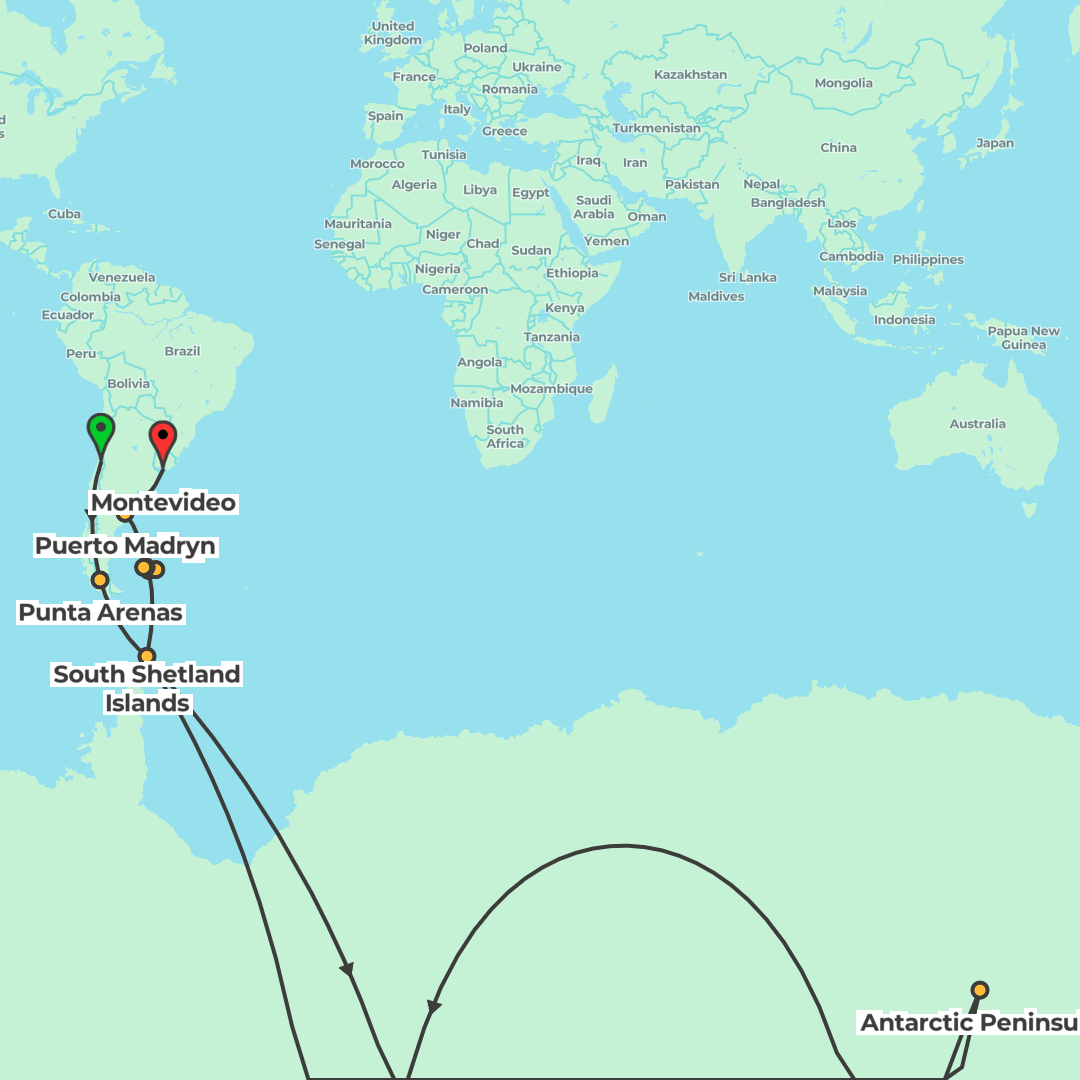
Begin your expedition cruise in Punta Arenas You’ll have an early start today as we depart Santiago and fly to Punta Arenas, Chile’s southernmost port, where your expedition ship awaits. Once you’ve boarded the ship, get settled in, explore, and meet your Expedition Team. As well as being your guides, hosts and local experts, they’re also your travel companions for the next three weeks. Friendly and welcoming, they’ll answer any questions you may have during your adventure in Antarctica, the Falklands, and Puerto Madryn.
Day 3
Drake Passage Seas
Centre on science before your Antarctic adventure On the two-day crossing through the Drake Passage, the Expedition Team will equip you with all you need to make the most of your expedition cruise. Visit the onboard Science Centre and find out what lies ahead. Listen to experts talk passionately about Antarctica’s history, the science beneath the ice, and the impact of climate change and plastic pollution. You’ll learn how to make your visit as safe and as low-impact as possible, and about the citizen science projects you can join. There’s plenty of time to relax, so unwind in the hot tub and sauna, enjoy some delicious cuisine and meet fellow travellers in the Explorer Lounge & Bar.
Day 4
Drake Passage Seas
Drake Passage Seas
Day 5
South Shetland Islands
Experience Antarctica in all its natural majesty Nothing quite prepares you for the awe of Antarctica. Surrounded by towering glaciers, the continent will fill you with wonder as you spend ten magical days exploring its frozen landscape. Large groups of penguins huddle on the ice floes, avoiding the cunning leopard seals that hunt them. Migrating whales glide among amazing icebergs as they feed on krill. Bird enthusiasts should look out for some of the many species of Antarctic seabirds that live here, such as skuas, cormorants, petrels and terns. When we arrive, the Antarctic summer is coming to an end, so you can look forward to seeing the landscape beautifully illuminated by breathtaking sunsets. It’s a great time to see penguins in their final stage of moulting and its peak whale-watching season as large amounts of krill lure cetaceans to the area. Here, nature is king, and we are mere observers. Our experienced Captain will continually monitor conditions to create the best possible itinerary for your adventure. You’ll spend an exciting 10 days busily exploring several of the many possible landing sites in the South Shetlands and on the Antarctic Peninsula based on when and where conditions are at their best. Wherever we go and whatever we do, each day will offer something different and thrilling. You’ll go on landings and ice cruises. You may even get a chance to go kayaking among the icebergs. Back on board, the Expedition Team will continue their lectures, giving you a deeper insight into the frozen continent.
Day 6
South Shetland Islands
Some 770 kilometers (478 miles) south of Cape Horn, the South Shetland Islands are usually the first land seen in Antarctica. Separated from the Antarctic Peninsula by the Bransfield Strait, nine major islands make up the group. The region was the first to be exploited by sealers in the early 19th century, and because of its proximity to South America, it still is the most visited by scientists and tourists. Chinstrap, Adelie, Gentoo and Macaroni Penguins all breed here. In addition, because it is the warmest part of the continent, large moss beds as well as orange, black, grey and green lichens grow –even hair grass and pearlwort manage to survive. Leopard seals, Weddell seals, crabeater seals, Southern elephant seals and Antarctic fur seals can be seen in the water and on the beaches.
Day 7
Gerlache Strait
Gerlache Strait
Day 8
Gerlache Strait
Gerlache Strait
Day 9
Gerlache Strait
Gerlache Strait
Day 10
South Shetland Islands
Some 770 kilometers (478 miles) south of Cape Horn, the South Shetland Islands are usually the first land seen in Antarctica. Separated from the Antarctic Peninsula by the Bransfield Strait, nine major islands make up the group. The region was the first to be exploited by sealers in the early 19th century, and because of its proximity to South America, it still is the most visited by scientists and tourists. Chinstrap, Adelie, Gentoo and Macaroni Penguins all breed here. In addition, because it is the warmest part of the continent, large moss beds as well as orange, black, grey and green lichens grow –even hair grass and pearlwort manage to survive. Leopard seals, Weddell seals, crabeater seals, Southern elephant seals and Antarctic fur seals can be seen in the water and on the beaches.
Day 11
South Shetland Islands
Some 770 kilometers (478 miles) south of Cape Horn, the South Shetland Islands are usually the first land seen in Antarctica. Separated from the Antarctic Peninsula by the Bransfield Strait, nine major islands make up the group. The region was the first to be exploited by sealers in the early 19th century, and because of its proximity to South America, it still is the most visited by scientists and tourists. Chinstrap, Adelie, Gentoo and Macaroni Penguins all breed here. In addition, because it is the warmest part of the continent, large moss beds as well as orange, black, grey and green lichens grow –even hair grass and pearlwort manage to survive. Leopard seals, Weddell seals, crabeater seals, Southern elephant seals and Antarctic fur seals can be seen in the water and on the beaches.
Day 12
Antarctic Sound
The Antarctic Sound is a stretch of water named after the first ship to have passed through this body of water from the Bransfield Strait to the Weddell Sea in 1902. The Antarctic eventually sank and crew and scientists had to spend quite some time in this area before they could be rescued. Sites that have to do with this story – like Hope Bay or Paulet Island – are sometimes visited. At Paulet, Hope Bay and Brown Bluff Adelie and Gentoo Penguins breed, as do Kelp Gulls and Cape Petrels, Snow Petrels and Skuas. The Sound’s main attractions are the spectacular tabular icebergs that come from the Larsen Ice Shelf further south.
Day 13
Antarctic Sound
The Antarctic Sound is a stretch of water named after the first ship to have passed through this body of water from the Bransfield Strait to the Weddell Sea in 1902. The Antarctic eventually sank and crew and scientists had to spend quite some time in this area before they could be rescued. Sites that have to do with this story – like Hope Bay or Paulet Island – are sometimes visited. At Paulet, Hope Bay and Brown Bluff Adelie and Gentoo Penguins breed, as do Kelp Gulls and Cape Petrels, Snow Petrels and Skuas. The Sound’s main attractions are the spectacular tabular icebergs that come from the Larsen Ice Shelf further south.
Day 14
Antarctic Sound
The Antarctic Sound is a stretch of water named after the first ship to have passed through this body of water from the Bransfield Strait to the Weddell Sea in 1902. The Antarctic eventually sank and crew and scientists had to spend quite some time in this area before they could be rescued. Sites that have to do with this story – like Hope Bay or Paulet Island – are sometimes visited. At Paulet, Hope Bay and Brown Bluff Adelie and Gentoo Penguins breed, as do Kelp Gulls and Cape Petrels, Snow Petrels and Skuas. The Sound’s main attractions are the spectacular tabular icebergs that come from the Larsen Ice Shelf further south.
Day 15
Sailing to the Falkland Islands
Relax and prepare for more adventures ahead As you savour your Antarctic experiences, prepare for more adventures ahead as we cruise towards the Falkland Islands. Your Expedition Team will brief you about the history and biology of the islands. In the Science Centre, you can look through the microscope at the tiny krill and phytoplankton that sustains so much of the region’s wildlife. Enjoy all the amenities on the ship and get tips on how to improve your images from our professional photographer, or join workshops on topics such as wildlife painting and nautical knot tying.
Day 16
Sailing to the Falkland Islands
Sailing to the Falkland Islands
Day 17
Port Stanley
Enjoy birding and hiking in these green islands The Falkland archipelago is filled with seamless horizons and white sands teeming with birdlife. Only the occasional farm dots the landscape. You’ll find grassy hills and wildflowers, in contrast to the vast whiteness of Antarctica. Enjoy a community walk around Stanley, taking in the Jubilee Villas gardens, Christ Church Cathedral and the Historic Dockyard Museum. Landings, hikes and excursions are, as always, guided by the conditions. We hope to visit albatross and penguin colonies, which are often found sharing space with seals, and getting as close as we can without disturbing them.
Day 18
Saunders Island
Saunders Island is the fourth-largest of the Falkland Islands in the western portion of the archipelago. The island’s topography is unusual, being made up of three peninsulas linked by narrow necks, and three big upland areas. Today the island is run as a sheep farm, but has historical importance as the location of the first British settlement in the Falklands. Saunders’ wildlife is also impressively varied. It is possible to see Gentoo and King Penguins in the open dune and sand-flat area, while Rockhopper Penguins (with the odd pair of Macaroni Penguins in between them), Imperial Shags and Black-browed Albatrosses frequent Mount Richards, the highest point on the island at 457 m (1500 feet). Other key bird species are the Black–throated Finch, Ruddy-headed Goose and Falkland Steamer Duck.
Day 19
West Point Island
Located slightly northwest of West Falkland, West Point Island is used for sheep farming and nature observations. Peale’s dolphins and the distinctive black and white markings of the Commerson’s dolphin can usually be seen in the waters around West Point Island. Rolling moorland and steep cliffs make for great photographic opportunities, but the main attraction is the Devil’s Nose, a cliffside colony of Black-browed Albatrosses nesting side-by-side with feisty Rockhopper Penguins. Magellanic Penguins and Magellanic Cormorants can also be found on the island.
Day 20
Cruising
Relax and get ready for Puerto Madryn Enjoy a relaxing day at sea as we sail towards Puerto Madryn. You’ll have experienced so much in Antarctica and the Falklands that your head will likely be a swirling kaleidoscope of special memories and new knowledge. Join the Expedition Team in the Science Centre to examine special interests in more depth. Or simply relax on deck, recalling the highlights of your memorable adventure. End the day in the Explorer Lounge & Bar with the new friends you’ve made on your trip, sharing experiences over a relaxing drink.
Day 21
Puerto Madryn
Visit a UNESCO wildlife haven Puerto Madryn boasts warm temperatures and beautiful beaches. It’s also the gateway to the dramatic Península Valdés, and while we’re here, you can explore a stunning nature reserve and UNESCO World Heritage Site. You might get the chance to see marine mammals. There are also no less than 180 species of birds living on the peninsula, so don’t forget to bring your binoculars. Stroll through the tranquil natural beauty of the reserve, enjoy a delicious bite to eat and browse the local arts and crafts shops.
Day 22
Cruising
Time at sea to rest and reflect As we sail the final leg from Puerto Madryn to Montevideo, enjoy your final day at sea. This is the perfect time to go through your pictures and relive your experiences in Antarctica, the Falklands and Puerto Madryn. Enjoy the onboard comforts one last time. Relax in the hot tubs or sauna or unwind in our Explorer Lounge & Bar. And you can join the Expedition Team in the Science Centre for further investigations and contribute to Citizen Science projects.
Day 23
Cruising
Cruising
Day 24
Montevideo
Disembark the ship and explore the vibrant city Disembark the ship in the morning and enjoy time to explore Uruguay’s interesting capital at your leisure. You might stroll along the Rambla of Montevideo, a picturesque waterfront promenade stretching over 13 miles, or wander through Ciudad Vieja, the historic centre lined with colonial architecture, art galleries, and bustling markets. Don’t miss the colourful Mercado del Puerto, a lively spot selling traditional Uruguayan cuisine. This is your chance to soak in Montevideo’s culture, history, and waterfront at your own pace.
What’s included
What’s not included
Additional information
Expedition Lecture Series & Science Center Discovery
Join the Expedition Lecture Series as your ship crosses the Drake Passage and beyond, and step into the Science Center to explore Antarctica’s wildlife, oceanography, and ice. Hear polar specialists explain seabird flyways, whale behaviors, and the forces shaping the White Continent.
Contribute to citizen science projects that aid real research—logging cloud cover, photographing whales for ID, or noting seabird sightings—while learning IAATO-aligned low-impact travel practices. These sessions deepen understanding and sharpen what to look for during landings and from deck.
Antarctic Peninsula & South Shetland Islands: Zodiac Cruising and Shore Landings
Venture out on Zodiac ice cruising beneath towering glaciers and sculpted bergs, then make a landing to walk among bustling penguin colonies. Expedition Guides set a careful pace across snow or pebble beaches while pointing out leopard seals on floes and skuas riding katabatic winds.
Gain close-up views as chicks molt and whales feed in late-season light, with time for photography and quiet observation. Short interpretive talks on geology, ecology, and exploration history turn each shore call into a field class, always adapted to wildlife and ice conditions.
South Shetland Islands Shore Landing & Wildlife Viewing
Explore the South Shetland Islands, often the first Antarctic landfall, where milder microclimates nurture moss beds and lichens splashing color across rock. Walk easy shore routes while your team spots Gentoo, Chinstrap, and Adélie penguins, alongside fur, Weddell, and elephant seals on beaches.
Between the Bransfield Strait and rugged volcanic ridges, seabirds wheel overhead and blowholes echo across coves. Guides share how life endures at the edge of the Southern Ocean, revealing adaptations from waterproof plumage to the choreography of synchronized penguin porpoising.
Gerlache Strait Glacier-Fringed Scenic Sailing
Cruise the Gerlache Strait, a mountain-lined waterway where blue glaciers pour to the sea and brash ice stipples mirror-flat bays. The ship threads between ice as naturalists scan for humpbacks bubble-net feeding and crabeater seals resting on floes.
Sheer peaks, misty mountain passes, and glassy coves create a palette of silvers and blues perfect for photography. Hear stories of early charting in these channels and learn to read ice and light to compose memorable shots from deck or observation lounges.
Antarctic Sound: Tabular Icebergs & Historic Sites
Enter the Antarctic Sound to witness flotillas of tabular icebergs calved from the Larsen Ice Shelf, vast as city blocks with ruler-straight sides. When conditions allow, the voyage may include shores like Hope Bay or Paulet Island, alive with Adélie and Gentoo penguins.
Guides recount the dramatic 1902 expedition whose ship gave the Sound its name and the survival tales written on these coasts. The scale of ice and the echo of surf against basalt cliffs offer a powerful sense of remoteness and endurance.
Stanley Community Walk & Historic Dockyard Museum
Explore Stanley on a hosted stroll past Jubilee Villas gardens to Christ Church Cathedral and the iconic Whalebone Arch. Continue to the Historic Dockyard Museum to trace Falklands maritime and social history through artifacts, photos, and stories of settlers and seafarers.
Along the waterfront, neat cottages, windswept flagpoles, and tea rooms frame a characterful South Atlantic capital. Your guide interprets daily life on the islands, from sheep farming to supply runs, revealing how community rhythms follow weather, seasons, and sea.
Saunders Island Wildlife Walk: Penguins & Albatross
Walk the sandy necks and open dunes of Saunders Island, where King and Gentoo Penguins share beaches and tussac with grazing geese. Follow your guide toward the slopes of Mount Richards to see Black-browed Albatross gliding in from the South Atlantic.
On cliff ledges, feisty Rockhopper Penguins clatter up sea-spray steps, sometimes with a Macaroni among them. The island’s role as the site of the first British settlement and today’s sheep-farming traditions add human texture to this rich wildlife mosaic.
West Point Island Hike to Devil’s Nose Albatross Colony
Hike across rolling moorland and along steep cliffs to the famed Devil’s Nose, where Black-browed Albatross nest side-by-side with Rockhopper Penguins. The route offers sweeping views and rewarding photography opportunities as birds wheel above the surf.
Peale’s and the striking black-and-white Commerson’s dolphins often pattern nearby waters. Learn how winds, tussac grass, and topography shape nesting choices, and how careful visitor management keeps the colony thriving on this privately run sheep station.
Peninsula Valdés UNESCO Wildlife Reserve Excursion
Visit Peninsula Valdés, a Patagonian wildlife sanctuary recognized as a UNESCO World Heritage Site. Traverse coastal steppe and lagoons with local experts to look for sea lions and elephant seals along beaches, guanacos on the plains, and a spectacular variety of shorebirds.
Interpretive stops reveal how currents and climate concentrate food here, drawing migratory species throughout the year. With more than 180 recorded birds, the reserve is ideal for binocular time and photography, complemented by insights into regional culture and conservation.
Creative Workshops at Sea: Photography, Wildlife Sketching & Nautical Skills
Boost your images with photo tips from the ship’s professional photographer—master exposure on ice, compose wildlife ethically, and make the most of polar light. Practice new techniques in relaxed sessions tailored to any experience level.
Balance screen time with hands-on creativity by joining wildlife painting or sketching circles, and try traditional nautical knot tying. These informal workshops turn sea days into skill-building interludes that enrich the way you see and record the journey.
Bridge & Deck Wildlife Watching with Naturalist Commentary
Head to the bridge and open decks to scan Southern Ocean horizons with the Expedition Team. Look for albatross, petrels, and prions riding wind lanes, and for blows, flukes, and dorsal fins as whales and dolphins surface near the ship.
Enjoy live naturalist commentary on behavior and ID features while crew share navigation insights. Binoculars and spotting scopes help you track action at distance, with moments to pause for photos and reflection as light and weather shift.
Sea Kayaking Among Antarctic Icebergs (Optional)
Paddle in small groups on a guided sea kayaking adventure, gliding through brash ice and alongside luminous blue bergs. The silence is punctuated by the crackle of ice and penguins porpoising—an intimate perspective on the Antarctic Peninsula.
This experience is at additional cost and is bookable on tour, with limited places and weather-dependent departures led by certified guides. All equipment is provided; previous paddling experience is recommended to make the most of this remarkable setting.
