Your itinerary

Day 1
Adventure begins in Kathmandu
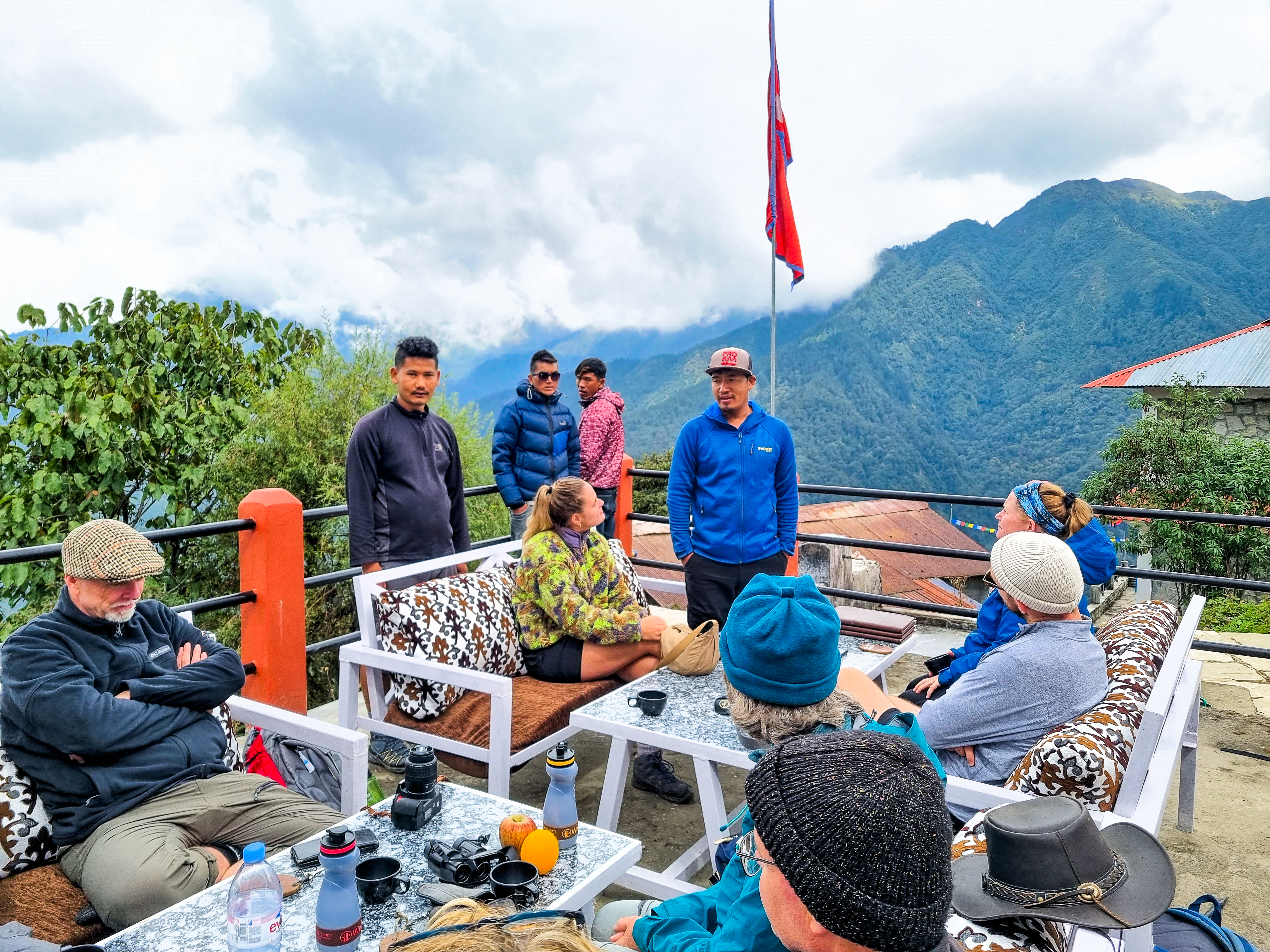
Begin your adventure at the Royal Singi Hotel in Kathmandu, the start point for many of our Himalayan treks over the years.Around 6pm, bid namaste to your tour leader and fellow travellers, when we gather as a group for the first time to get to know each other and learn more about the adventures ahead during a full trek briefing.Your tour leader then ensures a big Nepalese welcome by arranging a group dinner.Want to explore Kathmandu further? Secure pre-tour hotel nights through your sales representative.
Meals: Dinner
Day 2
Fly to Pokhara; drive to Birethanthi; optional afternoon walk
This morning, we fly west to Pokhara, the 20-minute flight offers views of the Himalaya range to the north (on a clear day). Pokhara is set in a beautiful valley overlooked by the Annapurnas and the fishtail-shaped Machhapuchhare, one of the most distinctive of the Himalayan peaks.We take a bus transfer (approximately two hours) from Pokhara Airport to Birethanthi, at the confluence of the Modi and Burungdi rivers, where we stay overnight. If there is time this afternoon, the tour leader takes you on an optional warm up hike to Tomijung, a pretty Gurung village.
Meals: Breakfast
Day 3
Trek through Tirkhedunga and Ulleri to Banthanti
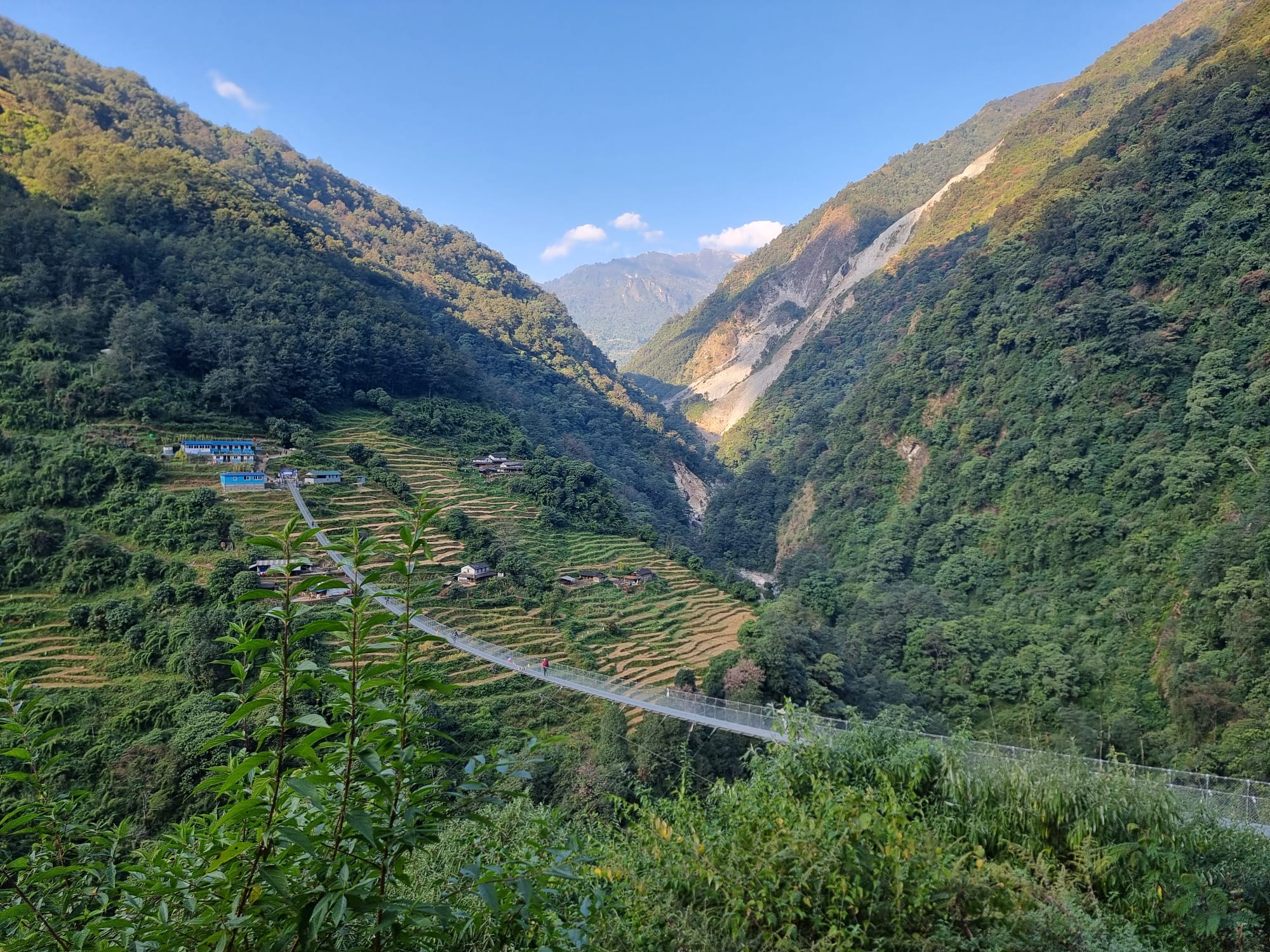
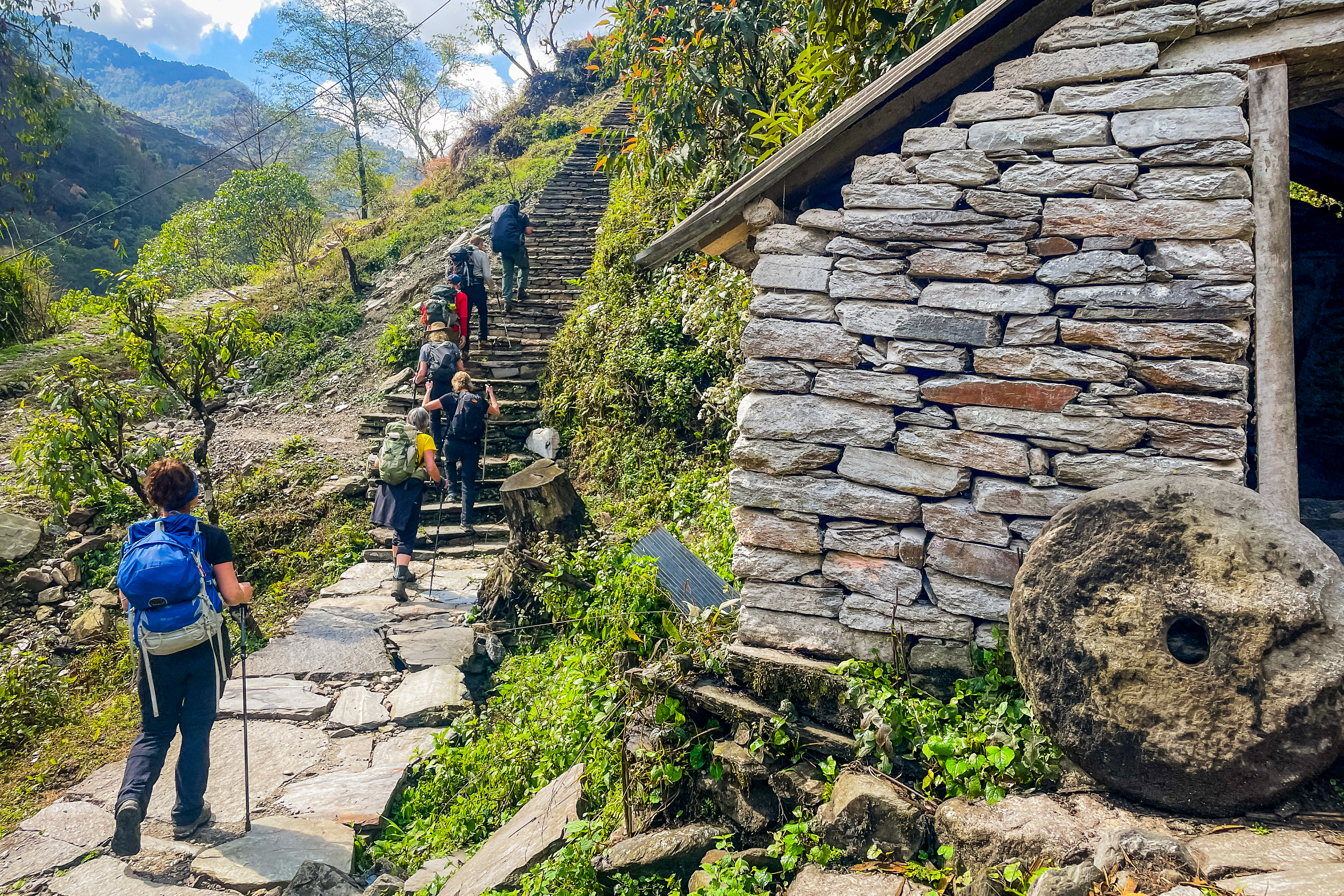
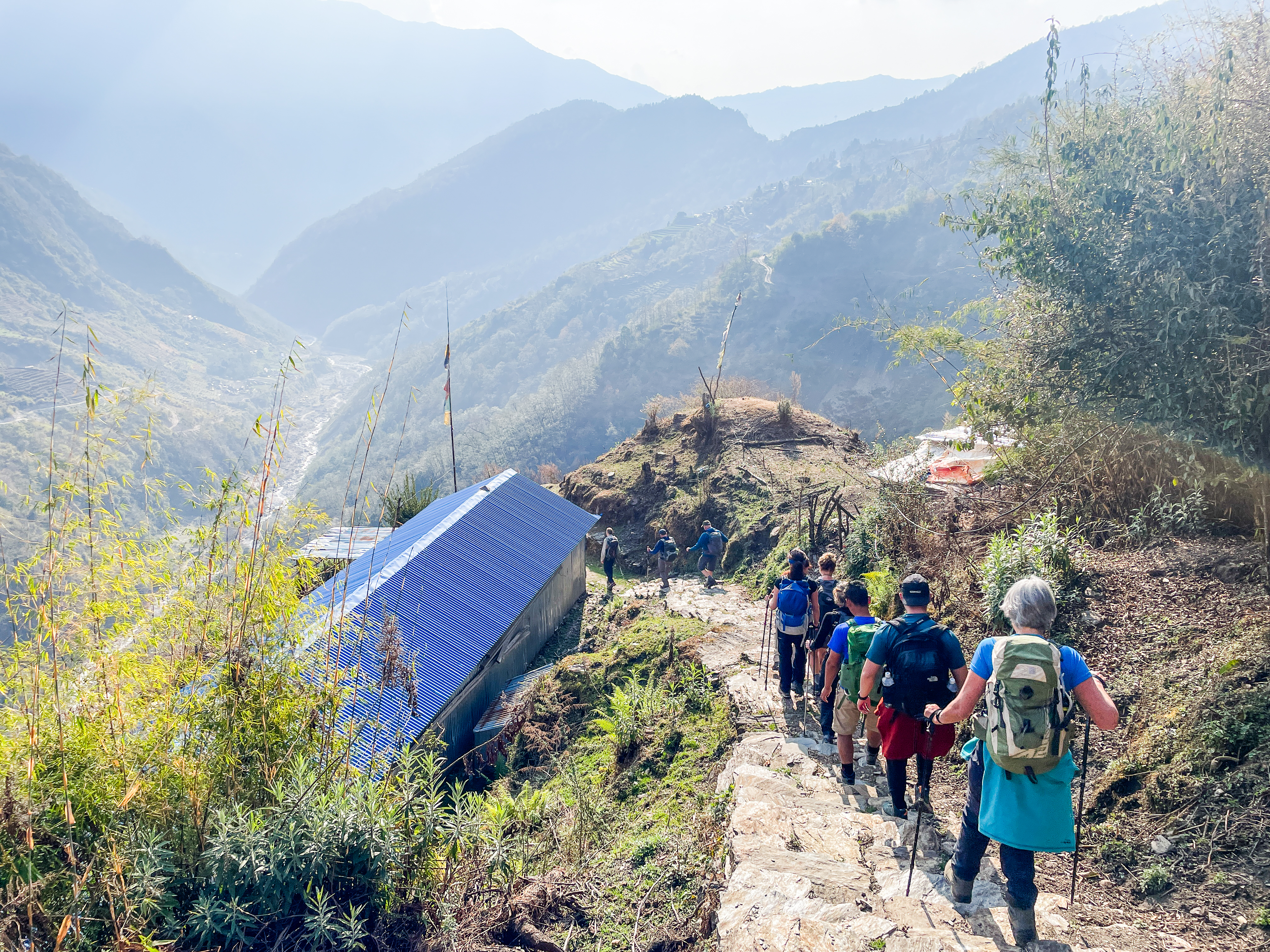
We start our trek by following the Burungdi upstream. After a lunch stop in Tirkhedunga (renowned for its variety of local beer called chang), we climb up on a steep, stone staircase (approximately three hours) through neatly terraced hillsides to Ulleri. Continuing through Ulleri, we climb a little further to our lodge at Banthanti.
Meals: Breakfast
Day 4
Ascend through rhododendron forests to Upper Ghorepani
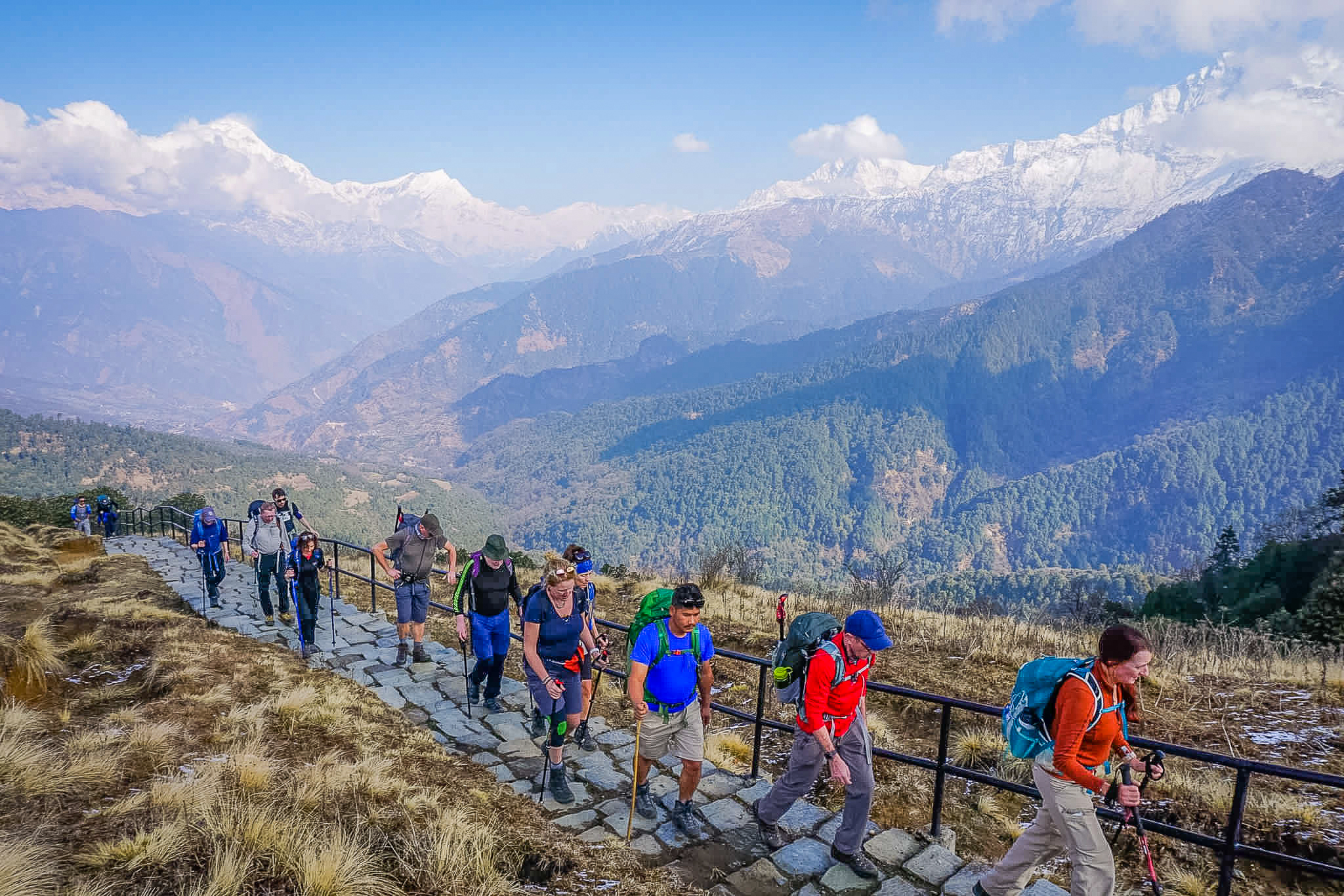
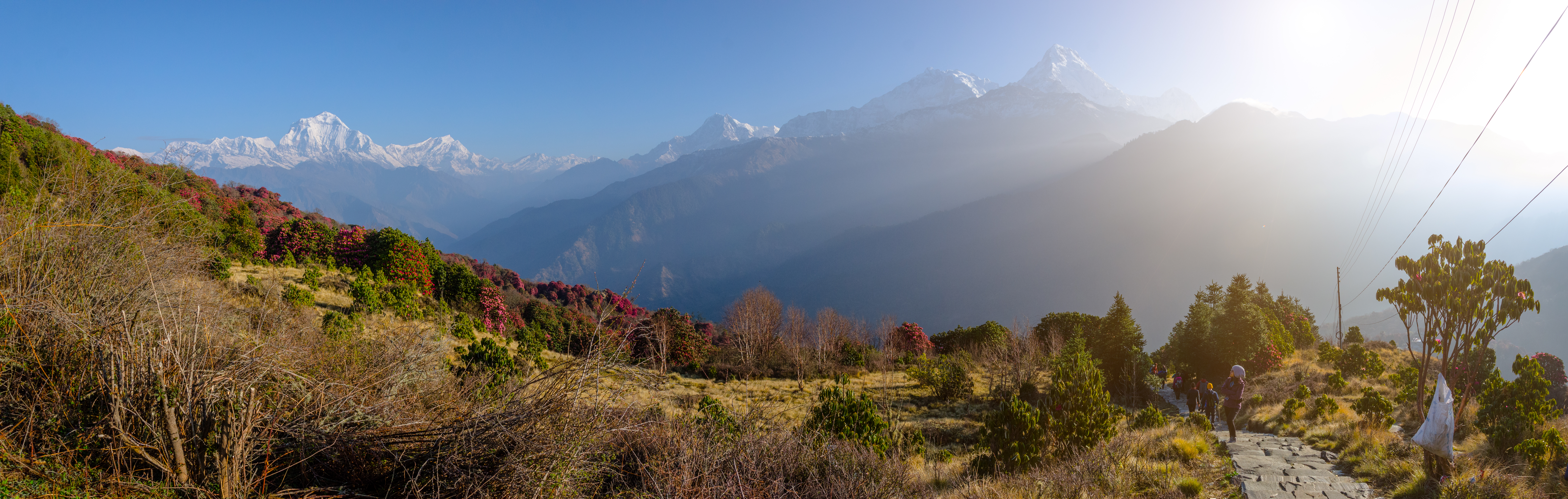
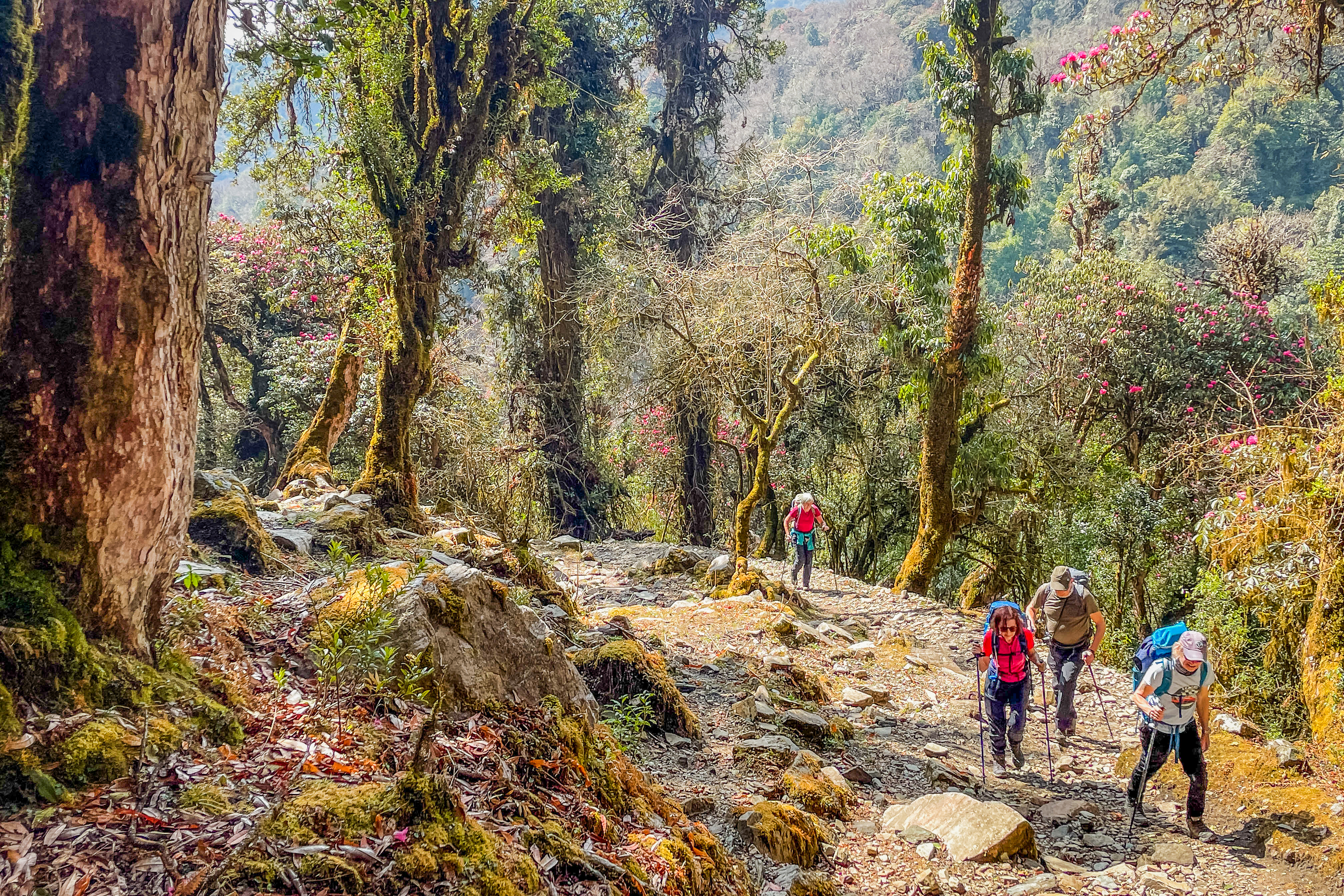
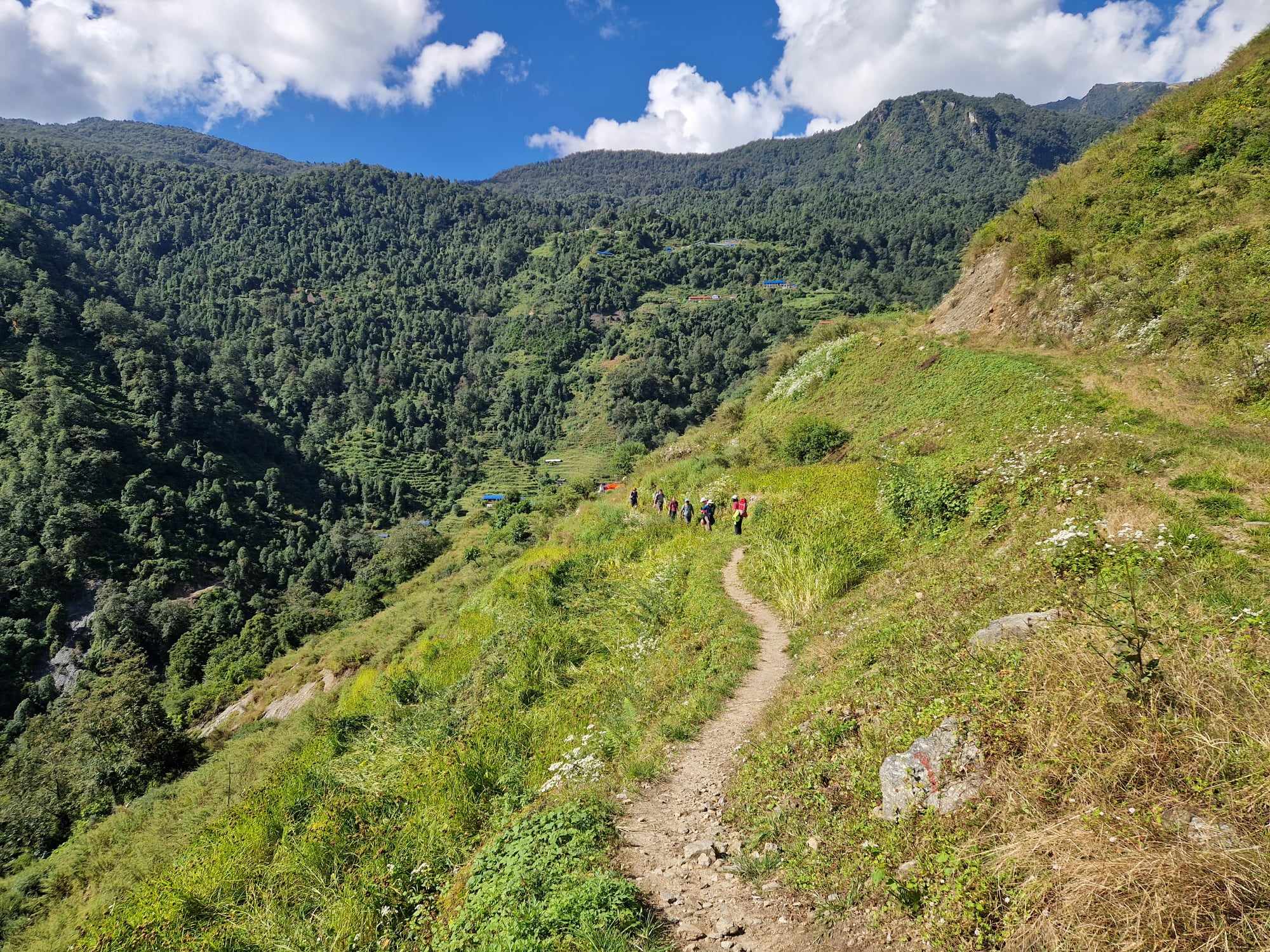
Continue our ascent through rhododendron forest, following trails, crossing suspension bridges and tackling more steps up as we head up to Ghorepani. Trains of mules provide vibrant, noisy interludes to the continuous ascent today (there are many stone staircases).Finally, we emerge from the forests at Ghorepani and suddenly a splendid mountain vista appears before us – Dhaulagiri, Annapurna, Hiunchuli, Machhapuchhare, Lamjung and other Himalayan giants. We continue up through Ghorepani to our lodge in Upper Ghorepani (9,515ft/2,900m), usually arriving by lunchtime.
Meals: Breakfast
Day 5
Optional early morning ascent of Poon Hill for incredible views of the Annapurnas, Machhapuchhare and Dhaulagiri at sunrise. After breakfast, we head through rhododendron forests to Chuili
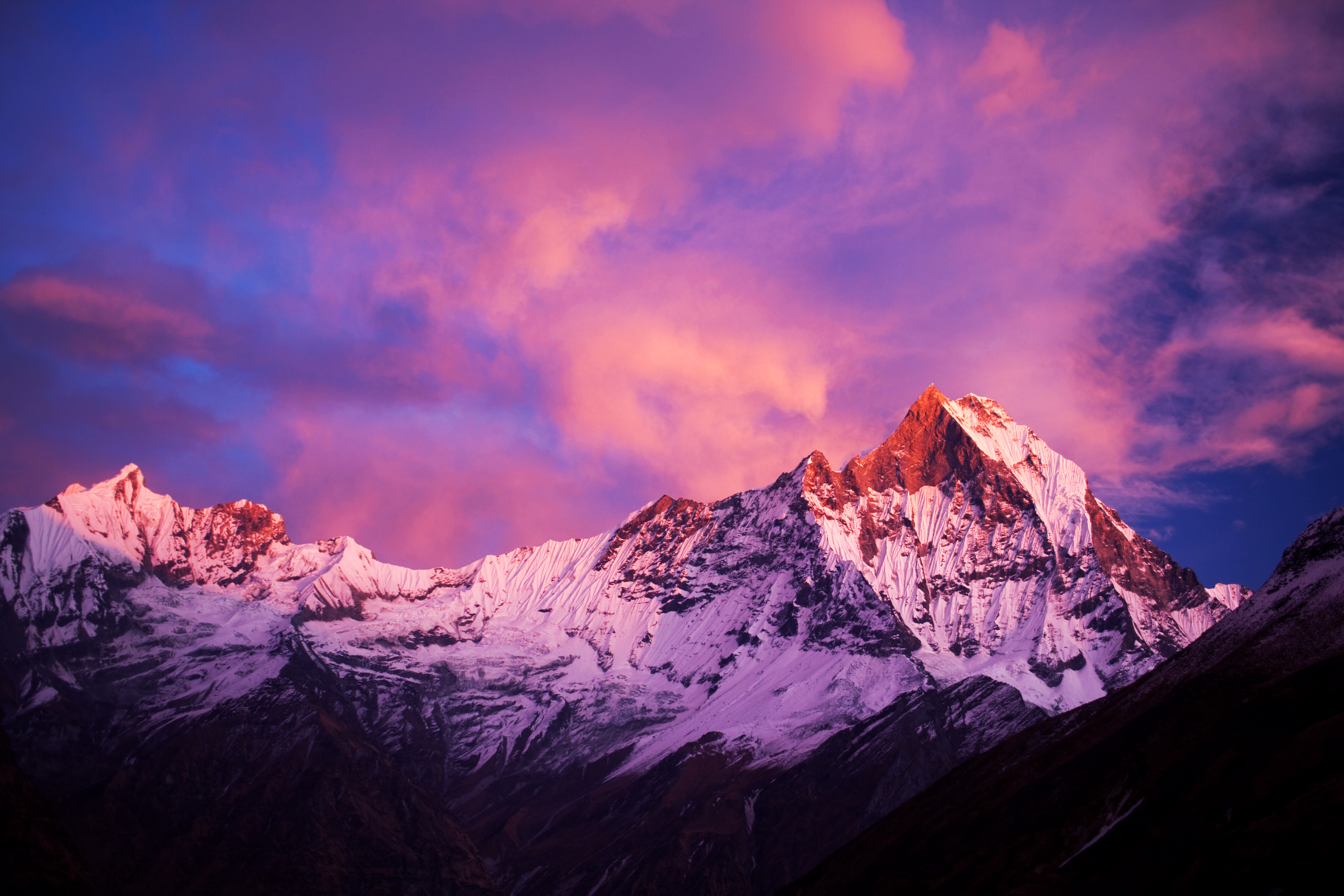
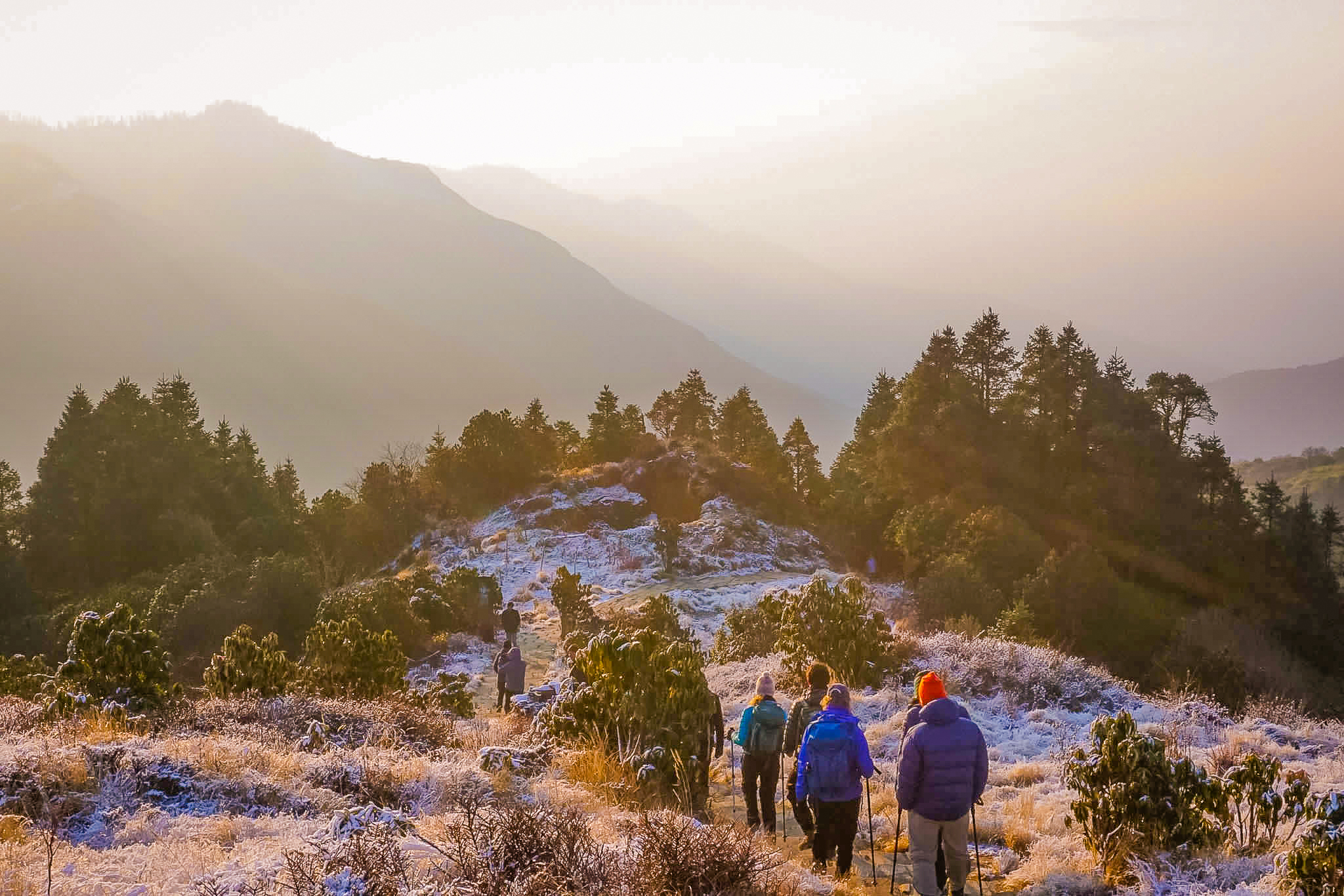
This morning there is an optional ascent of Poon Hill (10,530ft/3,210m, about an hour’s walk uphill) to see the spectacular sunrise over the Dhaulagiri and Annapurna range. As the sun emerges from behind the mountains, the sky glows red and pink.We head east after breakfast, following a ridge to cross a pass at 10,335ft (3,150m). We cut through more forest and past teahouses and then the descent becomes steeper as we take stone steps through jungle to a few lodges in a clearing called Banthanti at 9,055ft (2,760m), where we have lunch. Descending further to a small stream, we cross a bridge and climb back up to 8,825ft (2,690m) at Tadapani where we have a superb view of Annapurna South and Machhapuchhare. From here, we descend for a short while to our lodge at Chuili, where we have great views of the mountains from the lovely garden.
Meals: Breakfast
Day 6
Descend to the Siprong Khola and climb up into the Modi River valley to Chhomrong
We have an easier day today. The trail descends steeply through the forest to the Siprong Khola, a tributary of the Modi River. A steep ascent then brings us to Gurjung, where we have an early light lunch break. The trail then ascends further to Chhomrong (7,285ft/2,220m) another Gurung village and the last permanent settlement in the valley. Beyond here we see yersas, the summer shelters used by herdsmen. From Chhomrong, we have good views again of Annapurna South and from this point onwards the twin-peaks of Machhapuchhare (Fishtail) that give the mountain its name.
Meals: Breakfast
Day 7
Trek up the Modi River valley towards the Annapurna Sanctuary; overnight in Dobhan
The trail from Chhomrong descends first on a stone staircase to cross the Chhomrong River and then climbs steeply on another stone staircase out of this side valley to Sinuwa, where we enter the main Modi River valley. After a welcome tea break, the trail descends on stone steps through dense jungle and then undulates to lunch at Bamboo, a cluster of lodges in a clearing surrounded by bamboo thickets. These are cut extensively to make dokos, the carrying baskets used by our porters, and woven mats for floors and roofs. Undulating further through the bamboo forest we reach Dobhan at 8,200ft (2,500m), another small forest clearing with several teahouses.
Meals: Breakfast
Day 8
Continue up the valley to Machhapuchhare Base Camp
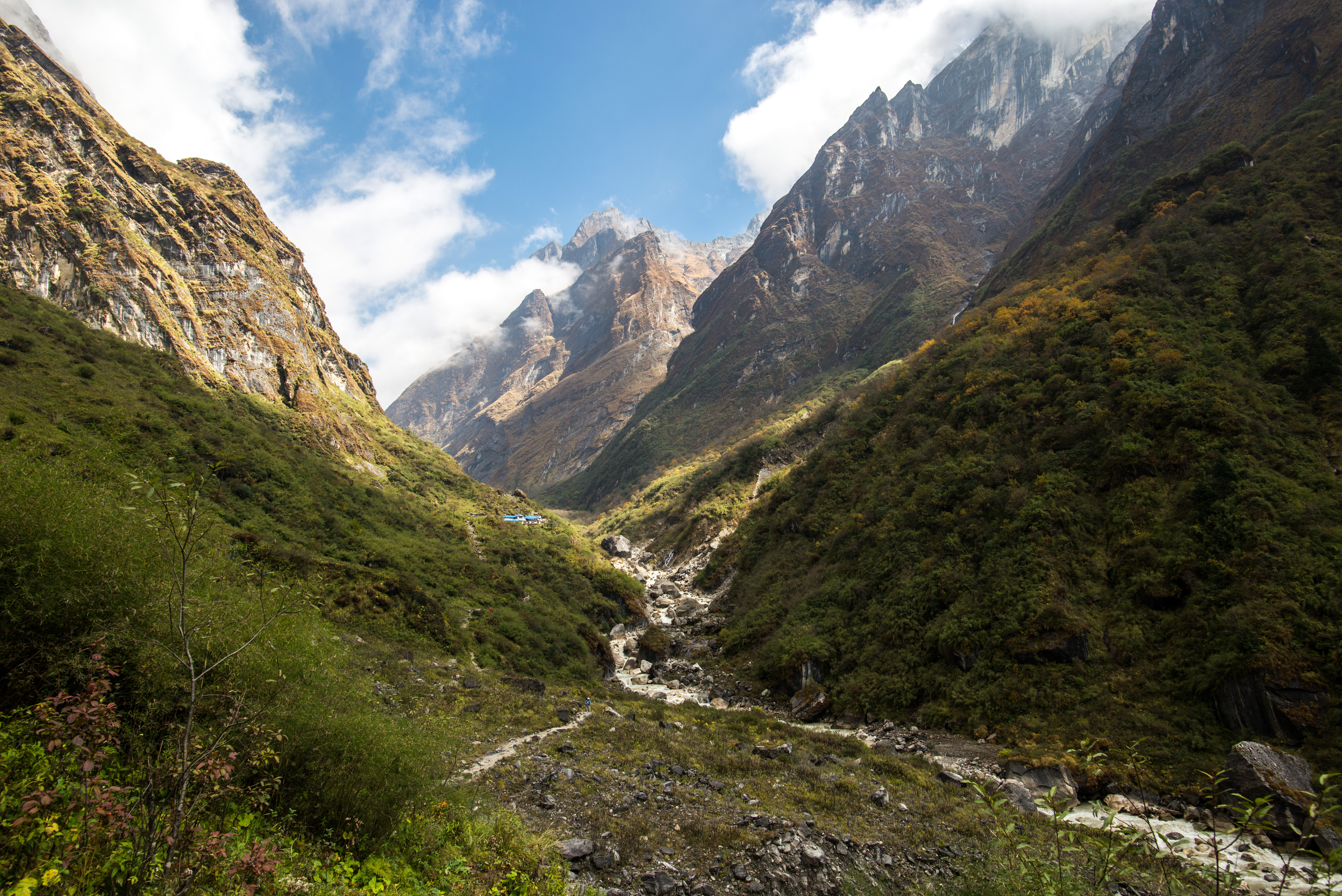
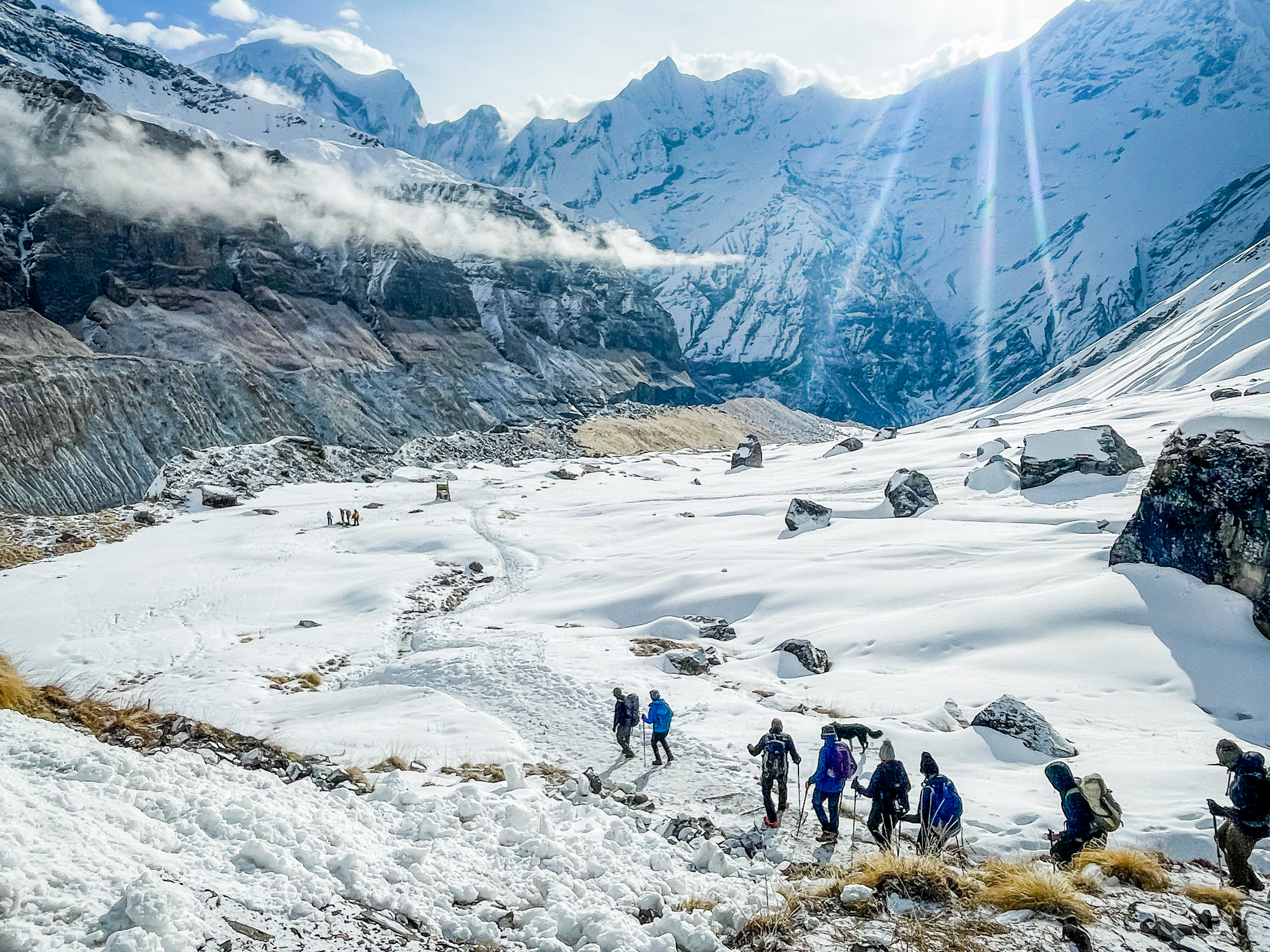
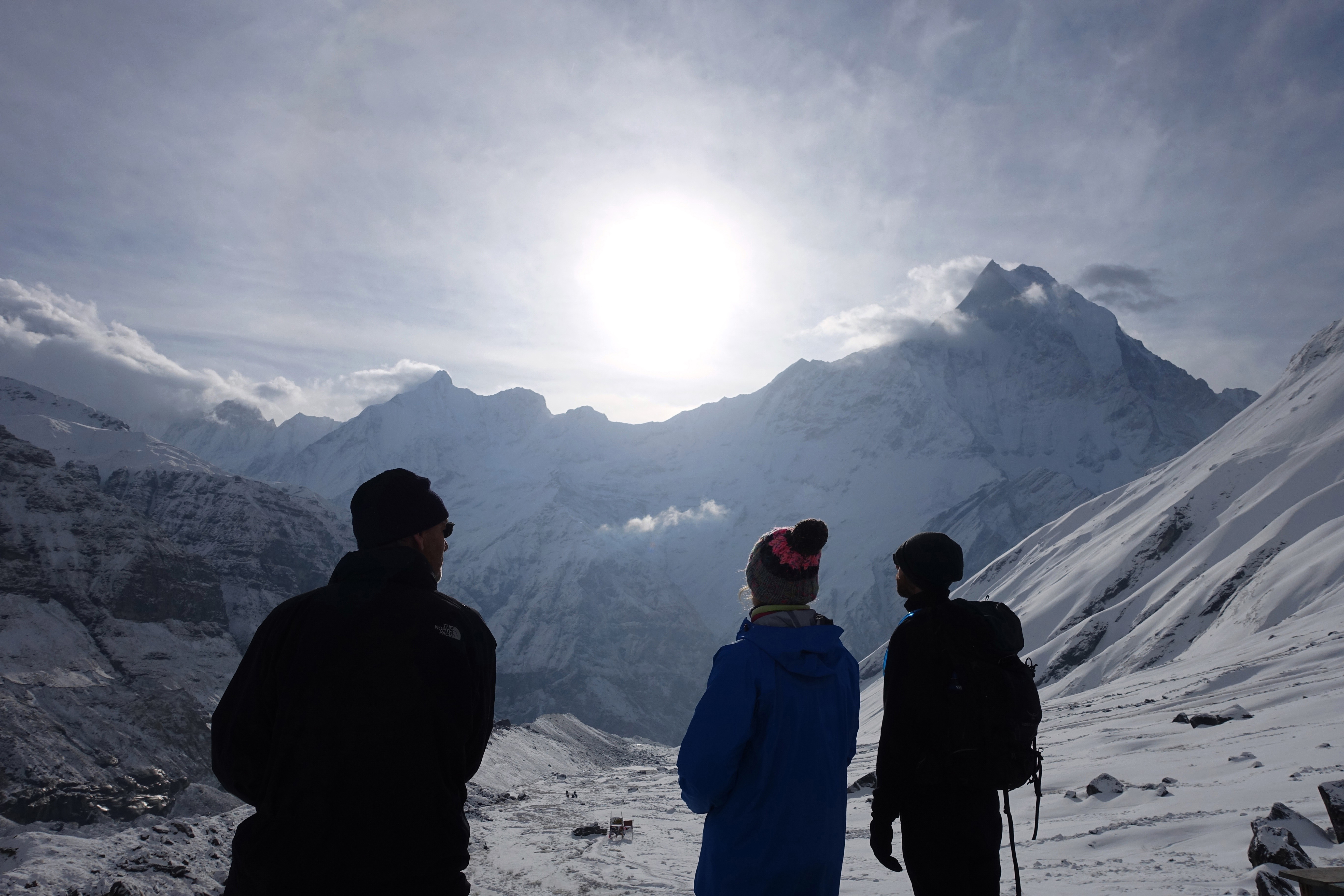
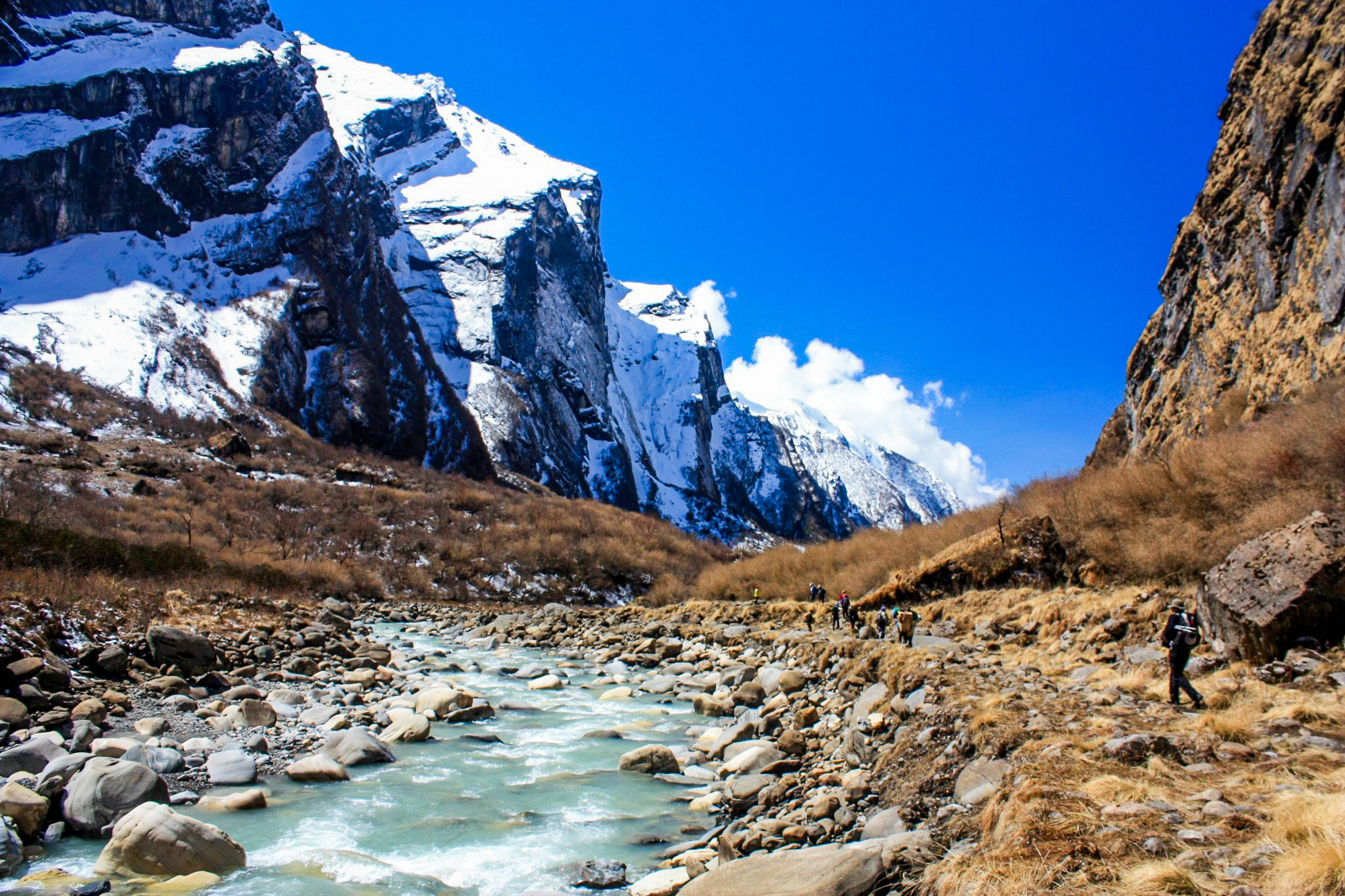
It’s a longer day today as we walk above 9,845ft (3,000m). The trail continues up through the forest, passing the lodges at Himalaya Hotel. The trail gets steeper and rockier from here as we climb up past Hinko Cave, where the first expeditions to the basecamp used to spend the night. Crossing a ravine, the trail continues to climb steeply among boulders, leaving the trees behind us. We have lunch at Deurali and from here the valley broadens and the scenery becomes wilder as we approach the gates of the sanctuary.From Deurali, there are two trails. The one on the left side of the valley is the main trail but when there is a lot of snow (especially in spring) it is not used and an alternative trail on the right side of the valley is used. Your leader will decide which to take. Both meet for the last 1hr 30min climb up between the heights of Hiunchuli and Machhapuchhare to Machhapuchhare Base Camp (12,140ft/3,700m), where we spend the night. The views are stupendous and the panorama includes Huinchuli, Annapurna 1, Annapurna 3, Gangapurna and Machhapuchhare.
Meals: Breakfast
Day 9
Explore the high alpine wilderness of the Annapurna Sanctuary. Stay at Annapurna Base Camp
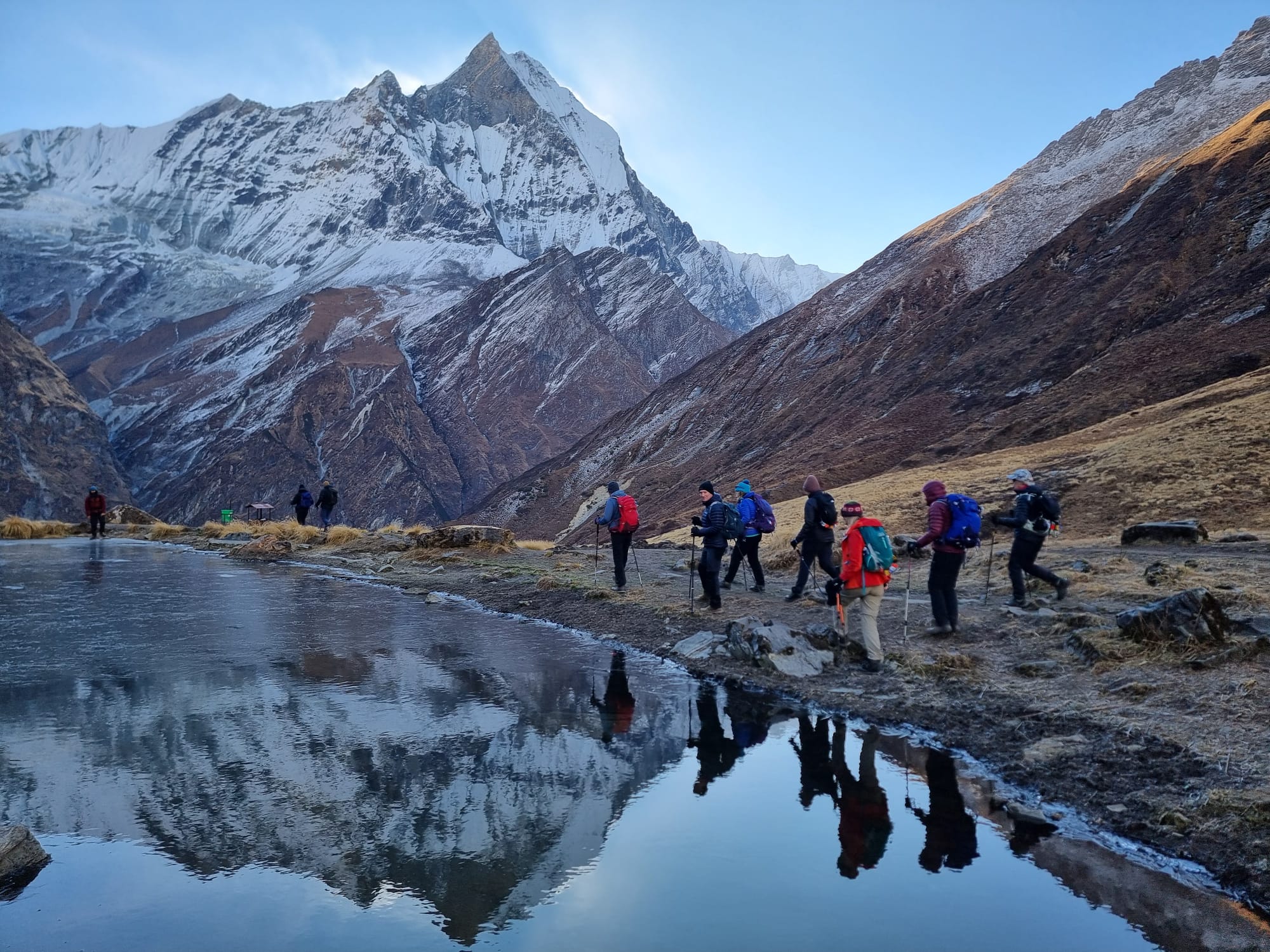
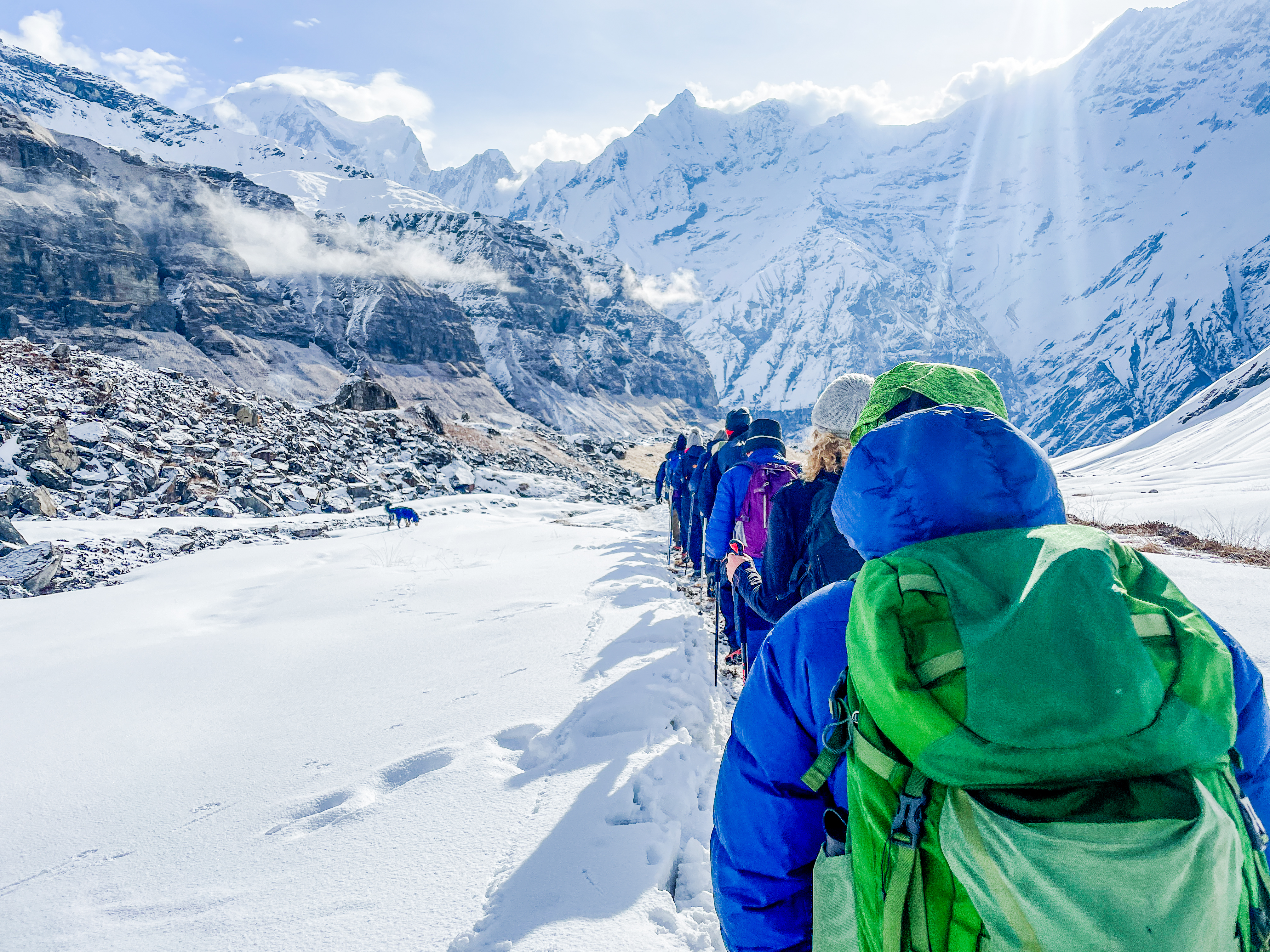
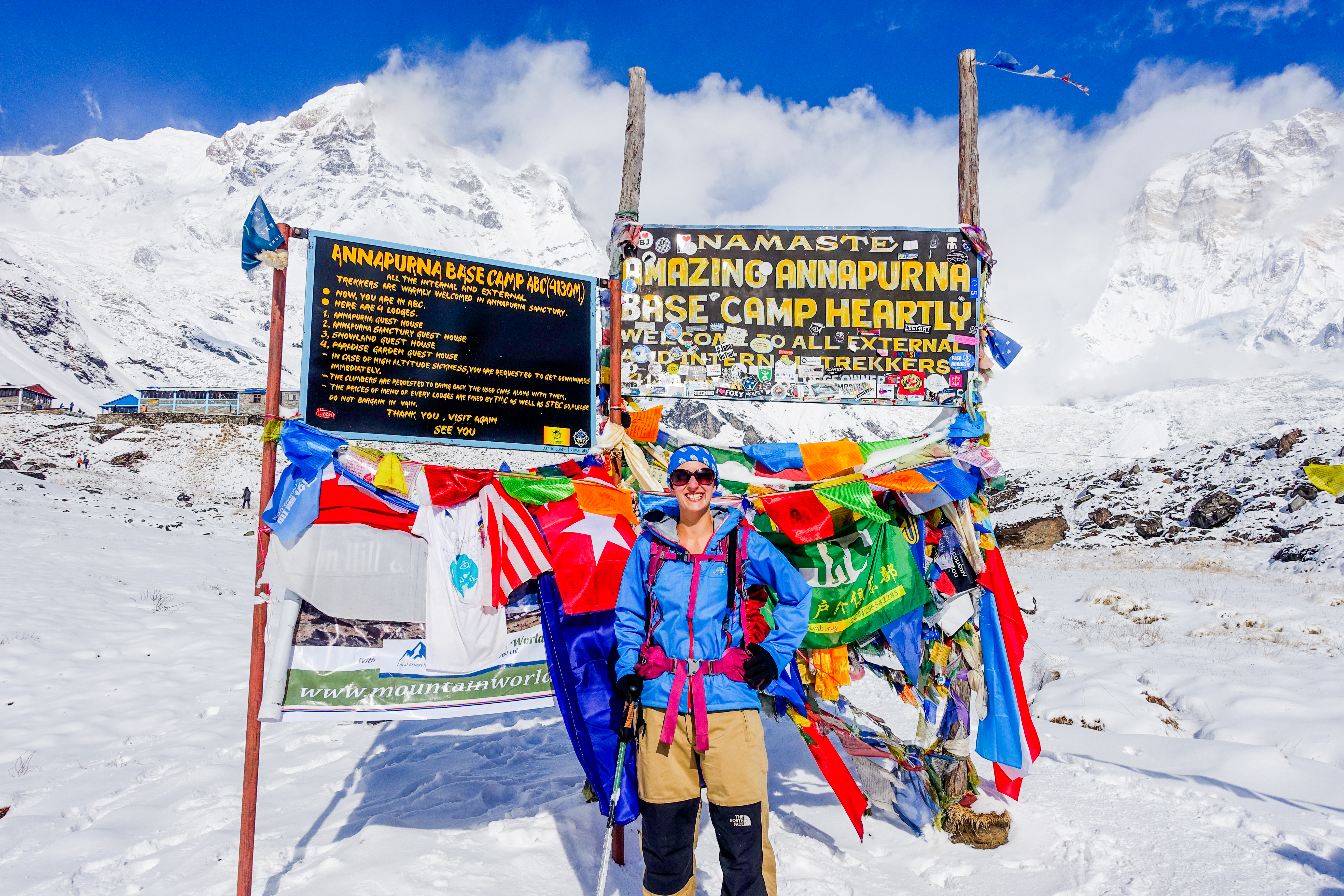
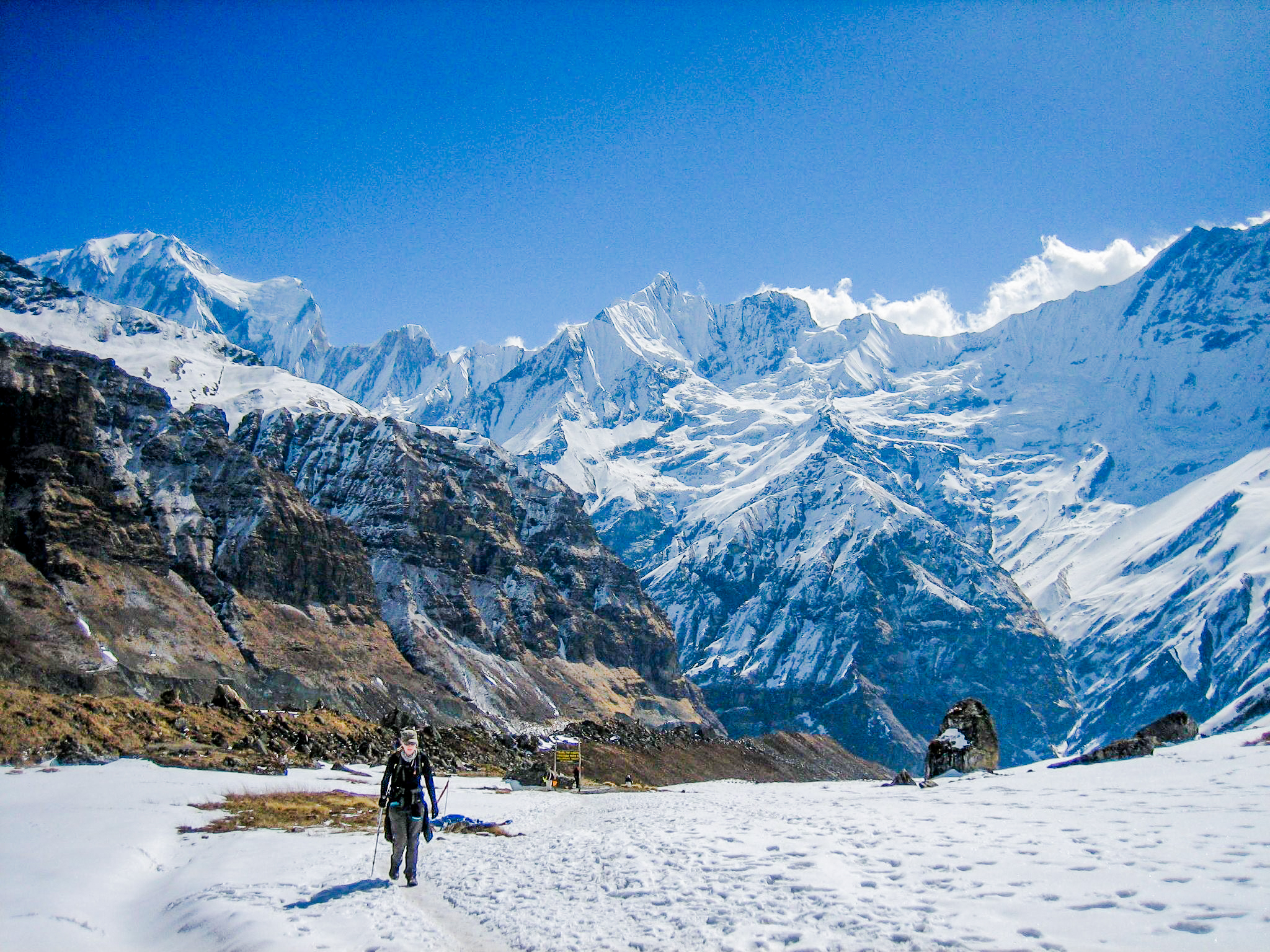
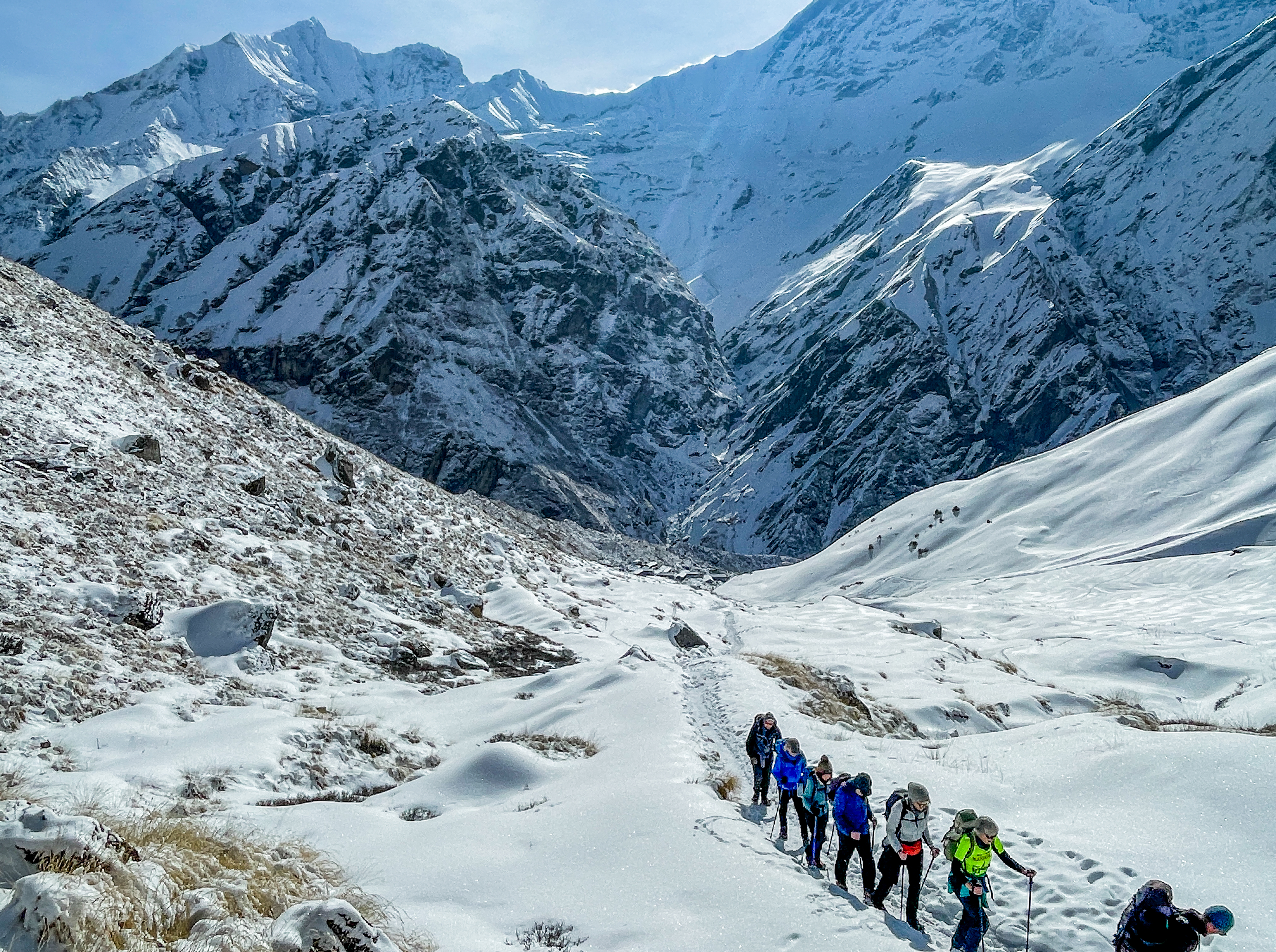
In the early morning, we walk for two hours up to Annapurna Base Camp (13,550ft/4,130m), surrounded by the snow-capped peaks of some of the highest mountains in the world. Hiunchuli, Annapurna South, Annapurna Fang, Annapurna 1 and 3, Gangapurna and Machhapuchhare all encircle us with unbroken soaring ramparts but for the route by which we entered. The sunset and sunrise are truly magnificent in this mountain arena.We spend the day in this special place with a chance to watch sunrise tomorrow. There should be time to make an excursion to the ridge overlooking the basecamp from which Sir Chris Bonington led the ascent of Annapurna’s South Face. (Occasionally there is too much snow to stay at Annapurna Base Camp. In this case, we walk back down to Machhapuchhare Base Camp in the late afternoon).
Meals: Breakfast
Day 10
Descend back down the valley to Bamboo
It’s a long and mostly downhill day as we leave the Sanctuary. We follow the same trail back to Machhapuchhare Base Camp and further down to Deurali. Entering the forest, we descend slowly and carefully on a rocky trail through Himalaya and Dobhan back to the lodge at Bamboo.
Meals: Breakfast
Day 11
Ascend and descend stone steps to Chhomrong. Descend steeply through terraces to Jhinnudanda
We have a rollercoaster walk today with lots of ups and downs. We start with a climb up to Sinuwa, then we descend to the river and climb back up the stone steps to Chomro. A final steep descent on stone steps brings us to Jhinnudanda. There are nearby hot springs you can visit if you wish; getting there involves descending for 20 minutes or so down to the river, and the climb back up takes a little longer (around 30 minutes).
Meals: Breakfast
Day 12
Trek to Sinwai; drive to Pokhara
The trail today undulates down the Modi River valley. We follow the valley down to the road head at Sinwai. If the road is in good condition, we pick up our transport here (sometimes our vehicle cannot get to here) and drive back to Pokhara. If we have to walk to Birethanthi this will add an additional three hours (6mi/10km).
Meals: Breakfast
Day 13
Free day in Pokhara
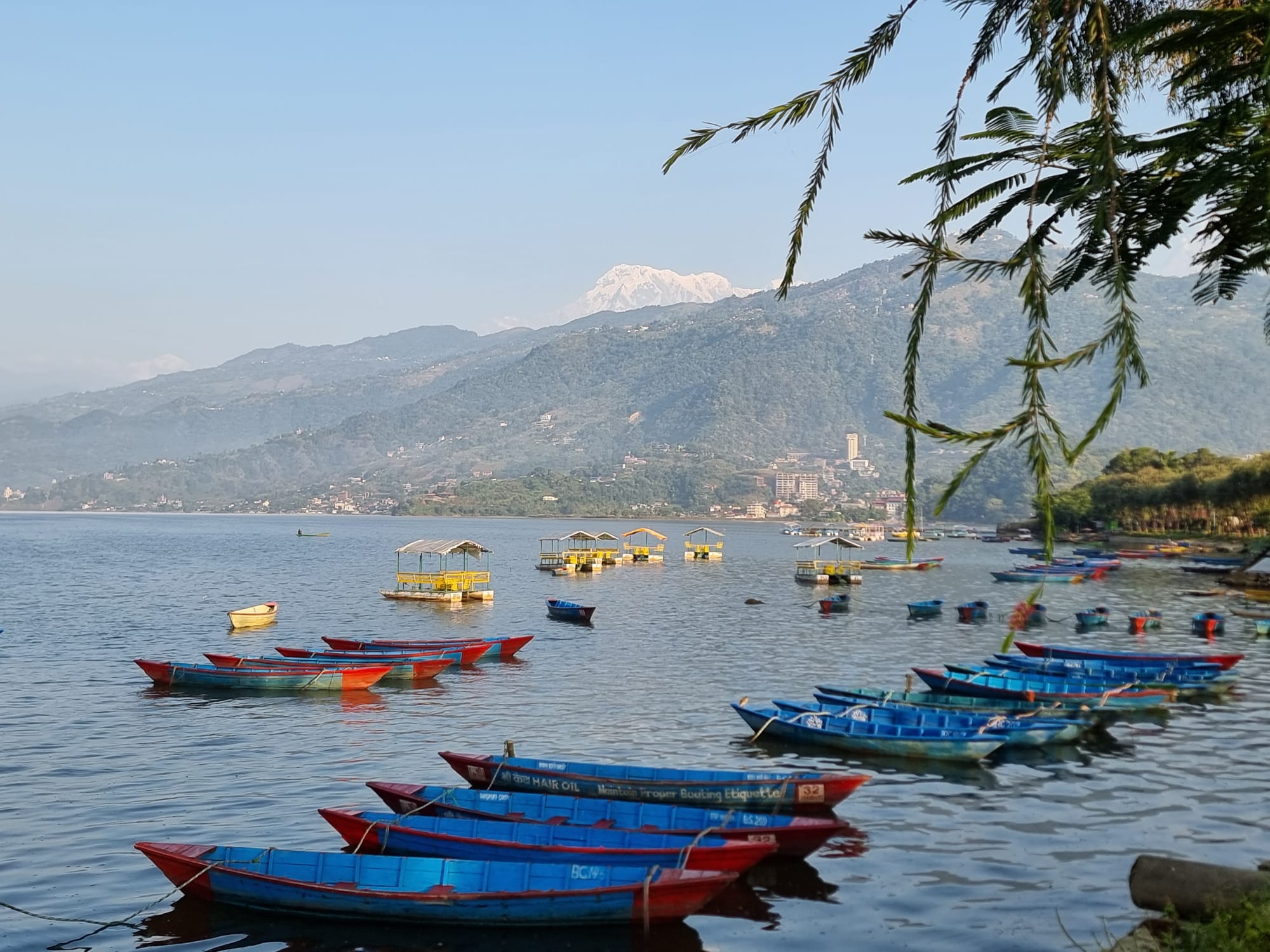
Enjoy a full day to relax in Pokhara. There are plenty of cafes and restaurants along the lakeshore where you can watch paragliders in flight. You may wish to take a rowing boat across Lake Phewa and walk up to the hilltop World Peace Pagoda for fantastic views of the lake. There are also plenty of shops and a traditional bazaar where you can pick up souvenirs. Alternatively, there are several museums to visit, including the International Mountain Museum and the Gurkha Museum.
Meals: Breakfast
Day 14
Fly to Kathmandu
We fly to Kathmandu. If the weather plays nicely, we can have good views of the western end of Nepal on this flight.The afternoon is free for sightseeing. You may wish to visit the monkey temple at Swayambhunath, one of the largest Buddhist stupas in the world at Boudhanath, or the most important Hindu temple in the valley at Pashupatinath.
Meals: Breakfast
Day 15
Adventure ends in Kathmandu
You’ve trekked through magnificent landscapes, explored the Annapurna Sanctuary and stayed at basecamp; but today, the tour comes to an end, so it’s time to start your return journey home.
Alternatively, swap mountain trails for animals tracks by joining our add-on safari tour in Chitwan. Speak to your sales representative to book.
Meals: Breakfast
What’s included
What’s not included
Additional information
Food
The breakfasts on trek are fixed set menus, usually porridge or muesli with either toast, chapatti or pancake, plus an egg or omelette and a cup of tea/coffee. You may also be able to supplement your included breakfast with additional items on the teahouse menu should you wish. Items not included should be ordered and paid for separately.
Please note, some more remote teahouses/lodges are unable to provide an extensive menu due to irregular delivery schedules and during periods of bad weather or a high volume of trekkers, there may be a more limited menu choice. Also, the higher altitude the more expenses the menus and extras generally are.
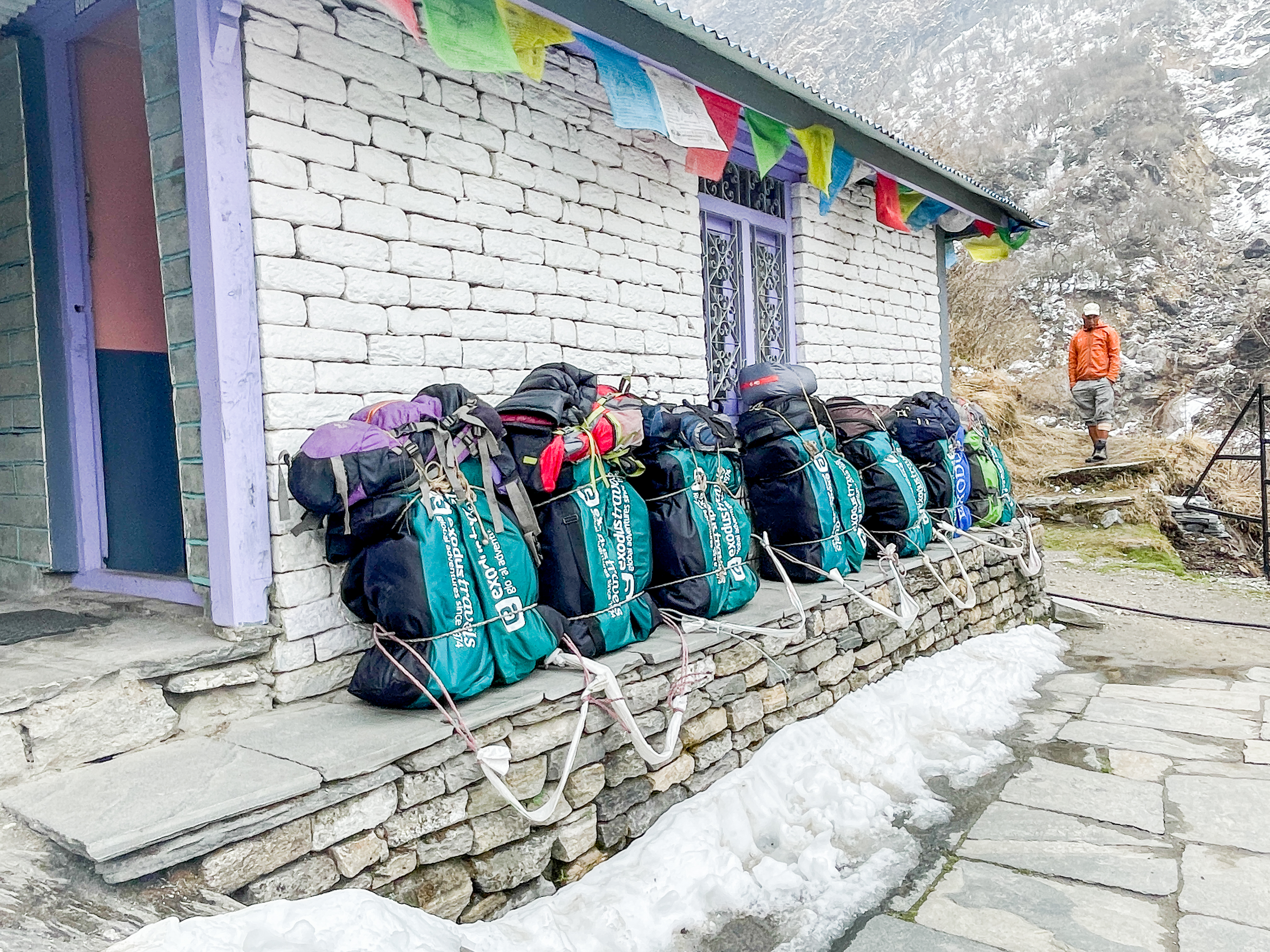
We do not include lunch and dinner on trek allowing you to choose what you want to eat. Lunch will be taken at a teahouse en route – sometimes one of your guides will go ahead with the group’s order to make it more expedient. Dinner will be in the same teahouse that you sleep at (this is custom in Nepal as teahouses base their room rate on it).
The menus in the lodges are almost identical to one another but offer a varied choice, ranging from traditional Nepalese dhal bhat to pizza and apple pie. Dhal bhat is the staple diet in Nepal and comes in many different forms but generally comprises curried lentils and meat or vegetables, rice, and a pickle/chutney. Another popular snack is momos, a type of Nepalese dumpling, fried or steamed and filled with meat or vegetables.
Meat is available in the teahouses but we advise against eating it on trek. The meat has often been carried in the heat from lower altitudes for several days before reaching the lodges and can cause stomach upsets or illness. Germs can also be spread by handling dirty money – we recommend using hand sanitiser.
If you have a gluten-free diet, we strongly recommend you bring extra food and snacks with you to supplement the food on trek as there will be little variety available to you, particularly for breakfast. Even many of the soups are from powder/packets and contain gluten.
If you buy imported food and drink on trek you will spend more than the suggested amount.
Drinking water
Staying hydrated is important when undertaking any physical activity but particularly so at altitude where it is generally recommended to drink at least 100floz to 135floz (three litres to four litres) per person per day.
However, we strongly encourage you not to buy bottled water on trek as this contributes to the growing problem of plastic pollution in the trekking areas of Nepal.
After Chomrong, the lodges sell filtered safe drinking water (no plastic bottles are allowed).
The teahouses also sell boiled water for approximately 150-300 rupees (US$1.15-US$2.30) per litre (the price increases the higher you trek) which should not require treating. This is also perfect for a bedtime refill as it can double up as a hot-water bottle.
Alternatively, all teahouses provide free cold water. Although this should not be drunk untreated, we recommend you bring a reusable bottle/water bladder/Camelpak (ideally two) and use an effective form of water treatment. There are a wide range of products available including Steripens or purification tablets, which are the quickest and easiest options to use on trek – we recommend talking to an outdoor retailer for the latest advice as technologies are improving all the time. Make sure to check the product’s performance in cold/freezing conditions and consider battery life (lithium batteries are best in cold conditions).
Exodus has partnered with Water-to-Go, a filtration system that eliminates more than 99.99 percent of all microbiological contaminants from any non-saltwater source – visit Water-to-Go for more information. Exodus customers can claim 15 percent off their first order and, better still, 15 percent of the purchase value will be donated to the Exodus Travels Foundation. These bottles filter the water as you drink through the spout may not be the most efficient while on the go on a trek. Please note, if the water freezes it will clog up the filter. In this event, defrost before use by sitting the filter in lukewarm water for 10-15 minutes.
Annapurna Sanctuary & Base Camp Overnight
Enter the heart of the Himalaya and step into the vast bowl of the Annapurna Sanctuary. Spend the night at Annapurna Base Camp (4,130m), where the snowbound cirque rises on all sides and sunset and sunrise wash the rock and ice in soft gold and rose.
Circle your gaze from Annapurna I to Annapurna South, the Fang and Gangapurna, with the sacred, unclimbed Machhapuchhare guarding the approach. This is storied ground—expedition history whispers from the surrounding ridges—yet the prevailing feeling is quiet awe amid towering walls of ice.
Welcome Nepalese Dinner & Trek Briefing in Kathmandu
Meet your group and meet your tour leader for a friendly introduction to the adventure ahead, followed by a convivial group trek briefing. Settle into the rhythm of Nepal while sharing a traditional Nepalese dinner featuring classic flavours such as momo dumplings and aromatic spices, with the lively Thamel district close at hand.
Hear practical guidance on altitude awareness, trail etiquette and teahouse customs, ensuring you feel prepared and supported. The evening’s warm tone captures the essence of mountain hospitality, turning a first night in the city into part of the Himalayan experience.
Jhinu Danda Natural Hot Springs
Descend stone steps to soak in the natural hot springs by the Modi Khola at Jhinu Danda. The riverside pools sit beneath forested slopes, where steam mingles with birdsong and the rush of glacial meltwater.
Locals prize the mineral-rich warmth for easing trail-weary muscles after big ascents and descents. Entrance fees apply; this experience is at additional cost and bookable on tour, with your leader coordinating timing from the nearby village.
Ghorepani Ridge Trek via Rhododendron Forests
Walk steady switchbacks to ascend through rhododendron forests, sharing the trail with colourful mule caravans and crossing airy footbridges. Emerging at Ghorepani, the landscape opens to a sweeping balcony where stone rooftops perch beneath serrated horizons and the air carries the scent of high mountain pine.
From this vantage, trace the silhouettes of Himalayan giants—Dhaulagiri, Annapurna and Machhapuchhare—as the skyline reveals the immense scale of the range. The day’s climb over stone staircases rewards with wide-angle panoramas and a first taste of the Sanctuary’s grandeur.
Machhapuchhare Base Camp Approach Hike
Follow the Modi Khola high into glaciated country, passing the overhang of Hinko Cave and boulder-strewn slopes as you press toward the gates of the sanctuary. Crest the final rise to Machhapuchhare Base Camp (3,700m), where frost-crisp air and a close ring of peaks signal your arrival in true alpine terrain.
The ramparts of Hiunchuli, Gangapurna and Annapurna III frame the valley while the sacred, fish-tailed Machhapuchhare dominates the skyline. The setting feels intimate yet immense—an ideal prelude to the Sanctuary’s inner amphitheatre.
Chhomrong Gurung Village Visit & Modi Khola Valley Views
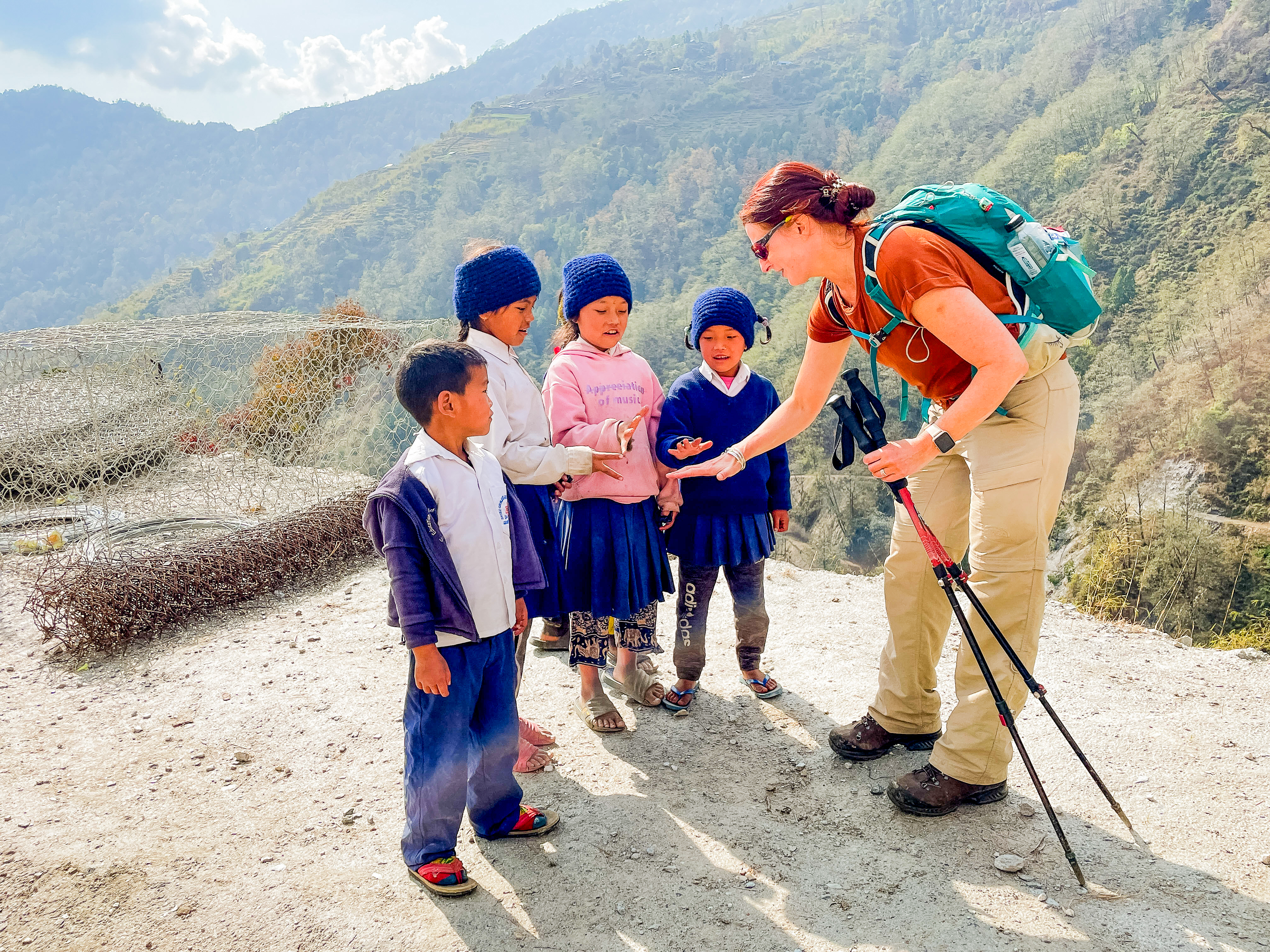
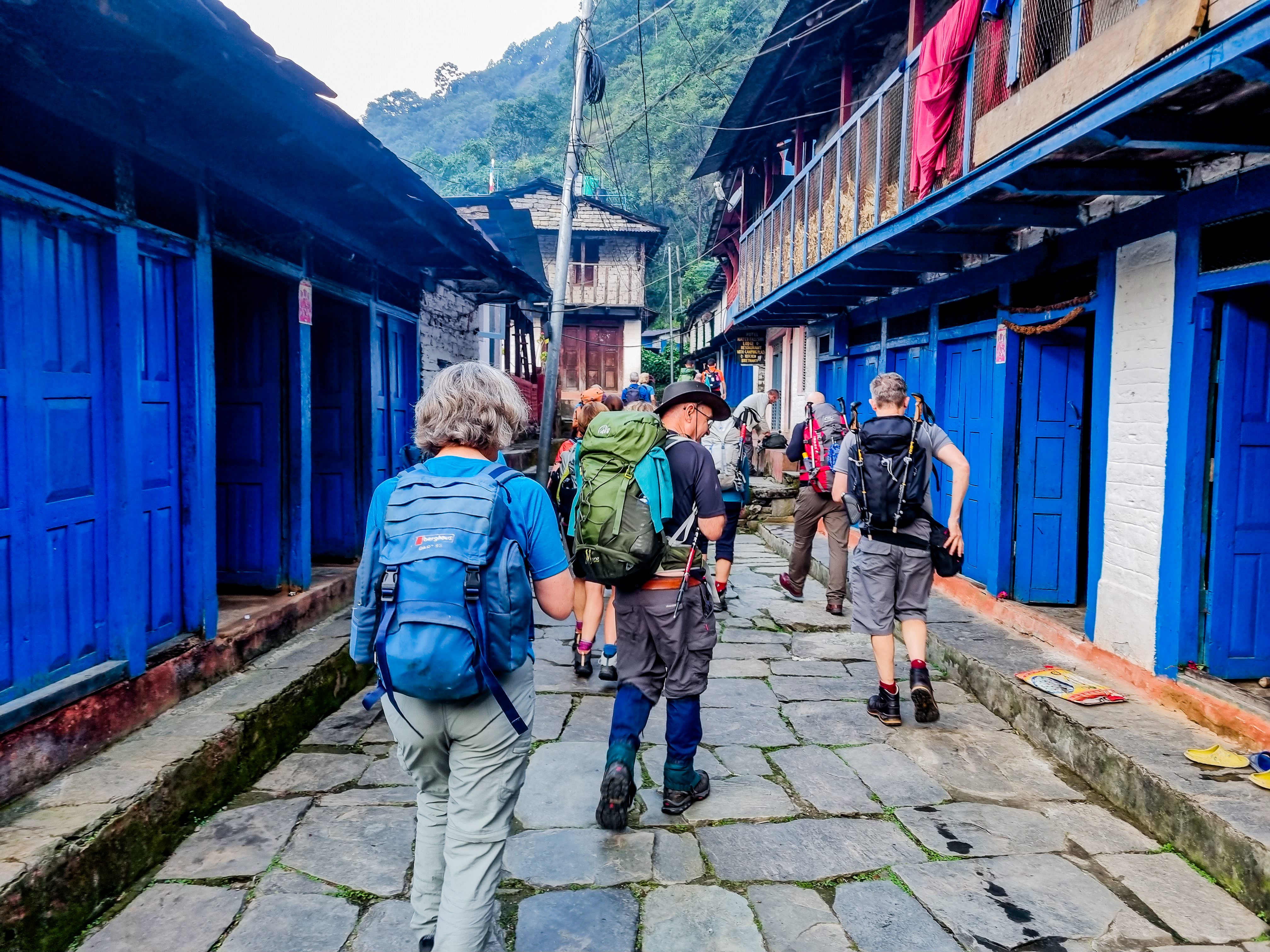
Explore Chhomrong, a classic Gurung village strung along a ridge above the Modi Khola Valley. Stone lanes, slate roofs and neat terraces frame head-on views of Annapurna South and Machhapuchhare, while friendly lodge verandas offer the perfect pause to watch daily life unfold.
Learn how seasonal herders use simple high pastures and yersas, and appreciate the Gurung reputation for warmth and mountain resilience. The village’s setting—clinging to steep, stepped fields—epitomizes human harmony with Himalayan topography.
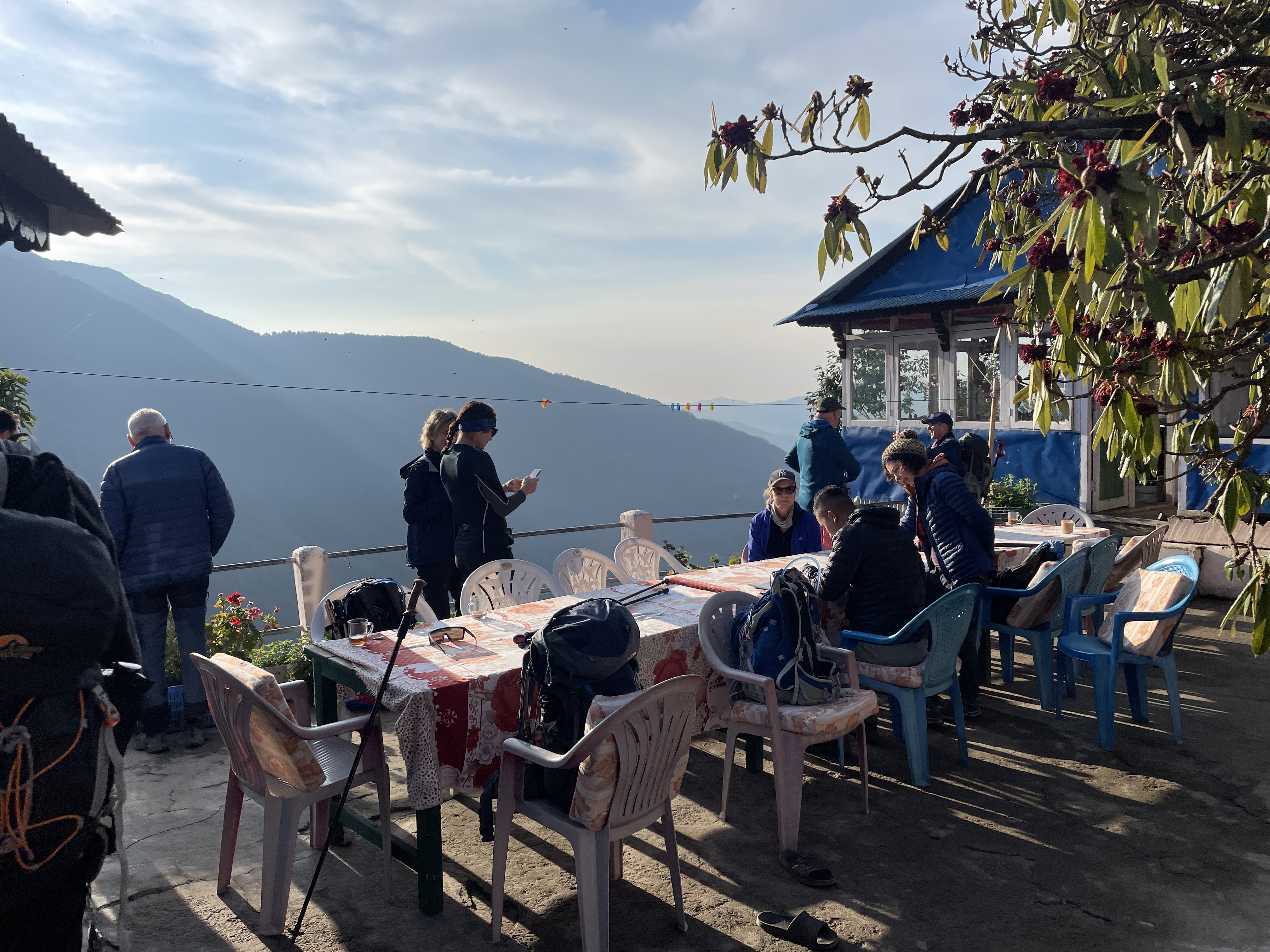
Himalayan Teahouse Stays & Mountain Hospitality
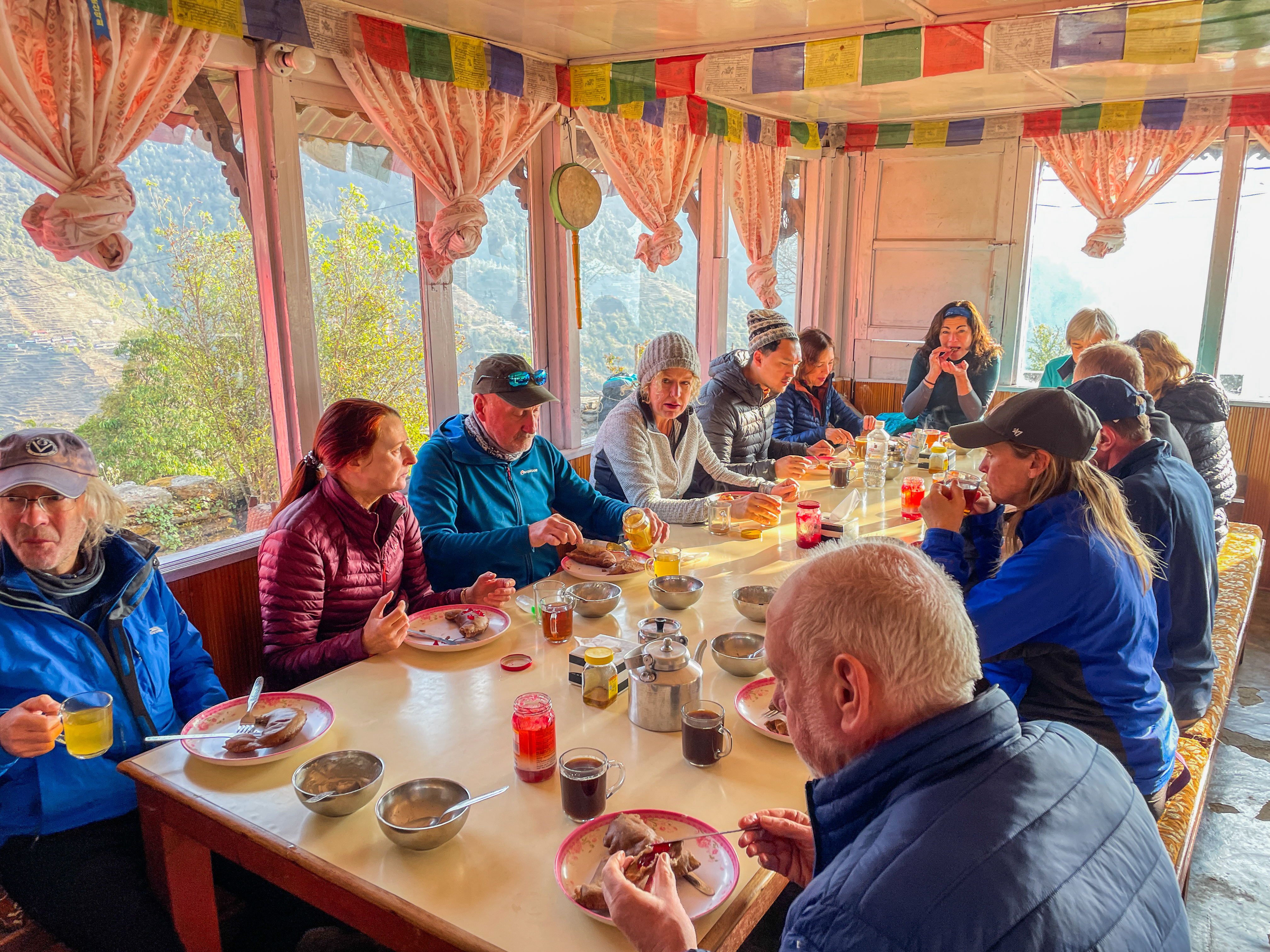
Experience the culture of the trail by staying in traditional teahouses, where trekkers gather around a warm stove-heated dining room to swap stories. Simple rooms, thick blankets and the aroma of spiced tea create a comforting refuge after days on stone steps and forest paths.
Menus showcase hearty staples—think dal bhat and vegetable curries—alongside trekkers’ favourites. Solar-lit rooms, local crafts and community-run lodges reflect sustainable mountain hospitality, turning each overnight into a cultural encounter as much as a rest stop.
Poon Hill Sunrise Viewpoint
Set out on an optional pre-dawn hike to Poon Hill (3,210m), a famed ridge above Ghorepani. As first light spills over the middle hills, watch sunrise over Dhaulagiri and the Annapurnas, with cloud seas and distant ridgelines glowing in pastel hues.
The panorama stretches from Nilgiri to Machhapuchhare, a sublime lesson in Himalayan scale and geometry. This experience is at additional cost and bookable on tour; your leader will advise on timing, weather and local permit checks.
Warm-Up Hike to Tomijung Gurung Village
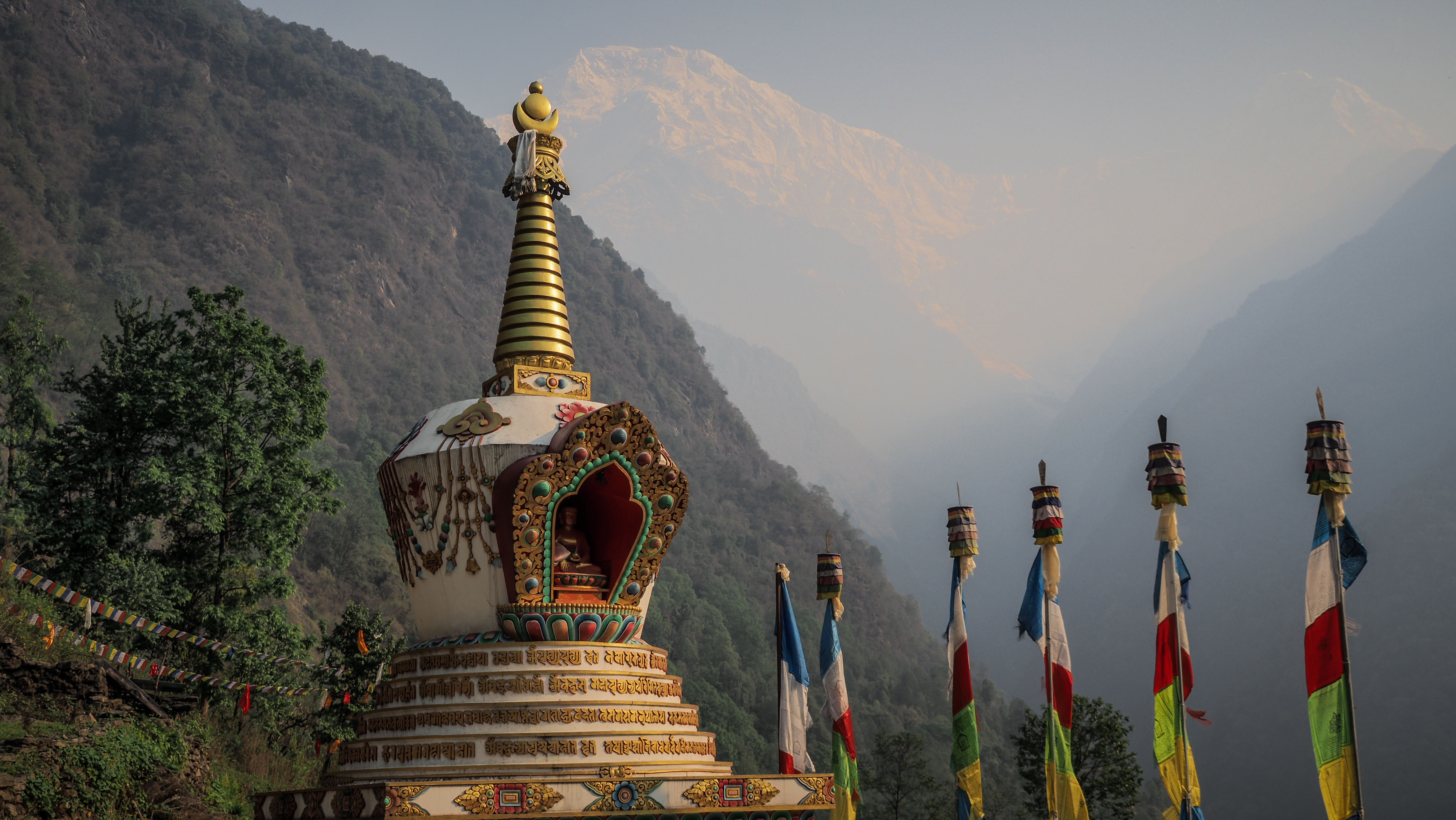
Stretch your legs on an optional warm-up hike to Tomijung, a small Gurung hamlet set amid terraced hillsides and cardamom groves. Pass chortens and prayer flags while taking in first glimpses of the fishtail peak on clear days.
Learn about traditional architecture, seasonal farming and village rhythms that sustain life along the foothills. This experience is at additional cost and bookable on tour, ideal for easing into trail pace before the longer ascents.
Lake Phewa Rowing & World Peace Pagoda Walk
Glide across Pokhara’s mirror lake as you row across Lake Phewa, then climb a forested path to the hilltop World Peace Pagoda. From the stupa terraces, admire the snowy Annapurna range reflected on the water far below.
The Shanti Stupa’s gleaming white dome invites quiet reflection, while prayer flags flicker in lake breezes. Boat hire and entrance donations apply; this experience is at additional cost and bookable on tour.
Pokhara Museums: International Mountain Museum & Gurkha Museum
Delve into the lore of Himalayan climbing at the International Mountain Museum, then trace Nepal’s proud martial story at the Gurkha Museum. Exhibits explore Himalayan mountaineering feats, Sherpa culture, equipment evolution and the military heritage of the Gurkhas.
See expedition artifacts, early ice axes and oxygen sets, then view regimental colours and personal stories spanning global campaigns. Museum entries are at additional cost and bookable on tour.
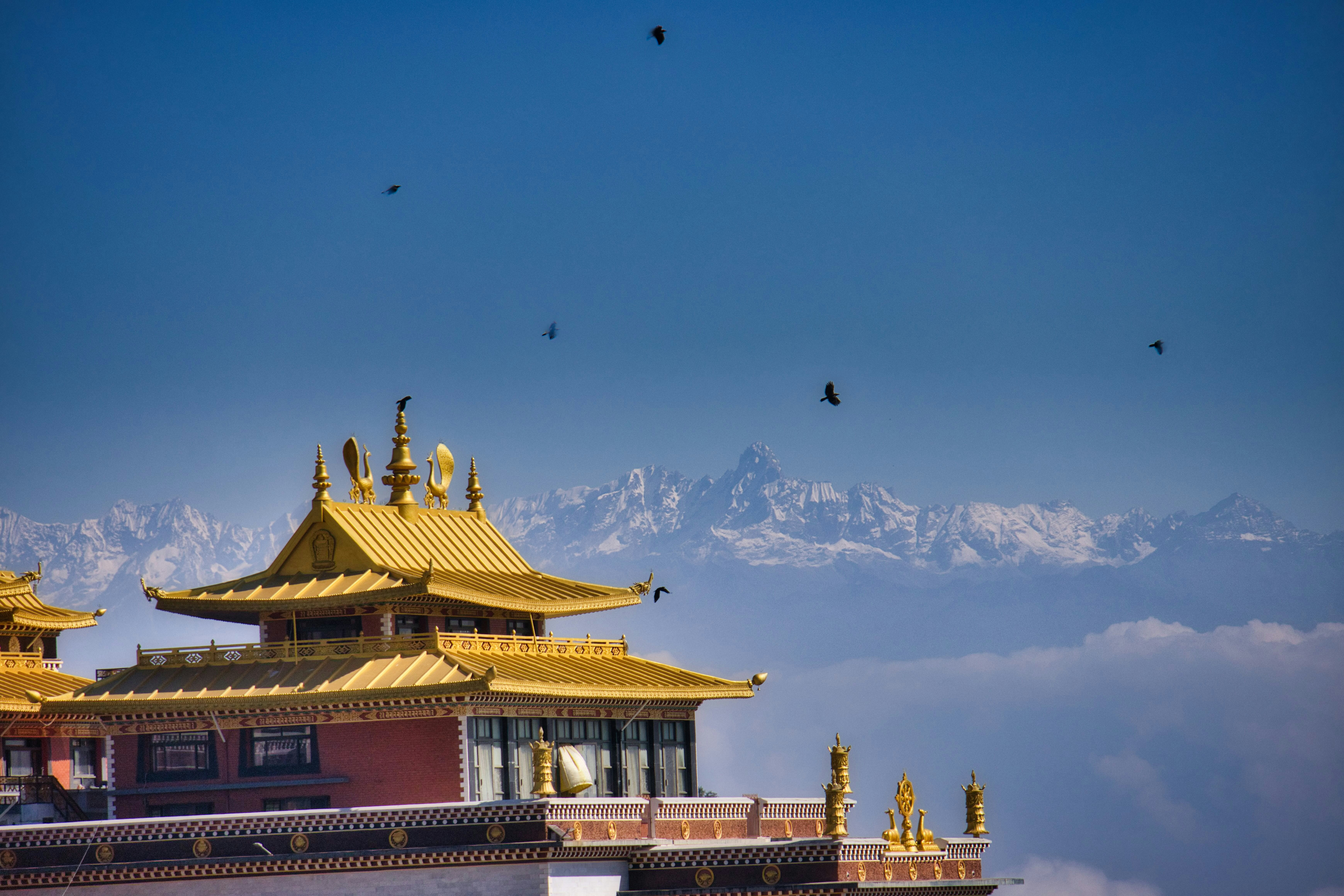
Kathmandu Heritage Tour: Swayambhunath, Boudhanath & Pashupatinath
Join a guided heritage tour to three UNESCO landmarks: hilltop Swayambhunath with its resident monkeys, the vast mandala of Boudhanath Stupa, and the sacred Pashupatinath Temple on the Bagmati River.
Explore layers of Buddhist and Hindu devotion—prayer wheels turning, butter-lamp glow and saffron-robed sadhus—while learning about Newar craftsmanship and cremation rites conducted on ghats. This experience is at additional cost and bookable on tour.