
Your itinerary
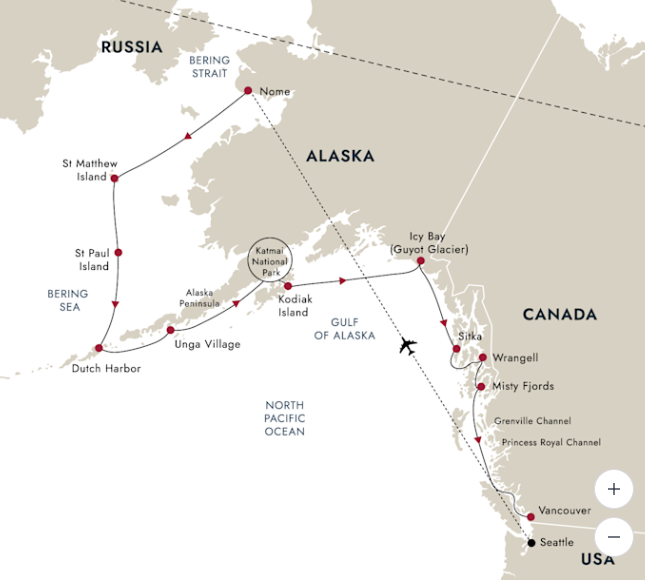
Day 1
Seattle, Washington
Arrive and overnight in Seattle. Explore Olympic Sculpture Park and Pike Place Market; optional Pre-Programme to regional natural highlights.
Day 2
Nome, Alaska
Fly from Seattle to Nome to begin the expedition. Explore Gold‑Rush history with artifacts such as dredges and steam engines, and note Roald Amundsen’s polar‑expedition links.
Day 3
Crossing the Bering Sea
Sea day and exploration along the Bering Sea. Watch for puffins, auklets, murrelets and the rare Red‑legged Kittiwake; join Science Centre talks or relax in the Explorer Lounge & Bar, infinity pool and hot tubs.
Day 4
St. Matthew Island, Alaska
Remote island with towering sea cliffs hosting nesting murres, kittiwakes and cormorants. Noted by the 1899 Harriman Expedition and later protected; hear the WWII‑era reindeer introduction story and their disappearance.
Day 5
Saint Paul Island, Alaska
Visit the only residential area in the Pribilofs, with Russian fur‑trader history and a Russian Orthodox church. In summer, look for ~500,000 northern fur seals and millions of seabirds, including tufted puffins.
Day 6
Crossing the Bering Sea
Crossing the Bering Sea.
Day 7
Dutch Harbor, Alaska
Sail past Mount Makushin. Explore Unangax̂ culture at the Museum of the Aleutians, visit the Russian Orthodox Cathedral and WWII museum, and watch for Bald Eagles, puffins and marine mammals in America’s largest fishing port.
Day 8
Unga Island, Alaska
Nature landing at the abandoned Unga Village (settled 1833, abandoned 1969). See weathered wooden buildings amid wildflowers along a remote shoreline.
Day 9
Kujulik Bay, Alaska
Explore secluded bays and inlets along the Alaska Peninsula by expedition boat. Scout for bears, Bald Eagles, sea otters and humpback whales while learning about the region’s geology.
Day 10
Geographic Harbor, Alaska
Enter Katmai National Park’s volcano‑studded coast to look for brown bears from deck or small boats. Depending on conditions, visit Geographic Harbor, Kinak Bay or Kukak Bay.
Day 11
Uyak Bay, Kodiak Island, Alaska
Cruise Kodiak’s ‘Emerald Isle’ of forests, mountains and wetlands. Watch for whales, sea otters, seals and, with luck, Kodiak brown bears within the Kodiak National Wildlife Refuge.
Day 12
Seward, Alaska
Day at sea across the Gulf of Alaska. Enjoy onboard facilities and Science Centre lectures; watch for Laysan, Black‑footed and the rarer Short‑tailed Albatross.
Day 13
Cruising Icy Bay
Explore Icy Bay among the Guyot, Yahtse and Tyndall glaciers by small boats or kayak, conditions permitting. Admire Mt St Elias and look for humpbacks, orcas, sea otters and harbour seals.
Day 14
Sitka, Alaska
Arrive amid Tongass National Forest with views of the Sisters Mountains and Mount Edgecumbe. Visit the Russian Orthodox cathedral and Russian Bishop’s House, see totem poles at Sitka National Historical Park, and enjoy a coastal forest walk.
Day 15
Wrangell, Alaska
Discover one of Alaska’s oldest harbour towns, homeland of the Lingít people. See the local museum, Chief Shakes Tribal House and totem poles on Shakes Island; view ancient carvings at Petroglyph Beach and hike nearby nature trails.
Day 16
Misty Fjords National Monument, Alaska
Weather permitting, explore by small boats or kayaks amid evergreens, waterfalls and snowcapped peaks. Scan for mountain goats, black and brown bears, moose, salmon, otters, Steller sea lions, harbour seals, orcas, Dall’s porpoises, herons and Bald Eagles.
Day 17
Sailing the Canadian Inside Passage
Cruise lesser‑travelled channels of the Inside Passage fjordlands aboard a small expedition ship. Keep watch for humpback, fin and minke whales, and possible orcas.
Day 18
Vancouver, British Columbia
Disembark in Vancouver. Stroll Gastown and Stanley Park or sample diverse cuisine in Chinatown, Punjabi Market or Little Italy before onward travel.
What’s included
What’s not included
Additional information
Bering Sea Day at Sea: Seabird Watch & Expedition Briefings
Settle into expedition rhythm on day 3 as we cross the Bering Sea and scan the wake for albatross and fulmars. Wrap up warm on deck to watch storm petrels stitch the wind while dolphins and whales occasionally surface alongside the ship.
Between sightings, your team may host short talks introducing Bering Sea currents, Indigenous lifeways, and navigation routes from Siberia to Alaska. Expect practical insights on photography and wildlife etiquette so you can enjoy a free afternoon outdoors with sharper eyes and a steadier lens.
St. Matthew Island Seabird Cliffs by Small Boat
Weather and permits allowing on day 4, we explore by small expedition boat beneath St. Matthew’s thousand-foot sea cliffs where murres, kittiwakes, and cormorants wheel and cry overhead. Black-sand beaches and wave-carved headlands reveal the island’s stark, unpeopled beauty.
Declared part of one of America’s first wildlife refuges in 1909 after the Harriman Expedition’s reports, St. Matthew is a living field lab. Hear the curious tale of the island’s reindeer boom and crash and how biologists still monitor ecosystem shifts in this remote Bering outpost. It’s raw, elemental nature up close, with time to pause for photos and reflection amid the surf and birdsong.
St. Paul Island Wildlife Rookeries & Russian Orthodox Heritage
On day 5, step ashore on the largest of the Pribilofs to visit northern fur seal rookeries and turf-fringed cliffs alive with tufted puffins and auklets. The wind carries salt and seabird calls as naturalists interpret life in the middle of the Bering Sea.
In town, explore the island’s human story from the 1780s arrival of Russian traders to the present-day Unangan community. We’ll visit the Russian Orthodox church, a National Historic building, and learn how faith, language, and subsistence culture endure in this isolated setting. Expect ample time to pause for photos and reflection along the basalt shore.
Aleutian Crossing: Volcano Vistas & Naturalist Talks
Day 6 brings ocean miles and big-sky views of the Aleutian volcanic arc. Keep watch for orcas, Dall’s porpoises, and shearwaters as the ship threads the North Pacific’s meeting place of currents.
Between deck time, join your team for short sessions on plate tectonics, island biogeography, and Aleut culture to deepen what you’re seeing on the horizon. As the light shifts across far-off cones and mist, you’ll enjoy a free afternoon to absorb the scale of Alaska’s rim of fire.
Dutch Harbor Cultural Heritage Tour & WWII Sites
Arriving on day 7, we explore Unalaska’s working waterfront and visit the Museum of the Aleutians to meet the Unangax^ story firsthand. Then step into the onion-domed Russian Orthodox Cathedral of the Holy Ascension, one of Alaska’s oldest churches, set against a backdrop of green hills.
Continue to WWII sites commemorating the 1942 Aleutian campaign, when the war briefly reached U.S. soil. Overhead, scan for bald eagles; at sea, watch for sea lions and whales patrolling the passes. The day reveals a layered port—Indigenous, Russian, American—where fishing boats and history share the same harbors.
Unga Island Abandoned Village Nature Landing
Conditions permitting on day 8, we land by small boat at Unga Village, an Unangax^ settlement founded in 1833 and abandoned in 1969. Wander among weathered timber houses as pink lousewort and fireweed reclaim boardwalks and fences, and the surf rolls over kelp-strewn stones.
Guides outline the region’s fishing economy and why families left, while you pause for photos and reflection beside skiffs long surrendered to the elements. The island’s silence—broken only by wind and gulls—brings the story of settlement and departure into sharp, memorable focus.
Kujulik Bay Zodiac Exploration & Bear Scouting
On day 9, join the Expedition Team to thread hidden coves by small boat along the Alaska Peninsula. Scan pebble beaches and sedge meadows for coastal brown bears, while bald eagles ride thermals above volcanic ridges.
Learn how the Peninsula’s raw topography—fjorded coasts, ash-layered soils, and mountain chains—was sculpted by ice and fire. The experience balances quiet wildlife tracking with moments to pause for photos and reflection in a landscape that feels unchanged since the last glacial retreat.
Katmai Geographic Harbor Bear Viewing by Small Boat
Day 10 brings us into Katmai National Park, where we scout for brown bears along tide flats and creek mouths in Geographic Harbor or neighboring bays. Watch for bears digging for clams and chasing salmon while kittiwakes and terns hover above the action.
Your guides connect today’s sightings to Katmai’s volcanic past, from the 1912 Novarupta eruption to the Valley of Ten Thousand Smokes. With over 2,000 protected bears, Katmai offers rare scale and intimacy—experienced at a respectful distance—before we return to the ship and enjoy a free afternoon with the park’s peaks on the horizon.
Uyak Bay, Kodiak Island: Fjords & Marine Wildlife Search
On day 11, we navigate Uyak Bay to look for humpbacks, sea otters, and harbor seals against steep spruce-clad slopes. Keep an eye on sedge flats and river mouths for the island’s emblematic Kodiak brown bears, the largest of their kind.
Hear how Alutiiq communities have lived with this landscape and how the Kodiak National Wildlife Refuge safeguards two-thirds of the archipelago. The blend of culture, conservation, and crisp marine air sets a contemplative tone as you pause for photos and reflection among mirror-calm fjords.
Gulf of Alaska Sea Day: Science Center Talks & Albatross Watch
Crossing the Gulf of Alaska on day 12, join the team in the Science Center for engaging talks on geology, glaciology, and wildlife. Learn to identify at-sea species before heading to the rail to scan for Laysan, black-footed, and short-tailed albatross arcing across the swells.
This is time to refine your naturalist’s eye, compare notes with fellow travelers, and enjoy a free afternoon as the ship traces a legendary coastline where mountains drop straight to the Pacific.
Icy Bay Glacier Front Cruising & Kayaking
On day 13, we cruise beneath the faces of Guyot, Yahtse, and Tyndall Glaciers, navigating past brash ice and bergy bits. Conditions allowing, join the team to paddle a kayak or board small boats for an eye-level perspective where seals rest on floes and otters roll in kelp.
Far above, the jagged massif of Mt. St. Elias rises dramatically from sea to 18,000 feet, illustrating the region’s extreme vertical relief. The thunder of calving ice and the crisp scent of glacial air make this a highlight of the Gulf—perfect for a final pause for photos and reflection before we turn south.
Sitka Cultural Walk: Totem Park & Russian Bishop’s House
Arriving on day 14, set out on foot to join a guided walking tour through Sitka’s layered history. Admire Haida and Lingít totem poles at Sitka National Historical Park and follow a rainforest trail where salmon streams meet the ocean.
Continue to St. Michael’s Cathedral and the meticulously restored Russian Bishop’s House to understand how Tlingit, Russian, and American eras shaped the town. With mountains and the Tongass as a constant backdrop, you’ll pause for photos and reflection in one of Alaska’s most culturally rich ports.
Wrangell Heritage, Shakes Island & Petroglyph Beach
On day 15, delve into one of Alaska’s oldest harbor towns. Visit the local museum, then cross to Chief Shakes Tribal House on Shakes Island where crest poles recount Lingít history and clan stories.
Walk the shore at Petroglyph Beach to see ancient spirals and faces carved into glacial boulders, thought to be over a thousand years old. The day weaves Indigenous heritage with Wrangell’s Russian and British chapters, framed by views of the Stikine River delta and Mount Dewey’s rainforest slopes.
Misty Fjords Scenic Cruising & Kayaking
Weather permitting on day 16, we enter a labyrinth of granite walls and waterfalls that ribbon down forested cliffs. Board small boats or take a kayak to slip beneath hanging valleys and echoing amphitheaters in this Tongass National Forest sanctuary.
Naturalists highlight John Muir’s praise for this landscape and help you scan for mountain goats on high ledges, plus bears, harbor seals, and Dall’s porpoises in the inky water. The scale, silence, and scent of spruce make this a quintessential Inside Passage immersion.
Inside Passage Scenic Sailing
On day 17, relax into the rhythm of the Inside Passage and soak in the lakeside atmosphere of mirror-calm channels, cedar-lined shores, and misty mountain passes slipping by your window.
Keep binoculars handy to scan for humpbacks and orcas as seabirds draft the ship’s breeze. This contemplative stretch ties together the journey’s geology, wildlife, and cultures—an ideal time to pause for photos and reflection before disembarkation in Vancouver.
Nome Embarkation & Gold-Rush Orientation
On day 2, fly to the storied edge of the Seward Peninsula and embark in Nome, overlooking the Bering Sea. Before sailing, see relics of the 1899 Gold Rush—abandoned dredges, narrow-gauge tracks, and rusted steam engines—still scattered across the tundra and shoreline.
Hear how explorers such as Roald Amundsen finished epic journeys here, and how Inupiaq communities thrived long before the stampede for gold. As lines are cast off, step on deck to pause for photos and reflection while your Expedition Team shares safety notes and the history of this far-flung port that once drew thousands to the ice-rimmed frontier.
Seattle Overnight & Self-Guided Highlights
Arrive in the Emerald City for an included overnight on day 1 and enjoy a free afternoon to get your bearings. Stroll the Olympic Sculpture Park for wide-angle views of Puget Sound and the Olympic Mountains, then dip into the sounds and scents of Pike Place Market where buskers perform and fishmongers send salmon arcing through the air.
In the evening, meet fellow explorers and meet your Expedition Team for a practical overview of the voyage ahead. Learn how Seattle grew from a timber town to a tech hub, and how its maritime setting shaped the Pacific Northwest. Use any extra time to soak in the waterfront atmosphere before tomorrow’s flight north.
