
Your itinerary
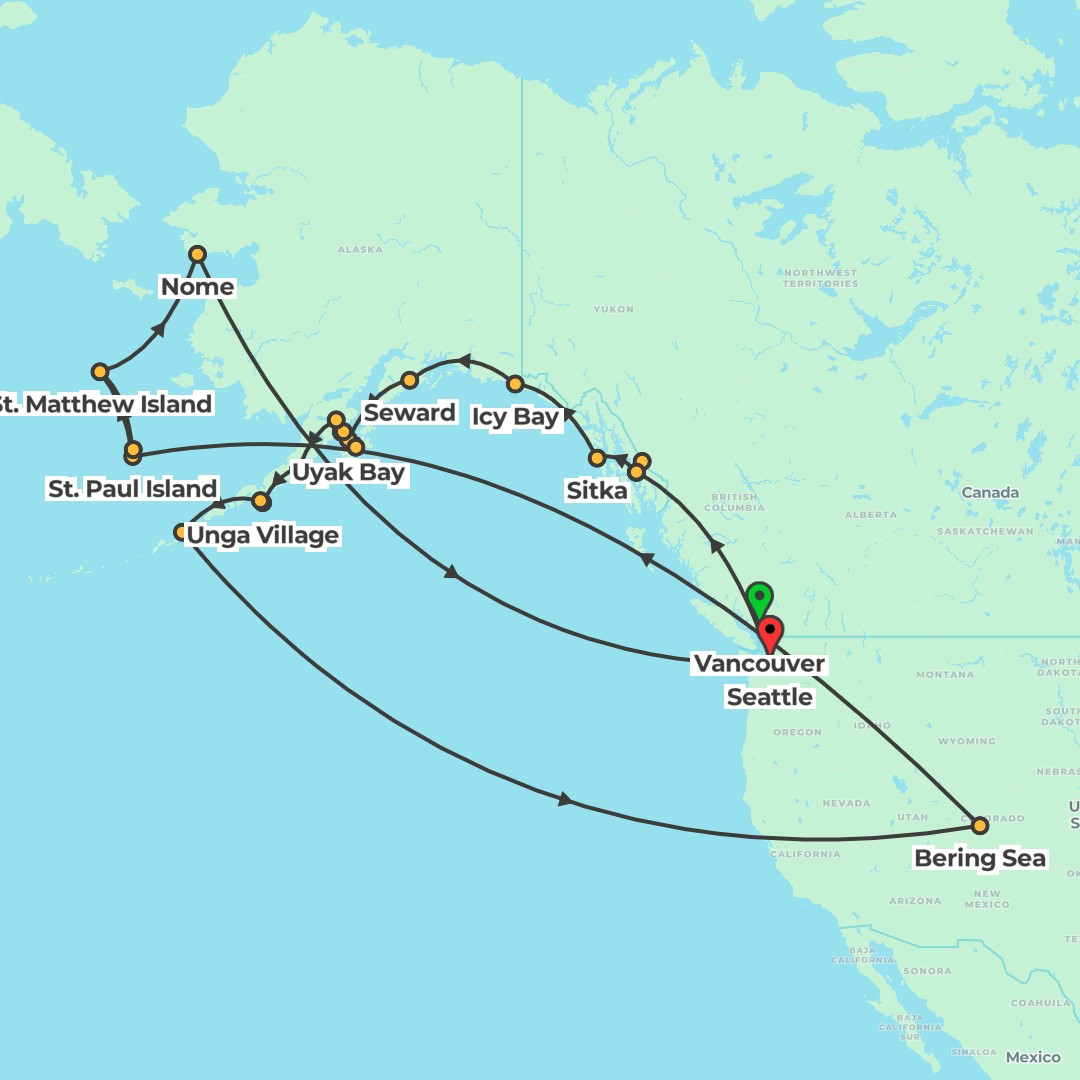
Day 1
Vancouver, British Columbia
Embark in Vancouver. Explore Gastown, the seawall and cedar groves of Stanley Park. In the evening, settle into your cabin, meet the Expedition Team and attend the safety briefing before sailing north.
Day 2
Sailing the Canadian Inside Passage
Sail the 930‑mile Inside Passage, navigating lesser‑traveled channels. Watch for humpback, fin and minke whales, and possibly orca.
Day 3
Misty Fjords National Monument, Alaska
Explore Misty Fjords’ glacier‑carved cliffs and waterfalls by Zodiac or kayak (weather permitting). Look for sea otters, Steller sea lions, harbor seals, orcas, Dall’s porpoises, mountain goats and bald eagles.
Day 4
Wrangell, Alaska
Call at Wrangell, traditional Łingít homeland. Visit the museum, Shakes Island’s Chief Shakes Tribal House and totem poles, Petroglyph Beach, and nearby trails by the Stikine River and Mount Dewey.
Day 5
Sitka, Alaska
Arrive in Sitka beneath Mount Edgecumbe. See Russian heritage at the Russian Orthodox Cathedral and Russian Bishop’s House, and Lingít and Haida totem poles at Sitka National Historical Park.
Day 6
Cruising Icy Bay
Navigate Icy Bay near the Guyot, Yahtse and Tyndall glaciers by Zodiac or kayak, with views of Mount St. Elias. Scout for humpbacks, orcas, sea otters and harbor seals.
Day 7
Seward, Alaska
Day at sea across the Gulf of Alaska. Enjoy onboard facilities and lectures on Alaska’s wildlife, geology, glaciology, history and culture. Look for Laysan, Black‑footed and Short‑tailed Albatross.
Day 8
Uyak Bay, Kodiak Island, Alaska
Explore Uyak Bay on Kodiak Island, the ‘Emerald Isle.’ Search for whales, sea otters, seals and, if conditions allow, Kodiak brown bears within Kodiak National Wildlife Refuge.
Day 9
Geographic Harbor, Alaska
Enter Katmai National Park by ship and Zodiac to watch brown bears along the shore. Depending on conditions, explore Geographic Harbor, Kinak Bay or Kukak Bay in this volcanic landscape.
Day 10
Kujulik Bay, Alaska
Discover remote Kujulik Bay’s rugged coast and secluded inlets with the Expedition Team. Watch for bears, Bald Eagles, sea otters and humpback whales; learn about the region’s geology.
Day 11
Unga Island, Alaska
Make a nature landing at abandoned Unga Village on Unga Island, where wildflowers surround weathered wooden buildings reclaimed by nature.
Day 12
Dutch Harbor, Alaska
Visit Dutch Harbor, America’s biggest fishing port. Learn about the Unangan people, and visit the Museum of the Aleutians, Russian Orthodox Cathedral and WWII museum. Spot bald eagles, puffins, wild horses, foxes, whales, sea lions and porpoises; filming site of The Deadliest Catch.
Day 13
Crossing the Bering Sea
Begin crossing the Bering Sea with two exploration days and two sea days. Possible landings include St. Paul Island (Unangan community; Important Bird Area with Pribilof Sandpiper and Tufted Puffin) and wild St. Matthew Island (abandoned buildings, black sand beaches, tundra; chance to see rare McKay’s Bunting). At sea, watch for puffins, auklets, murrelets and the red‑legged kittiwake; enjoy lectures and onboard amenities.
Day 14
Saint Paul Island, Alaska
Land at St. Paul Island in the Pribilofs. This small city—the islands’ only residential area—has a Russian Orthodox church (National Historic building) and basic services. In summer, see about 500,000 northern fur seals and millions of seabirds, including Tufted Puffins.
Day 15
St. Matthew Island, Alaska
Visit remote St. Matthew Island with towering sea cliffs over 1,000 ft hosting nesting murres, kittiwakes and cormorants. Designated a wildlife refuge in 1909; known for the introduced reindeer that boomed mid‑century then disappeared after harsh winters.
Day 16
Crossing the Bering Sea
Day at sea crossing the Bering Sea.
Day 17
Nome, Alaska
Arrive in Nome, rich in Gold Rush history with relics such as dredges, steam engines and tracks. Nome marked the end of several Roald Amundsen expeditions. Disembark MS Roald Amundsen and fly to Seattle for an overnight stay.
Day 18
Seattle, Washington
End the voyage in Seattle. If time allows, visit Olympic Sculpture Park and Pike Place Market.
What’s included
What’s not included
Additional information
Misty Fjords Zodiac Cruise & Kayaking, Tongass National Forest
Venture beneath sheer granite as you join a Zodiac cruise or paddle a kayak into Misty Fjords, where 3,000-foot cliff walls plunge to mirror-calm water and lacework waterfalls. Scan the ledges for mountain goats and the sky for circling bald eagles.
Hear how glaciers carved this vast wilderness within the Tongass, North America’s largest temperate rainforest. Your expedition team interprets geology and wildlife behavior while you listen for the echoing crackle of spray and the quiet dip of your paddle.
Icy Bay Glacier Front Zodiac Exploration
Skim across steel-blue water to the faces of Guyot, Yahtse, and Tyndall glaciers, close enough to hear the crack and rumble of calving ice. Your Zodiac weaves among growlers and brash ice while harbor seals haul out on floes.
Guide commentary unpacks how these tidewater glaciers feed the Gulf of Alaska and shape the coastline. Look up to Mount St. Elias towering on the skyline—a colossal wall of rock rising from sea to summit in a breathtaking vertical sweep.
Uyak Bay Wildlife Search, Kodiak Island
Scan emerald headlands and river mouths as you look for Kodiak brown bears along salmon streams, with rafts of sea otters bobbing in kelp and occasional humpbacks lifting flukes offshore. Lush valleys and fog-softened peaks frame every vantage.
Guides introduce the Kodiak National Wildlife Refuge, which blankets much of the island in protected habitat. Learn how rich currents and intact wetlands support eagles, shorebirds, and marine mammals, and why this archipelago is nicknamed the “Emerald Isle.”
Katmai Coast Bear Viewing: Geographic Harbor, Kinak or Kukak Bays
Watch the shoreline in quiet anticipation as brown bears appear in the shallows, fishing and digging for clams with unhurried focus. Zodiacs provide stable platforms for photography while guides manage respectful distances.
Gain perspective on Katmai National Park, a volcanic landscape sheltering one of the world’s densest brown bear populations. Naturalists explain tidal cycles and salmon runs that drive behavior here—moments where patience is richly rewarded by intimate, unforced wildlife encounters.
Kujulik Bay Remote Coast Zodiac Exploration
Explore a seldom-visited sweep of the Alaska Peninsula by Zodiac, nosing into sea caves, river mouths, and secluded coves. Keep watch for sea otters and humpback whales offshore and Bald Eagles riding thermals above the ridgelines.
Guides interpret the peninsula’s raw geology—uplifted ranges, volcanic ash layers, and surf-lashed headlands sculpted by North Pacific weather. Where conditions allow, pause for photos and reflection along shingle beaches backed by tundra and towering, windswept peaks.
Unga Island Abandoned Village Photo Walk
Land by Zodiac to wander the haunting remains of Unga Village, where weathered facades lean into salt wind and wildflowers reclaim wooden houses. Photographers will relish bleached timbers against volcanic backdrops and moody North Pacific skies.
Hear stories of the 19th-century trading post and fishing community that dwindled to silence by 1969. Guides reflect on subsistence lifeways, migration, and resilience as nature steadily reclaims this remote Aleutian settlement.
Wrangell Heritage Walk: Shakes Island & Petroglyph Beach
Cross a footbridge to Chief Shakes Tribal House on Shakes Island to view carved totem poles set among towering spruce. Continue to Petroglyph Beach to see ancient spiral and face motifs etched into shoreline boulders.
Guides share the living traditions of the homeland of the Lingít (Tlingit) people, and how clan stories, formline art, and cedar craftsmanship encode history. Museum exhibits and coastal trails round out a vivid portrait of culture anchored to sea and forest.
Sitka Cultural Walk & Totem Heritage
Explore overlapping cultures in Sitka, stepping inside the Russian Orthodox Cathedral of St. Michael and viewing artifacts at the Russian Bishop’s House. Stroll forest paths in Sitka National Historical Park amid monumental totems and salmon-rich streams.
Learn how Russian, Haida, and Lingít histories intersect—from colonial fur trade to U.S. purchase in 1867. Your guide decodes crest figures, clan stories, and carving techniques, framing Sitka as a crossroads of Pacific cultures and coastal lifeways.
Dutch Harbor Heritage Tour: Unangan Culture & WWII Sites
Discover Aleutian history at the Museum of the Aleutians, then visit the Russian Orthodox Cathedral of the Holy Ascension and WWII installations commemorating the Battle of Dutch Harbor. Bald eagles often perch on dock pilings as fishing boats unload their catch.
Guides explore Unangan (Aleut) resilience, wartime upheaval, and the islands’ modern fishing economy. Learn how volatile weather, rich currents, and strategic geography shaped this working port at the storm-tossed edge of the North Pacific.
St. Paul Island Seabird Cliffs & Fur Seal Rookery
Walk windswept headlands to clifftop lookouts where tufted puffins, auklets, and murres pack basalt ledges in raucous colonies. On the beaches below, tens of thousands of northern fur seals crowd traditional rookeries.
Naturalists explain how Bering Sea upwellings feed the food web that sustains these vast rookeries. Spotters assist with identification and photography, helping you frame flight paths, courtship displays, and the dark sweep of ocean meeting treeless tundra.
St. Matthew Island Wilderness Landing
Go ashore on one of the Bering Sea’s loneliest outposts, where black-sand beaches give way to tundra and volcanic rock. Scan sea cliffs over 1,000 feet for nesting murres, kittiwakes, and cormorants in swirling, wind-borne flocks.
Hear how reports from the Harriman Expedition of 1899 helped spur protection as part of America’s early wildlife refuges in 1909. Guides recount the island’s famed reindeer saga while you photograph wildflower-dotted slopes and surf-lashed promontories.
Pelagic Birdwatching on the Bering Sea
Settle on deck rails or in the Explorer Lounge to track puffins, auklets, and murrelets over long ocean fetch. Spotters call out flight silhouettes and behaviors as rafts of seabirds gather along food-rich currents and tidal fronts.
Learn why the Bering Sea is a global engine of productivity, drawing migratory species across hemispheres. With patience, you may glimpse the region’s specialty gulls and pause for photos and reflection as distant islands rise from steel-grey water.
Expedition Lecture Program & Science Center Sessions
Deepen your understanding as you join talks led by the Expedition Team on wildlife, geology, glaciology, and culture. Examine beach finds and plankton under microscopes in hands-on sessions that bring coastal ecology to life.
These interactive briefings prepare you for landings and wildlife viewing, connecting field observations with regional history and conservation. Expect practical tips, open Q&A, and a collaborative atmosphere that turns curiosity into insight.
Nome Gold Rush Heritage Orientation
Explore Alaska’s storied frontier as you trace relics of the 1898 stampede—abandoned dredges, steam engines, and shoreline claims that speak to boom-and-bust ambition. Guides highlight landmarks tied to Roald Amundsen’s Arctic ventures and the era’s daring navigation.
Gain context for modern Nome as you learn how gold, sea ice, and shifting trade routes shaped the community. This compact overview weaves together Indigenous history, prospecting lore, and the open, wind-bright landscapes of the Seward Peninsula.
Canadian Inside Passage Scenic Cruising & Whale Watching
Cruise the protected fjordlands as you cruise the Canadian Inside Passage, winding between forested islands and granite headlands where mist lingers on cedar and spruce. Keep binoculars ready for humpback and orca sightings as seabirds skim the swells and waterfalls ribbon down dark rock faces.
Learn how this sheltered marine corridor shaped Indigenous trade routes and modern coastal communities. Naturalists point out tidal rips and bait balls where marine life concentrates, helping you pause for photos and reflection amid lesser-travelled channels rarely seen from larger ships.
